
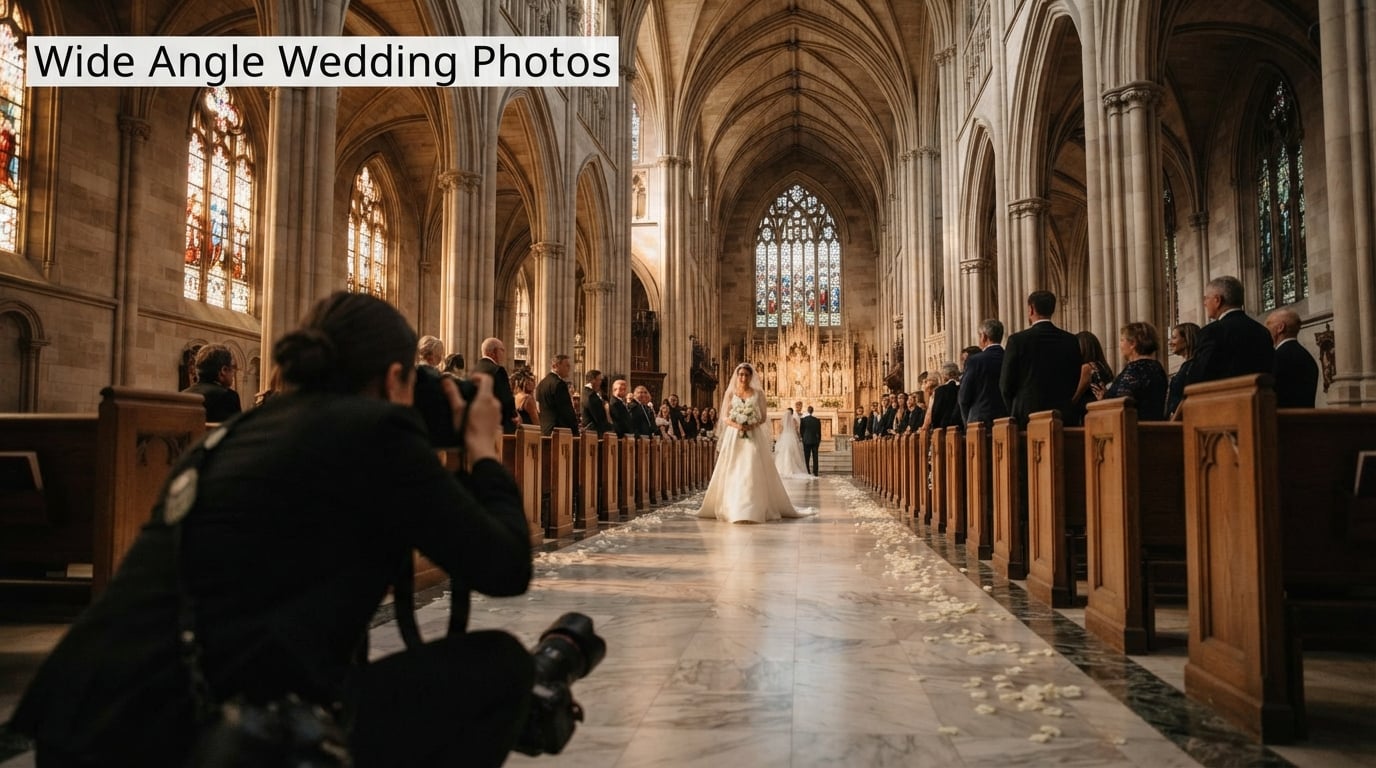
Wide angle wedding photos capture the full scale of a couple’s day in a single frame. From the soaring ceilings of a cathedral to the laughter of a packed dance floor, these images hold moments that standard lenses simply cannot fit. I have been shooting weddings for over a decade, and the wide angle lens remains one of the most powerful tools in my bag.
In this guide, I will walk you through everything I have learned about shooting wide angle wedding photos. We will cover lens choices, distortion fixes, real wedding scenarios, post-processing tricks, and creative techniques that add emotional weight to every image. By the end, you will know exactly when to reach for a 16mm, when a 35mm is enough, and how to keep your subjects looking natural.
Table of Contents
What Is a Wide Angle Lens and Why Does It Matter for Weddings
A wide angle lens is any lens with a focal length shorter than roughly 35mm on a full-frame camera. Anything from about 10mm to 35mm counts, and each focal length gives a different feel to the final image. The shorter the focal length, the more scene you capture and the more dramatic the perspective becomes.
For wedding photography, this matters because venues are often large and groups are often bigger than expected. A standard 50mm lens simply cannot fit the bride, groom, wedding party, parents, and officiant into one frame without backing up against a wall. A wide angle lens lets you step closer to the action while still capturing everyone.
Fisheye vs Rectilinear Wide Angle Lenses
Fisheye lenses curve straight lines and create a circular or heavily bowed image. They are fun for creative shots, but the distortion makes them unsuitable for most formal wedding portraits. Rectilinear lenses keep straight lines straight, which is what you want for architecture, group shots, and clean compositions.
I keep one rectilinear wide angle lens on my second camera body at almost every wedding. It saves me from swapping lenses at the wrong moment and lets me react quickly to whatever the day throws at me.
Why Wedding Photographers Rely on Wide Angle Lenses
Wide angle wedding photos do something no other focal length can match. They preserve the relationship between the people and the place. A bride walking down the aisle of a stone church looks very different at 24mm than at 85mm. The 85mm isolates her face beautifully, but the 24mm shows her walking through that specific place at that specific moment.
Storytelling is the heart of wedding photography, and wide angles are storytelling lenses. They let the viewer feel the size of the venue, the energy of the dance floor, and the calm of the getting-ready suite. Without them, an album can feel like a series of tight portraits with no sense of place.
Capturing Venue Atmosphere in One Frame
Couples choose venues for a reason. A historic barn, a coastal cliff, a grand ballroom, or a small chapel each has character that deserves to be remembered. Wide angle lenses let you frame the couple inside that character rather than cropping them out of it. The result is an environmental portrait that says far more than a headshot ever could.
When I deliver a wedding gallery, the wide angle wedding photos are almost always the ones that end up as wall prints. They carry the day, not just the faces.
Common Wide Angle Wedding Photo Challenges and Distortion
Wide angle lenses come with real challenges. The most common issue is perspective distortion, where objects close to the lens look much larger than objects far from it. A bride’s nose can appear oversized if you shoot too close to her face at 24mm or wider.
Barrel distortion is another common problem, especially on ultra-wide zooms. Straight lines near the edges of the frame bow outward, which can make buildings look curved. Pincushion distortion does the opposite, pulling edges inward, and it is more common on telephoto zooms but can show up on some wide primes.
How Distortion Affects Faces and Group Shots
Edge distortion is the silent killer of wide angle wedding photos. People standing at the far edges of a group shot can look stretched or squished. The bride leaning in for a kiss at the corner of the frame can look warped. The fix is awareness: keep important faces toward the center of the frame and step back whenever possible.
Distance is your best friend here. The further you are from your subject, the less distortion affects them. A 24mm lens at 10 feet gives a very different look than a 24mm lens at 2 feet. Train yourself to recognize when you are too close, and your wide angle wedding photos will improve immediately.
Lighting Challenges with Wide Glass
Wide angle lenses often have smaller maximum apertures than standard zooms, especially in affordable ranges. A typical 16-35mm might be f/4, while a 24-70mm is often f/2.8. In a dark church or candlelit reception, that extra stop matters. Plan to push your ISO higher or use slower shutter speeds when the light drops.
When to Use Wide Angle at Every Wedding Stage
Knowing when to reach for a wide angle lens is just as important as knowing how to use it. I treat my wide angle as a situational tool, not a default setting. Here is how I use it across a typical wedding day.
Getting Ready and Bridal Preparations
Hotel suites and getting-ready rooms are usually small. A 24mm or 28mm lens lets you capture the whole scene: bridesmaids doing hair, the dress hanging in the window, gifts on the bed. Step back from the bride for close-ups and switch to a 50mm or 85mm, but keep the wide ready for the storytelling frames.
The first look at the dress, the bride’s reaction to a gift, the room in full swing. These are wide angle moments.
Ceremony and Church Photography
The ceremony is where wide angle wedding photos really shine. Back up to the rear of the aisle and you can capture the bride walking down, the groom’s face, the officiant, and the whole front row in a single frame. That one image can replace three or four tighter shots.
Be respectful during the ceremony. Use a silent shutter, move slowly, and avoid walking into the aisle. Wide angles let you stay at the back and still deliver impact.
Reception Venue and Group Shots
Formal group shots are the classic wide angle use case. A 24mm lens lets you fit a wedding party of ten or more people without crowding. Position the group in shade or open shade to avoid harsh shadows, and always shoot at a slightly stopped-down aperture like f/5.6 to keep everyone sharp.
Reception wide angle wedding photos show the room, the decor, the cake, and the couple in one image. These shots anchor the album and remind couples why they chose that venue.
Confetti, Exit, and Dance Floor Moments
Wide angles create energy. A confetti shot at 20mm makes the celebration feel huge. A dance floor wide at 16mm pulls in the lights, the crowd, and the couple’s movement in one chaotic, joyful frame. These are the images that end up on social media and bring couples back to the emotion of the day.
Popular Wide Angle Lenses for Wedding Photography
While I do not recommend specific products in this guide, I can share the focal lengths and lens types that working wedding photographers reach for most often. Your choice will depend on your camera system and budget, but the patterns are consistent across brands.
Standard Zoom Range: 24-70mm
A 24-70mm zoom covers everything from wide angle to short telephoto. The 24mm end handles group shots and venues, while the 70mm end handles portraits. Most wedding photographers carry one of these as their workhorse lens because it removes the need to swap glass during fast-moving moments.
Ultra-Wide Zoom: 16-35mm or 14-24mm
For dramatic interiors, architecture, and tight spaces, an ultra-wide zoom is hard to beat. The 16-35mm range is the most popular because it covers both wide angles and slightly less extreme shots. The 14-24mm gives you more wow factor but less versatility for portraits.
Wide Angle Primes: 24mm, 28mm, and 35mm
Wide primes are sharper and often faster than zooms. A 35mm f/1.4 is a favorite of documentary-style wedding photographers because it is wide enough to capture context but fast enough to shoot in low light. A 24mm f/1.4 gives a more dramatic look. Both are excellent choices for low-light receptions.
Specialty Lenses: Fisheye and Tilt-Shift
A fisheye lens is fun for creative shots, dance floor silliness, and venue experiments. Use it sparingly. A tilt-shift lens corrects converging lines in architecture, which is helpful in churches and grand reception halls, but it is a specialty tool most photographers rent rather than own.
Best Practices for Shooting Wide Angle Wedding Photos
Technique matters more than gear. Here are the habits I lean on every time I shoot with a wide angle lens at a wedding.
Mind Your Distance from the Subject
Step back whenever you can. The further you are from your subject, the less distortion you introduce. If you are too close at 24mm, your subject’s features will look exaggerated and unflattering. Find the distance where the framing feels right and the faces look natural.
Use the Edges Carefully
The center of a wide angle lens is sharper and has less distortion than the edges. Place important subjects near the center of the frame. Use the edges for scenery, architecture, and decorative elements rather than faces.
Get Low for Drama
Shooting from a low angle exaggerates the wide angle effect and creates a sense of grandeur. Crouch down for a shot of the bride and groom with the ceiling behind them, or get low for a confetti shot to make the falling petals fill the frame.
Watch Your Foreground
Wide angles capture a lot of foreground. A messy foreground can ruin a great background. Look at the bottom edge of your frame and remove distracting objects before you shoot. A small adjustment can save an otherwise unusable wide angle wedding photo.
Use Leading Lines and Symmetry
Wide angles love leading lines. Aisle lines, ceiling beams, table rows, and tile patterns all become powerful compositional tools when shot wide. Symmetrical compositions also work well, especially for churches, reception entrances, and formal portraits.
Shoot at the Right Aperture
For group shots, stop down to f/5.6 or f/8 to keep everyone in focus. For environmental portraits, f/2.8 to f/4 gives a nice balance of subject sharpness and background context. Avoid shooting wide open unless you intentionally want to blur the background.
Post-Processing Tips for Wide Angle Wedding Shots
Even with great in-camera technique, most wide angle wedding photos benefit from a little editing. The good news is that distortion correction has become fast and accurate in modern software.
Use Built-In Lens Profiles
Lightroom and Photoshop both ship with lens profile corrections for most major wide angle lenses. Enabling this profile automatically fixes barrel distortion, vignetting, and chromatic aberration with a single click. Apply the profile as your first edit step so that all your other adjustments build on a corrected image.
Manual Distortion Correction
Sometimes the auto profile is not enough, especially for ultra-wide shots. Use the manual distortion slider in Lightroom or the Transform tools in Photoshop to nudge straight lines back into place. Pay special attention to architectural lines in churches and reception halls.
Batch Editing for Consistency
If you shoot a whole wedding with a wide angle zoom, batch-editing saves hours. Apply your base corrections to one image, sync the settings across the rest, and then fine-tune individual frames as needed. Consistency in editing style makes your wide angle wedding photos feel cohesive in the final album.
Cropping for Better Composition
Wide angles capture more than you need. Do not be afraid to crop. A 16mm shot of a couple can be cropped to look like a 24mm or 35mm, giving you more compositional flexibility in post.
Creative Wide Angle Techniques for Emotional Impact
Once you have the basics down, experiment with techniques that turn wide angle wedding photos from documentation into art.
Foreground Interest
Place an object close to the lens to create depth. A flower bouquet, a chair back, or a piece of stationery can add layers to your composition and draw the eye into the wider scene. This works especially well for detail shots that still tell a story.
Reflection and Refraction
Mirrors, windows, and glass can create interesting wide angle compositions. Shoot through a window with the couple framed beyond it, or use a mirror to add a secondary subject into the same scene.
Environmental Storytelling
Use the wide angle to place your subjects in their environment. The bride in the cathedral, the groom on the stairs, the couple in the field. These are the photos that grandparents frame on the wall because they capture the moment in full context.
Motion and Energy
Wide angles exaggerate motion. A bride spinning at 20mm with a slow shutter becomes a swirl of dress and lights. Use this to your advantage for dance floor and exit shots where energy matters more than tack-sharp focus.
Frequently Asked Questions
What is the best wide angle lens for wedding photography?
The best wide angle lens for wedding photography depends on your style and camera system. Documentary wedding photographers often prefer a 35mm prime for its balance of context and low-light ability. Traditional wedding photographers usually rely on a 24-70mm zoom because it covers wide group shots and portraits in one lens. For dramatic interiors and architecture, a 16-35mm zoom is hard to beat. Choose based on the venues you shoot and the weight you want to carry.
What are wide angle pictures?
Wide angle pictures are photographs taken with a lens that has a focal length shorter than about 35mm on a full-frame camera. These lenses capture a wider field of view than the human eye naturally focuses on, allowing you to fit more of a scene into a single frame. They are commonly used in wedding photography to capture venues, large groups, and environmental portraits that show both the people and the place.
How do you avoid distortion in wide angle wedding photos?
Avoid distortion in wide angle wedding photos by keeping your distance from the subject, placing important faces near the center of the frame, and shooting at focal lengths of 24mm or longer whenever possible. Enable your editing software’s lens profile corrections for automatic barrel distortion fixes, and use the manual transform tools for stubborn architectural lines. Standing further back reduces perspective distortion, while post-processing fixes any remaining lens distortion.
Is 35mm wide enough for wedding photography?
Yes, 35mm is wide enough for many wedding photography situations, especially getting-ready shots, intimate ceremonies, and smaller group portraits. For large wedding parties, full venue shots, and tight church interiors, you will want something wider like 24mm or 16mm. Many professional wedding photographers shoot with both a 35mm and a 24-70mm zoom to cover every situation without constantly swapping lenses.
When should you use a wide angle lens at a wedding?
Use a wide angle lens at a wedding during the getting-ready stage for room context, during the ceremony for full aisle and altar shots, for formal group photos that include the whole wedding party, for reception venue shots that show the decor and atmosphere, and for high-energy moments like confetti exits and dance floor celebrations. Reach for tighter lenses for portraits, detail shots, and quiet emotional moments where face and expression matter most.
Final Thoughts on Wide Angle Wedding Photos
Wide angle wedding photos are about scale, context, and emotion. They show the venue, the people, and the day together in a way that no other lens can. If you have been hesitant to shoot wide, start with one focal length like 24mm or 35mm, practice at a few weddings, and review your results. You will see patterns quickly.
Our team updates this guide regularly to reflect new wide angle lens technology and techniques. For more wedding photography tips and tutorials, return to the Kingdom Wedding Photography blog in 2026 and beyond.