
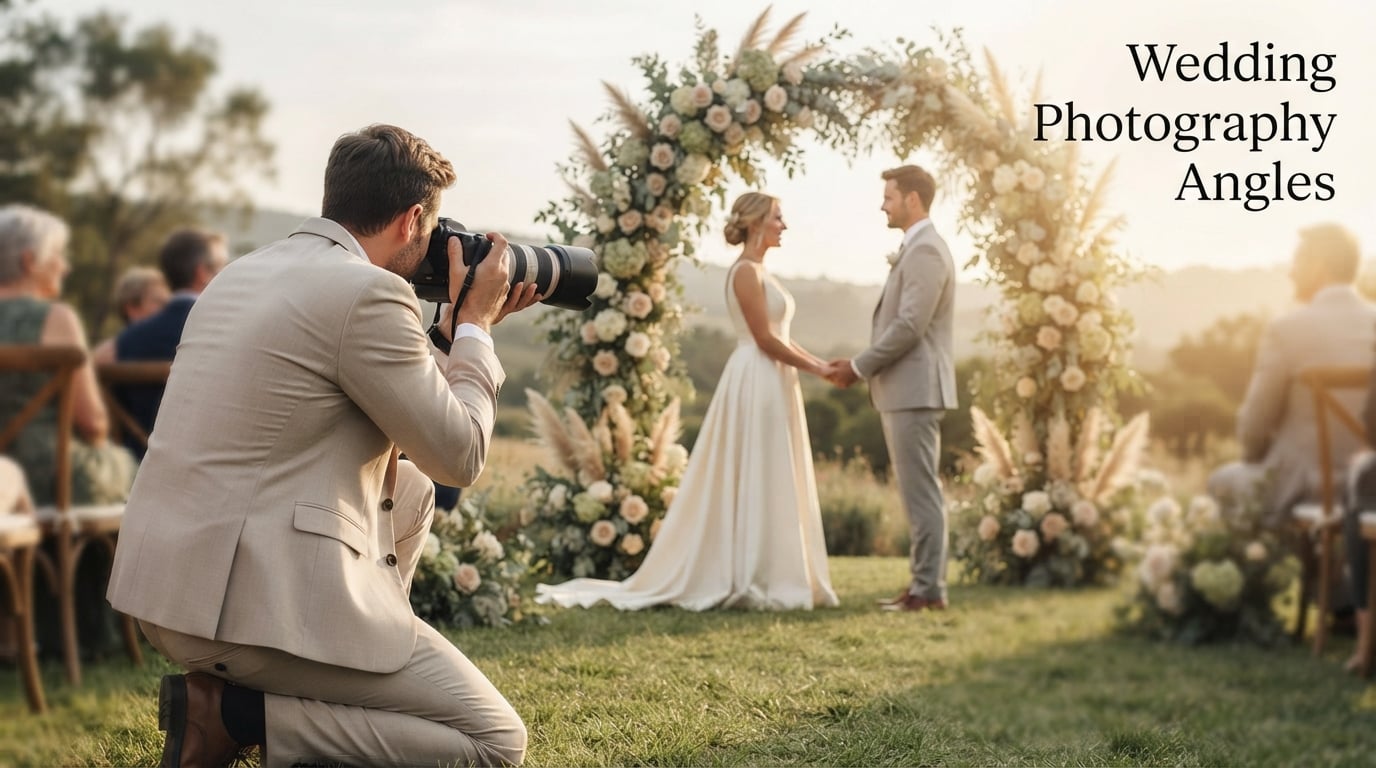
Wedding photography angles are the different camera positions and perspectives photographers use to capture a couple’s wedding day, from straight-on frontal shots to sweeping bird’s eye views. Each angle tells a different part of the story, controls how light falls on the subject, and shapes the emotion a viewer feels when they look at the finished image.
I have spent the last decade shooting weddings across the country, and angles are the single biggest difference between a flat, forgettable gallery and one that makes couples cry happy tears during their slideshow. In this guide, our team breaks down every angle you should know for 2026, the rules working photographers rely on, and the common mistakes I see new shooters make when they first step behind the lens at a ceremony.
Table of Contents
Wedding Photography Angles: Why They Matter
Wedding photography angles matter because they control three things at once: how light hits the couple, what background lands behind them, and how the viewer experiences the moment emotionally. A ceremony shot from the front feels ceremonial and inclusive. A shot from behind feels private and intimate. The same kiss, captured from two different angles, becomes two completely different memories.
Variety in angles also solves practical problems on a wedding day. Harsh midday sun can be tamed by shooting from a shaded side angle. A dim reception hall can be rescued by raising the camera overhead and using a fast prime. When photographers only shoot from one spot, they get one set of lighting problems. When they move, they get options.
The 12 Basic Camera Angles Every Wedding Photographer Should Know
The 12 basic camera angles are the foundational perspectives every photographer learns in school, and each one has a clear job on a wedding day. Here is the full list with how I use them during real ceremonies and receptions.
- Eye-level angle – The camera sits at the subject’s eye line. This is the default angle for portraits, getting-ready shots, and most ceremony coverage.
- High angle – The camera points down at the subject. It slims the body, hides double chins, and works well for first-look reveals.
- Low angle – The camera points up at the subject. It makes subjects look powerful, dramatic, and tall. Great for the groom’s reaction shots.
- Bird’s eye view – The camera points straight down from directly overhead. This is the geometric shot used for ring details, table settings, and bridal party group layouts.
- Worm’s eye view – The camera sits on the ground looking up. Use it for shoes, trains, veils, and architectural backgrounds like church ceilings.
- Over-the-shoulder angle – The camera shoots past one subject toward another. Essential for first-look moments and ring exchange close-ups.
- Dutch angle (tilt) – The camera is tilted on its axis. It adds tension, motion, and energy. Often used for dance floor shots.
- Side angle (profile) – The camera shoots the subject from the side. Perfect for capturing veils, profiles, and elegant walking shots.
- Front angle – The camera faces the subject straight on. The classic ceremony shot facing the bride and groom.
- Back angle – The camera shoots from behind the subject toward the scene ahead. It frames the subject looking toward their future.
- 45-degree angle – The camera sits between front and side. The most flattering angle for portraits because it adds depth without distortion.
- Wide-angle – The camera pulls back to include the environment. Best for venue shots, ceremony wide frames, and dancing crowds.
Essential Wedding Photography Angles Explained
Of those 12 basic camera angles, seven show up on every wedding shot list I have ever built. The rest are creative options for specific moments. Below is how the essential angles actually work during a real ceremony.
Front Angle: The Ceremony Standard
The front angle means shooting the bride and groom head-on from the front of the ceremony space. This is the angle that captures facial expressions, tears, and vows without distortion. Place the camera at chest height and shoot with a 70-200mm lens at f/2.8 to blur the background.
Front angles also work for family portraits after the ceremony because they show every face evenly. The downside is they can flatten a face, so angle the camera slightly to the side (about 15 degrees) whenever possible.
Behind the Ceremony (Back Angle)
Standing behind the couple during the ceremony lets you frame them looking out toward their guests, the altar, or the horizon. This is the angle that creates those moody, storytelling frames where you see the back of the bride’s dress and her partner waiting at the end of the aisle.
I use the back angle most during processionals, recessionals, and quiet moments like candle lighting. Pair it with a long lens so you do not block other guests or the officiant’s view.
High Angle and Bird’s Eye View
High angles come from shooting downward from above the subject, and the bird’s eye view is the extreme version shot straight down. A ladder, balcony, or simply raising the camera above your head gets you the elevated perspective.
Bird’s eye views work beautifully for ring shots, invitations, floral arrangements, and group portraits of the full bridal party. During the reception, a balcony shot of the dance floor captures the energy of the night in one frame.
Low Angle
Low angles shoot upward at the subject, which makes them appear taller, more powerful, and more dramatic. I use low angles for groom portraits, the couple’s first look, and any moment where I want the bride’s veil to sweep across the sky.
Get low by kneeling, sitting, or laying on the floor. Watch the background carefully because low angles also capture more sky, and a blown-out sky will ruin the shot. Expose for the subject’s face and let the sky go bright.
Side Angle
Side angles capture the subject in profile, showing the line of the nose, the slope of the shoulders, and the curve of a veil. They are the most flattering angle for walking shots because the body moves naturally across the frame.
I default to the side angle for the couple’s portraits after the ceremony. It shows depth, separates the couple from the background, and creates the classic three-quarter view that flatters every face shape.
Aisle End Perspective
Standing at the end of the aisle lets you shoot the bride walking toward the camera, the groom seeing her for the first time, and the recessional exit. This is the angle that captures the anticipation and the joy at the very start and end of the ceremony.
For the processional, kneel or sit at the end of the aisle to keep a low profile so guests behind you can still see. Use a fast prime lens because you will be far from the action and need every bit of light.
Couple’s Perspective
The couple’s perspective means showing what the bride and groom see during the ceremony. Shoot from their point of view looking at each other, the officiant, or the guests. These frames often become the most emotionally powerful images in the entire gallery.
To capture this angle, walk to where the couple is standing and shoot from their shoulder height, framing their partner’s face over their own shoulder. A 35mm or 50mm lens works best because it matches the way human eyes see.
Photography Rules That Guide Your Angle Choices
Two simple rules help photographers decide how many angles to use during a wedding day and where to position themselves. Neither rule is written in stone, but both are useful guardrails I follow on every shoot.
The 20 60 20 Rule in Photography
The 20 60 20 rule in photography suggests that 20 percent of your images should be tightly framed close-ups, 60 percent should be medium-distance shots, and 20 percent should be wide environmental frames. The rule keeps galleries balanced so couples get detail, connection, and context all in one story.
In practice, this means at a wedding ceremony I aim for roughly 20 percent close-ups of hands, rings, and tears, 60 percent medium shots of the couple, officiant, and bridal party, and 20 percent wide shots of the venue and full scene. The exact split shifts by moment, but the balance stays close.
The 30 5 Rule for Weddings
The 30 5 rule for weddings says a photographer should aim to capture roughly 30 to 50 keepers per hour of coverage, with at least 5 different angles of the most important moments like the vows, the first kiss, and the recessional. The rule helps photographers avoid under-delivering or over-shooting.
Most full-day weddings I shoot produce 600 to 800 final edited images from about 8 hours of coverage. That works out to roughly 30 keepers per hour. Forgetting the 5-angle minimum on big moments is a rookie mistake I made early in my career, and it shows in galleries where every kiss looks the same.
Dutch Angle and Trendy Wedding Photography Perspectives
The Dutch angle, also called the Dutch tilt, tilts the camera on its axis to create a slanted, off-kilter frame. It is the trendy angle photographers use to add energy, motion, and a slightly cinematic feel to wedding photos.
I use the Dutch angle sparingly on the dance floor, during the bouquet toss, and in any moment with strong movement. The angle should never be applied to portraits, ceremonies, or family formals because it makes people look like they are falling over. Reddit threads on wedding photography confirm the same advice: a tilted frame is a special effect, not a default setting.
Other trendy perspectives in 2026 include mirror reflections, drone shots from above, and through-the-glass shots using windows, mirrors, or glass reflections on tables and decor. Each adds variety, but each also risks looking dated in five years if overused.
Common Mistakes to Avoid With Wedding Photography Angles
The most common mistake I see is staying in one spot too long. Photographers plant themselves in front of the couple and shoot from the same angle for an entire ceremony. Move at least every 5 to 10 minutes so your gallery does not look like it was shot with a security camera.
The second mistake is ignoring the background. A great angle with a messy background becomes a bad photo. Before pressing the shutter, check the corners of the frame for guests with phones, exit signs, or trash cans.
The third mistake is using only the wide angle because it is easy. Wide angles distort faces, especially at the edges of the frame. Pull in to 85mm or 135mm for portraits and ceremony close-ups. Your subjects will thank you.
Frequently Asked Questions
What is the 20 60 20 rule in photography?
The 20 60 20 rule in photography suggests that about 20 percent of your images should be tight close-ups, 60 percent should be medium-distance shots, and 20 percent should be wide environmental frames. The rule keeps galleries balanced with detail, connection, and context.
What is the 30 5 rule for weddings?
The 30 5 rule for weddings says photographers should aim for roughly 30 to 50 keepers per hour of coverage, with at least 5 different angles of the most important moments like the vows, the first kiss, and the recessional. It prevents under-delivering and over-shooting.
What are the 12 basic camera angles?
The 12 basic camera angles are eye-level, high, low, bird’s eye view, worm’s eye view, over-the-shoulder, Dutch tilt, side profile, front, back, 45-degree, and wide-angle. Each angle changes how light, emotion, and composition come together in the final image.
Is $4000 a lot for a wedding photographer?
$4000 is a fair market rate for a professional wedding photographer in most US markets in 2026. Pricing depends on coverage hours, experience, location, and whether albums or second shooters are included. Always compare full packages, not just the headline price.
Conclusion
Wedding photography angles are the foundation of a great gallery, and mastering them takes practice on real wedding days. Start with the seven essential angles covered here, add the 12 basic camera angles to your toolkit, and use the 20 60 20 and 30 5 rules to keep your coverage balanced. Move often, check your backgrounds, and let the light guide your position.
Our team is always testing new angle combinations at real weddings, and we update this guide every season with fresh tips. If you are planning a wedding and want to see how different angles shape a gallery, browse our recent wedding stories for inspiration.