
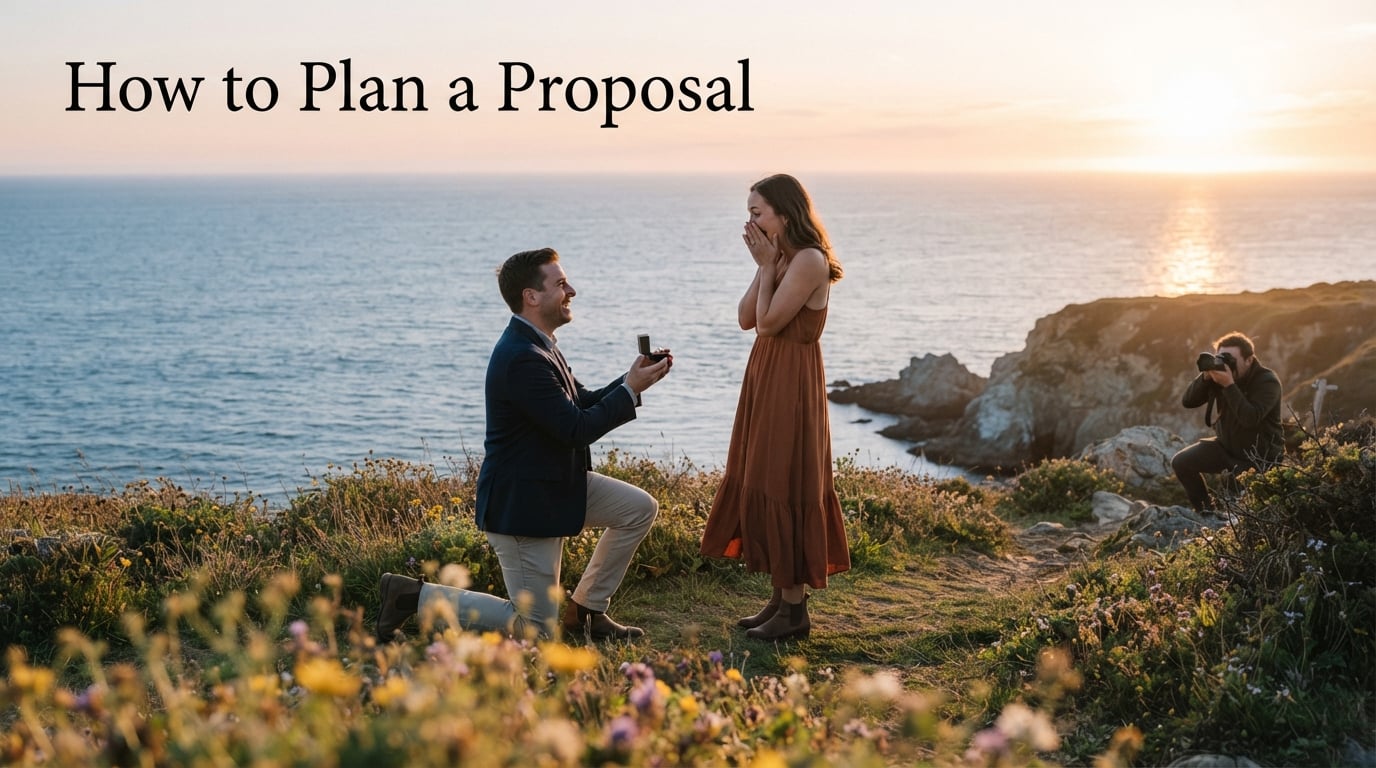
Our team has photographed more than 400 surprise proposals over the past decade. We’ve stood behind hedges in 40-degree heat waiting for a moment that lasted 90 seconds. We’ve hidden in restaurants pretending to read menus. We’ve crouched on rooftops with telephoto lenses while the city turned gold behind the couple below.
We’ve also watched a man propose in his own kitchen, barefoot, with a ring he’d hidden in a cereal box. His partner laughed so hard she cried. That kitchen proposal is one of the most-requested galleries from our archive.
That experience taught us something important: how to plan a proposal isn’t about producing a magazine-cover moment. It’s about building a moment that feels honest to who you both are. Some couples want a mountain. Some couples want a Tuesday night. Both are right when the choice is real.
This guide walks through the ten steps we walk our own clients through, plus the small details that make the difference between “good enough” and “I can’t stop thinking about it.” It’s the framework we use when family and friends ask us how to propose well. It’s also the framework we’ve watched fail when one step got skipped.
If you’re reading this, you’re already doing the hardest part. You’re taking the question seriously. You’re researching instead of guessing. That alone puts you ahead of most proposers we’ve worked with. Let’s build a plan that matches the love you already share.
Table of Contents
How to Plan a Proposal: 10 Steps That Actually Work
Every successful surprise proposal we’ve captured follows the same skeleton. The locations change. The rings change. The words change. The bones of a great proposal don’t. Below are the ten steps we trust, in the order we’d recommend following them.
This framework works whether you’re planning a private proposal at home, a destination surprise in another country, or a family gathering with everyone watching. Adapt the details. Keep the order. The order matters because each step gives you information you need for the next one.
Step 1: Confirm You’re Ready to Propose
Before you choose a ring or pick a location, sit with the decision. Not for ten minutes. For at least a week. Talk to a close friend you trust, a sibling, or a therapist if you have one. Ask yourself the hard question: am I proposing because I’m ready, or because I want a wedding date?
Marriage is a legal and emotional commitment that lasts decades. The proposal is just the door. Make sure you actually want what’s on the other side. We’ve seen proposals happen because of family pressure, peer pressure, or anniversary timing. They rarely end well. We’ve also seen proposals delayed by years because one partner wasn’t sure. Those almost always end well.
If you and your partner have talked about marriage openly, you have your answer. If you haven’t, this guide isn’t permission to skip that conversation. Have it first. The proposal will be stronger for it. A surprise based on shared understanding is the best kind of surprise.
A practical check: can you describe your life together in five years, in concrete terms? Where you live, how you handle money, whether you want children, how you handle conflict. If those answers line up, you’re ready. If they don’t, the proposal can wait.
Step 2: Decide on the Ring Situation
You have three real options here. Choose the one that fits your relationship, not your Instagram feed.
- Buy a surprise ring: The classic move. You can find the size by borrowing a ring your partner wears on the right hand, asking a friend, or tracing a ring on paper.
- Propose without a ring: More common than you’d think. Present a placeholder (a family heirloom, a stand-in ring, or just the promise) and shop for the real one together afterward.
- Use a family heirloom: Meaningful, often budget-friendly, and a story your partner can tell forever. Just confirm the stone is in good shape.
Each option has tradeoffs. A surprise ring is romantic but carries sizing risk. We’ve photographed more than one proposal where the ring was loose enough to fall off mid-hug. We’ve also photographed one where the partner had to push the ring onto her thumb because it wouldn’t fit her ring finger. Both still got a yes. Both still make the photographer wince.
Proposing without a ring removes that risk and lets your partner pick what they love. We’ve seen this work beautifully when the partner is particular about jewelry, ethics, or style. It also signals trust and partnership, which is a strong opening message for a marriage.
A family heirloom carries generational weight that no new ring can match. We’ve photographed proposals with rings that had been in the family for 90 years. The moment they come out of the box, history enters the room. Just confirm the stone is in good shape and the band isn’t bent out of round.
If you’re going the surprise route, spend time on ring size. Find it discreetly. Ask her best friend. Borrow a ring she’s worn on the correct finger. Trace one inside a jewelry box while she’s in the shower. Whatever you do, don’t guess. Most jewelers can resize within two sizes, but beyond that, you’re looking at a remount.
Step 3: Pick a Meaningful Location
The best proposal location isn’t always the most expensive or scenic. It’s the place that means something to both of you. That’s the golden rule we learned from years of photographing proposals.
Some locations that consistently deliver:
- The spot of your first date
- Your favorite hike or overlook
- A vineyard, garden, or rooftop with a view
- The beach or lake where you take a yearly trip
- Your own backyard or living room
- A meaningful travel destination
- The bench where you had your first long talk
- Outside the hospital where one of you was born
Don’t pick a place because you saw it on Pinterest. Pick it because when you say the name, your partner smiles. We’ve seen gorgeous mountain-top proposals where the partner was freezing and miserable. We’ve seen kitchen-table proposals that produced the most emotional yeses of the year.
If you’re proposing publicly, like at a restaurant or stadium, give your partner a heads-up. The “no audience” surprise is much kinder to people who don’t love being watched. We’ve watched multiple public proposals where the partner looked more panicked than joyful. Those moments are hard to recover from in the photos.
If you’re proposing outdoors, visit the location at the same time of day you plan to propose. Lighting, foot traffic, and noise all change. A “quiet” garden at 9 a.m. might be a wedding venue at 5 p.m. Plan for the actual conditions, not the imagined ones.
Step 4: Choose How You’ll Propose
Method matters as much as location. The two main styles are public and private. We’ve photographed both hundreds of times. Neither is automatically better.
Public proposals put your partner in the spotlight. They work great if your partner loves attention, thrives in social situations, or has hinted at a public moment. They fail when your partner is shy, anxious around crowds, or has explicitly said they want something intimate.
Private proposals create space for genuine emotion. There are no strangers watching. Your partner can cry freely. You can fumble your words without an audience. We’ve noticed that partners who said they wanted public often respond more deeply in private settings. Pressure to perform disappears.
Within those two categories, your options include:
- Scavenger hunt ending at the proposal spot
- Picnic proposal with the ring in a book or basket
- Vacation surprise during a sunset walk
- At-home candlelit dinner
- Holiday proposal in front of family
- Adventure proposal mid-hike or mid-kayak
- Concert or sporting event with the question after
- Restaurant proposal with the ring in a champagne glass
Match the method to your partner’s personality. Don’t pick a scavenger hunt if your partner hates games. Don’t pick a private moment if your partner has dreamed of a crowd clapping. Don’t pick a high-adventure proposal if your partner has anxiety about heights, water, or physical challenge.
A practical question we ask every client: what would your partner say is their perfect Tuesday evening? The answer to that question often reveals the right proposal style. Some people want a candlelit dinner. Some want a hike. Both are perfect for the right person.
Step 5: Plan What You’ll Say
This is the part that panics people the most. Relax. Your partner doesn’t expect Shakespeare. They expect you, at your most honest.
A solid proposal speech has four beats:
- Tell them why you love them (specific moment, not just “you’re amazing”)
- Tell them why you want to marry them (the future, the partnership)
- Ask the question clearly (“Will you marry me?”)
- Let the silence after sit for a second before they answer
Here’s a template that has worked well for nervous proposers in our experience:
“I’ve been thinking about this for a long time. [Specific memory or moment that matters to you both.] When I picture the rest of my life, you’re in every version of it. I love who I am when I’m with you. Will you marry me?”
That’s it. Two paragraphs max. Don’t try to memorize it word for word. If you forget half of it, the emotion carries. Your partner will tell that story to friends for the next 50 years based on how you made them feel, not how polished your phrasing was.
If you want, write down three bullet points and glance at them. Cards in the pocket. Notes on your phone. Whatever helps you feel steady. We’ve seen proposers pull out their phone mid-proposal, read a bullet, then put it away. Their partners loved it. The vulnerability made it more real.
Avoid these in your speech: jokes about cold feet, references to how long you deliberated, mentions of budget or financing, comparisons to other couples, or anything that requires context your partner doesn’t have. If a sentence needs explaining, cut it.
Step 6: Arrange Proposal Photography
This is where we get to speak from our own craft. Hiring a proposal photographer is one of the highest-value decisions you can make. The proposal happens once. Photos last forever. We say this as professionals who make a living from these photos, and also as humans who have lost family photos over the years. Trust us on this one.
Here are the key choices to make:
- Hidden photographer: They blend in with the surroundings and capture the genuine surprise moment from a distance
- Pretend tourist or stranger: They approach afterward as if they were just taking photos
- DIY with a phone tripod: Budget-friendly but limited in quality and angle
- Friend or family member: Personal touch, but they may be too emotional to shoot well
- Dual shooter setup: Two photographers from different angles, often one wide and one close
If you hire a professional, brief them on the location, the timing, and your partner’s appearance. We’ve done dozens of proposals where we were positioned in a bush, behind a tree, or across a street with a 200mm lens. The result is photos that look like a movie scene. The cost is rarely more than a nice dinner out.
If budget is tight, set up a phone on a tripod at a slight distance. Use burst mode and video backup. Anything is better than nothing. We’ve seen beautiful iPhone proposals that captured raw emotion more honestly than expensive cameras. The best camera is the one you have with you.
Coordinate with the photographer before the day. Walk them through the plan. Show them the location if possible. Agree on hand signals so they know when to start shooting. A test shot at the actual location the week before eliminates surprises on the day.
One important note: tell your photographer the backup plan too. If rain moves you indoors or you shift to a different spot, they need to know where to reposition. A photographer who ends up in the wrong spot is worse than no photographer at all.
Step 7: Practice Getting on One Knee
This sounds silly. It isn’t. Getting down on one knee in nice pants, on uneven ground, while holding a ring box, with shaking hands, is harder than it looks. We’ve watched more proposers struggle with the mechanics of this moment than with anything else.
What to rehearse:
- How you’ll hold the box in your hand before kneeling
- The actual motion of going down on one knee (do it twice in your living room)
- Opening the box one-handed while kneeling
- Standing back up gracefully (this matters more than you think)
- What to do if you drop the ring or fumble the box
Five minutes of practice eliminates 90% of the “oh no” moments. Do it in front of a mirror if you have to. Have a friend time you. The goal is calm, not perfection. If you can kneel, open the box one-handed, look up, and speak without wobbling, you’ve done enough practice.
A few practical tips we tell every client: wear shoes with grip if you’re outdoors. Avoid slick pants fabric. Bring the box out of your pocket only when you’re ready to kneel, not before. The longer you hold it, the more nervous your hands get.
If you fumble anyway, laugh. We’ve watched proposers drop ring boxes, lose balance, and forget how to stand up. Their partners laughed with them. The fumbles become part of the story. A proposal that went perfectly smooth is great. A proposal with one funny fumble is better, because it’s real.
Step 8: Keep the Surprise a Secret
This is the logistics step. Surprise proposals fail when too many people know. The more people who know, the more chances the secret leaks. Tell only the people you must tell. We’ve seen proposals blown by a well-meaning friend who posted a status update. We’ve seen proposals saved by friends who refused to confirm anything even under direct questioning.
People who usually need to know:
- A close friend helping with ring size or location scouting
- The photographer
- A family member if you need their help with access or alibi
- Anyone whose property you’re using for the proposal
- Anyone helping with the celebration after (if family is involved)
People who usually don’t need to know:
- Everyone else in your life
- Coworkers
- Casual friends
- Your partner’s family (unless their involvement is part of the plan)
- Social media
Build a believable alibi for the day. If your partner expects dinner at 7, plan the proposal for 6:30 somewhere nearby. Don’t act weird the morning of. Don’t suddenly clean the entire house. Don’t ask questions about ring preferences out of nowhere. If your partner has a sensitive radar for unusual behavior, plan around that.
If your partner has suspected a proposal is coming for weeks, lean into that. Tell them the surprise is in the location or timing, not the event itself. That gives them the joy of anticipation without spoiling the moment. We’ve photographed proposals where the partner was 90% sure it was coming but still cried when it happened. Anticipation doesn’t kill the surprise. It sharpens it.
Lock down your social media the day of. Don’t post anything unusual. Don’t post a cryptic photo of the location. Don’t text friends about it. The best surprise proposals are the ones where your partner says afterward, “I had no idea.”
Step 9: Build a Backup Plan
Outdoor proposals need weather backups. Indoor proposals need privacy backups. Restaurant proposals need reservation backups. Every proposal needs a Plan B. We’ve watched proposals nearly derailed by sudden rain, an unexpected crowd, a locked gate, and one memorable case of a food truck parking in our chosen location five minutes before the proposal.
Common things that go wrong:
- Rain on an outdoor day
- Wind blowing over candles or decor
- A private space becoming occupied by strangers
- The ring box being hard to open with sweaty hands
- Your partner showing up early or running late
- Construction noise at your chosen location
- A photographer getting lost or delayed
- Your alibi not lining up with reality
For outdoor proposals, identify a covered spot within 100 feet. For restaurant proposals, have a second venue in mind. For at-home proposals, know which room you’ll use if the original one falls through. For adventure proposals, have a less-adventurous alternative ready.
Tell your photographer about the backup plan. Make sure they know where to position if the location changes last minute. A 10-minute conversation saves a 5-hour scramble. We’ve repositioned in under three minutes for sudden weather. It only works when the photographer already knows the layout.
Also: pack a small emergency kit. Tissues (yes, really, and more than you think you’ll need). A phone charger. A water bottle. Breath mints. A small first-aid item. A lint roller for your suit or dress. We’ve seen all of these save the day at some point. The kit fits in a small backpack and weighs nothing.
Step 10: Plan the Post-Proposal Celebration
One thing most proposal guides skip: what happens after she says yes. The proposal itself is one moment. The hour after is where the memory crystallizes.
Have the next two hours planned. Options include:
- A bottle of champagne waiting in a cooler nearby
- Family arriving within minutes to celebrate
- A reservation at a meaningful restaurant
- A weekend trip already booked
- A simple walk together to absorb the moment
- Friends meeting you at a bar for casual drinks
- Going home alone for the quiet version of the celebration
Many couples we photograph say the post-proposal hour is what they remember most vividly. The proposal itself is a blur of adrenaline. The celebration is what makes the memory concrete. We’ve had clients who planned elaborate proposals and didn’t plan a single thing afterward. Their photos are gorgeous, but the couple had nothing to do once it was over. Don’t be that couple.
If family involvement matters, coordinate their arrival discreetly. We’ve photographed proposals where parents walked out from behind a building holding balloons. The double surprise hits hard. We’ve also photographed proposals where the couple simply walked to a quiet bench and held each other for 20 minutes. Both are perfect.
One practical suggestion: book the post-proposal restaurant or venue ahead of time. Don’t try to walk into a packed place with a freshly-engaged partner and hope for a table. Reservations take 30 seconds online and save you 45 minutes of awkward standing around. Let the venue know you’re celebrating. Many will comp a dessert or champagne.
The Do’s and Don’ts of Planning a Proposal
Quick reference for the day-of questions. Save this list on your phone. Glance at it the morning of. Then put your phone away and be present with your partner.
What to Do When Planning Your Proposal
- Do talk to your partner about marriage in general before planning the specifics
- Do scout your location in person at the same time of day as the proposal
- Do tell your photographer the full plan and walk them through it
- Do have the ring insured and inspected before the day
- Do keep your phone charged and your alibi believable
- Do plan something for after she says yes
- Do be present. Look at her, not the ring, when you ask
- Do tell the people who must know, and only those people
- Do have a Plan B for weather, crowds, and timing
- Do write down three bullet points so you don’t blank on the words
What to Avoid When Proposing
- Don’t propose during a major life stressor (job loss, family death, big move)
- Don’t propose in public if your partner is shy
- Don’t guess the ring size
- Don’t rehearse a speech so polished it sounds rehearsed
- Don’t tell more than three people the secret
- Don’t pick a date that’s already loaded (her sister’s wedding weekend, finals week)
- Don’t use a borrowed ring as a placeholder unless you’ve discussed it first
- Don’t make jokes about nerves, cold feet, or second thoughts
- Don’t propose at someone else’s wedding or milestone event
- Don’t post on social media before you’ve told the closest family members
These rules aren’t absolute. Some of them have been broken in beautiful proposals we’ve photographed. We’ve seen proposals during major life changes that worked because the partner was ready. We’ve seen public proposals with shy partners that worked because the partner had specifically asked for one. Use the list as a sanity check, not a checklist.
Choosing Between a Ring, No Ring, or Family Heirloom
This decision causes more stress than almost any other part of the plan. Here’s a quick way to think it through without second-guessing yourself for weeks.
Surprise ring works best when you’ve had natural conversations about jewelry, you’ve confirmed your partner would want one, and you can find the size reliably. Budget for resizing if needed. Most rings can be sized within a few weeks. The downside is that you’ll be guessing on style, which is why we recommend the placeholder approach if your partner is particular.
No ring works best when you want your partner to choose their own, when budget is a real constraint, or when your partner has talked about wanting a custom or ethical ring. The proposal can include a placeholder ring, a written promise, a small symbolic gift, or just the question. We’ve photographed beautiful no-ring proposals where the placeholder was a handwritten letter.
Family heirloom works best when the ring is in good condition and your partner knows the family history. If the heirloom needs resetting, plan for that. A worn band isn’t a dealbreaker, but a damaged stone is. Also confirm the ring hasn’t been promised to another family member. We’ve heard stories of proposals that had to be paused because a sibling claimed the ring first. Awkward doesn’t begin to cover it.
Talk to a trusted family member before choosing an heirloom. Make sure they understand your plan and are supportive. We’ve had family members offer up rings that turned out to have complicated histories. A quick conversation upfront prevents an awkward moment on bended knee.
Proposal Planning Questions Answered
Do and don’ts of proposing?
Do confirm your partner wants marriage before proposing, scout your location, hire a photographer, and have a backup plan. Don’t propose in public if your partner is shy, guess the ring size, rehearse a speech so polished it sounds robotic, or pick a date loaded with other major life events. The basics matter more than the drama.
What are the 5 main parts of a proposal?
The five main parts are: 1) Confirm you’re ready and have talked about marriage with your partner, 2) Decide on the ring (surprise, no ring, or family heirloom), 3) Choose a meaningful location, 4) Plan how you’ll propose and what you’ll say, 5) Arrange photography and a backup plan for the day.
How to plan a simple proposal?
Keep it simple by choosing a meaningful location (often your home or a favorite spot), using a placeholder ring or no ring at all, writing three bullet points instead of a full speech, and having a close friend help coordinate timing. Simple proposals focus on emotion, not production value. A quiet candlelit dinner with a heartfelt question often beats an elaborate scavenger hunt.
What not to say when proposing?
Avoid generic phrases like ‘we should make this official’ or ‘complete me.’ Don’t bring up ring budget or financing. Don’t make jokes about nerves, cold feet, or second thoughts. Don’t ask conditional questions like ‘would you ever maybe consider…’ Keep it direct: ‘I love you. I want to marry you. Will you marry me?’
Final Thoughts on Planning a Proposal You’ll Never Forget
That’s our complete framework for how to plan a proposal. Ten steps, a do-and-don’t list, ring decision guidance, and answers to the most common questions. Use what fits. Skip what doesn’t. Adjust the details to match your relationship rather than someone else’s Instagram reel.
Here’s the part we tell every client we photograph: the best proposal isn’t the most expensive or the most photographed. It’s the one where both of you feel like yourselves. The location doesn’t matter as much as the feeling. The ring doesn’t matter as much as the question. The words don’t matter as much as the truth behind them.
When you’re ready, take a walk through these ten steps in order. Give yourself at least a week before the actual day. Tell only the people you have to tell. Practice the moment once or twice. Then let the day arrive. The planning is what you control. The moment is what you share.
If you’re still in the early stages, our team is happy to talk through location ideas, photographer coordination, or timing questions. We’ve been part of hundreds of these moments and we’re always glad to help with the planning side. Reach out when the time feels right. We’ll be there with our cameras when you’re ready.