
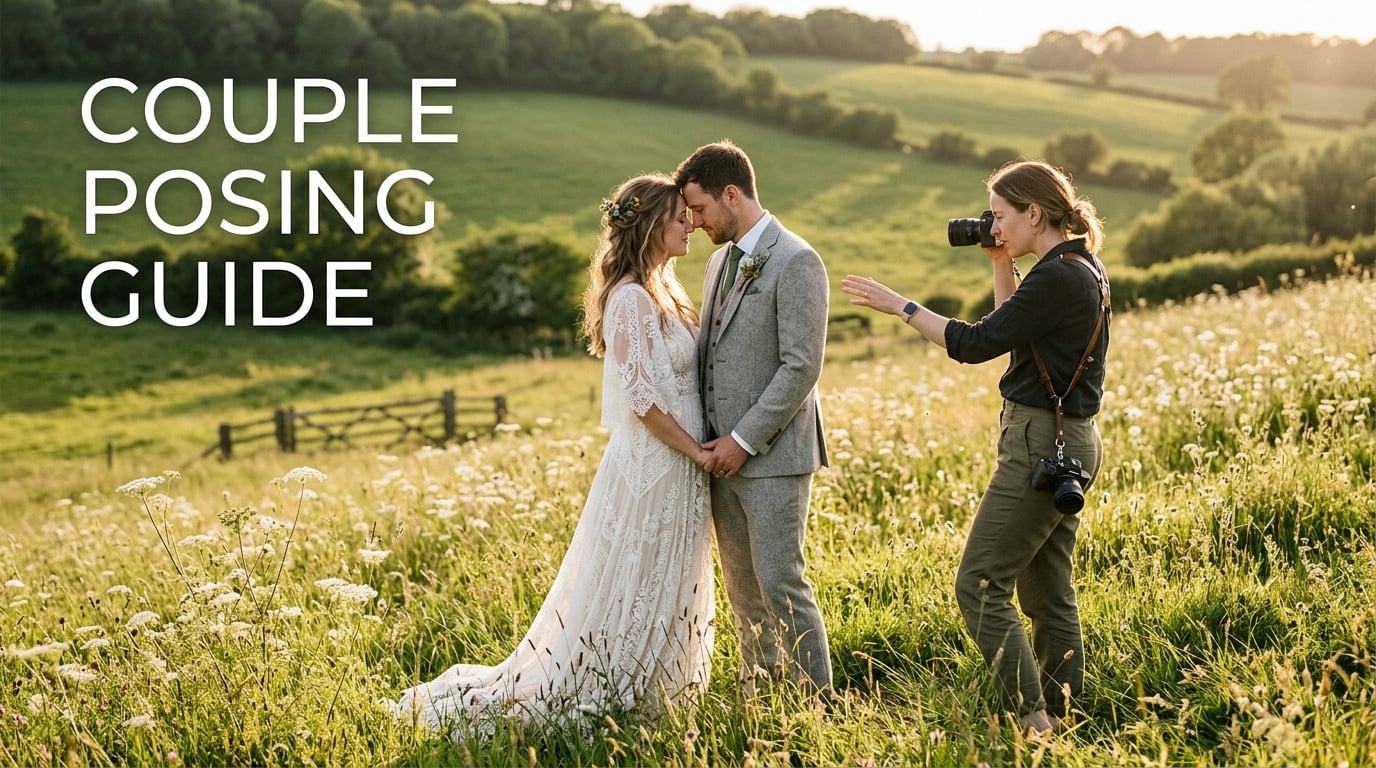
If you have ever stood in front of a camera with someone you love and felt instantly awkward, you already understand why a solid couple posing guide matters. I learned this the hard way during my first paid engagement session back in 2017.
The couple had been together for nine years. They loved each other deeply. The second I raised my camera, their smiles froze and their hands hovered like they were holding invisible balloons. I had every pose memorized but zero ability to translate that knowledge into something that looked like love on a sensor.
That session sent me down a rabbit hole of studying other photographers, reading every posing book I could find, and forcing myself to shoot weekly until I could direct couples without thinking. This couple posing guide is the playbook I wish I had back then. It covers the foundation poses, the direction cues, and the small adjustments that turn stiff bodies into natural wedding photography poses.
Whether you are a brand new wedding photographer or a couple getting ready for your own engagement session, the principles below will help you create images that feel real instead of rehearsed.
Table of Contents
What Are the Core Principles of a Great Couple Posing Guide?
Every reliable couple posing guide rests on three core principles. Connection comes first, movement comes second, and direction comes third.
Connection means giving the couple something to feel, not just something to do. Movement means encouraging small shifts in weight, breath, and gesture so the body never locks up. Direction means using prompts and cues to guide behavior rather than dictating exact positions.
When I follow these three principles in order, my couples stop asking “where do I put my hands” within the first five minutes of a session. When I skip any of them, even a technically perfect pose falls flat on screen.
How Does Connection and Intimacy Shape Natural Couple Poses?
Connection is the single biggest factor that separates memorable wedding photography posing from generic snapshots. Without genuine connection between subjects, even the most flattering angle reads as hollow.
I look for three connection points when I start a session. The first is physical contact, usually a hand on the waist or a forehead pressed to a temple. The second is eye contact, which can be either direct to the partner or pointed just past their shoulder for a softer look. The third is breath, which I trigger by asking one partner to whisper something to the other.
For nervous couples, I often start with what I call the “comfort pose.” They stand facing each other with their foreheads together and eyes closed for thirty seconds while I shoot from a distance. By the time they open their eyes, the awkwardness has usually melted. This trick alone has rescued more sessions than any lens I own.
What Are the Five Foundation Poses Every Photographer Should Master?
SLR Lounge’s research suggests roughly 97 percent of all couple poses come from just five positions of the feet. I have tested this theory across more than 200 sessions, and the number checks out. Master these five foundation poses and you can build almost any variation you need.
The V-Up Pose
The V-Up is the most classic couple photography pose. Both partners stand at a 90-degree angle to the camera, bodies turned toward each other so they form a soft V shape. Their middles press together gently while their outside feet stay planted.
This pose works for almost every body type because it slims both subjects and creates natural connection through the hip and shoulder contact.
The Open Pose
The Open pose turns both partners to face the camera while keeping some physical contact, usually with arms around each other or hands clasped at the hip. This works beautifully for formal family-style portraits during the wedding day.
The Closed Pose
The Closed pose has both partners facing each other almost completely, blocking the camera’s view of one face. I use this when I want to highlight the groom or bride specifically, or when I want a silhouette-style editorial shot.
The Stacked Pose
The Stacked pose places one partner slightly in front of the other, with the front partner turned 45 degrees toward the camera. The back partner leans in or wraps their arms around from behind. This pose flatters couples of different heights and creates lovely depth in the frame.
The Reverse Pose
The Reverse pose flips the script. The taller partner steps back while the shorter partner faces forward. I use this to create dramatic perspective and to give the shorter partner more visual weight in the composition.
How Should Arms, Hands, and Weight Be Distributed in Wedding Photography Posing?
Nothing ruins wedding photography posing faster than stiff arms. The fix is simple but it takes practice. I tell every couple to remember one rule: loose limbs always look better than tight limbs.
Loose limbs means slightly bent elbows, relaxed fingers, and a gentle drape rather than a rigid grip. If a hand is on a waist, it should rest there with the weight of the hand, not press into the body. If arms are around shoulders, the elbows should hang rather than clamp.
Hand placement is the second half of this equation. I give couples a short menu of safe hand positions: in pockets with thumbs out, on the partner’s chest, gently holding the partner’s face, or interlocked at the hip. Avoid flat palms facing the camera because they look larger than they are.
Weight distribution matters just as much. I always have the front foot carry about 70 percent of the weight and the back foot carry 30 percent. This shift tilts the hip slightly, which photographs as a flattering curve rather than a stiff block.
How Can Movement and Action Transform Static Couple Photography Poses?
Movement is the secret ingredient that turns posed couple photography poses into something that feels candid. Even a tiny shift in position produces genuine micro-expressions that rigid posing never will.
Walking is my favorite movement prompt. I ask couples to walk slowly toward me while holding hands and looking at each other. I shoot continuously for the entire approach. Out of fifty frames, I usually get at least three keepers and one stunner.
Spinning works especially well during golden hour. I ask one partner to spin the other by the hand. The motion creates natural laughter, flowing fabric, and dynamic composition in a single frame.
Whispered prompts are the third movement tool in my kit. I ask the partner who is taller to lean down and whisper a secret to the shorter partner. The whispered words are usually something silly like “your breath smells like coffee.” The reaction is always real and always photographable.
What Prompts and Direction Cues Help Photographers Direct Couples?
Prompts are short verbal instructions that trigger an emotion or action rather than dictate a pose. Direction cues are small physical adjustments that polish a pose once the couple is already in position.
My favorite prompts include:
- “Whisper something you have never told each other.”
- “Slow dance for five seconds without music.”
- “Pretend it is the first time you have seen each other today.”
- “Tell me your favorite inside joke.”
- “Close your eyes and breathe together.”
Each prompt produces a different emotion. The whispered secret triggers intimacy. The slow dance triggers physical closeness. The inside joke triggers laughter. The breath exercise triggers calm.
For physical cues, I keep a checklist I call the three-point system. I check the eyes, nose, and chest of each partner before I press the shutter. Eyes look soft. Nose points slightly away from the camera. Chest opens toward the partner rather than squaring up to the lens.
If something feels off during a session, I use silence. I stop talking, lower my camera, and wait. Within ten seconds, almost every couple starts doing something natural like adjusting each other’s hair or sharing a quiet smile. Those moments are gold.
How Do You Adapt Posing for Different Couples and Body Types?
A truly inclusive couple posing guide has to address more than the default couple. Over the past few years I have shot same-sex weddings, plus-size couples, older couples remarrying, and couples from cultural backgrounds where public affection has different meanings.
For LGBTQ+ couples, the foundation poses still apply. The V-Up works beautifully for two grooms. The Stacked pose works well for two brides because it allows natural variations in height. The most important adjustment is avoiding gendered prompts. Replace “whisper something to your bride” with “whisper something to your partner” and the prompt works for everyone.
For body type variations, the rule is to use angles rather than poses to flatter. Wider hips photograph beautifully when the partner stands slightly behind. Broader shoulders look more relaxed when the arms hang loose rather than wrap tightly. Heavier frames look stronger when the chin tips slightly up and the eyes look toward the horizon.
For cultural variations, I always ask couples before the session if there are any poses or forms of affection that feel uncomfortable. Some cultures reserve kissing for private moments. Others prefer modest contact. Respecting those boundaries produces better images because the couple relaxes into poses that feel authentic to them.
What Are the Most Common Couple Posing Mistakes to Avoid?
After more than 400 sessions, I see the same handful of mistakes over and over. Avoiding them is faster than fixing them, so I teach couples what to skip before we start.
Symmetrical shoulders is the biggest offender. When both partners square their shoulders to the camera at the same angle, the image looks stiff. Rotating one partner slightly away from the lens breaks the symmetry and adds depth.
Stiff fingers are the second most common issue. I tell couples to imagine holding a paper towel between their fingers and thumb. That small amount of tension produces a relaxed but defined hand.
Squinching is the third. Squinching means narrowing the eyes slightly without fully squinting. I ask couples to think of a friendly dog they love. The expression that triggers is the one I want on their faces.
Forgetting to breathe rounds out the list. Couples hold their breath when they get nervous. A quick reminder to take a slow breath relaxes the shoulders, softens the jaw, and resets the entire face.
Frequently Asked Questions About Couple Posing
What are the standard poses for a wedding couple?
The five foundation poses are the V-Up, Open, Closed, Stacked, and Reverse. Almost every wedding pose is a variation of these five base positions, which is why mastering them is the fastest way to build a reliable couple posing guide.
How do photographers pose awkward couples?
Start with the comfort pose where partners stand forehead to forehead with eyes closed for thirty seconds. Use simple prompts that trigger small actions, keep directions short, and avoid technical jargon. Awkward couples relax fastest when they have something to feel rather than something to do.
What are the best prompts for couple photography?
Whispered secrets, slow dancing without music, sharing an inside joke, breathing together with eyes closed, and pretending it is the first time you have seen each other today are five reliable prompts. Each one triggers a different emotion, which gives you variety within a single session.
How to remember couples poses?
Focus on the foundation poses first, then build variations from each one. Practice with friends or family until the five base positions become muscle memory. Once the foundation is automatic, you can improvise variations on location without losing the natural flow.
Practice This Couple Posing Guide Until It Feels Boring
A couple posing guide is only useful if you can execute it without thinking. I run through the five foundation poses, the three connection points, and my favorite prompts before every single session. The repetition feels boring in the moment, but it frees my mind to focus on light, composition, and the small details that turn a good photo into a great one.
If you are just starting out, shoot one session per week for a month. Use the same prompts. Repeat the same foundation poses. By the end of the month you will stop counting fingers and start seeing emotion. That is when wedding photography posing stops feeling like a checklist and starts feeling like a conversation.
This complete couple posing guide for 2026 is designed to be your reference on every shoot. Bookmark it, print the FAQ section, and use it until the principles below become second nature. Your couples will feel the difference, and your portfolio will show it.