
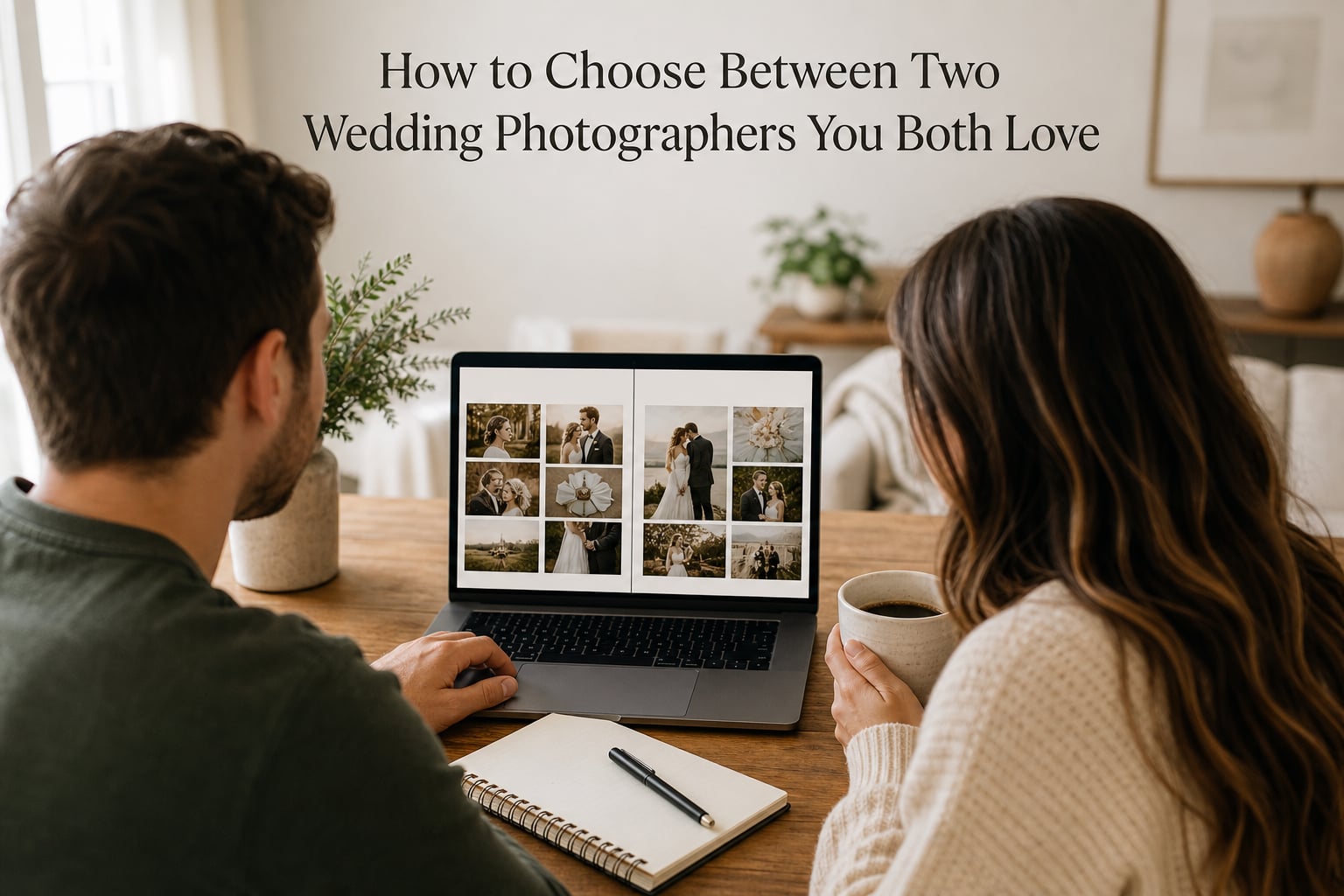
You have done everything right. You narrowed your list from dozens of wedding photographers to two. You love both of their portfolios. Both fit your budget. Both seem wonderful. And now you are completely stuck.
This is the hardest version of the photographer decision, and almost no guide addresses it directly. Most articles tell you how to find a photographer or what questions to ask. But what happens when you have already done all of that and you are left with two finalists you genuinely cannot separate?
Learning how to choose between two wedding photographers you both love requires a different approach than the initial search. You are no longer filtering out bad options. You are making a fine-grained comparison between two excellent ones, and that calls for a structured system rather than gut feeling alone.
Our team has worked with hundreds of couples through this exact scenario. The framework below will help you evaluate both photographers systematically so you can make a confident decision without second-guessing yourself for months.
Table of Contents
The Core Framework: Why Comparing Two Is Harder Than Comparing Twenty
Here is something that might surprise you. Having two great options is psychologically harder than having ten mediocre ones. Psychologists call this the paradox of choice. When you are filtering from a large pool, you can eliminate quickly based on obvious differences. When you are down to two strong candidates, every factor feels weighted with finality.
Many couples we speak with describe the same feeling. They obsess over tiny details, replay conversations in their heads, and worry that whichever choice they make will be the wrong one. One bride on a popular wedding planning forum wrote that she changed her mind six times in two weeks before finally booking.
The solution is to stop relying on emotion and start relying on a comparison system. When you evaluate both photographers across the same criteria using the same standards, patterns emerge that your anxious brain has been hiding from you. One photographer almost always pulls ahead when you look at the data instead of the feelings.
Think of this process like a job interview where both candidates are impressive. You would not flip a coin. You would compare their work samples, their communication style, their references, and their fit with your team. Choosing between two wedding photographers deserves the same rigor.
Before we walk through the five steps, grab a notebook or open a spreadsheet. You will want to score both photographers as you go. Trust me, the act of writing things down will clarify more than you expect.
Step 1: Request Full Wedding Galleries From Both Photographers
This is the single most important step, and it is where most couples fail. A photographer’s portfolio and Instagram feed show you their best work. Their full wedding gallery shows you their typical work.
There is a massive difference between the two. Any talented photographer can capture ten stunning images from a wedding. The question is whether they can deliver 600 images that are consistently beautiful, sharp, well-exposed, and emotionally resonant across an entire eight-hour day.
Ask both photographers for links to two or three complete wedding galleries. Most professionals share these happily. If a photographer hesitates or refuses to show you a full gallery, that alone is valuable information.
When you review each gallery, look for the following. Are the getting-ready photos as strong as the ceremony shots? Do the reception photos hold up in dim, challenging lighting? Are the family formals organized and well-composed? Are there enough candid moments, or does it feel posed throughout?
Here is a practical exercise. Open both galleries side by side on your computer. Scroll through each one at the same pace, spending no more than three seconds per image. Count how many photos from each gallery genuinely stop you in your tracks and make you look longer. The photographer with more stopping-power images across a full wedding is delivering more consistent quality.
A common mistake couples make is only requesting galleries from weddings that look like theirs. You should absolutely do that, but also ask for one gallery from a different venue type or lighting situation. This reveals how each photographer adapts when conditions are not ideal.
Step 2: Compare Photography Style Consistency Head-to-Head
Once you have full galleries from both photographers, the next step is assessing style consistency. This is different from simply liking someone’s aesthetic. You need to verify that their style shows up reliably in every wedding they shoot, not just the ones they choose to feature.
Start by identifying the editing style of each photographer. The three most common approaches are bright and airy, dark and moody, and natural or true-to-life. Some photographers blend elements, but most have a recognizable signature look. Write down which category each of your finalists falls into.
Now compare that signature look across multiple weddings. Does Photographer A deliver the same warm, natural tones in every gallery? Does Photographer B consistently produce those deep, moody shadows you love? If you notice that one photographer’s style shifts dramatically from wedding to wedding, that inconsistency should concern you.
Pay special attention to skin tones across both photographers’ galleries. This is where editing quality becomes most obvious. Natural, flattering skin tones that look consistent across different lighting conditions and skin types require real skill. Some photographers over-saturate, leaving orange-looking skin. Others wash everything out, making people look flat and lifeless.
Also evaluate shooting style. Is one photographer more documentary-focused, capturing candid moments as they unfold? Is the other more editorial, guiding you into poses and creating stylized compositions? Neither is inherently better, but one will match your vision for the day more closely.
Ask yourselves which set of images feels more like your relationship. If you are a relaxed, spontaneous couple, a documentary approach might capture your energy better. If you love the idea of magazine-quality portraits, an editorial photographer will deliver that vision. Being honest about who you are as a couple will often break a tie quickly.
One last check on style. Look at how each photographer handles the same key moments across different weddings. Compare their first dance photos, their ceremony shots, and their couples portraits across at least two galleries each. The photographer whose work feels more predictable in the best way is the safer choice.
Step 3: Evaluate Technical Quality Side by Side
Style is subjective, but technical quality is not. Two photographers can have similar aesthetics and wildly different skill levels. When you are choosing between two wedding photographers you both love, technical assessment often reveals the winner that your eye could not.
Start with sharpness and focus. Zoom in on faces in both photographers’ galleries. Are the eyes tack-sharp? Are group photos where everyone is in focus, or do people on the edges blur? Soft focus in key moments like the ring exchange or first kiss is a red flag, even from an otherwise talented photographer.
Next, examine exposure consistency. Look at ceremony photos from both photographers. Does the exposure look balanced across different parts of the venue? Are details preserved in both bright areas like windows and shadowed areas like dark interiors? A photographer who handles high-contrast scenes well will deliver better results regardless of your venue.
Check for noise and grain, especially in reception photos. Low-light reception photography is where less experienced photographers struggle. Some grain is acceptable and even stylistically intentional. But if the dance floor photos look muddy or the faces lose detail in dim reception lighting, that photographer may not have the technical chops for challenging conditions.
Composition is more subjective but still worth comparing systematically. Look at how each photographer frames the same types of shots. Are their ceremony photos taken from interesting angles or just standard front-facing positions? Do they use architectural elements, natural frames, and leading lines to create more dynamic images? Consistently thoughtful composition separates good photographers from great ones.
Here is a specific test that our team recommends. Find the family group formal photos in both galleries. These are notoriously difficult to shoot well because they involve large groups, varying heights, and often unflattering lighting. The photographer whose family formals look organized, evenly lit, and genuinely flattering has demonstrated a higher level of technical control.
Finally, assess each photographer’s ability to capture genuine emotion. Technical perfection means nothing if the photos feel sterile. Look for tears, laughter, and unguarded moments in both galleries. The photographer who consistently catches real emotion is delivering something that no amount of posing can replicate.
Step 4: Assess Personality and Communication Fit
You will spend more hours with your wedding photographer than with almost anyone else on your wedding day. They are there when you get ready, when you share private moments, when you are stressed, and when you are celebrating. Their personality and energy will directly impact your experience of the day.
This is where the decision often becomes personal. Both photographers may produce gorgeous work, but one of them will feel like a better fit for you as people. That matters more than most couples realize.
Think about your interactions so far. How quickly did each photographer respond to your initial inquiry? Did their emails feel warm and personal, or generic and transactional? Did they ask thoughtful questions about your wedding vision, or did they talk mostly about themselves and their packages?
If you have had consultation calls or in-person meetings with both, reflect on how each one felt. Did the conversation flow naturally? Did you feel at ease? Did your partner connect with them too? Many couples report that one photographer made them feel excited and comfortable while the other felt perfectly professional but less personal.
Personality fit is especially important if you are camera-shy. A photographer who makes you laugh and relax will capture better photos of you than one who is technically superior but socially awkward. The best wedding photographers are part artist, part psychologist, and part hype person.
Consider energy level as well. Some photographers work quietly and unobtrusively, almost disappearing into the background. Others are energetic, directive, and involved. Neither approach is wrong, but one will suit your wedding day personality better. Think about whether you want a calm presence or an enthusiastic one guiding you through portraits.
One more practical consideration. If you and your partner disagree about which photographer feels like a better fit, talk about why. Often one partner is prioritizing the photos while the other is prioritizing the experience. Both matter. Finding the photographer who wins on both fronts is the goal.
Step 5: Build Your Decision Matrix
Now it is time to turn your analysis into a decision. Create a simple scoring system with weighted criteria so both photographers are evaluated on the same scale. This removes the temptation to keep going back and forth based on emotion.
List these five categories and assign each a weight based on what matters most to you. Full gallery quality, style consistency, technical skill, personality fit, and package value. If stunning photos matter most, weight quality and technical skill higher. If experience matters most, weight personality higher. There is no wrong distribution.
Score each photographer from one to five in every category. Be honest. Do not give both photographers the same score in a category just because you cannot decide. Force yourself to differentiate. If Photographer A has slightly sharper focus and Photographer B has slightly better composition, give them different scores and move on.
Multiply each score by the weight you assigned and add up the totals. The photographer with the higher weighted score is your answer.
What if the scores are nearly identical? This happens more often than you might think. If your decision matrix results in a near-tie, that means both photographers are genuinely excellent choices for your wedding. At that point, there is likely no wrong answer, and you can move to tiebreaker strategies.
One important note on pricing. Try not to let price be the ultimate deciding factor unless there is a significant gap. Forum after forum is filled with couples who regretted choosing the cheaper option and loving the other photographer’s work. That said, if one package offers substantially more value for a similar price, that is a legitimate factor in your matrix, not an emotional one.
When You’re Still Torn: Tiebreaker Strategies
Sometimes the matrix does not resolve it. Both photographers score nearly identical, you love both of their work, and you feel paralyzed. Here are five tiebreaker strategies that couples in your exact position have used to find clarity.
First, try the coin-flip gut check. Assign each photographer to heads or tails, flip a coin, and pay close attention to your emotional reaction when you see the result. If you feel relieved, that is your answer. If you feel disappointed and want best-of-three, the other photographer is your true preference. This sounds silly, but it works because it forces your subconscious to reveal what it already knows.
Second, ask each photographer for two or three references from past couples. Actually call or message those couples. Ask about their experience working with the photographer, the delivery process, and whether they would book them again. The conversations will often make one photographer stand out clearly.
Third, review contracts and policies carefully. Which photographer has clearer delivery timelines? Who offers better protections if they fall ill on your wedding day? Who has backup equipment and a contingency plan? Practical professionalism can be a decisive factor when everything else is equal.
Fourth, if both offer engagement sessions, consider booking a mini session with each before making your final wedding decision. Some couples split the cost and use it as a test run. You will learn more about working with each photographer in thirty minutes than you can from any portfolio review.
Fifth, if you truly cannot decide after everything above, let your partner make the call. This is especially effective if you are the one who has been driving the photographer search. Stepping back and trusting your partner’s instinct can break the deadlock and prevent resentment.
Remember that decision paralysis often signals that there is no bad choice. If two photographers are this close after rigorous evaluation, both will likely deliver beautiful photos. The fear of making the wrong choice is usually worse than any outcome.
FAQs
What is the 20-60-20 rule in photography?
The 20-60-20 rule suggests that roughly 20 percent of your photos will be excellent, 60 percent will be solid and usable, and 20 percent will be below average or discarded. When comparing two wedding photographers, look at their full galleries through this lens to gauge how many truly exceptional images they deliver per wedding.
What is the 30 5 rule for weddings?
The 30-5 rule is a planning guideline suggesting you allocate about 30 minutes for wedding party and family formal photos before the ceremony and 5 minutes for a first look or private couples session. When evaluating photographers, ask how they handle this timeline to see if their approach matches your day’s flow.
Is $4000 a lot for a wedding photographer?
In most markets, $4000 falls in the mid-range for professional wedding photography. Prices vary widely by location and experience, with some photographers charging $2000 and others over $10000. Rather than focusing solely on the number, compare what each package includes, such as hours of coverage, a second photographer, an engagement session, digital files, and an album.
Is it better to have two photographers for a wedding reception?
Having two photographers at your reception can capture more angles during key moments like the first dance, toasts, and guest reactions. However, a single skilled photographer can cover most receptions effectively. When choosing between two wedding photographers, ask whether each includes a second shooter in their package or charges extra for one.
Making Your Final Decision With Confidence
Choosing between two wedding photographers you both love is genuinely difficult, and feeling stuck does not mean something is wrong with you or your options. The five-step framework above exists to replace anxiety with analysis.
Request full galleries, compare style consistency, evaluate technical quality, assess personality fit, and build a weighted decision matrix. If those steps still leave you in a near-tie, use the tiebreaker strategies to let your gut or your partner break the deadlock.
Once you decide, commit fully. Stop looking at the other photographer’s work. Stop second-guessing. Book your photographer, trust their process, and focus on enjoying your engagement. The photos will be beautiful either way, and your confidence in your choice will make the experience better for everyone involved.