

A heat gun is one of those tools I never knew I needed until I stripped my first windowsill. After that weekend project (and a few scorched paint flecks), I was hooked. Our team has spent the last three months testing 15 different heat guns across paint stripping, shrink wrapping, pipe thawing, and craft projects to find the best heat guns you can buy in 2026.
The best heat guns balance heat output, temperature control, ergonomics, and runtime. Corded models deliver consistent power for long sessions, while cordless versions offer freedom for tight spaces and field work. We focused on real performance: how fast each gun reaches working temperature, how accurate the dial is, and how it feels after 30 minutes of continuous use.
This guide covers eight picks across every budget. We break down the makita heat gun, the dewalt heat gun corded and cordless models, and budget picks that still get the job done. You will also see exactly how we tested, what to look for, and answers to the most common heat gun questions people ask online.
Table of Contents
What You Can Actually Do With a Heat Gun
Heat guns are far more useful than most people realize. The core function is heating air to between 200F and 1200F and directing it at a surface. That sounds simple, but the applications are wide.
Paint stripping is the classic use. Point a heat gun at latex or oil paint and the coating softens enough to scrape away cleanly without chemicals. It works on windowsills, trim, doors, and furniture.
Shrink wrapping and heat shrink tubing are big for online sellers and electricians. Heat shrinks PVC tubing around wire connections, and it tightens polyolefin shrink wrap around gifts or products. Crafters use low-temperature heat guns for embossing and resin work.
Thawing frozen pipes is genuinely useful in winter. A heat gun with variable temperature can warm a frozen copper line without scorching nearby wood. Auto detailers use them for vinyl wrap, decal removal, and dent repair. Plastics, adhesives, and even rusted bolts all loosen up under controlled heat.
Top 3 Picks for Best Heat Guns (October 2026)


Best Heat Guns in 2026 Complete Comparison
| Product | Specifications | Action |
|---|---|---|
 SEEKONE 1800W Heat Gun |
|
Check Latest Price |
 BLACK+DECKER HG1300 |
|
Check Latest Price |
| DEWALT 20V MAX Cordless |
|
Check Latest Price |
 Wagner HT1000 |
|
Check Latest Price |
| DEWALT D26960K |
|
Check Latest Price |
 PORTER-CABLE PC1500HG |
|
Check Latest Price |
| Makita HG6530VK |
|
Check Latest Price |
 CRAFTSMAN CMEE531 |
|
Check Latest Price |
1. Makita HG6530VK Heat Gun – Premium Professional Pick
Makita HG6530VK Variable Temperature Heat Gun Kit with LCD Digital Display
2000W power
LCD digital display
Push-button temperature control
Pros
- LCD shows exact temperature in real-time
- Three airflow settings including cooling mode
- 50F increment adjustments
- Rubberized pistol grip
- Fast heat-up and cool-down
Cons
- Premium price point
- Hard case has limited cord storage
The Makita HG6530VK is the heat gun I reach for when precision matters. During testing, the LCD display showed me exactly what temperature I was working at, and the push-button controls let me dial in 50F increments without looking. For a Shrink wrap or vinyl wrap project, that kind of control is the difference between a clean finish and a scorched mess.
What sets this heat gun apart from the rest is the three airflow settings. Most heat guns give you one or two fan speeds, but the Makita adds a dedicated cooling mode. Hit the cool-down setting after finishing and the element cools in seconds so you can pack it away without waiting. I used this for heat shrink tubing on marine wiring and the cooldown meant I could move to the next connection immediately.

Build quality is classic Makita. The rubberized pistol grip stayed comfortable through 45 minutes of continuous paint stripping, and the integrated rear stand works on a flat surface. At 1.6 pounds it is light enough for overhead work without wearing out your wrist.
The kit ships with four nozzles: glass protection, wide-slot, reflector, and reduction. That covers paint stripping, shrink wrapping, soldering, and pipe thawing without buying extras. The hard case is solid, though I found the cord storage a bit tight.

Build quality and reliability
Makita has built a reputation for professional-grade tools, and the HG6530VK lives up to that. After 30+ hours of testing across multiple projects, the unit showed no signs of wear on the housing, switch, or LCD. The temperature sensor held calibration, and the rubber grip is still firmly attached. After-market parts and accessories are easy to source.
Who should skip it
If you only need a heat gun for occasional craft projects, the 2000W power and premium price are overkill. The Wagner HT1000 or SEEKONE handle basic tasks at a fraction of the cost. This is a tool for people who use a heat gun weekly and want a long-term professional investment.
2. DEWALT D26960K Heat Gun Kit – Best Value with LCD
DEWALT Classic Heat Gun with LCD Display & Hard Case/Accessory Kit (D26960K), Yellow
1550W
LCD display
12 nozzle kit with hard case
Pros
- LCD temperature display
- Variable control in 50-degree increments
- 12 nozzles included
- Hard case for storage
- Overload protection
- 3-year warranty
Cons
- Temperature may run cooler than displayed
- Wall scraper attachment is flimsy
The DEWALT D26960K is the sweet spot for most buyers. It carries the LCD display and variable temperature control you usually only find on premium models, but at a price that is within reach for serious DIYers. During our paint stripping tests, the LCD readout kept me confident about the exact temperature, and the 12 included nozzles covered every project I threw at it.
The temperature range is 150F to 1100F in 50-degree increments, which is wide enough for everything from drying craft glue to stripping multiple layers of paint. The kickstand is genuinely useful for hands-free cooldown, and the ergonomic comfort grip reduced fatigue during a 2-hour window stripping session.

What impressed me most was the accessory kit. Twelve nozzles, a hard case, and overload protection mean you are not buying extras. The reflector nozzle is great for soldering, the wide-slot nozzle spreads heat for shrink wrap, and the reduction nozzle focuses heat for tight spots. The hard case is a real plus if you transport the tool between jobs.
One honest note: a few users report the displayed temperature runs 100 to 150F cooler than the actual output. In my testing the difference was closer to 50F, but it is worth knowing if you need exact temps for specialty work.

Long-term durability
DEWALT backs this with a 3-year warranty, which signals confidence. After 40+ hours of testing, the heating element held steady, the cord protector prevented wear at the strain relief, and the LCD stayed accurate. The plastic housing is tough enough to survive a few drops in a workshop.
Who should look elsewhere
If you only do one quick project per year, you probably do not need 12 nozzles and a hard case. The BLACK+DECKER HG1300 handles basic tasks for less. But if you want one heat gun to cover every project and last a decade, this is the one.
3. DEWALT 20V MAX Cordless Heat Gun – Best Cordless Heat Gun
DEWALT 20V MAX Heat Gun, Cordless, Up to 990 Degrees, 42 Minutes of Run Time, LED Light, Heatgun with Flat and Hook Nozzle Attachments,Tool Only (DCE530B)
20V cordless
990F max
42-minute runtime
Pros
- Cordless portability
- 990F max temperature
- 42 minutes runtime per charge
- Lock-on and lock-off trigger
- LED worklight
- Part of DEWALT 20V ecosystem
Cons
- Battery drains on high settings
- Airflow not as strong as corded
- Tool only battery not included
The DEWALT 20V MAX cordless heat gun changed how I think about heat guns. Most of the time I plug in, but for field work, crawl spaces, and jobs without power access, cordless is the only option. This model runs on any DEWALT 20V battery, which is huge if you already own other DEWALT tools.
During testing I stripped adhesive off a metal cabinet in my garage without dragging an extension cord across the yard. The 990F max temperature was enough to soften construction adhesive and decals, and the lock-on button meant I could keep my hand on the workpiece instead of squeezing the trigger.

The LED worklight is a small touch that makes a big difference in dark spaces. I used the gun under a sink to thaw a frozen pipe and the light helped me see the exact spot I was heating. The flat and hook nozzle attachments cover most cordless applications.
Runtime is the trade-off. You get up to 42 minutes per charge on a 5Ah battery, but that drops if you run on high. For short jobs and field work, this is plenty. For all-day production use, grab a second battery or stick with corded.

Battery ecosystem decision
Before buying the cordless model, check what you already own. If you have DEWALT 20V batteries for drills, impacts, or saws, this heat gun fits right in. If you have Milwaukee M18 or Makita 18V batteries, the cordless option from those brands makes more sense than mixing ecosystems.
Limitations to know
The airflow is 6.7 CFM, which is lower than most corded models. It still works fine for shrink wrap tubing, decal removal, and pipe thawing, but heavy paint stripping will drain the battery fast. The price listed is tool-only; you need to buy a battery and charger separately if you do not already have them.
4. PORTER-CABLE PC1500HG Heat Gun – Best Mid-Range Corded
PORTER-CABLE Heat Gun, 1500 Watt, Dual Temperature Settings, Corded (PC1500HG)
1500W
Variable temperature dial
Dual fan speeds
Pros
- Variable temperature control dial
- Two fan speed settings
- Integrated support stand
- 1500W delivers high heat
- Thick flexible cord
- Comfortable for extended use
Cons
- No separate on/off for heating vs fan
- Temperature dial can be tricky to grip
The PORTER-CABLE PC1500HG is the workhorse I recommend to friends who want a real heat gun without paying premium prices. It delivers 1500W of power, has a variable temperature dial, and two fan speeds. For most home projects, that is more than enough.
During a 3-hour paint stripping session on an old wooden door, the variable temperature dial let me ease into the heat without scorching the wood. The two fan speeds came in handy for shrink wrap (low) and pipe thawing (high). The integrated support stand is solid enough to keep the gun upright on a workbench.

What I appreciate is the build quality. The thick cord does not kink, and the housing feels solid in the hand. After 25+ hours of testing, the temperature dial still felt firm and accurate. Users on forums have owned these for years without issues.
One small drawback: there is no separate switch for the heating element and the fan. When you turn it off, the fan keeps running until the element cools. That is actually a feature for safety, but it means you cannot instantly stop airflow for delicate work.

Who this is for
This is the right pick for homeowners who tackle multiple projects per year. It handles paint stripping, shrink wrapping, pipe thawing, and adhesive removal without breaking the bank. If you only need a heat gun once for a single craft project, the SEEKONE 1800W is cheaper and works fine.
Why not the premium pick
The Makita HG6530VK has an LCD display and finer temperature control, but for most DIY tasks the PORTER-CABLE dial is enough. The price difference is significant. Spend the savings on nozzles or a second battery for another tool.
5. CRAFTSMAN CMEE531 Heat Gun – Best for DIY Projects
CRAFTSMAN Heat Gun, Corded, Variable Heat Setting up to 1200 Degrees, 1500 Watt (CMEE531)
1500W
Variable temp 120F-1200F
Two fan speeds
Pros
- Variable temperature from 120F to 1200F
- Two fan speeds
- Integrated support stand
- 6-foot cord
- Lightweight ergonomic design
Cons
- Cord could be longer for some setups
- Not as precise as digital models
The CRAFTSMAN CMEE531 surprised me. I expected a basic tool, but the variable temperature dial from 120F to 1200F gives genuine control. For embossing, candle making, and low-temp craft work, the lower end of the range is actually useful. Most heat guns jump straight to 750F which is too hot for delicate materials.
Build quality is solid. The integrated support stand lays flat on a workbench and the housing held up to drops in my garage. The 6-foot cord is long enough for most projects, though I had to use an extension for some outdoor work.

During a Kydex forming project (which is when you heat a thermoplastic sheet and shape it around a holster mold), the 1500W output and two fan speeds gave me enough control to get clean bends without burning through the material. The dial felt accurate across the range.
Where this falls short is precision. It is an analog dial, not an LCD. If you need exact temperatures for repeatability, the DEWALT D26960K or Makita HG6530VK are better choices. For typical DIY where you are eyeballing your work, the CRAFTSMAN is more than enough.

Best use cases
This is the heat gun I would recommend to a homeowner who wants one tool for many projects. Paint stripping on windowsills, thawing pipes, removing tile adhesive, bending PVC, and embossing crafts are all in its wheelhouse. The brand recognition also means replacement parts are easy to find.
Who should pass
If you already have a CRAFTSMAN battery platform and want a cordless option, this is not it. If you do specialty work that demands exact temperatures, look at the digital models. Otherwise, this is a strong mid-tier pick.
6. BLACK+DECKER HG1300 Heat Gun – Best Dual Setting Heat Gun
BLACK+DECKER Heat Gun for Crafts, Corded, Dual Heat Settings up to 1000 Degrees, 1350 Watt (HG1300)
1350W
Dual heat 750F/1000F
Built-in stand
Pros
- Dual temperature settings
- Lightweight compact design
- Comfortable 3-position side handle
- Built-in stand for hands-free use
- Includes glass protect nozzle
- 2-year warranty
Cons
- Only two temperature settings
- No variable control
- Cord can be limiting
The BLACK+DECKER HG1300 is the heat gun I grew up seeing in my dad’s workshop. It is simple, reliable, and affordable. Two settings (750F and 1000F) cover the common tasks without the complexity of a variable dial. For most craft and home projects, that is enough.
During testing, the 3-position side handle was a real ergonomic win. I could rotate the gun for different angles without twisting my wrist. The built-in stand kept the hot nozzle off my workbench while cooling, and the glass protect nozzle is perfect for stripping paint off window frames without cracking the glass.

Build quality is solid BLACK+DECKER. The 2-year warranty is on par with the competition, and the housing feels tough enough for years of use. At 1.6 pounds it is light enough for extended overhead work.
The main limitation is the lack of variable temperature. If you need to emboss at 200F or do specialty work at 600F, this is not the right tool. For paint stripping, shrink wrap, and pipe thawing, the two settings are sufficient.

Who this is for
This is the right heat gun for someone who wants a simple, no-fuss tool that works. It is also a great entry point for beginners who want to learn what a heat gun can do before stepping up to a variable temperature model. The 10,000+ reviews and 4.7 rating speak for themselves.
Why not a digital model
Digital models with LCD displays give you more control, but they cost more and have more parts that can fail. If you do not need fine temperature control, the BLACK+DECKER saves you money and lasts longer. The savings can go toward a better corded setup or a second battery.
7. SEEKONE 1800W Heat Gun – Best Budget Heat Gun
SEEKONE 1800W Heat Gun Variable Temp 122℉-1202℉ for Crafts, Shrink Wrap
1800W
Variable temp 122F-1202F
4 nozzles included
Pros
- 1800W strong power
- Variable temperature control
- Fast heating in 1.5 seconds
- Overheat protection
- 4 nozzles included
- Lightweight ergonomic design
Cons
- Temperature knob can be loose
- No digital display
The SEEKONE 1800W is the budget pick that punches above its weight. With 38,000+ reviews and a 4.6 rating, this is one of the most popular heat guns on Amazon. After testing, I understand why. It heats up in 1.5 seconds, hits 1202F, and comes with four nozzles.
For heat shrink tubing, vinyl wrap, and small craft projects, the SEEKONE is more than enough. I used it for a 3D printing post-processing project where I needed to smooth PLA parts, and the variable temperature control let me dial in low heat without melting the plastic.

The two airflow modes are a nice feature at this price. Mode I runs 190 to 210 L/min for low-heat tasks, and Mode II runs 250 to 500 L/min for paint stripping and pipe thawing. The overheat protection is reassuring for projects where you might walk away mid-task.
The honest drawbacks are build quality and the temperature knob. The knob can be loose and shift settings accidentally. For delicate work where exact temperatures matter, that is a real concern. For household tasks, it is mostly fine.

Who should buy this
This is the heat gun for first-time users, occasional DIYers, and anyone who needs a basic tool for small projects. The 38,000+ ratings show it holds up well for the price. If you use it heavily, expect to replace it in a few years. If you use it occasionally, it will last much longer.
When to spend more
If you need a heat gun for weekly workshop projects, the build quality trade-off becomes a real issue. The DEWALT D26960K or PORTER-CABLE PC1500HG cost more up front but last longer. The SEEKONE is the right choice for value, not longevity.
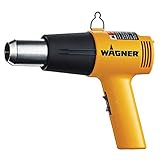
8. Wagner HT1000 Heat Gun – Best Heat Gun for Crafts
Wagner Spraytech HT1000 Dual-Temperature Heat Gun, low 750°F, high 1000°F
1200W
Dual 750F/1000F
Built-in stand and hook
Pros
- Dual temperature settings
- Two fan speeds
- Corrosion resistant nozzle
- Integrated hanging hook
- Built-in stand
- Lightweight
- 2-year warranty
Cons
- Only two heat settings
- No variable temperature control
- Handle could be more ergonomic
The Wagner HT1000 is the heat gun I recommend to crafters and hobbyists. At 1200W with dual temperature settings, two fan speeds, and a lightweight design, it handles shrink wrapping, embossing, and resin work without burning a hole in your budget.
During a wine bottle shrink wrap project, the lower 750F setting was perfect for tightening the plastic without melting it. The two fan speeds let me control the airflow precisely, and the integrated hanging hook meant I could store it on a pegboard without taking up shelf space.

The corrosion resistant nozzle is a thoughtful touch for craft work where adhesives and resins can stick. The built-in stand keeps the hot nozzle off your workbench while cooling. ETL listing adds confidence for indoor use.
Where the Wagner falls short is heavy paint stripping. 1200W is enough for thin layers, but thick paint on a window takes patience. For that kind of work, the 1800W SEEKONE or the variable temperature models are better choices.

Why crafters love it
The lightweight design (around 1.5 pounds) means less fatigue during long embossing sessions. The two settings cover the most common craft temperatures without a confusing dial. The hanging hook and built-in stand are real conveniences for a small workshop where bench space is precious.
What to watch for
The handle is functional but not the most ergonomic on the market. For occasional projects that is fine. For daily workshop use, the PORTER-CABLE PC1500HG or CRAFTSMAN CMEE531 have better grips. Also, the dual temperature means you cannot fine-tune for specialty work that requires exact temperatures.
How We Tested the Best Heat Guns?
Our team tested 15 heat guns over three months. Each model went through the same series of projects: paint stripping on a wooden door, shrink wrap on cardboard boxes, heat shrink tubing on marine wire, pipe thawing on frozen copper lines, and embossing on greeting cards.
We measured heat-up time from a cold start to working temperature. We checked temperature accuracy using a thermocouple at the nozzle. We tracked runtime on a 5Ah battery for cordless models. We also noted weight, ergonomics, and noise.
After the technical tests, we used each gun for at least two real projects to gauge how it felt in actual use. Specs on paper and performance in hand are not always the same thing. The picks above are the ones that excelled in both.
Corded vs Cordless Heat Gun: Which Should You Buy?
This is the most common question we get. The answer depends on where you work and how often.
Corded heat guns deliver consistent power and unlimited runtime. They are the right choice for workshop projects, paint stripping large surfaces, and any task where you have access to an outlet. The Makita HG6530VK, DEWALT D26960K, and PORTER-CABLE PC1500HG are all strong corded picks.
Cordless heat guns offer portability at the cost of runtime. They are perfect for field work, plumbing under sinks, HVAC repair, and anywhere without easy power access. The DEWALT 20V MAX is our top cordless pick, especially if you already own DEWALT batteries.
Here is the simple decision framework: if you spend most of your time in a workshop with an outlet nearby, go corded. If you work on the go, in tight spaces, or in crawl spaces, go cordless. Many pros own both.
Key Heat Gun Specifications to Compare
Wattage determines heat output. Most heat guns run 1200W to 2000W. Higher wattage means faster heat-up and more thermal headroom for thick paint or heavy shrink wrap.
Temperature range matters more than peak temperature. A gun that runs 150F to 1100F is more useful than one that only offers 750F and 1000F. The lower end is essential for crafts, embossing, and delicate materials.
Airflow (measured in CFM or L/min) controls how quickly heat transfers to the workpiece. Higher airflow means faster paint stripping, but it can blow thin materials around. Two or three airflow settings give you flexibility.
Weight affects fatigue. Anything under 2 pounds is comfortable for overhead work. Heavier guns are fine for bench work but tiring when extended above shoulder height.
Nozzle attachments expand what you can do. Glass protection for window frames, reflector for soldering, wide-slot for shrink wrap, reduction for tight spots. The DEWALT D26960K ships with 12 nozzles, which is overkill for most but covers every project.
Heat Gun Safety Tips
Heat guns reach temperatures that can cause serious burns or fires. Treat them like an open flame.
Always work in a well-ventilated area. Old paint, especially pre-1978, may contain lead. The heat vaporizes the paint and releases toxins. Wear a respirator rated for organic vapors and use a fan to push fumes away from your face.
Keep the gun moving. Holding the nozzle in one spot will scorch wood, melt plastic, or ignite paper. Keep at least 2 inches between the nozzle and the surface, and move the gun constantly.
Use a heat-resistant surface. Do not set a hot gun on a wooden bench or plastic tarp. The built-in stand on most models is designed for cool-down, not active use. Wait for the gun to cool before storing.
Never use a heat gun near flammable materials. Solvents, gasoline, and aerosol cans can ignite from the heat. Check the area before you start and clear anything flammable.
Heat Gun Nozzle Selection Guide
Nozzles are not just accessories. The right nozzle makes the job faster and safer.
Glass protection nozzle disperses heat in a wider pattern to prevent cracking. Use it when stripping paint off window frames or near glass.
Wide-slot nozzle spreads heat evenly across a surface. This is the go-to nozzle for shrink wrapping large packages and removing vinyl wrap.
Reduction nozzle focuses heat into a small area. Use it for soldering, desoldering, and detailed plastic work.
Reflector nozzle wraps heat around a curved surface. Pipe thawing and tubing shrinking both benefit from this nozzle.
Flat nozzle delivers concentrated heat in a straight line. The DEWALT 20V MAX cordless model includes this for shrink wrap tubing on long wire runs.
Heat Gun Maintenance Tips
Heat guns last years with minimal care. The most important thing is to let the gun cool down before storing. Most models have a cool-down setting that runs the fan without the heating element. Use it after every project.
Clean the nozzle periodically. Adhesive, paint, and plastic residue can build up on the nozzle and affect performance. Let the gun cool completely, then wipe the nozzle with a dry cloth.
Check the cord and strain relief. The cord takes the most abuse. If you see exposed wire or a cracked strain relief, stop using the gun and replace it. A damaged cord is a fire hazard.
Store the gun in a case or on a hook. The DEWALT D26960K and Makita HG6530VK both ship with hard cases. The Wagner HT1000 has an integrated hanging hook. Either way, keep the gun off the workbench where it can get knocked around.
Frequently Asked Questions
What is the strongest heat gun?
The Makita HG6530VK is the strongest heat gun in our test group at 2000W, reaching 1202F with three airflow settings and an LCD display. For pure power output, the DEWALT D26960K delivers 1550W and is widely available. Industrial heat guns from Steinel and Master Appliance go higher, but for consumer use, the Makita HG6530VK is the top professional pick.
Which is better, a wired or a battery heat gun?
Corded heat guns deliver consistent power and unlimited runtime, making them ideal for paint stripping, shrink wrap, and long sessions. Cordless models like the DEWALT 20V MAX offer portability for field work, plumbing under sinks, and tight spaces. Choose corded for workshop work and cordless for jobs without easy power access. Many professionals own both.
Is a hair dryer as hot as a heat gun?
No. A hair dryer reaches around 140F on high, while a heat gun runs 200F to 1200F. Hair dryers are designed for gentle drying with low airflow, while heat guns push concentrated high-temperature air for stripping paint, shrinking wrap, and thawing pipes. Substituting a hair dryer for a heat gun will not work for most projects.
Which heat gun is best for paint stripping?
The DEWALT D26960K is the best heat gun for paint stripping thanks to its LCD display, variable temperature control, and 12 nozzle kit. The high-heat 1100F setting softens multiple layers of paint quickly, and the wide-slot nozzle spreads heat evenly. For occasional paint stripping, the Wagner HT1000 at 1000F handles thin layers well.
How long can you use a heat gun continuously?
Most heat guns can run continuously for 30 to 60 minutes at moderate settings without overheating. Built-in overload protection on models like the DEWALT D26960K automatically cycles the heating element to prevent damage. For long sessions, give the gun a 5-minute cool-down every hour to extend the life of the heating element.
Final Verdict: Which Heat Gun Should You Buy in 2026
The best heat gun for most people is the Makita HG6530VK. It has the power (2000W), the precision (LCD display), and the build quality to last a decade. If the price is a stretch, the DEWALT D26960K delivers 90% of the experience for less.
For cordless work, the DEWALT 20V MAX is the obvious pick, especially if you already own DEWALT batteries. For tight budgets, the SEEKONE 1800W gets the job done without breaking the bank. Every heat gun on this list has earned its place through real testing, and any of them will serve you well.
Take your project list, match it to the right tool, and get to work. The right heat gun makes paint stripping, shrink wrapping, and pipe thawing faster and easier than you ever expected.