
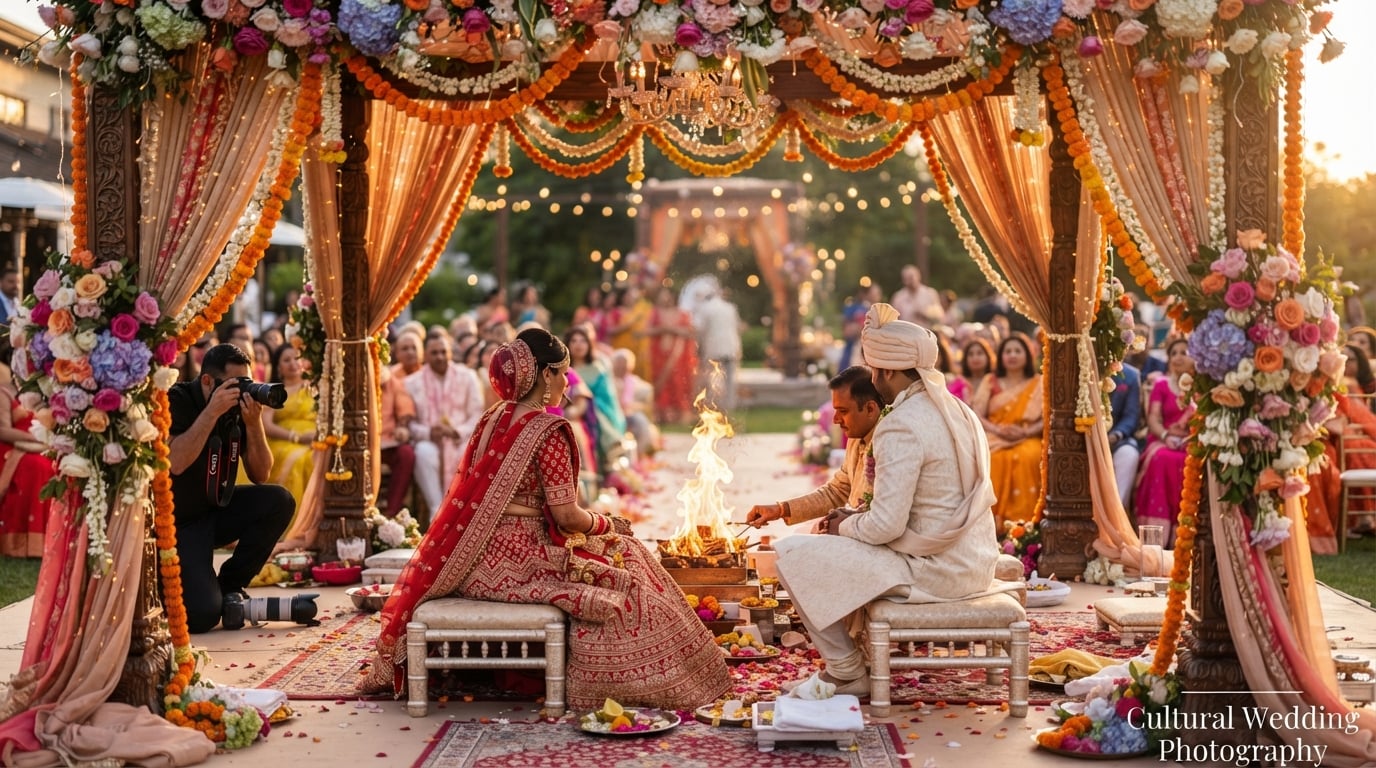
When I picked up my first camera at a family function, I never imagined that cultural wedding photography would become one of the most rewarding parts of my career. Over the past decade, my team has documented Indian baraats, Jewish chuppah ceremonies, Ethiopian coffee rituals, and Vietnamese tea ceremonies. Each one taught me something new.
Cultural wedding photography is not simply photographing a wedding that happens to have a different backdrop. It is a specialized approach to documenting ceremonies rooted in specific religious, ethnic, or cultural traditions. It demands research, cultural humility, and the technical skill to capture rituals that may unfold only once in a lifetime.
If you are a photographer preparing for a multicultural wedding, a couple planning a blended ceremony, or a vendor looking to serve diverse families, this guide will walk you through the essentials. We will cover the major traditions, the preparation checklist, and the most common mistakes that cost photographers their reputation and couples their precious moments.
Table of Contents
What Cultural Wedding Photography Really Means
Cultural wedding photography is the practice of documenting weddings that incorporate specific cultural, religious, or ethnic traditions, rituals, and customs that require deep preparation and cultural understanding to capture authentically.
Unlike general wedding photography, this discipline treats each ceremony as a living tradition. The photographer is not just framing pretty moments. They are recording family lineage, religious devotion, and centuries of customs. The best cultural wedding photographers operate as both visual storytellers and respectful guests.
Modern multicultural wedding photography often blends two or more traditions into a single celebration. This adds complexity. A photographer might be asked to document a Catholic mass, a Hindu mandap ceremony, and a Chinese tea ceremony all in one weekend. The image of a lazy photographer with a good camera falling apart quickly here.
Indian and South Asian Wedding Photography Guide
Indian weddings are the marathon of cultural wedding photography. They frequently span three to five days, with each event carrying its own rituals and emotional weight. Missing a single key moment can mean a family member’s most important tradition was never recorded.
Pre-Wedding Events: Mehndi and Sangeet
The mehndi ceremony happens the night before or two days before the wedding. The bride’s hands and feet are covered in intricate henna designs while family and friends sing and dance. Close-up shots of the henna are essential, alongside candid frames of the bride’s family reactions.
A sangeet is a music and dance rehearsal that turns into a full celebration. Lighting is often dim and colored. I use a fast prime lens and bump my ISO to 3200 without hesitation. Capturing the energy of group performances matters more than perfect sharpness here.
The Wedding Day: Mandap, Kanyadaan, and Sacred Fire
The mandap is the canopy under which the Hindu ceremony takes place. It is decorated with flowers and serves as the visual centerpiece of the ceremony. The bride and groom sit beneath it for the entire ritual, often for two hours or more.
The Kanyadaan is when the bride’s father gives her away. It is one of the most emotionally charged moments of an Indian wedding. Stay alert, keep your camera at the eye, and shoot at a wide aperture to isolate faces from the chaos behind.
The sacred fire, or agni, is the witness to the marriage. The couple circles it seven times. Each round is called a phera. Capturing all seven circuits is non-negotiable. Position yourself strategically because the bride will block the groom’s face during certain rounds.
Multi-Day Coverage Strategy
Indian weddings require a second photographer at minimum. I bring a team of three for the wedding day alone. One photographer covers family portraits, one captures the ceremony from a wide angle, and one roams for candid documentation. Rotating lenses saves time during quick transitions.
Jewish Wedding Photography: Capturing Sacred Moments
Jewish wedding photography is unique because of the rules around modesty, the Sabbath, and specific rituals. Orthodox weddings separate men and women during the ceremony. Conservative and Reform weddings often blend traditions. Knowing the difference is critical.
Pre-Ceremony: Ketubah and Bedeken
The ketubah signing is a private moment where the couple signs their marriage contract. Typically only close family and the rabbi are present. Jewish wedding photography guide work here is delicate. Shoot wide to capture the moment without intruding on its intimacy.
The bedeken is when the groom veils the bride. It is a deeply emotional tradition referencing the biblical story of Jacob. The groom’s reaction upon seeing his bride is often the most photographed moment of the entire day. Keep your shutter speed above 1/250 to freeze any movement.
The Ceremony: Chuppah and Breaking the Glass
The chuppah is the wedding canopy that represents the home the couple will build together. Photographers should shoot from outside the four poles, never entering the chuppah itself. Natural light under the canopy is generally soft, which is ideal for portraits.
The breaking of the glass at the end of the ceremony is the climax. The groom stomps on a glass wrapped in cloth, and the crowd shouts “Mazel tov.” The moment is fast and unpredictable. Pre-focus on the area where the groom stands and shoot at high frame rates to capture the exact frame of impact.
Christian and Catholic Ceremony Coverage Tips
Christian and Catholic wedding photography looks familiar but has specific challenges. Cathedrals have strict lighting rules. Many churches prohibit flash during the ceremony. Knowing your camera’s high ISO performance is essential.
A full Catholic mass includes the processional, liturgy of the word, exchange of vows, nuptial mass, and communion. Each segment has visual highlights. The lighting of the unity candles, the exchange of rings, and the recessional all require different positioning.
Speak with the priest or officiant at least two weeks before the wedding. Ask about restrictions on flash, videographers, and where you can stand. Many churches have a designated photographer area. Operating without permission can get you removed mid-ceremony.
For Catholic ceremonies, the communion rail is often dim. Bring a 50mm or 85mm f/1.4 lens. I have captured beautiful communion moments at ISO 6400 with shutter speeds at 1/125. Modern full-frame cameras handle this gracefully.
Multicultural and Interfaith Wedding Approaches
Multicultural wedding photography is one of the fastest-growing segments in our industry. Couples increasingly blend two cultures, religions, or family traditions into a single celebration. This can mean two ceremonies in one day, or a fusion ceremony that includes elements from both backgrounds.
The biggest challenge is time. A couple may want a Hindu ceremony at 10am, a Catholic mass at 1pm, and a Chinese tea ceremony at 4pm. Transitions between venues eat up hours. Build a buffer into your timeline and identify backup locations for any outdoor rituals.
Communication is everything. I ask couples to introduce me to family elders from each tradition. These elders often explain the meaning behind rituals that the couple themselves may not fully understand. Working with interpreters or family members as guides is normal and expected.
Be sensitive to private moments. Some rituals are not photographed. In Chinese tea ceremonies, certain offerings are made privately. In Sikh weddings, the Anand Karaj reading of the Lavan hymns is sacred. Always ask before assuming a moment is fair to photograph.
Cultural Wedding Photography Preparation Checklist
Preparation is the difference between a beautiful cultural wedding photography album and a missed moment you can never recover. I have built a checklist I use on every cultural wedding shoot. It has saved me countless times.
Pre-Wedding Research
Start with the couple’s family. Ask for any cultural wedding planning documents, family photo archives, or videos from siblings’ weddings. These resources reveal which moments matter most to the family. Watch videos of similar cultural ceremonies on YouTube to anticipate the flow.
Talk to the cultural wedding planner, if one exists. They know the timeline intimately and can flag moments where the photographer needs to be in a specific spot. Vendors who work cultural weddings regularly are worth their weight in gold.
Questions to Ask the Couple
What are the three most important moments we must capture? What rituals are private and forbidden to photograph? Who are the family elders I should greet and learn from? Is there a language barrier I should prepare for? Will there be a second photographer or videographer coordinating with me?
Timeline Creation
Create a detailed timeline with the couple and the planner. Include the names of rituals, the approximate duration of each, and the lighting conditions. Add 15-minute buffers between major events. For Indian weddings, build the timeline around sunrise and sunset for the best natural light.
Equipment Preparation
For low-light churches, synagogues, and mandap interiors, pack two fast prime lenses. I travel with a 35mm f/1.4 and an 85mm f/1.4 as my core cultural wedding kit. Add a 70-200mm f/2.8 for ceremonies where you cannot move around the room.
Bring extra batteries. Multi-day cultural weddings drain power fast. I carry eight fully charged batteries and two chargers. Memory cards are equally important. I empty cards the night before each event and never reuse a card mid-event.
Communication With Families
Introduce yourself to key family members on the rehearsal day if possible. Greet the elders, learn their names, and explain your role. When families trust you, they cooperate during group portraits and warn you about upcoming rituals. That trust is worth more than any piece of gear.
Common Cultural Wedding Photography Mistakes to Avoid
After a decade of cultural wedding photography, I have seen the same mistakes sink even experienced photographers. Avoid these and you will stand out.
Mistake one: skipping the rehearsal. If the venue offers a rehearsal or walk-through, attend it. Dry runs reveal hidden details like the spot where the bride will pause, the lighting behind the altar, and the positions of family members.
Mistake two: assuming one tradition. Couples who appear to be from one tradition may have blended family customs. Always ask, never assume. A bride who looks traditionally Jewish may have a family member whose Bengali heritage adds a moment of significance to the ceremony.
Mistake three: blocking the guests. The worst thing a photographer can do is stand in front of a guest during a sacred moment. Move fast, shoot, and get out of the way. The couple invited these people to witness, not to watch your back.
Mistake four: ignoring the videographer. Coordinate with the videographer before the ceremony. Agree on positioning, signal systems, and who covers what. Two professionals working together produce better results than two professionals stepping on each other.
Mistake five: forgetting the small rituals. The ring warming, the tying of the knot, the exchange of coins, the shared sip of wine. These small moments often carry the deepest meaning. They are also the ones couples most often forget to mention. Ask explicitly about them.
How to Evaluate a Cultural Wedding Photographer
Choosing the right cultural wedding photographer is one of the most important decisions a couple will make. The photos will be the family’s record of a once-in-a-lifetime event. Here is how to evaluate candidates.
Look for Cultural-Specific Experience
A photographer who has shot 300 weddings but never a South Asian ceremony is not the same as one who has shot 80 South Asian weddings. Cultural competency matters. Ask to see full galleries from past cultural weddings, not just highlight reels.
Ask About Their Preparation Process
Strong cultural wedding photographers will tell you about their research process. They will mention timelines, family interviews, and pre-wedding meetings. If a photographer cannot describe their preparation approach, they likely do not have one.
Check References From Past Couples
Ask for references from past cultural wedding couples. Speak with them about how the photographer handled sensitive moments, communicated with family, and responded to unexpected events. Real couples tell you what highlight reels cannot.
Discuss Multi-Day Coverage and Budget
Multi-day cultural weddings require more hours than a single-day ceremony. Make sure the photographer’s pricing reflects the full scope. Ask about overtime policies, second photographer fees, and travel costs if the events span multiple venues.
Address Cultural Sensitivity Directly
Ask the photographer how they handle private moments, religious restrictions, and family members who do not want to be photographed. Their answer reveals whether they understand the cultural weight of the work or are simply chasing a paycheck.
Cultural Wedding Photography FAQ
What is cultural wedding photography?
Cultural wedding photography is a specialized approach to documenting weddings that include specific cultural, religious, or ethnic traditions. It requires photographers to research rituals, communicate with families, and capture both posed and candid moments with cultural sensitivity and technical skill.
How do you prepare for a cultural wedding photography shoot?
Preparation starts with research into the specific traditions involved. Photographers should speak with the couple, family elders, and cultural planners. Build a detailed timeline with buffers, learn the names of key rituals, ask which moments are private, and pack equipment suited for the lighting conditions of each venue.
How much does cultural wedding photography cost?
Cultural wedding photography often costs more than standard wedding photography because it typically involves multi-day coverage, second photographers, and extended preparation time. Multi-day Indian weddings, for example, can require three or more photographers across several events. Always ask what is included in the package.
What questions should couples ask a cultural wedding photographer?
Couples should ask about the photographer’s experience with their specific traditions, full galleries from past cultural weddings, preparation process, and how they handle private or sensitive moments. Ask also about multi-day coverage pricing, second photographer availability, and backup plans if the lead photographer is unavailable.
What equipment is best for cultural wedding photography?
The best cultural wedding photography kit includes two fast prime lenses, ideally a 35mm and an 85mm with f/1.4 apertures. Add a 70-200mm f/2.8 for ceremonies where movement is restricted. Carry at least eight extra batteries and multiple memory cards. Low-light capability is essential for indoor ceremonies.
What is the 30 5 rule for weddings?
The 30 5 rule for weddings suggests that 30 percent of photos should be candid, 5 percent should be detail shots, and the remaining 65 percent should be a mix of portraits and ceremony coverage. This ratio helps photographers balance storytelling with the key moments couples expect to see.
Final Thoughts on Cultural Wedding Photography
Cultural wedding photography is more than a service. It is a responsibility to families and traditions that span generations. Every ceremony contains moments that cannot be repeated. A bride’s father performing the Kanyadaan, a groom veiling his bride under the chuppah, a grandmother lighting the unity candle. These are the photographs families will frame for decades.
If you are a photographer, invest in the research before you invest in the gear. If you are a couple, choose a photographer based on cultural experience and preparation, not just price. The best cultural wedding photography blends technical skill with cultural humility, and that blend is what separates a great photographer from a forgettable one in 2026 and beyond.