
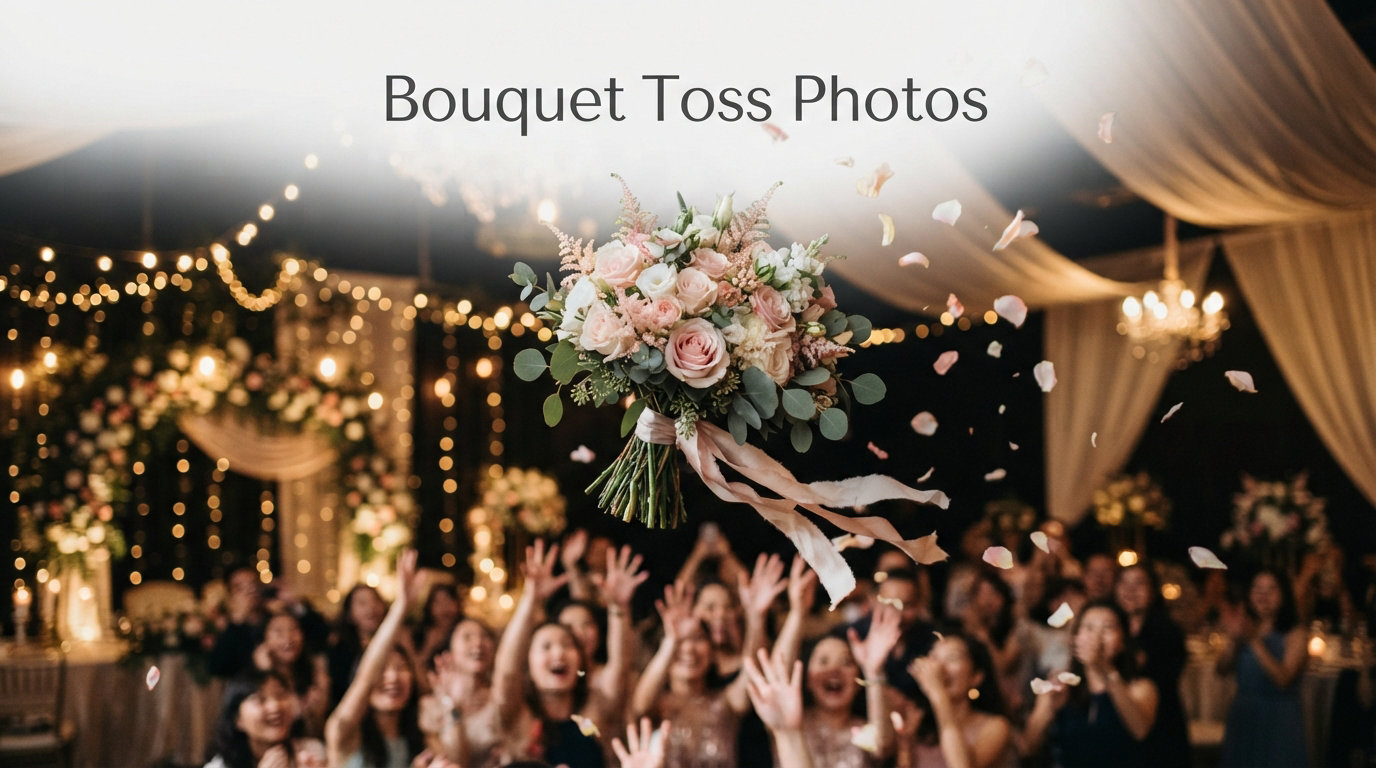
Bouquet toss photos are some of the most energetic, joy-filled frames in any wedding album. We have shot hundreds of receptions over the past decade, and the bouquet toss consistently delivers the single most candid burst of emotion on the dance floor.
Capturing that moment well takes more than pointing a camera at the bride. It requires preparation, the right settings, smart positioning, and a quick read on the crowd. In this guide, I’ll walk you through exactly how to get bouquet toss photos your couples will frame on their walls.
Table of Contents
How to Prepare Before the Bouquet Toss
Preparation starts hours before the toss, not seconds. The best bouquet toss photos come from photographers who plan the moment like a sports shooter plans a play.
Talk with the DJ or band leader at the reception. Ask for the cue they’ll use to introduce the toss so you know exactly when to grab your position. Most coordinators will text you the timeline, and that single document saves you from sprinting across the dance floor.
Walk the reception space during setup. Identify where the bride will stand, where the single ladies will gather, and which direction she’ll likely throw. Look for the brightest ambient light source and any chairs or DJ booths that could block your angle.
Confirm with the wedding planner whether the couple is doing a traditional toss or a modern alternative. Couples skipping the tradition still want a moment of fun, so you’ll adjust your plan rather than skip the shot entirely.
Best Camera Settings for Bouquet Toss Photos
Reception lighting changes constantly, so I shoot in manual mode with a fast aperture and rely on flash for consistency.
Here are the starting settings I use for bouquet toss photos:
- Shutter speed: 1/200s (sync speed) when using flash, 1/160s as a safety floor
- Aperture: f/2.8 to f/4 for a sharp subject with soft background
- ISO: 800 to 1600 on modern full-frame bodies, 400 to 800 if you bounce flash
- White balance: 5500K flash, or use AWB and fix in post
- Drive mode: High-speed continuous (8 fps or faster) for the action burst
- Focus: Continuous AF (AI Servo or AF-C) with eye detection locked on the bride
Test your settings during the parent dances. The ambient light is usually similar, and you’ll catch any exposure issues before the toss begins.
Lens Selection for Bouquet Toss Photography
A 24-70mm f/2.8 zoom is the workhorse for bouquet toss photos. It gives you wide enough coverage for the group shot and tight enough reach for the bride’s reaction.
I pair the 24-70mm with a 70-200mm f/2.8 on a second body. The wider zoom handles the toss and crowd, while the telephoto catches genuine reactions from guests who don’t know you’re shooting. Two bodies save you from missing a frame while swapping lenses.
For solo shooters, a fast 35mm or 50mm prime on one body and the 24-70mm on the other covers nearly every bouquet toss photo situation. Avoid anything slower than f/4 indoors. Reception lighting is unforgiving, and slow glass will leave you boosting ISO into noisy territory.
Where to Stand: Positioning Strategies
Positioning determines whether your bouquet toss photos look like a snapshot or a magazine spread. Where you stand controls the light, the background, and the emotion.
For lead photographers, the best spot is in front of the bride, about 10 to 15 feet away, slightly off to one side. This angle captures her face as she turns, the bouquet mid-flight, and the crowd behind. Standing directly in line with the throw is risky because you’ll be backed into a corner of the room.
For second shooters, move behind the bride at a 45-degree angle. You’ll catch the toss, the expressions of the single ladies, and the catcher celebrating. A third shooter can climb on a chair for an overhead shot, which adds variety to the final gallery.
Always leave yourself an exit path. Receptions fill up fast during the toss, and you may need to reposition in under five seconds.
Lighting Techniques: Flash and Ambient
Flash turns mediocre reception light into gorgeous bouquet toss photos. Without it, you’ll fight red tones, motion blur, and shadowed faces.
On-camera flash with a bounce card is the simplest setup. Aim the head at the ceiling at about 45 degrees, dial in +1 to +2 stops of flash compensation, and let the camera balance ambient and flash exposure. This works in most banquet halls with white ceilings.
Off-camera flash gives you more control. Place a speedlight on a light stand behind the bride, slightly higher than head height, and trigger it wirelessly. This creates a rim light that separates the bride from the crowd and turns bouquet toss photos into something cinematic.
Watch your flash recycling time. Modern speedlights recycle in 1 to 2 seconds at full power, but older units can take 4 seconds or longer. If your flash lags, drop the power to 1/4 or 1/8 to speed up recycling and still get consistent exposure.
Directing the Bride and Guests
Direction is the secret to bouquet toss photos that look effortless. Even experienced brides freeze when 20 guests are staring at them.
Pull the bride aside 10 minutes before the toss and ask her to throw over her shoulder with both hands. Most brides underhand-toss like a softball, which kills the drama. A shoulder toss gives the bouquet height and arc, both of which photograph beautifully.
Ask the DJ or coordinator to gather single ladies (or anyone who wants to participate) into a tight cluster about 15 feet behind the bride. A loose crowd creates empty space in your frame. A tight crowd fills the background with faces and reactions.
Do a fake toss right before the real one. The fake toss gets everyone laughing, loosens the crowd, and produces a bonus candid frame. Then count to three and let the bride go for real.
Capturing Reactions and Candid Moments
The toss itself lasts about 2 seconds. The reactions last 10 times longer, and that’s where the magic lives.
Keep shooting for at least 30 seconds after the bouquet leaves the bride’s hands. You’ll capture the scramble, the catch, the celebration hug, and the mock disappointment of everyone who didn’t catch it. These frames often become the couple’s favorites.
Shoot the catcher immediately. Walk toward her, ask her name, and take three quick portraits with the bouquet. Couples love seeing the catcher’s joy, and the catcher loves having a photo of her own.
Watch the periphery. The best candid bouquet toss photos often come from guests at the edge of the crowd who are laughing, cheering, or pretending to dive out of the way. A 70-200mm pointed at the sidelines catches these moments while your main camera tracks the action.
Bouquet Toss Equipment Checklist
Here’s the kit I pack in my camera bag specifically for the bouquet toss:
- Two camera bodies (one wide zoom, one telephoto)
- 24-70mm f/2.8 and 70-200mm f/2.8 lenses
- Two speedlights with fresh batteries
- Wireless flash trigger (e.g., PocketWizard, Godox X system)
- Light stand with sandbag for off-camera flash
- Bounce card or small flash diffuser
- Lens cloth (receptions get sweaty and steamy fast)
- Spare memory cards and batteries
Common Mistakes to Avoid
Most bouquet toss photo disasters come from the same handful of errors. Avoid these and you’ll stay ahead of most shooters in your market.
- Shooting too tight. Always leave headroom for the bouquet’s arc.
- Using too slow a shutter speed. Anything under 1/160s blurs the action.
- Forgetting flash recycling. Drop power before the toss, not during it.
- Standing in line with the throw. You’ll catch a back of someone’s head, not the bouquet.
- Stopping too early. Keep shooting through the celebration.
- Ignoring the crowd. The reactions often matter more than the toss itself.
Post-Processing Tips for Bouquet Toss Photos
Post-processing turns a good bouquet toss photo into a great one. I run a consistent workflow in Lightroom on every reception set.
Start with white balance. Flash photos often look slightly cool, so warming them by 200 to 400K gives skin tones a healthy glow. Then lift shadows by 20 to 30 to recover any underlit faces in the crowd.
Crop tight for impact, wide for storytelling. The hero toss photo usually crops to a 4×5 portrait to emphasize the bouquet arc. The reaction photos stay 3×2 landscape to capture the full group energy.
Apply selective sharpening on the bouquet and the bride’s eyes. A little clarity and texture boost on the flowers makes them pop without overdoing skin retouching. For action blur, use Topaz Photo AI or Lightroom’s denoise to recover sharp edges without losing motion feel.
Export two versions for the couple: a clean web gallery at 2048 pixels and high-resolution prints at full resolution. Bouquet toss photos often get printed as gifts for the catcher, so the full-res version matters.
Modern Alternatives to the Bouquet Toss
Many couples in 2026 are skipping the traditional toss for personal, cultural, or practical reasons. As a photographer, your job is to capture whatever moment they choose.
Popular alternatives include a money bouquet raffle, a ribbon-pull bouquet where guests pull ribbons until one releases the flowers, or a group hug photo of all the single ladies with the bride. Some couples plant the bouquet on a family member’s grave as a remembrance moment.
Whatever the couple decides, talk through the plan with them during the engagement session. That conversation makes you look professional, and it ensures you capture the real story of their day.
Frequently Asked Questions
What camera settings work best for bouquet toss photos?
Use manual mode with shutter speed at 1/200s, aperture between f/2.8 and f/4, ISO 800 to 1600, and continuous autofocus with eye detection on the bride. Add flash with bounce or off-camera placement for consistent exposure.
Where should a wedding photographer stand for the bouquet toss?
Lead photographers should stand in front of the bride at a slight angle, 10 to 15 feet away. Second shooters work best behind the bride at a 45-degree angle, and a third shooter can capture overhead angles from a raised platform.
Is a bouquet toss still done at weddings in 2026?
Yes, the bouquet toss is still popular in 2026, though more couples are choosing creative alternatives like ribbon-pull bouquets, money bouquets, or group photos. Photographers should confirm the plan with the couple before the reception.
What lens should I use for bouquet toss photography?
A 24-70mm f/2.8 covers the wide group shot and tighter portraits. Pair it with a 70-200mm f/2.8 on a second body for candid reactions. Solo shooters can use a fast 35mm or 50mm prime as a backup lens.
How do you light a bouquet toss indoors?
Use on-camera flash bounced off the ceiling at 45 degrees with +1 to +2 stops of compensation. For more dramatic light, place an off-camera speedlight behind the bride on a light stand and trigger it wirelessly.
Final Thoughts on Bouquet Toss Photos
Great bouquet toss photos come down to preparation, gear, and presence. Walk the room early, pack the right lenses, dial in your settings during the parent dances, and keep shooting long after the bouquet lands.
Our team has used this workflow at over 200 weddings, and it consistently delivers images couples text their friends about the next morning. Master these steps and your bouquet toss photos will stand out in any wedding album.