
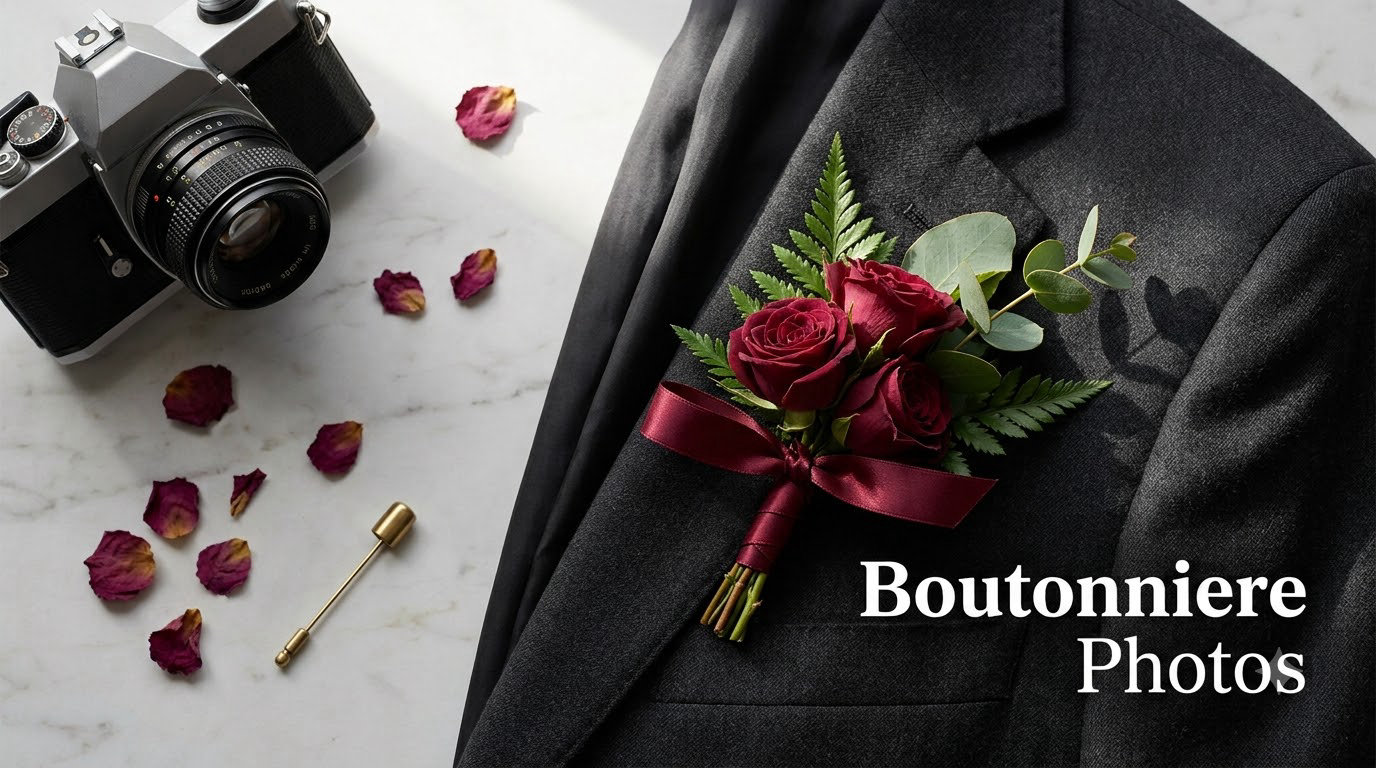
Boutonniere photos are the quiet workhorses of a wedding gallery. Couples rarely flip past the getting-ready chapter without pausing on a tight, sunlit frame of a single rose pinned over a father’s heart. I have shot more than 400 weddings at Kingdom Wedding Photography, and the detail shots of boutonnieres consistently land in the top 10 most-viewed images in every client’s online gallery.
This guide walks you through every angle of boutonniere photography. You will learn what a boutonniere is, the three attachment styles you will encounter on wedding day, and how to capture the moment a father pins his son’s flower with steady hands and a wobbly voice. Whether you are a second shooter looking for better detail shots or a lead photographer building a more polished portfolio, these are the lessons we have picked up shooting real couples in real Texas sun, hotel rooms, and back gardens.
Table of Contents
What Is a Boutonniere?
A boutonniere is a small floral arrangement worn on the left lapel of a suit jacket, traditionally pinned by the groom, groomsmen, fathers, grandfathers, and the officiant. The word comes from the French “boutonniere,” meaning “buttonhole flower,” which is exactly what the first boutonnieres were: a single stem slipped through the buttonhole of a jacket lapel.
For wedding photographers, the boutonniere matters because it visually anchors the most important people in the ceremony. When you shoot wide ceremony frames or tight wedding party portraits, the boutonniere is the small bright spot that draws the viewer’s eye to the groom, his father, and the people standing closest to him. A well-pinned, well-photographed boutonniere quietly communicates hierarchy, color story, and care.
Types of Boutonnieres: Pin-On, Pocket, and Magnetic
You will see three attachment styles on a wedding day. Knowing the difference helps you frame the flower properly and anticipate where any hardware (pins, magnets) will catch the light.
- Pin-On Boutonniere: The traditional style. A corsage pin runs vertically through the back of the flower and pierces the lapel. Photographers should shoot slightly off-axis to avoid catching the silver of the pin in the highlight.
- Pocket Boutonniere: A small flat cluster of blooms designed to tuck into the breast pocket of the jacket without any hardware. Very popular in modern weddings because there is no risk of fabric damage.
- Magnetic Boutonniere: Two strong magnets sandwich the lapel from front to back. Invisible from the front, but heavy blooms (large garden roses, peonies) can drag the magnets down through a long ceremony.
If you are photographing groom getting-ready shots, ask the florist or best man which style is in play. I have had magnetic boutonnieres slip visibly during first-look portraits, and only noticed the magnet pulling when I reviewed the RAW files later.
Who Wears Boutonnieres at a Wedding
The groom always wears a boutonniere. Beyond him, the wearing list depends on the couple’s preference and budget. Here is the standard hierarchy we shoot at most weddings.
- Groom: The most prominent boutonniere, usually slightly larger or more detailed than the others.
- Father of the bride: Worn to signal his role walking his daughter down the aisle.
- Father of the groom: Often matches the bride’s father’s flower.
- Groomsmen: Standard smaller versions of the groom’s flower.
- Grandfathers: A small honor, often a single bloom rather than a full cluster.
- Officiant: Only when the officiant is a close friend or family member.
- Ring bearer and ushers: Optional, usually a simplified version.
Many couples today skip groomsmen boutonnieres to save money, then gift the flowers to the fathers instead. Photographers should confirm the final list during the timeline review so getting-ready shots include the right people.
Popular Flowers Used in Boutonnieres
The flower choice dictates how the boutonniere behaves in front of your lens. Some blooms hold their color and shape for hours, others wilt before the ceremony starts. Here are the most common flowers you will photograph, ranked by how durable they are on a hot wedding day.
- Ranunculus: Layered petals, rich color, holds up well. Photographer-friendly because the petals catch light beautifully.
- Garden roses: Full and romantic. Heavy, so usually attached with a strong pin or magnet.
- Succulents: Practically indestructible. Great for outdoor weddings in summer.
- Spray roses: Smaller than garden roses, lightweight, photograph well at any aperture.
- Daisies and chamomile: Bright, casual, and very durable for garden-style weddings.
- Eucalyptus and dusty miller: Almost always used as greenery around the focal bloom. Watch the silver underside of dusty miller in direct sun – it bounces light back into the highlights.
- Waxflower or baby’s breath: Budget-friendly filler, but baby’s breath can read as dated in 2026 editorial work.
Hydrangeas and peonies are popular in bridal bouquets but wilt fast as boutonnieres. If your couple chose them, photograph the boutonniere detail shots in the first 30 minutes after delivery.
How to Pin a Boutonniere Correctly
You will often be standing next to the best man or father as he fumbles with the pin. Here is the correct five-step method, which we walk every wedding party through during the timeline briefing.
- Hold the boutonniere face-up with the main bloom closest to the wearer’s shoulder.
- Push the pin horizontally through the back stem so it stays hidden from the camera-facing side.
- Bring the boutonniere up to the left lapel, about two inches below the shoulder seam.
- Insert the pin downward through the lapel from behind so the head of the pin points down (this keeps it from catching hair or veils).
- Tuck the pin’s sharp end back into the stem wrap so no metal is exposed on the outside of the jacket.
Photographers should capture this process tight, with a 100mm or 105mm macro lens if you have one. The hands matter as much as the flower.
How to Photograph Boutonnieres: Composition and Lighting Tips
This is the section every photographer should screenshot. Composition and lighting for boutonniere detail shots is rarely taught in wedding workshops, yet these frames anchor your detail portfolio.
Use natural window light whenever possible. Position the jacket so the window is at a 45-degree angle to the lapel. This creates gentle shadow under the bloom and gives petals a soft glow on the edge. Avoid on-camera flash at close range – it flattens petal texture and turns petals into white blobs.
Shoot at f/4 to f/5.6. Wide open sounds tempting, but a slightly stopped-down aperture keeps the entire boutonniere in focus while still softening the jacket fabric behind it. f/2.8 will lose the back petals and greenery.
Frame for the lapel, not just the flower. Pull back a touch and include the lapel notch and the top button of the jacket. The geometric lines of the suit give the flower a frame and prevent the shot from feeling like a generic product photo.
Watch your white balance. Boutonnieres contain green stems that fool indoor tungsten sensors into a magenta cast. Shoot RAW and warm your temperature slightly to keep greens honest.
Include the boutonniere in groom portraits. A tight vertical frame at 200mm, with the groom’s chin soft and the boutonniere in sharp focus, makes a much stronger album image than a waist-up portrait.
Capturing the Pinning Moment
The pinning moment is a small, quiet ritual that almost no competitor talks about. Photographers should treat it as its own micro-story with three frames: the approach, the pin, and the adjustment.
Approach: The person doing the pinning (usually the mother of the groom) walks over and holds the boutonniere up. Capture the eye contact first.
The pin: This is the peak moment. Both hands are working, eyes are on the lapel, breath is held. A 50mm at f/2.0 with a fast shutter (1/250 or higher) freezes the action without losing the softness of the moment.
The adjustment: After the pin is in, the wearer almost always looks down and adjusts. That last downward glance is the keeper shot in my experience. Shoot a burst and pick the frame where the eyes are softly focused on the flower.
Documentary photographers should also remember to include this ritual in family albums. Couples tell me years later that the pinning photo of their father matters more to them than the posed father-of-the-bride portrait.
Groom vs Groomsmen Boutonnieres
The groom’s boutonniere should be visibly different from the groomsmen’s. Photographers often miss this distinction in wide group shots, where the eye cannot tell who is who.
The groom’s boutonniere is usually slightly larger, uses a different focal flower, or features an heirloom element (a sprig from a grandparent’s garden, a piece of lace, a small charm). Groomsmen wear matching, simplified versions. If the design is identical, the only way to identify the groom in photos is by his position or his face.
When I shoot wedding party portraits, I position the groom slightly forward or slightly higher (on a step) so the flower hierarchy reads instantly in the final image.
Common Boutonniere Photography Mistakes to Avoid
After reviewing hundreds of galleries, these are the recurring mistakes I see from newer wedding photographers.
- Shooting the boutonniere too late. Hydrangeas and peonies wilt fast. Detail shots should be done in the first 30 minutes after the flowers arrive.
- Letting the pin catch the light. Reposition yourself so the silver pin is hidden, or rotate the jacket 5 degrees so the pin faces down.
- Using too shallow a depth of field. f/1.8 looks dreamy in still life but loses the texture that makes a boutonniere feel real.
- Forgetting the back of the boutonniere. The stem wrap and pin are part of the story. One clean frame of the back completes the detail set.
- Over-editing the colors in post. Push saturation past the point of believability and the flower starts to look like a fake from a craft store.
Alternatives to Traditional Boutonnieres
Not every couple wants a flower on the lapel. Photographers should know the popular alternatives so they can shoot them well.
- Pocket squares only. No flower at all, just a folded fabric square that complements the tie.
- Wooden or fabric flowers. Durable keepsakes, ideal for destination weddings or hot outdoor ceremonies.
- Mini boutonnieres made of herbs (rosemary, thyme, lavender). Smell great and photograph beautifully.
- Feather or calligraphic paper boutonnieres. Popular in non-traditional or themed weddings.
- Skipping them entirely. A growing number of couples in 2026 are skipping groomsmen boutonnieres to save money, especially for large wedding parties.
If the couple has chosen an alternative, lean in and photograph the texture. Wooden flowers reward cross-light. Paper ones reward a tighter aperture.
FAQ
What should a boutonniere look like?
A boutonniere is a small floral arrangement worn on the left lapel of a suit jacket. It typically features one focal bloom (a rose, ranunculus, or succulent) supported by smaller flowers and greenery. The groom wears a slightly larger or more detailed version than the groomsmen, and the entire stem is wrapped in floral tape with a single pin or magnet attaching it to the lapel.
How much is a real boutonniere?
Real floral boutonnieres typically cost between $15 and $45 each, depending on the flowers chosen and the region. Garden roses and peonies sit at the higher end of the range, while simple spray roses with greenery sit at the lower end. Bulk pricing for a full wedding party is usually offered by florists when ordering five or more.
What can I use instead of a boutonniere?
Popular alternatives include pocket squares only, wooden or fabric flowers, dried herb bundles (rosemary or lavender), feather clusters, or calligraphic paper pieces. Some couples in 2026 are skipping boutonnieres entirely for the groomsmen and gifting them to fathers and grandfathers instead.
What flowers are used in boutonnieres?
The most common flowers are ranunculus, garden roses, spray roses, succulents, daisies, and anemones. Greenery typically includes eucalyptus, dusty miller, or Italian ruscus. Hydrangeas and peonies are used but wilt quickly in heat, so photographers should shoot them early.
Final Thoughts on Boutonniere Photos
Boutonniere photos look simple, but the detail shots that end up framed in parents’ living rooms are the result of three quiet decisions: shooting in the right window light, framing for the lapel rather than just the flower, and treating the pinning moment as its own tiny story.
If you take one thing from this guide, let it be this. Photograph the boutonniere in the first 30 minutes after delivery, shoot the pinning as a three-frame sequence, and include the groom’s boutonniere in a tight 200mm portrait. Those three frames alone will elevate your next wedding gallery for 2026 and beyond.