
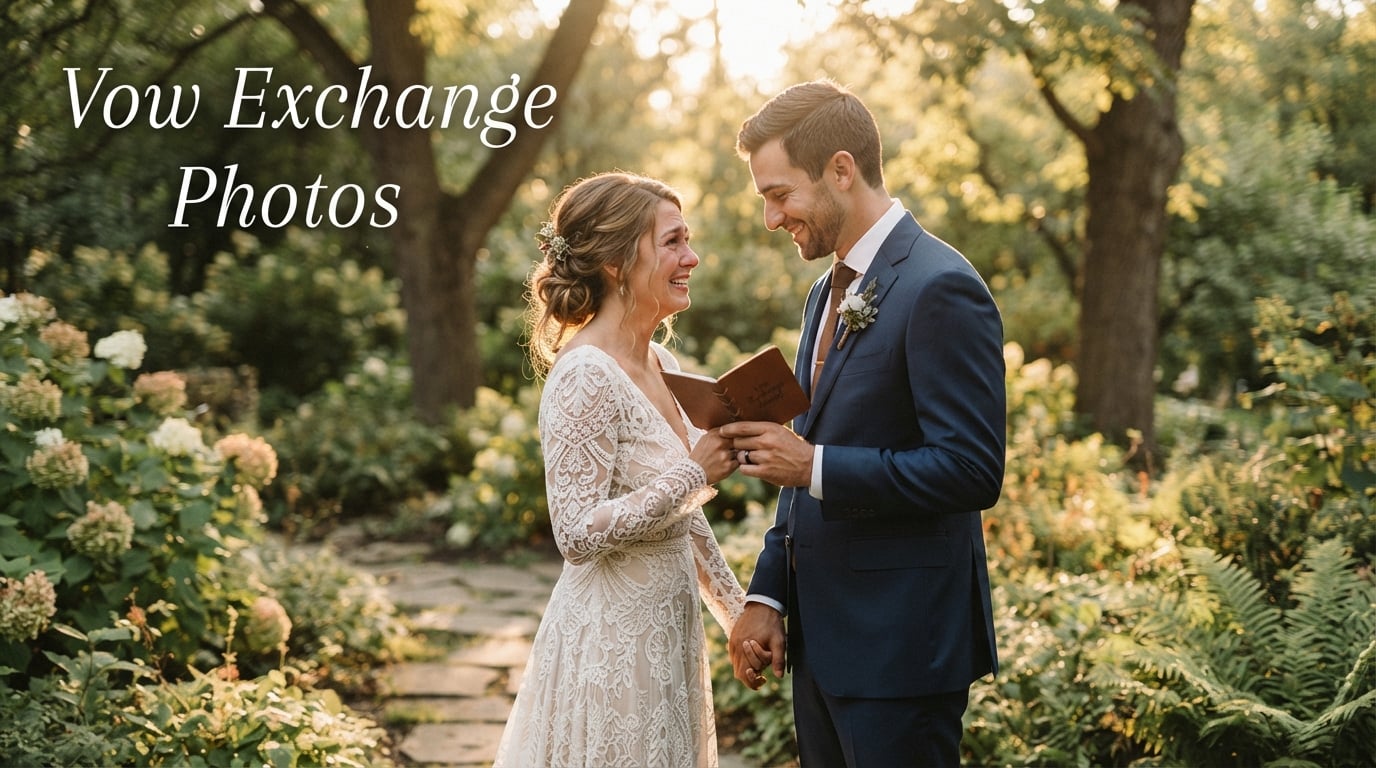
When couples ask me about the most powerful images from their wedding day, the answer is almost always the same. It is the moment their partner’s voice cracks mid-promise, the silent tears, the breath before the next sentence. Those moments live in what we call vow exchange photos, and capturing them well takes more than just pointing a camera at two people.
Whether you are a couple planning your 2026 wedding or a photographer refining your coverage, this guide walks through what vow exchange photos really are, why they matter, and how to make them unforgettable. We will cover the difference between private and public exchanges, the angles and camera positions that produce the strongest frames, the shot list I rely on, timing logistics, and the common mistakes that ruin otherwise beautiful moments.
By the end, you will know exactly what to ask for and what to deliver when those two people stand face to face and start speaking from the heart.
Table of Contents
What Are Vow Exchange Photos
Vow exchange photos are images that document the moment a couple reads their personal promises to each other during their wedding day. The moment can happen publicly as part of the formal ceremony or privately during a first look before guests arrive.
The defining feature is not the location, but the emotional content. These frames capture real reactions, silent pauses, a trembling hand holding a vow book, a tear wiped quickly before the next sentence. Unlike posed portraits, vow exchange photography is documentary at its core. The couple is not performing for the lens, so the photographer’s job is to anticipate and stay invisible.
Private Vow Exchange vs Public Vow Exchange
A private vow exchange happens between the couple alone, often paired with a first look. A photographer and sometimes an officiant are the only other people present. This setup tends to produce the most candid, emotional wedding vow exchange imagery because there is no audience to perform for.
A public vow exchange takes place during the formal ceremony with guests watching. The couple exchanging vows is still emotionally open, but the energy is different. Photographers must work around officiants, wedding parties, family members, and tighter movement restrictions.
Both styles produce powerful intimate vow exchange images when handled correctly. The difference is mostly in logistics, positioning, and the type of pressure each couple handles best.
Why Vow Exchange Photos Matter for Your Wedding Day
Of all the images a photographer delivers, vow exchange photos tend to become the ones couples revisit decades later. Here is why these frames earn that status and why they deserve dedicated attention from everyone involved.
They Preserve the Emotional Peak of the Day
The vows are the moment everything else on the wedding day is built toward. Every vendor, every decision, every dollar leads to those few minutes when two people make their promises. Documenting that peak with care gives couples a permanent record of the single most significant exchange of their relationship.
I have photographed couples who barely cried all day come undone the second their partner started speaking. Those honest reactions, the laugh that interrupts a tearful sentence, the deep breath before the hardest line, are the textures that make vow exchange photography irreplaceable.
They Relieve Public Pressure for Nervous Couples
Not every couple wants to cry in front of 150 guests. For couples anxious about showing emotion publicly, a private vows ceremony removes that pressure entirely. The couple can speak freely, pause without embarrassment, and hold each other without an audience judging the moment.
The photography from private exchanges often looks noticeably more relaxed for this reason. Shoulders drop, voices soften, and the couple stays connected to each other instead of the room.
They Create Heirloom-Style Images
Combined with heirloom vow books and handwritten notes, vow exchange photos become artifacts families pass down. The image of a grandmother reading her own words from a leather-bound book, paired with the photograph of her face as she spoke them, becomes part of a family’s story rather than just a wedding album page.
This is one reason I always encourage couples to invest in proper vow books. The book is a prop, but it is also a keepsake that ties the photo to a tangible object years later.
They Give Photographers Better Conditions to Work In
From a technical standpoint, private vow exchanges usually happen during the first look window. That means controlled lighting, predictable backgrounds, and the ability to move freely around the couple. Public ceremony exchanges, by contrast, are often backlit, shadowed by arches, or crowded by wedding parties.
The practical upside is that the most emotional wedding moments are also some of the easiest to light and compose when scheduled thoughtfully.
Key Photography Tips for Capturing the Vow Exchange
This is where most existing guides go silent. Photographers want specifics on angles, positions, and shot lists, and couples want to know what to request. Below are the techniques I rely on for both private and public vow exchanges.
Choose the Right Camera Angles
Three angles consistently produce the strongest vow exchange photography. The first is a wide shot from roughly 12 feet back that captures both partners in frame along with the setting, the light, and the moment’s atmosphere.
The second is a tight profile shot focused on the listening partner’s face. Their reaction matters as much as the speaker’s words, and the profile angle catches emotion without intruding on the couple’s eye contact.
The third is an over-the-shoulder frame shot from behind the speaker. This angle shows the listener’s face fully while placing the speaker in soft focus, which gives the image a sense of intimacy and point of view.
Position Yourself to Stay Invisible
During a private vows ceremony, move slowly and speak softly or not at all. The couple should forget you are there within the first minute. I use longer focal lengths, typically 85mm to 135mm, so I can stay back while still capturing tight detail.
During a public ceremony, identify two or three positions before the exchange begins and rotate through them quietly. Avoid crossing directly between the couple and their guests, and never step between the couple and the officiant during the actual promises.
The Must-Have Vow Exchange Shot List
Here are eight shots I make sure to capture during every vow exchange, whether private or public:
1. Wide establishing shot showing both partners, the setting, and the emotional tone of the moment.
2. Tight profile of the listening partner as the speaker delivers their hardest line.
3. Speaker’s face mid-sentence capturing their expression, their lips moving, and the emotion of the words.
4. Hands holding vow books with visible handwritten text or trembling fingers.
5. Over-the-shoulder frame from behind the speaker toward the listener.
6. Ring exchange moment when hands meet for the rings, if that is part of the ceremony flow.
7. First reaction after vows are complete, often a kiss, a hug, or a shared laugh of relief.
8. Detail shot of the vow book after the exchange, possibly with a tear stain or pressed flower nearby.
Coordinate With the Officiant Beforehand
This is a step photographers and couples often skip, and it costs them. A 30-second conversation with the officiant before the ceremony prevents missed moments and awkward positioning.
Ask the officiant where they will stand, whether they will hold the microphone close to the couple’s faces, and how they cue the ring exchange. Knowing their blocking lets you pre-position your cameras so you never have to scramble during the most important minutes of the day.
For private vow exchanges, ask whether the officiant needs to be present at all. Some couples exchange private promises with only the photographer in the room and then repeat shorter public vows during the formal ceremony.
Manage Lighting Without Disrupting the Moment
For private first look vows, schedule the exchange during soft, directional light. Mid-morning or late afternoon tends to flatter skin tones and avoid harsh shadows under the eyes. Avoid direct overhead sun, which forces couples to squint during a moment meant to be intimate.
For indoor or evening ceremonies, use off-camera flash positioned at a flattering angle rather than harsh on-camera lighting. If flash is not permitted, push your ISO and shoot wide open so the natural emotional content carries the frame even with imperfect exposure.
Move Quietly and Predictably
Sudden movements, fast lens changes, and loud shutters all pull couples out of the moment. Use silent shutter mode if your camera supports it, preset your exposure so you are not chimping between frames, and time your position changes to natural pauses in the reading.
The goal is to capture the vows, not interrupt them. Couples who feel observed start performing, and performance kills the emotional authenticity that makes these images powerful in the first place.
Timing and Logistics for the Vow Exchange Moment
Getting the timing right is half the work. Below is how I sequence vow exchanges into a wedding day, whether the couple chooses private, public, or both.
Pair Private Vows With the First Look
The most common and efficient setup pairs private vows with the first look. Once the couple sees each other for the first time, they exchange their personal promises immediately, before portraits or family formals begin.
This works because the couple is already emotionally primed from the first look, the light is consistent, and the rest of the timeline is undisturbed. Photographers also benefit because they capture the most emotional wedding moments before the day’s chaos fully takes over.
Schedule With Buffer Time
Vows rarely run on a stopwatch. A reading that should take two minutes often stretches to four once tears and pauses enter the picture. Build in at least 10 minutes of buffer around any scheduled vow exchange so couples are not rushed and photographers have room to work.
If the couple is reading in front of guests during the formal ceremony, share the timeline with the officiant and confirm the cue for the ring exchange so photographers can pre-position.
Who Goes First in a Vow Exchange
There is no rule about who reads first. Tradition often places the partner being walked down the aisle second, but modern couples decide based on who feels most comfortable going first. Some couples alternate sentences. Others write one shared vow and read it together.
If you are unsure, the simplest approach is to let whoever wrote their vows first read first. For couples reading repeat-after-me vows, the officiant leads and the order matters less.
Private Vows vs Public Vows at a Glance
Private vows work best for couples who want emotional authenticity, flexibility in timing, and intimate photography without audience pressure. They pair naturally with a first look and produce some of the most candid frames of the entire day.
Public vows work best for couples who want the shared energy of their community and the traditional ceremony structure. They require more photographer preparation but still produce powerful images when timed and positioned well.
Many couples in 2026 choose both: a private exchange for the real, raw promises and a shorter public reading during the ceremony. This gives them the best of both formats and the strongest collection of vow exchange photos overall.
Common Mistakes to Avoid
A handful of avoidable errors quietly ruin vow exchange photography. The first is skipping a vow rehearsal. Couples who never read their words aloud tend to stumble, rush, or freeze. A single read-through the night before smooths delivery and lets emotions land naturally.
The second mistake is writing vows that are too long. Anything over three minutes becomes exhausting for both the reader and the listener. Aim for one to two minutes per partner, which gives photographers enough time to capture variety without the moment dragging.
The third mistake is positioning the couple facing the sun or directly under harsh light. Even the most heartfelt words cannot rescue photoshoot images ruined by squinting faces and blown highlights.
The fourth is forgetting about the vow book as a prop. Holding a loose sheet of paper creates shaking hands and visual clutter. A bound vow book anchors the hands and becomes a keepsake.
Frequently Asked Questions
Who goes first in vow exchange?
There is no fixed rule about who goes first. Tradition often has the partner walked down the aisle read second, but modern couples usually decide based on comfort. Whoever feels ready can go first, or the couple can alternate lines. For repeat-after-me vows, the officiant leads and the order matters less.
What are the 7 traditional vows?
The seven traditional wedding vows come from the Book of Common Prayer and reference pledging to have and to hold, to love and to comfort, to honor and keep, in sickness and in health, for richer or for poorer, forsaking all others, and being faithful until death. Modern couples often rewrite these in personal language while keeping the same themes of loyalty, care, and permanence.
Is 2.5 minutes too long for vows?
Two and a half minutes is on the longer side but not excessive if the content is genuine and well-paced. Most couples aim for one to two minutes per partner. Anything over three minutes tends to feel stretched and can lose the listener’s focus during the exchange.
Do you exchange rings during vows?
Rings are typically exchanged right after the vow reading, not during it. The officiant cues the ring exchange once the verbal promises are complete. Photographers should confirm this cue in advance so they can reposition for the moment hands meet without missing the transition.
Final Thoughts on Capturing Your Vow Exchange
Vow exchange photos are the emotional anchor of any wedding gallery. Done well, they preserve the moment two people actually became married, not just the party that followed. Done poorly, they become distant, stiff frames that miss the words entirely.
The formula is straightforward. Decide between private and public exchange, rehearse the reading, coordinate with your photographer and officiant, and give the moment real space in your timeline. If you are working with a photographer in 2026, talk through these details well before the wedding day so everyone is prepared when the vows begin.