
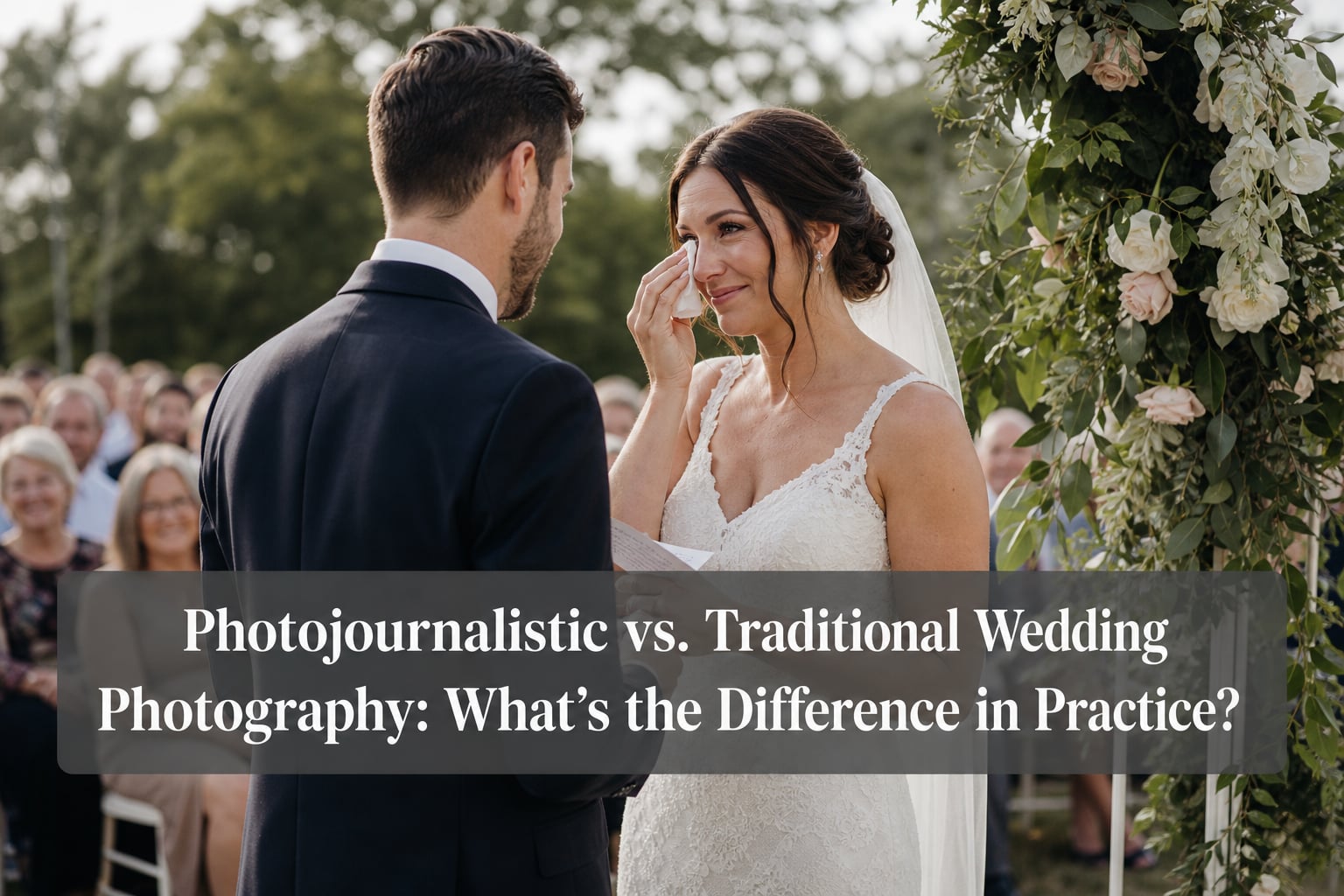
If you have been scrolling through wedding photography portfolios and feeling like everyone is speaking a different language, you are not alone. Couples tell us all the time that the terminology around photography styles feels designed to confuse rather than clarify. Photojournalistic, traditional, documentary, candid, editorial, fine art — the list goes on.
Here is the short version: photojournalistic wedding photography documents your day as it naturally unfolds without staging or directing, while traditional wedding photography uses posed, formal shots with specific compositions your photographer plans in advance. That distinction sounds simple on the surface, but it has real consequences for your timeline, your wedding album, and how you actually experience your wedding day.
In this guide, we will break down what photojournalistic vs traditional wedding photography really means in practice — not just in theory. We will cover the techniques behind each approach, what your wedding day timeline looks like under each style, and how to figure out which approach fits your personality and celebration.
Table of Contents
What Is Photojournalistic Wedding Photography?
Photojournalistic wedding photography is a storytelling-driven approach where the photographer documents your wedding day as it naturally happens, without directing, posing, or interfering with moments. The photographer acts as a fly on the wall, anticipating emotions and reactions before they occur and capturing them in real time.
This style traces its roots back to press and news photography. The term draws directly from the work of Henri Cartier-Bresson, the French photographer who pioneered the concept of the “decisive moment” — that split second when action, emotion, and composition align into a single frame that tells the entire story. Wedding photojournalism applies that same principle to your celebration, treating your day like a narrative that unfolds organically.
A photojournalistic wedding photographer does not carry a shot list of specific poses. Instead, they read the room, position themselves strategically, and wait for authentic emotions to surface. The tear in a father’s eye during a first look. The burst of laughter during a toast. The flower girl twirling in her own world during the ceremony. These are the moments this style lives for.
Key Characteristics of Photojournalistic Photography
Understanding what sets this approach apart helps you know exactly what to expect on your wedding day.
Hands-off approach: The photographer does not pose you, your bridal party, or your guests for the majority of the day.
Observational storytelling: Images are arranged to create a sequential narrative of your wedding day from start to finish.
Authentic emotions: Every smile, tear, and laugh is genuine because subjects are not aware of the camera.
Unposed naturalness: The photographer stays as invisible as possible, letting real moments happen without interference.
Anticipatory shooting: Rather than reacting after a moment happens, the photographer predicts when something is about to occur and is ready before it does.
This approach requires a specific skill set. A photojournalistic photographer needs patience, anticipation, and the ability to compose a compelling image in a fraction of a second. There is no opportunity to say “let me try that again” — the moment is either captured or it is gone forever.
What Is Traditional Wedding Photography?
Traditional wedding photography is a structured, posed approach where the photographer directs subjects through planned compositions and specific groupings. Think of the classic wedding portraits: the couple looking at each other in a formal pose, the full extended family lined up after the ceremony, the bridal party arranged symmetrically on the church steps.
This style has been the backbone of wedding photography for decades. Your parents’ and grandparents’ wedding albums were almost certainly shot this way. There is a reason for that staying power — traditional photography guarantees specific shots are captured, leaves nothing to chance, and produces clean, polished images that look beautiful framed on a wall.
A traditional wedding photographer typically works from a shot list. They know exactly which combinations of family members to photograph, which classic couple poses to use, and how to light each scene for maximum flattering results. The photographer takes charge during portrait sessions, positioning your hands, adjusting your dress, and directing where you look.
Key Characteristics of Traditional Photography
Traditional wedding photography brings a level of control and polish that many couples find reassuring.
Directed posing: The photographer actively positions subjects, adjusts posture, and guides expressions for the best results.
Comprehensive shot list: Every must-have photo is planned in advance, from the rings to the cake cutting to specific family groupings.
Formal family photos: Structured group portraits ensure no important family member is left out of the album.
Signature poses: The photographer brings proven posing techniques that reliably produce flattering, classic images.
Controlled lighting and composition: The photographer adjusts elements to guarantee each shot meets a technical standard.
One common misconception is that traditional photography means stiff or boring photos. A skilled traditional photographer can absolutely create beautiful, emotional portraits. The difference is that those emotions are guided rather than captured spontaneously.
Photojournalistic vs Traditional Wedding Photography: Side-by-Side Comparison
The fastest way to understand how these two wedding photography styles differ in practice is to compare them directly. Here is a breakdown of the core differences that affect what your final gallery looks like and how your wedding day flows.
| Aspect | Photojournalistic | Traditional |
|---|---|---|
| Approach | Observational, hands-off, storytelling-driven | Directed, posed, structured |
| Emotion Source | Spontaneous, authentic reactions | Guided and crafted by the photographer |
| Couple Experience | Minimal awareness of the camera; you live in the moment | More interaction with photographer during posed sessions |
| Timeline Impact | Less formal portrait time needed; runs alongside events | Requires dedicated blocks of time for posed sessions |
| Family Formals | Usually limited or skipped in pure photojournalism | Comprehensive, organized family group portraits |
| Risk Factor | Some moments may be missed; relies on anticipation | Lower risk; specific shots are guaranteed |
| Album Feel | Documentary narrative, chronological story | Gallery of polished portraits and key moments |
Timeline Implications: How Each Style Shapes Your Day
One of the most overlooked differences between photojournalistic and traditional wedding photography is how each approach affects your wedding day schedule. This matters more than most couples realize.
With a traditional photographer, you need to build dedicated portrait time into your timeline. Family formals alone can take 30 to 45 minutes depending on how many combinations you want. Couple portraits typically require another 30 to 60 minutes at a separate location or during golden hour. That means blocking off 1 to 2 hours where you and key family members are actively posing rather than celebrating.
A photojournalistic photographer works in parallel with your events. Since they are capturing moments as they happen, there is no need to pull you away from your cocktail hour for an hour of posed portraits. The trade-off is that you may want to carve out a shorter window — maybe 15 to 20 minutes — for a few couple portraits, since even the most documentary-focused couples usually want at least a handful of images of just the two of them.
This timeline difference is one reason the hybrid approach has become so popular. You get the storytelling coverage during the reception and ceremony, plus a focused portrait session that does not eat your entire afternoon.
Cost Considerations Between Styles
Cost is rarely discussed in comparisons of these two styles, but it is a real factor for couples working within a budget. Pure photojournalistic photographers tend to charge more for several reasons: the approach requires more experience, there are no reshoots, and the photographer must be constantly alert throughout the entire event rather than working in planned bursts.
Traditional photographers may offer more flexibility in pricing because their workflow is more predictable. They know exactly how many setups they need, how long each will take, and can package their services more efficiently. However, top-tier photographers in either style will command premium pricing based on experience and demand in your market.
The cost question is less about which style is more expensive and more about what you are paying for. With photojournalism, you are investing in anticipation and storytelling instinct. With traditional photography, you are investing in technical precision and guaranteed compositions. Both have value — it comes down to what matters most to you.
Candid vs Photojournalistic: Understanding the Nuance
One question that comes up constantly on wedding planning forums is whether candid and photojournalistic wedding photography are the same thing. They are related, but they are not interchangeable — and understanding the difference will make you a much more informed client.
Here is the key distinction: all photojournalistic wedding photography qualifies as candid, but not all candid wedding photography is photojournalistic. A photographer can capture candid moments — your guests laughing at the reception, kids running around the dance floor — without telling a coherent story with those images. The photos might be lovely individually, but they do not connect to form a narrative.
Photojournalistic photography takes candid images and elevates them through storytelling. A photojournalistic photographer thinks about how each shot relates to the next. They capture establishing shots, detail shots, action shots, and reaction shots that together build a sequential narrative. When you flip through the final gallery, it reads like a story with a beginning, middle, and end rather than a collection of nice moments.
Think of it this way: a candid photographer reacts to moments happening in front of them. A photojournalistic photographer anticipates those moments, positions themselves for the best angle, and frames the shot with the overall story in mind. Both can produce beautiful images, but the photojournalistic approach results in a more cohesive wedding album.
The Hybrid Approach: What Most Photographers Actually Do
Here is something most comparison guides will not tell you: the majority of professional wedding photographers today do not practice pure photojournalism or pure traditional photography. They use a hybrid approach that blends both styles, and that is actually what most couples want.
This is where the 80-20 rule in photography comes into play. Many photographers describe their style as roughly 80 percent documentary or photojournalistic coverage during the events that naturally unfold — the ceremony, the reception, getting ready — combined with about 20 percent directed time for couple portraits and family formals. This ratio gives you the best of both worlds: authentic storytelling for the bulk of your day, plus the structured portraits that families expect.
Some photographers flip that ratio. They might describe themselves as primarily traditional but with a documentary flair, meaning they spend more time on posed portraits and formal setups while also grabbing candid moments between directed sessions. The specific blend varies from photographer to photographer.
This is why reviewing full wedding galleries matters so much more than browsing highlight reels on social media. A photographer’s Instagram might showcase their best photojournalistic moments, but their actual wedding day coverage could be heavily traditional. When couples on wedding planning forums talk about confusion over terminology, this is often the root cause — the marketing does not match the actual delivery.
What a Hybrid Wedding Day Looks Like in Practice
Picture a typical wedding day with a hybrid photographer. During the morning, the photographer quietly documents hair and makeup, captures the dress hanging in the window, and shoots detail shots of rings and invitations. These are observational, storytelling images.
Then comes a 20-minute couple portrait session — directed, posed, with the photographer guiding your positioning and expression. After that, a structured 30-minute family formal session where the photographer calls up each family combination from a pre-planned list. This is the traditional portion.
From the ceremony through the reception, the photographer shifts back to photojournalistic mode. They capture the processional, the vows, the first kiss, the toasts, and the dancing without directing anyone. The final gallery tells the complete story of your day with both authentic moments and polished portraits.
This blend is what most of our couples at Kingdom Wedding Photography respond to best. It delivers the emotional authenticity of photojournalism while ensuring that the family photographs — the ones parents and grandparents actually frame — are properly composed and guaranteed.
How to Choose: A Practical Decision Framework
Choosing between photojournalistic or traditional wedding photography is not about which style is objectively better. It is about which style matches your personality, your wedding vision, and how you want to experience your day. Here is a practical framework to help you decide.
Choose Photojournalistic If You…
Feel awkward when posed and prefer natural interactions over directed moments
Want to experience your wedding day without feeling like you are constantly performing for a camera
Value storytelling and emotional authenticity over technical perfection
Are planning a smaller, more intimate celebration where candid interactions are the highlight
Trust your photographer’s judgment and are comfortable not knowing exactly which shots they will capture
Photojournalistic photography is ideal for relaxed couples who want to look back at their wedding album and feel the real emotions of the day rather than see a series of posed portraits. If the idea of being directed through poses makes you uncomfortable, this is your style.
Choose Traditional If You…
Want guaranteed family portraits and specific must-have shots checked off a list
Appreciate classic, polished images with controlled lighting and composition
Have a large extended family and need organized group photos to ensure everyone is included
Are planning a formal wedding where traditional portraiture matches the overall aesthetic
Prefer knowing exactly what you will get and want to minimize the risk of missed moments
Traditional photography gives you peace of mind. You know your family formals will be comprehensive, your portraits will be flattering, and no important shot will be left to chance. For couples with large families or formal celebrations, this structure is reassuring.
Questions to Ask Your Photographer
Once you have a sense of which direction you lean, the next step is confirming that a photographer’s actual style matches what you want. These questions cut through marketing language and get to the truth.
“What percentage of your typical wedding gallery is posed versus candid?”
“Can I see a full wedding gallery from start to finish, not just highlights?”
“How much time do you need for family formals, and how do you organize them?”
“During the ceremony and reception, do you direct moments or document what happens?”
“What happens if a key moment does not occur naturally — do you recreate it?”
“How would you describe your editing style — is it consistent across the full gallery?”
A photographer’s answers to these questions will tell you far more than the labels they use on their website. If a photographer who calls themselves photojournalistic says they recreate moments that did not happen naturally, that is a traditional approach dressed in documentary language. Listen for alignment between what they say and what their full galleries show.
The Personality Factor
We have found that the photography style you respond to often mirrors your personality. Couples who describe themselves as easygoing, spontaneous, and uncomfortable in the spotlight tend to love photojournalistic photography. The camera stays out of their way, and they get images that reflect how the day actually felt.
Couples who appreciate structure, want things done a certain way, and enjoy being the center of attention during planned moments often gravitate toward traditional photography. They like knowing what is happening next and having a photographer who takes charge to deliver specific results.
Neither personality type is better than the other. The goal is self-awareness — understanding which approach will make you feel most comfortable and most satisfied with your photos years from now.
FAQs
What is photojournalistic wedding photography?
Photojournalistic wedding photography is a documentary-style approach where the photographer captures events as they naturally unfold, without posing, directing, or interfering. The photographer acts as an observer, anticipating genuine moments and emotions to tell the story of your wedding day through authentic, unposed images.
What are the 7 C’s of photojournalism?
The 7 C’s of photojournalism are the core principles that define the craft: 1) Closeness, getting physically and emotionally near the subject, 2) Context, providing setting and background information, 3) Compassion, showing empathy for subjects and their experiences, 4) Courage, being present in difficult or emotional moments, 5) Composition, framing images with technical skill even under pressure, 6) Credibility, capturing real moments without manipulation or staging, and 7) Clarity, ensuring each image communicates a clear story. These principles guide wedding photojournalists in documenting authentic moments.
What is the best wedding photography style?
There is no single best wedding photography style — the right choice depends on your personality and vision. Photojournalistic photography suits couples who want authentic, candid storytelling and minimal posing. Traditional photography works better for couples who want guaranteed formal portraits and organized family photos. Most couples benefit from a hybrid approach that blends both styles, typically 80 percent documentary coverage with 20 percent posed portraits.
What is the 80 20 rule in photography?
The 80-20 rule in wedding photography refers to a common hybrid approach where approximately 80 percent of the coverage is documentary or photojournalistic (capturing events as they unfold naturally) and 20 percent is directed (posed couple portraits and formal family photos). This ratio gives couples authentic storytelling images alongside the structured portraits that families expect.
What is the difference between candid and photojournalistic wedding photography?
All photojournalistic wedding photography is candid, but not all candid wedding photography is photojournalistic. Candid photography captures unposed moments as they happen. Photojournalistic photography takes those candid images and organizes them into a cohesive, sequential narrative that tells the complete story of your wedding day. The key difference is storytelling — a photojournalistic photographer thinks about how each image connects to the next to build a narrative arc.
Making Your Decision With Confidence
Understanding photojournalistic vs traditional wedding photography comes down to one question: do you want your photos to tell the story of what your day felt like, or do you want them to show what your day looked like in its most polished form? Both are valid, and most couples want a thoughtful combination of both.
Now that you know how each approach works in practice — the timeline implications, the candid versus photojournalistic distinction, and what the hybrid approach actually delivers — you are equipped to review photographer portfolios with a critical eye. Ask for full galleries. Listen for alignment between how photographers describe their work and what their images actually show. The right photographer for your wedding is the one whose approach matches how you want to remember your day.