
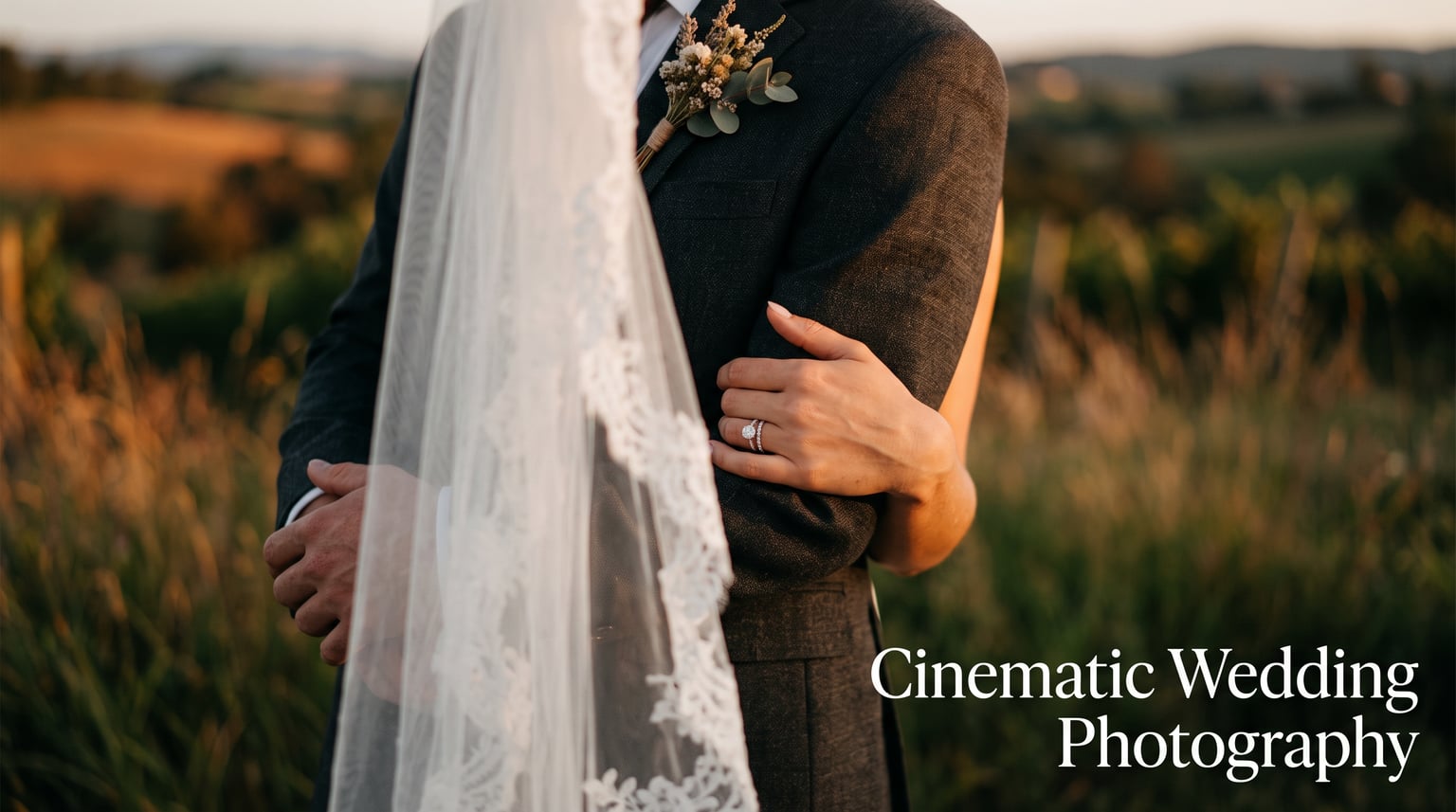
When I shoot a wedding cinematically, I’m not chasing pretty backgrounds. I’m chasing feeling. Cinematic wedding photography borrows the visual language of film and applies it to your day, so every image feels like a frame from a movie about the two of you.
In this guide, I will walk you through exactly what cinematic wedding photography means, how it compares to documentary and editorial styles, the lighting and composition techniques behind the look, and how to prepare so your gallery feels timeless rather than trendy. Whether you are choosing a photographer or just curious about the style, by the end you will know how to spot it and how to plan for it.
Table of Contents
What Is Cinematic Wedding Photography
Cinematic wedding photography is a style inspired by motion picture cinematography that uses dramatic light, intentional composition, and narrative sequencing to turn a wedding day into a visual story. Instead of documenting each moment as a standalone photo, a cinematic photographer treats the day like a film, weaving together wide establishing shots, intimate close-ups, and quiet in-between moments.
The goal is emotional resonance. A cinematic photograph should make you feel something, the way a single frame from a great movie can pull you back into a scene. That feeling usually comes from a few specific ingredients working together:
- Dramatic or natural light that sculpts the subjects with shadow
- Composition borrowed from cinema, like leading lines, negative space, and layered foregrounds
- Color grading that mimics film stock rather than neutral digital output
- Storytelling sequencing where the gallery reads like chapters
- Candid, unposed moments captured with intention rather than orchestrated poses
Couples who choose cinematic wedding photography usually want timeless, emotionally honest images. They are less interested in dozens of smiling group shots and more interested in the quiet, fleeting moments that actually defined their day.
How Cinematic Differs From Traditional and Documentary Styles
The terms cinematic, traditional, and documentary get thrown around interchangeably, but they are distinct approaches. Understanding the differences helps you choose the right fit for your personality and priorities.
Traditional Wedding Photography
Traditional photography is the classic wedding style most of us grew up seeing. The photographer directs poses, lines up family groupings, and ensures every key person is captured smiling at the camera. Lighting is usually even and bright, with little drama. The aim is comprehensive coverage that satisfies family expectations.
Documentary Wedding Photography
Documentary photography takes a hands-off, photojournalistic approach. The photographer works like a quiet observer, capturing what happens without staging anything. The result is honest and candid, but it can sometimes feel visually flat because the focus is on reportage rather than aesthetics.
Cinematic Wedding Photography
Cinematic photography borrows the honesty of documentary work but adds intentional artistry. The photographer still seeks candid moments, but uses composition, light, and color grading to elevate each frame. It is a hybrid approach, documentary at heart, but treated with the visual care of a film still.
Here is a quick comparison:
- Traditional: posed, comprehensive, family-friendly, evenly lit
- Documentary: candid, hands-off, authentic, photojournalistic
- Cinematic: candid but composed, moody, narrative, film-inspired
If you want both real moments and beautiful frames, cinematic is usually the sweet spot.
Key Lighting Techniques Behind the Cinematic Look
Light is the single biggest factor that separates cinematic wedding photography from everything else. A cinematic photographer treats light as the subject, not just an illumination tool. These are the techniques that show up most often in our galleries.
Chiaroscuro Lighting
Chiaroscuro is the dramatic interplay between deep shadow and bright highlight, the same technique painters like Caravaggio and cinematographers like Roger Deakins use. On a wedding day, it means letting shadows fall across part of the frame and allowing one side of a face or body to catch the light. The result feels three-dimensional and painterly rather than flat.
Golden Hour and Side Light
Most cinematic wedding portraits are shot within an hour of sunset, when the light is warm, low, and directional. Side light rakes across faces and textures, creating depth. We plan our couple portraits and many of the bridal party shots around this window because it does the heavy lifting for us.
Natural Window Light
Indoor cinematic portraits depend on window light. A subject placed near a window with the light coming from the side or back gives a soft, directional glow that flatters skin and creates atmosphere. Even on overcast days, the diffused light through a large window can feel like a film set if you know how to position for it.
Candlelight and Practical Sources
Reception venues often have candles, fairy lights, or string bulbs. A cinematic photographer embraces these practical light sources instead of fighting them with flash. A couple dancing under warm Edison bulbs looks infinitely better than a couple blasted with on-camera flash.
Negative Fill
This one is more advanced, but worth knowing. When the ambient light is too flat, a photographer can hold up a black flag or use shadow on the side opposite the light source to deepen contrast. Negative fill is how we add drama to bright midday situations that would otherwise look ordinary.
Composition Principles Borrowed From Cinema
Cinematographers spend entire careers studying composition. As wedding photographers, we borrow their lessons and apply them in the chaos of a wedding day. These are the principles that show up most often in a cinematic gallery.
Leading Lines
Leading lines guide the viewer’s eye toward the subject. A hallway, a row of trees, the aisle of a church, the edge of a table, all of these can be used to lead the eye toward your couple. A cinematic image often has a strong line that pulls you in.
Negative Space
Negative space is the empty area around your subject. Leaving room for sky, shadow, or a quiet wall lets your subject breathe and emphasizes the emotion of the moment. Crowded frames feel busy; spacious frames feel cinematic.
Depth and Layering
Cinema loves layering, where the foreground, midground, and background each carry visual information. In wedding photography, that might mean a veil in the foreground, the couple in the middle, and a landscape behind them. Layering adds depth and makes a two-dimensional photo feel like a window into a three-dimensional world.
Wide and Tight Coverage
Every great film cuts between wide shots that establish place and tight shots that reveal emotion. A cinematic wedding gallery does the same. You will see wide environmental shots that set the scene, medium shots that capture interactions, and tight detail shots that focus on hands, rings, glances, and tears.
Intentional Framing
Doorways, arches, branches, and windows all become natural frames within the frame. A cinematic photographer looks for these structures and uses them to isolate the subject. Framing adds focus and a sense of place at the same time.
Equipment and Camera Settings for Cinematic Shots
Equipment does not make the photographer, but the right tools make cinematic results much easier to achieve consistently.
Prime Lenses
Most of our cinematic work is shot on fast prime lenses like 35mm, 50mm, and 85mm. These lenses render beautifully out of focus, with smooth bokeh and sharp subject separation. They also force the photographer to move and compose, which mirrors the discipline of a cinematographer.
Shallow Depth of Field
Cinema almost always shoots with a shallow depth of field to separate subjects from their surroundings. We aim for wide apertures, often f/1.4 to f/2.8, especially for portraits and detail shots. A tack-sharp background makes a photo look like a snapshot; a soft background makes it look like cinema.
Full Frame Sensors
Full frame sensors handle low light better, give us more dynamic range for moody grading, and produce the kind of shallow depth of field we want for cinematic portraits. While not strictly required, they are the standard for serious cinematic work.
Film Cameras
Some photographers shoot weddings entirely on analog film. Film grain, color rendition, and the slower pace of shooting all contribute to a cinematic look that is difficult to replicate digitally. If you love film, ask your photographer if they offer hybrid or all-film coverage.
Post-Processing and Color Grading the Cinematic Way
A cinematic photograph is not finished in camera. Post-processing is where the look is locked in. This is the part most couples never see, but it is half the work.
Color Grading Over Correction
Traditional editing tries to make colors accurate and neutral. Cinematic editing tries to make colors feel intentional. We shift hues, deepen shadows, lift blacks, and introduce a consistent palette across the whole gallery. The result feels cohesive, like a film with one color grade running through every scene.
Film Emulation
Many cinematic photographers emulate the look of specific film stocks, like Kodak Portra 400 for warm, natural skin tones, or Cinestill 800T for moody tungsten-lit scenes. Even when shooting digital, emulating film gives the gallery a timeless quality that pure digital output often lacks.
Adding Grain
Film grain is one of the most recognizable cinematic elements. A subtle grain layer added in editing mimics the texture of analog film and breaks up the digital cleanness that can otherwise feel sterile. The grain should be present but never distracting.
Moody Tones
Cinematic grading leans moody. Highlights might be pulled down, shadows might be deepened, and saturation might be reduced in favor of richer tones. The goal is not to look dark, but to look intentional, as if every frame was color-graded by a film colorist.
Consistency Across the Gallery
The most overlooked part of cinematic editing is consistency. Every image in the gallery should feel like it came from the same film. That means consistent white balance, consistent contrast, and consistent color decisions across hundreds of photos. It is painstaking work, and it is what separates a true cinematic style from a quick preset slapped on a few favorites.
How to Prepare for Cinematic Wedding Photos
Couples play a much bigger role in cinematic results than they realize. The photographer brings craft and vision, but the day itself is your canvas. Here is how to prepare so the gallery tells the story you actually want.
Communicate Your Vision Early
Share reference images, film stills, and mood boards with your photographer before the wedding. If you love the look of a specific movie, show it. The clearer your vision, the more your photographer can plan lighting, locations, and timing to match.
Plan Time for Light
Light is everything. Make sure your timeline includes a window for portraits during golden hour, even if it means stepping away from the reception for 20 minutes. The best cinematic portraits come from light that exists only at specific times, and once it is gone, it is gone.
Choose Venues With Atmosphere
Cinematic photography thrives in venues with texture, mood, and natural light. A ballroom with fluorescent lighting will fight your photographer. A chapel with stained glass, a barn with warm wood, a garden with mature trees, these all give the photographer something to work with.
Trust the Process
Cinematic photography requires more time, more stillness, and more trust than traditional photography. Be willing to slow down, sit with your partner, and let moments happen naturally. The best cinematic shots come from quiet presence, not constant posing.
Embrace Real Moments
If you tend to feel awkward in front of a camera, cinematic photography is actually your friend. The style leans into candid interactions rather than stiff poses. Talk to each other, walk together, dance, ignore the camera. Your photographer will capture the real thing.
Build in Buffer Time
Unlike documentary photography, which thrives on fast-paced chaos, cinematic photography needs pockets of calm. Build buffer time into your schedule so your photographer can find angles, set up compositions, and wait for the right light. Rushed timelines produce rushed images.
Famous Film Influences on Cinematic Wedding Photography
Every cinematic photographer has a list of films and filmmakers who shaped their eye. Here are the references that show up most often in our work and across the industry.
Roger Deakins
Roger Deakins is the cinematographer behind films like Skyfall, Blade Runner 2049, and No Country for Old Men. His use of single-source light, deep shadows, and bold color palettes has influenced a generation of wedding photographers. If you love those films, you will love a cinematic wedding gallery.
Wong Kar-wai
Wong Kar-wai, director of In the Mood for Love and Chungking Express, is known for saturated color, slow motion, and a romantic, dreamlike quality. Photographers influenced by him lean into bold color grading and intimate, emotionally charged framing.
Emmanuel Lubezki
Lubezki shot The Revenant, Gravity, and Children of Men almost entirely with natural light and long takes. His work inspires photographers to use available light creatively and to look for natural, flowing moments rather than staged scenes.
Classic Hollywood Lighting
Old Hollywood lighting, with its soft key light, careful shadow placement, and sculpted faces, is another major influence. The portraits from that era feel timeless because the lighting was designed by artists who understood how to flatter form with light.
When you hire a cinematic wedding photographer, ask them which films inspire their work. Their answer will tell you a lot about how your gallery will look and feel.
Frequently Asked Questions About Cinematic Wedding Photography
What is cinematic wedding photography?
Cinematic wedding photography is a style inspired by motion picture cinematography that uses dramatic lighting, intentional composition, and narrative sequencing to turn a wedding day into a visual story. It combines the honesty of documentary photography with the visual care of film, producing images that feel like stills from a movie about the couple.
How is cinematic photography different from documentary?
Documentary photography focuses on candid photojournalism with little attention to aesthetic choices. Cinematic photography keeps the documentary heart but adds intentional lighting, composition, and color grading. The result is honest and authentic, but treated with the visual polish of a film still rather than a news photo.
What lighting techniques create the cinematic look?
The cinematic look comes from chiaroscuro lighting, golden hour side light, natural window light, candlelight, and intentional use of negative fill. These techniques create depth, mood, and contrast rather than the flat, even lighting of traditional wedding photography. The goal is to sculpt subjects with light, not just illuminate them.
How do I prepare for cinematic wedding photos?
Share reference images and mood boards with your photographer early, plan golden hour portrait time into your timeline, choose venues with atmosphere and natural light, build in buffer time for slow compositions, and trust the photographer to capture real moments rather than staging every shot. Preparation matters as much as the photographer’s skill.
Final Thoughts on Cinematic Wedding Photography
Cinematic wedding photography is more than a filter or a preset. It is a way of seeing your day that prioritizes feeling over formality, story over snapshot. The right photographer will use light, composition, and color grading to create a gallery that still moves you years from now.
If you are planning a 2026 wedding and want images that feel timeless and true, start by looking for a photographer whose portfolio already looks like a film. Talk about vision, timeline, and venues early. The rest will follow naturally.