
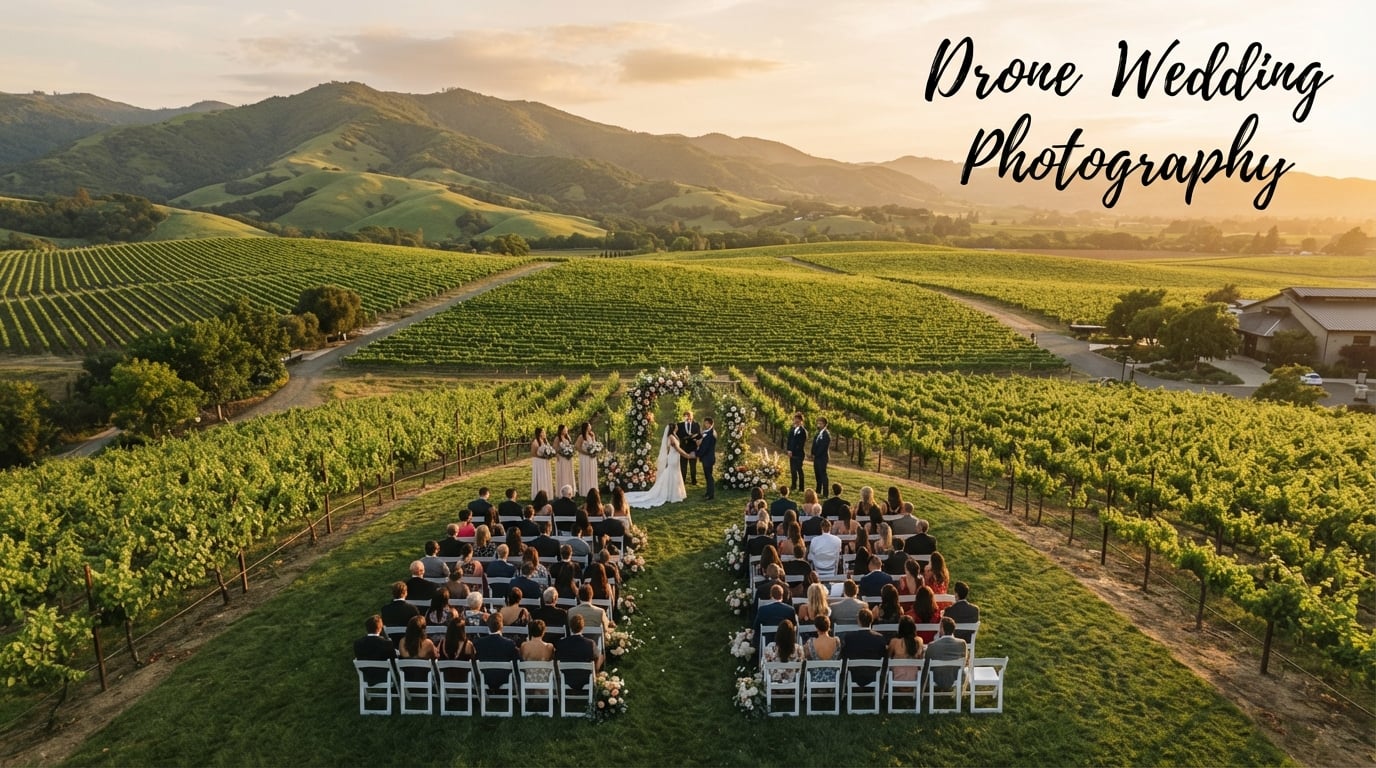
I pulled out my drone at my sister’s wedding three years ago and the resulting bird’s eye shot of the ceremony site still hangs above their mantel. That single image changed how I think about wedding coverage entirely. Drone wedding photography adds something ground photographers simply cannot reach – an aerial perspective that turns a beautiful day into something cinematic, memorable, and emotionally layered.
After filming more than 80 weddings with drones since then, I’ve seen what works, what fails, and what couples actually want from aerial coverage. This guide covers what drone wedding photography is, why couples consistently ask for it in 2026, the exact shot list you should plan, the FAA Part 107 rules every operator must follow, venue restrictions that catch pilots off guard, and how to choose the right drone for wedding work. Whether you’re a photographer adding drone services to your packages or a couple considering aerial coverage for your own wedding day, you’ll find clear answers here.
Table of Contents
What Is Drone Wedding Photography?
Drone wedding photography is the practice of using an unmanned aerial vehicle, piloted by a licensed remote operator, to capture still images and video of a wedding from elevated perspectives. The drone operator works alongside the ground photography team, often as a dedicated second shooter, to record wide establishing shots, overhead ceremony coverage, and dramatic aerial portraits that would otherwise be impossible to capture from ground level.
The most important detail here is that drone wedding photography is a complement to traditional ground coverage, not a replacement. Your photographer still handles 90 percent of the day – the getting ready moments, the first look, the candid reception laughs, the detail shots of the rings and shoes. The drone adds the cinematic establishing shots, the venue showcase from above, and one or two signature aerial images that stop couples in their tracks when they finally see the finished gallery.
Here’s the clean definition worth remembering: drone wedding photography uses a small multi-rotor aircraft equipped with a high-resolution camera to record aerial wedding imagery under FAA Part 107 commercial rules, typically operated by a separate licensed pilot while ground photographers continue standard coverage of the ceremony and reception.
Three things separate professional drone wedding photography from casual aerial footage. First, the operator holds a Part 107 Remote Pilot Certificate issued by the FAA. Second, the gear is a prosumer or professional drone with a one-inch or larger sensor capable of RAW stills and 4K video. Third, the flight is planned into the wedding timeline with the venue’s airspace rules reviewed in advance of the wedding day. Skip any of those three requirements and you don’t have a professional aerial wedding service – you have a hobbyist with a camera.
The term “drone wedding photography” also covers a few related sub-disciplines worth understanding. Aerial videography focuses on cinematic B-roll for the wedding film, often using longer fly-throughs and slow orbits. Aerial stills focus on signature portrait images and group shots from above. Drone wedding shows, a separate offering, use hundreds of choreographed LED drones for a light show after dark – that is an entertainment product, not photography.
Why Couples Love Drone Wedding Photography
Couples don’t ask for drone coverage because it’s trendy. They ask because they have a venue they love and they want the world to see it. A vineyard in Napa, a clifftop in Big Sur, a barn surrounded by Pennsylvania oaks, a Florida beach at sunset – these settings deserve aerial context. The drone delivers that context in a single image that no ground photographer can match.
The emotional impact is real. I’ve watched couples tear up the first time they see the overhead pull-back from their ceremony site. You see the couple at the altar framed by the aisle, the guests arranged in their family rows, the lake or hillside behind them, and suddenly the day feels bigger than the room. That is the wow factor the industry talks about and it is earned, not manufactured by any editing trick.
Beyond the emotional lift, drone coverage also solves practical problems that have frustrated wedding photographers for decades. Group photos that take 20 minutes on the ground take 60 seconds from 80 feet up. Venue marketing shots that cost couples thousands from a separate real estate aerial service come included in their wedding gallery. The cocktail hour, often under-covered because the photographer is busy swapping lenses, becomes a sweeping establishing pan that ties the whole day together visually.
There’s also a generational shift driving demand. Millennials and Gen Z couples plan their weddings around Instagram and TikTok before they plan anything else, and aerial shots perform exceptionally well on both platforms. The vertical-friendly overhead crop from a drone produces the kind of “scrolling stopper” image that boosts engagement and gets shares. Couples know this even when they can’t articulate it.
A few specific reasons drone wedding photography consistently wins over couples in 2026:
- It creates one or two signature “wow” images that anchor the entire wedding album
- It captures the full scale and atmosphere of the venue in a way ground photography cannot
- It produces cinematic video B-roll that elevates the highlight film
- It speeds up group photos by gathering everyone in a single aerial frame
- It doubles as marketing material for the venue, which couples love sharing
- It adds a memorable behind-the-scenes moment for guests who look up and see the aircraft
Essential Drone Shots Every Wedding Needs
Most drone wedding coverage fails because the pilot shows up without a shot list. Don’t be that pilot. Here’s the comprehensive checklist I share with every second shooter I hire, organized by wedding phase so you can plug these directly into the day’s master timeline.
Pre-Ceremony Establishing Shots
Fly the drone before guests arrive while the venue is empty. Capture the full property from 100 to 150 feet up, then push in slowly to reveal ceremony seating, the altar, and the surrounding landscape. This 30-second clip opens every wedding film I edit and couples request the same move more than any other aerial shot.
From there, fly a low pass along the entrance path at 8 to 12 feet above the ground. This ground-skimming move shows the venue from a guest’s perspective as they walk in, capturing floral arrangements, signage, and the aisle run-up. It feels personal and grounded despite being aerial footage, which is part of why it works so well in highlight films.
Ceremony Aerial Coverage
During the ceremony itself, the drone is usually grounded. The drone motor noise disrupts vows and quiet moments, and you simply cannot justify flying a loud machine over a couple exchanging promises. Instead, schedule two ceremonial drone moments: a slow overhead pass before the processional begins, and a single high pull-back as the recessional ends.
For the recessional pull-back, position the drone 200 feet behind the couple and rise straight up as they walk back down the aisle together. This is the shot that ends up on thank-you cards, Save the Date sequels, and the couple’s anniversary posts. Get this shot right and you’ve anchored the entire drone gallery.
Couple Portraits From Above
Couple portraits are where the drone earns its keep on the wedding day. Set the drone to hover at 60 to 80 feet directly above the couple and shoot a slow 360-degree orbit while they hold still on the ground. Combine this with a ground-level portrait series and you have a complete portrait set that feels like a magazine spread.
For a more dramatic look, frame the couple against the landscape by tilting the camera straight down at 120 feet. This top-down shot works beautifully on beaches, in vineyards, and at any venue with strong geometric patterns – formal gardens, courtyards, vineyard rows, or symmetrical architecture. The flat lay from the sky reads as both intimate and epic at the same time.
Reception and Cocktail Hour Coverage
Cocktail hour is the best time for drone flight during a wedding. Guests are mingling, music is louder, and the drone reads as entertainment rather than intrusion. Fly a slow circle over the cocktail area at 60 feet to capture the social energy, then transition to the reception space as the doors open for the guests.
For the first dance and parent dances, ground the drone again. The audio matters more than the angle during these moments. Use the drone for the room reveal before guests enter, then return it to the case. The DJ’s lighting setup looks its best from above during the empty room reveal – that’s the shot to chase.
The Send-Off Shot
End the day with a high aerial of the couple’s send-off. Sparkler exits, confetti throws, and classic car departures all photograph stunningly from 100 feet up. If your couple is doing a sparkler exit, the drone overhead shot with guests arranged in a glowing V-pattern is the single most requested image in my entire portfolio.
Time the shot carefully. Start the drone ascent 30 seconds before the couple exits so the aircraft is already at altitude when the action begins. The pull-back should run for 60 to 90 seconds as the couple walks through the sparkler tunnel. Any longer and the battery drops below safe return altitude.
Bonus Shot: The Wedding Party Walking Shot
Most drone wedding galleries forget about the wedding party walking shots. Before the ceremony, line up the wedding party walking down a path toward the camera at ground level while the drone flies backward at matching speed 30 feet up. This Hollywood-style follow shot looks expensive, captures genuine laughs, and gives you a kinetic B-roll clip that fits any highlight film cut.
Legal Requirements: Do You Need a Part 107 License?
Yes. If you are being paid to fly a drone at a wedding, you need an FAA Part 107 Remote Pilot Certificate. There is no commercial drone exception for weddings. The moment money changes hands for the drone flight, even as part of a bundled photography package, Part 107 rules apply and the pilot must hold an active certificate.
Part 107 is the FAA’s small unmanned aircraft system rule that went into effect in 2016. To earn the certificate you must be at least 16 years old, pass an aeronautical knowledge exam at an FAA-approved testing center, and complete a TSA background check. The exam covers airspace classifications, weather patterns, FAA regulations, emergency procedures, and sectional chart reading. Most pilots study for 20 to 40 hours using online prep courses and pass on the first attempt. The retake fee is $175.
Once certified, you must follow specific operational rules every time you fly for compensation. The drone must remain within visual line of sight at all times. Flight must stay below 400 feet above ground level or 400 feet above a structure if you’re inspecting it. You must avoid people and moving vehicles, and you cannot operate over a crowd of more than 50 people without a specific FAA waiver. You also must register your drone with the FAA and mark the registration number on the aircraft.
Three additional legal realities matter for wedding work specifically. First, you cannot fly within five miles of an airport without getting airspace authorization through LAANC, the FAA’s Low Altitude Authorization and Notification Capability. Most wedding venues are within five miles of a small airport, so check this in advance using apps like AirMap or B4UFLY. Second, national parks prohibit drone launches and landings without a special use permit – couples eloping at Yosemite, Zion, or Glacier cannot use drones without prior approval from the park superintendent. Third, private venues can set their own drone rules and you must respect those regardless of FAA permission.
Night drone operations, flights over people, and flights beyond visual line of sight all require separate FAA waivers under Part 107. The receptions that run past sunset, sparkler exits, and indoor drone work in large venues all fall under these restricted categories. Apply for waivers well in advance – approval often takes 60 to 90 days through the FAA DroneZone portal.
If you don’t hold a Part 107 certificate, you cannot legally fly a drone for a paid wedding job. Operating without one risks FAA fines starting at $1,000 per incident and potential criminal charges for repeat or reckless violations. Couples should always ask to see their pilot’s certificate and a copy of their drone insurance before the wedding day. Any hesitation on that request is a red flag.
Venue and Airspace Considerations
Every venue has its own drone policy and many ban drones entirely. Before booking drone coverage, call the venue coordinator and ask three questions: do you allow drones on the property, are there restricted flight zones on site, and do you require insurance documentation. Get the answer in writing by email so you have proof if a dispute arises on the wedding day.
Urban venues are the hardest for drone work. Buildings create wind tunnels that make stable flight difficult, GPS signals bounce off glass and steel causing compass errors, and emergency helicopter routes are common over downtown areas. Rural and coastal venues are easier to fly at but introduce other challenges – salt spray corrodes motors and electronics, beach wind shifts unpredictably throughout the day, and wildlife protection laws at coastal preserves can restrict flight zones entirely.
Weather is the single biggest wildcard for drone wedding photography. Wind above 20 mph grounds most consumer drones and challenges even professional platforms. Rain destroys electronics and any pilot who flies in rain voids most warranties. Extreme heat above 95 degrees shortens battery life and degrades sensor performance noticeably. Plan a weather contingency with your couple – either an indoor backup shot list or a postponed drone session during golden hour the next day for destination weddings.
Timeline coordination matters more than pilots admit. The drone operator needs 15 minutes to set up, pre-flight check, calibrate the compass, and launch before each aerial session. That means your photographer and videographer must build drone windows into the day’s master timeline rather than expecting the pilot to grab a moment between events. The best practice is two dedicated drone sessions: a pre-ceremony establishing flight and a post-ceremony aerial portrait session during cocktail hour.
Battery life caps your shooting window at 25 to 35 minutes per flight depending on wind and temperature. Most drone weddings need three to five batteries to cover both sessions comfortably. Pilots who arrive with a single battery run out of power at the worst possible moment – usually mid-orbit on the couple’s recessional. Pack extra batteries, a charging hub, and a portable power station for the venue.
Working with a second shooter is the industry standard for serious drone wedding work. Your ground photographer continues documenting the candid moments while the drone operator flies the aerial sessions. Coordinate via two-way radios rather than relying on hand signals – the audio clarity prevents missed cues and lets the ground photographer adjust the couple’s positioning for the aerial orbit. This separation of duties is also why drone operators should not be the primary photographer; mixing both roles creates safety risks and missed moments.
Choosing the Right Drone for Wedding Photography
The right drone for weddings balances image quality, portability, flight time, and low-light performance. Bigger is not always better – a heavy drone is harder to fly in wind, draws more attention at intimate venues, and creates more noise during ceremony moments. Here’s how the popular options stack up.
Sensor Size and Image Quality
Sensor size matters more than megapixel count. A one-inch sensor collects roughly four times more light than the half-inch sensors found in entry-level drones. That extra light capture translates to cleaner shadows, less noise at high ISO settings, and the ability to shoot during golden hour and blue hour without grainy footage. For wedding work where the ceremony might run past sunset, that low-light capability matters as much as resolution.
For wedding work, target a drone with at least a one-inch CMOS sensor and the ability to shoot RAW stills plus 4K video at 60fps. RAW format gives you the editing latitude to recover blown-out bridal gowns and crushed shadow detail under tuxedos during post-processing. 4K video at 60fps lets you slow footage to half speed in post for cinematic moments without dropping resolution below the final delivery standard.
Flight Time and Battery Planning
Most modern wedding drones deliver 28 to 45 minutes of flight time per battery according to the manufacturer. The published numbers are optimistic – real-world flight with wind, hover time, and active camera operation runs 10 to 20 percent shorter. Budget three batteries minimum for a standard wedding day, five for destination weddings where recharging options are limited.
Look for drones with hot-swappable batteries. Pulling a dead battery and clicking in a fresh one keeps the shoot moving with under a minute of downtime. Drones with sealed internal batteries force a full shutdown and reboot between flights, costing five to seven minutes of downtime every cycle. For a wedding timeline that runs on minute-level precision, that downtime is unacceptable.
Portability and Discretion
A drone that takes 15 minutes to assemble is a drone that stays in the car. Wedding photographers need gear that deploys in under three minutes from a backpack so it can be ready when the timeline calls for it. Foldable designs like the Mavic and Mini series win here – they collapse to roughly the size of a water bottle and deploy with a single unfolding motion that takes under 60 seconds.
Discretion matters for ceremonies. Smaller drones like the Mini series produce less noise and read as less intrusive than larger professional platforms. For ceremonies where drone audio would distract from vows, consider flying the drone at higher altitudes where motor noise dissipates below ambient sound levels. Above 150 feet, most consumer drones become inaudible over crowd noise and wind.
Obstacle Avoidance and Safety
Obstacle avoidance sensors prevent the most common wedding drone accident – clipping a tree branch during a low pass or kissing a building corner during an orbit. Modern drones with omnidirectional obstacle sensing can stop themselves before contact, which saves the aircraft, the couple’s venue, and your business reputation all in one move.
Always fly with a visual observer for wedding work, even when not legally required. Even with the best sensors, a second pair of eyes watching for unexpected obstacles – balloons, kites, low-flying aircraft, the bride’s veil caught by wind – prevents the kind of accident that ends careers and creates liability lawsuits. Most Part 107 waivers for night operations and over-people flights actually require a visual observer by law, so build this into every wedding workflow.
Insurance and Liability Protection
Carry drone liability insurance with at least $1 million in coverage before your first paid wedding job. The DJI Care refresh policy covers your own aircraft damage but does not protect you against third-party injury or property claims. Companies like SkyWatch, DroneInsurance.com, and Verifly offer on-demand drone liability policies specifically for wedding and event work at reasonable annual rates.
Final thought on drone selection: rent before you buy. Most photographers should rent their first wedding drone to confirm the gear fits their shooting style before committing $2,000 to $5,000 on a platform. Once you’ve shot three or four weddings with the rental unit and confirmed it handles your typical venues, then buy. The rental period also gives you time to confirm Part 107 certification and built-out workflows before the equipment investment.
How to Add Drone Coverage to a Wedding Photography Package
Wedding photographers have three common ways to monetize drone wedding photography. The choice depends on your local market, your existing client base, and how much drone work you want to take on. Each model has tradeoffs that matter for the long-term business.
The first model is the bundled add-on. Couples booking your full photography package receive drone coverage as part of the deliverable. You absorb the drone cost into your pricing and use aerial footage as a competitive differentiator. This model works for established photographers with strong booking volume who want to win more leads against competitors who don’t fly drones.
The second model is the standalone add-on. Couples book your ground photography package and pay an additional fee for drone coverage on top. This is the most common model and the easiest to start with because it isolates the drone cost as a separate line item. Pricing varies by region but the national average sits between $300 and $1,500 depending on session length, deliverables, and travel.
The third model is the standalone drone-only package. Couples who already have a ground photographer hire you solely for aerial coverage. This is rare in the wedding market but common in commercial and real estate work. If you go this route, you coordinate with the existing ground photographer via shared timeline document and radio comms during the wedding day.
Whatever pricing model you choose, build the drone line item into the wedding contract explicitly. Spell out the number of flight sessions, the number of edited images delivered, the video clip count, and the weather contingency policy. Couples will not pay extra for “drone coverage if weather permits” – they want a guaranteed deliverable. Have a backup plan written into the contract so neither side is surprised if winds ground the aircraft.
For portfolio building, offer two to three strategic free drone shoots per wedding season. Pick couples whose venues showcase aerial potential – vineyards, beaches, mountain overlooks – and deliver the drone gallery in exchange for portfolio rights and a referral relationship. After three to five portfolio weddings, you have a gallery strong enough to justify premium pricing on every subsequent booking.
Frequently Asked Questions
Do I need a drone license for wedding photography?
Yes. Any paid drone operation at a wedding requires an FAA Part 107 Remote Pilot Certificate. There is no commercial exception for wedding work. Pilots must pass the aeronautical knowledge exam at an FAA-approved testing center, register their drone with the FAA, and follow Part 107 operational rules including visual line of sight, 400-foot altitude limits, and LAANC airspace authorization near airports.
What drones do wedding photographers use?
Most wedding photographers use DJI platforms – the Mini series for portability and discretion, the Air series for balance of features and price, and the Mavic Pro series for premium image quality with the largest sensors. Look for a one-inch or larger sensor, RAW photo capability, 4K video at 60fps, omnidirectional obstacle avoidance, and at least 30 minutes of real-world flight time per battery.
How much is a drone show for a wedding?
A drone light show for a wedding typically costs between $10,000 and $50,000 depending on the number of drones, choreography complexity, and location permits. For drone photography services added to a wedding package, expect $300 to $1,500 as an add-on when bundled with a primary photography or videography package. Standalone drone-only coverage typically runs higher.
What are the rules for using drones at weddings?
Wedding drone rules include FAA Part 107 certification for commercial pilots, drone registration with the FAA, visual line of sight operation, flights below 400 feet, LAANC airspace authorization near airports, and respect for venue-specific policies that may be stricter than FAA rules. Additional restrictions apply at national parks, military bases, and during temporary flight restrictions. Always check the venue’s drone policy and local airspace status before the wedding day.
Final Thoughts on Drone Wedding Photography
Drone wedding photography has moved from a luxury add-on to an expected element of premium wedding coverage. The combination of a licensed Part 107 pilot, a quality one-inch sensor drone, and a coordinated timeline delivers the cinematic aerial shots that define modern wedding galleries. Plan your shot list, confirm your venue policy, build weather contingencies into the contract, and bring extra batteries. The drone will earn its keep on every wedding day it flies.