
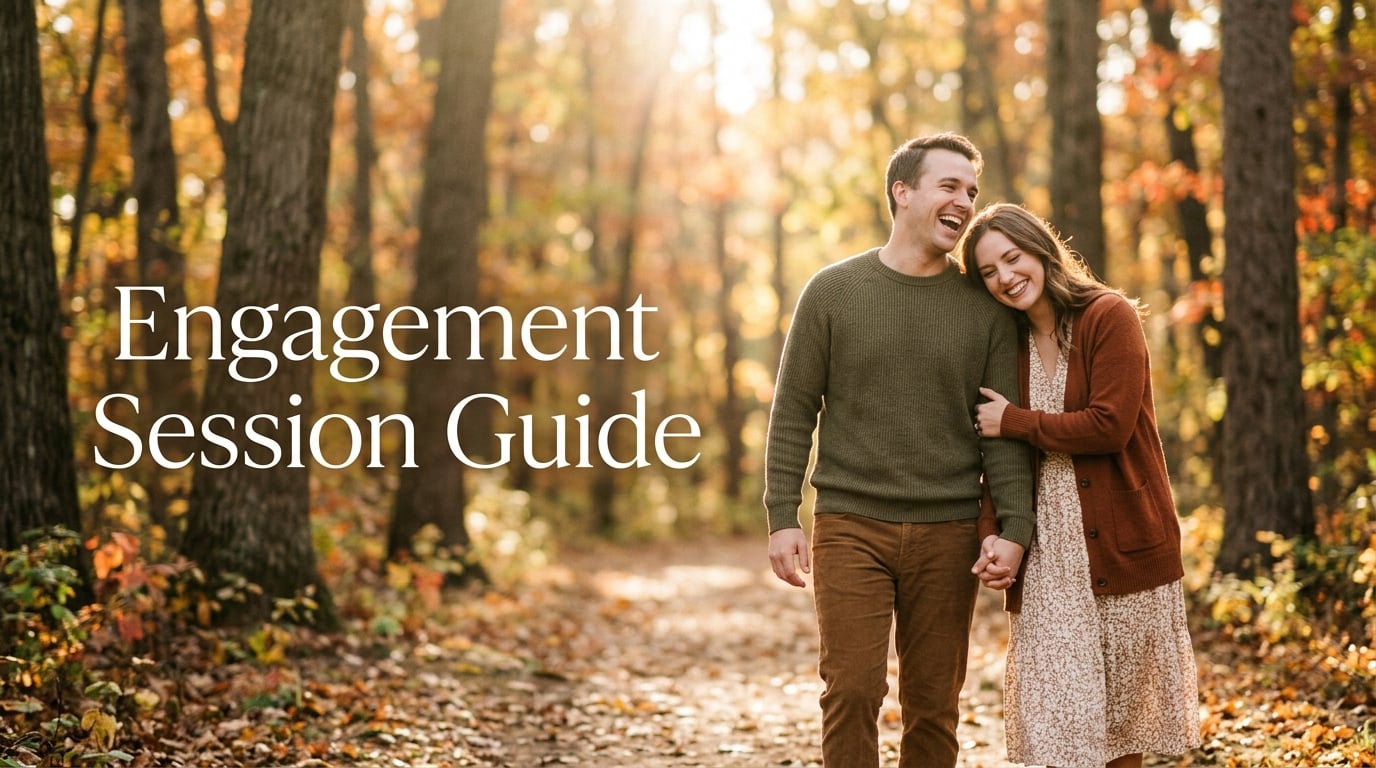
Congratulations on your engagement. This is one of the most exciting chapters of your life, and you deserve photos that actually feel like the two of you.
I’ve been photographing couples for years, and I can tell you the engagement session is usually where my couples go from “we’re awkward in photos” to “we actually had a great time.” That’s not an accident. It’s the result of good preparation, the right mindset, and a photographer who gives you space to be yourselves.
This engagement session guide walks you through everything you need to know, from when to book your photographer to what to do with your hands. I built this resource after sitting with hundreds of nervous couples on the other side of the camera. Everything below comes from real sessions, real Reddit threads, and the most common questions I get in my inbox every week.
By the end, you’ll have a clear plan for booking, prep, outfits, locations, posing, and what happens after the shutter clicks. Let’s get into it.
Table of Contents
What Is an Engagement Session, Really?
An engagement session is a 60 to 90 minute portrait session with your wedding photographer, scheduled months before the wedding, designed to capture the two of you without the timeline pressure of the big day.
That’s the short answer. The longer answer matters more. An engagement session is really three things rolled into one appointment.
It’s a rehearsal. You’ll learn how your photographer works, how they give direction, and how they handle the awkward bits. By the time your wedding day arrives, you’ll already trust them with a camera in your face.
It’s a content library. The photos from your session show up in save-the-dates, wedding websites, guest books, and large prints at the reception. Most couples use engagement photos in five to seven different places throughout the wedding planning months.
It’s a confidence reset. Every couple I’ve worked with has walked into their session thinking they’d hate it. Almost every couple walks out asking when they can do it again. The session itself, not the photos, is often the bigger gift.
You don’t have to use the photos for anything specific. Plenty of couples book a session purely because they want updated portraits of this phase of their life. Both reasons are equally valid.
When to Book Your Engagement Session
Book your engagement photographer 4 to 6 months before your wedding, and schedule the actual session 2 to 3 months before the date. That timing gives you enough lead time for editing and printing save-the-dates without rushing the photographer.
Here’s the rhythm that works for most couples planning a spring or fall wedding. Book your photographer right after you book your venue, typically 9 to 12 months out. Lock in your session date for 8 to 10 weeks before the wedding. That timing leaves room for weather reschedules and gives you a 2 to 3 week gallery turnaround before you send out save-the-dates.
If your wedding is in summer, you have more flexibility. Sessions at sunset in July can run as late as 8:30 PM, which opens up weeknight scheduling for busy couples. Winter weddings need earlier planning because golden hour hits by 4 PM and indoor locations book out fast.
Don’t wait until the last minute. The couples who book 5 to 6 months ahead always have more location options, more wardrobe time, and less stress. The couples who reach out two weeks before the wedding almost always end up with photos they’re not proud of.
How to Choose the Right Engagement Photo Location
Pick a location that means something to you, that has good light, and that gives your photographer enough room to work. Bonus points if you can spend real time there the week before so the setting feels familiar.
Most couples default to “pretty outdoor spot” and that’s a fine default. But the best locations usually have a personal layer underneath. Where did you have your first date. Where do you go every Saturday. Where do you feel most like yourselves.
Outdoor Engagement Session Locations
Outdoor locations work well because of natural light and visual variety. Golden hour, the hour before sunset, gives you soft, warm tones that flatter every skin type. A good photographer can work with most outdoor conditions, but here are settings worth considering.
City settings like downtown alleys, murals, and historic architecture give you texture and color variety. Coastal settings work magic in the two hours before sunset, with sandy beaches and water reflecting the sky. Mountain and forest settings shine in fall, when the light gets golden and the trees pull double duty for color.
Public parks are easy, free, and they photograph better than you’d think. Botanical gardens, arboretums, and urban gardens offer structure for poses and variety in a small footprint. Farms, ranches, and orchards are popular for couples who want a rustic look.
One rule I share with every couple. Scout the location a week before your session, around the same time of day. Take a few test photos on your phone. This walkthrough gives you confidence and helps you flag any issues like a busy gate, a closed trail, or a wall you didn’t notice.
In-Home Lifestyle Engagement Sessions
In-home engagement sessions are a quieter alternative that have grown in popularity over the last few years. They involve a photographer spending an hour or two with you in your home, capturing the small things. Making coffee, reading on the couch, cooking together, lying in bed with the dog.
The appeal is simple. Your home already feels comfortable and safe. There’s no travel time, no weather anxiety, and the energy is naturally intimate. Several of my favorite engagement photos in 2026 came from sessions where we never left the apartment.
In-home sessions work best when your home has good natural light (large windows, soft curtains) and is relatively clean. You don’t need a magazine-ready space. You need a space where you actually live. Pets are welcome, music is welcome, takeout on the couch is welcome. If your love story mostly happens at home, this might be the most honest version of it.
What to Wear for Engagement Photos (Body-Positive Guide)
Wear something that makes you feel like yourself, fits well, and coordinates with your partner without matching exactly. Most importantly, wear something that lets you breathe, move, and forget you’re wearing it.
The outfit question is where my couples spend the most time stressing, so let’s slow down here.
The Outfit Coordination Rule
Most couples should aim to coordinate, not match. Pick a color palette of two or three colors and let each person choose their own outfit within that range. One of you in a soft blue top with the other in cream and tan looks intentional. Both of you in identical white shirts looks like a candid from 1998.
Patterns are fine. One patterned piece per couple is enough. Solid colors are easier, but if you love that floral dress, wear it. Just avoid tiny busy patterns that can moiré under camera flashes or in bright sun.
Move around in your outfit before the session. Sit on the floor. Hug your partner. Reach for something high. If you have to keep adjusting, tugging, or smoothing, change the outfit. Every outfit I see where the couple looks uncomfortable has something they kept adjusting.
Body-Positive Outfit Guidance
I want to spend some extra time on this because most guides don’t. Your body does not need to look a certain way to deserve beautiful photos. You are allowed to take up space, wrinkles exist on every single dress, and the photographer’s job is to find angles that flatter you, not to fix you.
If your arms are something you normally hide, sleeves will help you relax. If you love your shoulders, an off-the-shoulder cut frames them beautifully. If you have a feature you love, wear something that draws the eye to it. If you have a feature you’re self-conscious about, don’t dress for it. The camera lies in directions that almost always flatter you, and your photographer has spent years learning those angles.
Skip the dress you’ve been “saving for when you lose 10 pounds.” Wear the dress that makes you feel like the best version of yourself today. The version of you that exists in 2026, engaged and excited, is the one who deserves these photos.
Two more outfit ground rules. Avoid pure white, cream, or pale colors if your partner is wearing them, because couples tend to look like one blob at sunset. Skip heavy logos or text, which date photos fast. Bring a backup outfit just in case, because sometimes the weather shifts your plans.
Seasonal Outfit Tips
Fall calls for layers, earth tones, and texture. Think a wool coat, a chunky sweater, or a knit dress with boots.
Winter works best in monochromatic outfits with a coat as the anchor. Bring hand warmers and a backup layer for between sets.
Spring is great for pastels, florals, and lighter fabrics. Cherry blossom season books out quickly with photographers, so plan ahead.
Summer shifts to breathable fabrics, lighter colors, and shorter sleeves. Schedule sessions within two hours of sunset to avoid harsh midday sun and sweating through your shirt.
How to Pose for Engagement Photos When You Feel Awkward
You don’t need to know a single pose. A good photographer gives you prompts, direction, and movement the entire time. Your only job is to show up and respond.
This is something I wish more couples knew. You are not expected to walk onto a trail and start vogueing. The photographer does the directing. You do the responding.
That said, a few prompts help you warm up faster. Walk slowly toward the camera while talking about anything. Sit on a bench and lean into each other naturally. Stand hip to hip and look off in the same direction. Hug from behind with your head on their shoulder. Forehead to forehead is almost always flattering. Kissing the top of your partner’s head or their nose is allowed in nearly every setting.
If you’re camera-shy, this helps. Practice 5 minutes of casual poses in front of a mirror before the session. Don’t memorize them, just get comfortable seeing yourself. Then let the prompts take over. The mirror is also useful to bring along to the session, so you can check hair and lipstick between setups.
Don’t worry about your hands. Most photographers will give your hands a job. Hands in pockets. Hands on a hip. Hands holding a coffee cup. Hands adjusting a jacket. The moment your hands have a job, the awkwardness evaporates.
Real couples rarely look awkward in photos even when they feel awkward. The camera picks up the part of you that loves them, not the part of you that worries about your left elbow.
The First 15 Minutes: Surviving Pre-Session Nerves
The first 15 minutes of every engagement session feel a little awkward. That’s normal, predictable, and not a sign that things are going wrong. Almost every couple I’ve worked with has the same first-quarter-hour experience.
Here’s what actually happens. You show up a little wound up. You forgot to eat enough. The camera feels bigger than it did in your head. You laugh at nothing because you’re nervous. You ask your photographer “okay what do we do” and then forget the answer.
This phase ends on its own. The job of your photographer is to keep things moving while your nervous system settles. By minute 20, you’re usually laughing for real. By minute 30, you forget you’re being photographed. By minute 45, you don’t want it to end.
A few things help speed up that transition. Tell your photographer at booking if you’re nervous. They can’t help with what they don’t know. Wear an outfit you’ve worn before so it doesn’t feel like a costume. Eat something small an hour before. Bring water. Bring a snack. Bring something to fidget with between shots.
Most importantly, don’t judge the photos from minute 3. The first few frames are usually throwaways. The gallery is built from minute 25 onward, and that’s where the magic lives.
If you have anxiety specific to being photographed, tell your photographer that, too. They will adjust. Some will give you more direction. Some will give you more silence. There is no wrong answer, only what works for you.
What to Expect During Your Engagement Session
Your photographer will arrive early, walk the location, talk through your plan, and then guide you through a mix of posed and candid moments for the full session. You’ll move between three to five spots, change outfits once or twice, and wrap before you ever feel tired of it.
A typical 90-minute session looks something like this. The photographer shows up 10 to 15 minutes early to scout light. You meet, walk through the plan, and chat for 5 to 10 minutes so you’re not strangers with a lens between you. The first 15 minutes are warm-up shots in the most flattering light. Minutes 30 to 60 are the main shooting block with prompts and movement. Minutes 60 to 75 are outfit changes, location moves, or both. Minutes 75 to 90 are bonus shots at golden hour.
Throughout, expect your photographer to break the silence often. They’ll suggest movements, point out good light, compliment an expression, and redirect when needed. If you’ve hired someone you trust, this part is fun.
Be ready for some direction that feels silly. Walk and hold hands. Whisper something embarrassing in their ear. Spin around. Look at each other for ten full seconds without laughing. Almost every prompt has a purpose, and almost every prompt produces something great.
You’ll also see outtakes. Stumbles, sneezes, mid-sentence laughs, your partner making a face to make you laugh. The photographer captures all of it, and many couples end up loving the outtakes more than the polished shots.
Can You Bring Your Dog to the Engagement Session?
Yes, in most cases you can bring your dog to your engagement session. Just check with your photographer first, scout for off-leash rules, and plan for a backup human to handle the dog during setups where they can’t be in frame.
I love dog-inclusive sessions. Dogs add personality to photos in a way that’s hard to fake. They also help nervous couples relax, because the dog is something familiar and silly in a moment that feels high-stakes.
Before bringing your dog, confirm the location allows pets. Many public spaces have leash rules, time-of-day restrictions, or seasonal wildlife protections. Your photographer may already know the best dog-friendly spots nearby.
Bring a backup human. A friend or family member can hold the leash during setups, take the dog for a break, and handle cleanup. Sessions run smoother when your dog isn’t the only one responsible for being on.
Skip the session entirely if your dog doesn’t do well around strangers, gets anxious in new places, or has health issues that make long sessions hard. A stressed dog shows up in every frame, and there will be plenty of dog-friendly moments in your daily life already.
How to Prepare the Night Before Your Engagement Photos
The day before your session, hydrate, lay out your outfits and accessories, pack your session bag, get a good night’s sleep, and try not to overthink. The most common session regrets come from decisions made in a panic at 11 PM.
A simple checklist works better than a long mental list. Lay out every outfit, including shoes, jewelry, and undergarments. Charge your phone and your photographer’s communication method. Pack a small bag with water, snacks, a mirror, lipstick or comb, safety pins, and a backup outfit. Set two alarms. Stop drinking anything but water after 7 PM. Sleep.
On the morning of the session, eat breakfast, hydrate, and check the weather. Avoid heavy new products on your skin or hair. Skip the experimental haircut. Bring whatever helps you relax during the 30 minutes before the session.
If you’re getting professional hair and makeup, schedule it to finish at least 90 minutes before your session start. That buffer covers travel time, parking, any touch-ups, and the brief panic that sets in when you first look in the mirror with all of it done.
Trust your preparation. After the day-before and morning routine, the work is done. The session itself is yours to enjoy.
After Your Engagement Session: What Comes Next
Most photographers deliver engagement galleries within 2 to 3 weeks of the session. You’ll receive a private online gallery, the ability to download high-resolution files, and print release so you can order prints, save-the-dates, and albums on your own timeline.
The gallery itself is usually a curated set of 60 to 120 edited images, with both color and black-and-white versions depending on your photographer’s style. You’ll get to download, share with family, and post on social media if you choose.
Use the photos widely. Save-the-dates go out 6 to 8 weeks before the wedding, so a 2 to 3 week turnaround gives you time to design, proof, and mail. Wedding websites, invitations, guest books, and reception prints all benefit from these images too.
If you ordered a wedding package that includes an engagement album or print credit, your photographer will usually follow up within a week of gallery delivery to walk you through the design process. Some photographers design albums for you, others send you templates. Either way, the engagement photos are usually your first opportunity to see your wedding photography style on a finished product.
Frequently Asked Questions
How do I prepare for my engagement photo session?
Start by booking your photographer 4 to 6 months before the wedding. Schedule the session 2 to 3 months out. Lay out your outfits in advance, eat a small meal the morning of, hydrate the day before, and arrive 10 to 15 minutes early to settle in. Tell your photographer at booking if you’re nervous about being photographed so they can adjust.
What should I wear for engagement photos?
Wear something that fits well, coordinates with your partner without matching exactly, and feels like you. Pick a color palette of two to three colors and let each person dress within that range. Avoid outfits that require constant adjusting, heavy logos, and pure white if your partner is in light colors. Most importantly, wear something that lets you forget you’re being photographed.
How long does an engagement photo shoot last?
Most engagement sessions last 60 to 90 minutes. That’s enough time to cover two or three setups, one to two outfit changes, and golden hour without rushing. Some shorter mini-sessions run 30 minutes, and longer destination sessions run two hours or more depending on travel and outfit count.
Where should we go for our engagement photos?
Pick somewhere that means something to you, has good light, and gives your photographer room to work. Popular options include outdoor settings like parks, beaches, downtown streets, and forests, plus in-home lifestyle sessions in your own space. Scout your location a week ahead at the same time of day you’ll be shooting.
How many outfits should we bring to an engagement session?
One to two outfit changes is the sweet spot for a 90 minute session. One formal outfit and one casual outfit is enough variety for most galleries without eating into shooting time. More than two changes usually means the session runs long or the photographer has less time for golden hour shots.
Can we bring our dog to the engagement session?
In most cases yes, but check with your photographer first and confirm the location allows pets. Bring a backup human to handle the leash during setups where the dog cannot be in frame. Skip the session if your dog has severe stranger anxiety or health concerns that make long sessions difficult.
How far in advance should we book our engagement photographer?
Book 4 to 6 months before your wedding date, and schedule the actual session 2 to 3 months out. Fall and spring weekends book out fast, so earlier is better. Summer and winter weekdays often have more availability if you have flexible schedules.
What if we’re nervous about being photographed?
Tell your photographer at booking. Every engagement session has a 10 to 15 minute warm-up phase where everyone feels a little awkward, and that resolves on its own. Good photographers work through this with prompts, movement, and conversation. Wearing an outfit you’ve worn before, eating beforehand, and giving yourself time to arrive early all help settle the nerves.
Final Thoughts: Your Engagement Session Guide Wrap-Up
This engagement session guide covers the full arc, from the day you book your photographer to the day your gallery lands. The big things to remember. Book early. Wear what feels like you. Pick a location with meaning. Show up prepared, then let go. Trust your photographer to do the part you hired them for.
The reason I write guides like this, and the reason I share what I share, is that engagement sessions aren’t really about the photos. They’re about a few hours where you remember, in body and not just in mind, that this is the person you chose. Everything else, the outfits, the poses, the location, exists to put you in a frame of mind that lets that truth rise to the surface.
If you take one thing from this guide, take this. The couples who enjoy their sessions the most are the ones who stop trying to perform. They walk, talk, kiss, laugh at random things, and let the camera catch what was already there.
Your engagement session guide checklist is short. Book a photographer you trust. Plan an outfit that fits. Pick a location you’d visit anyway. Show up 15 minutes early, eat something, and tell the photographer if you’re nervous. That’s it.
Everything else is the photographer’s job, and that’s why you hired them. If you have questions about your engagement session, reach out any time. I’d love to hear the story of how you got engaged, and I might know a couple of photographers in your area who’d be a great fit. Here’s to a session you’re proud to print on the wall and a wedding day that feels like you. Cheers to 2026, and cheers to you.