
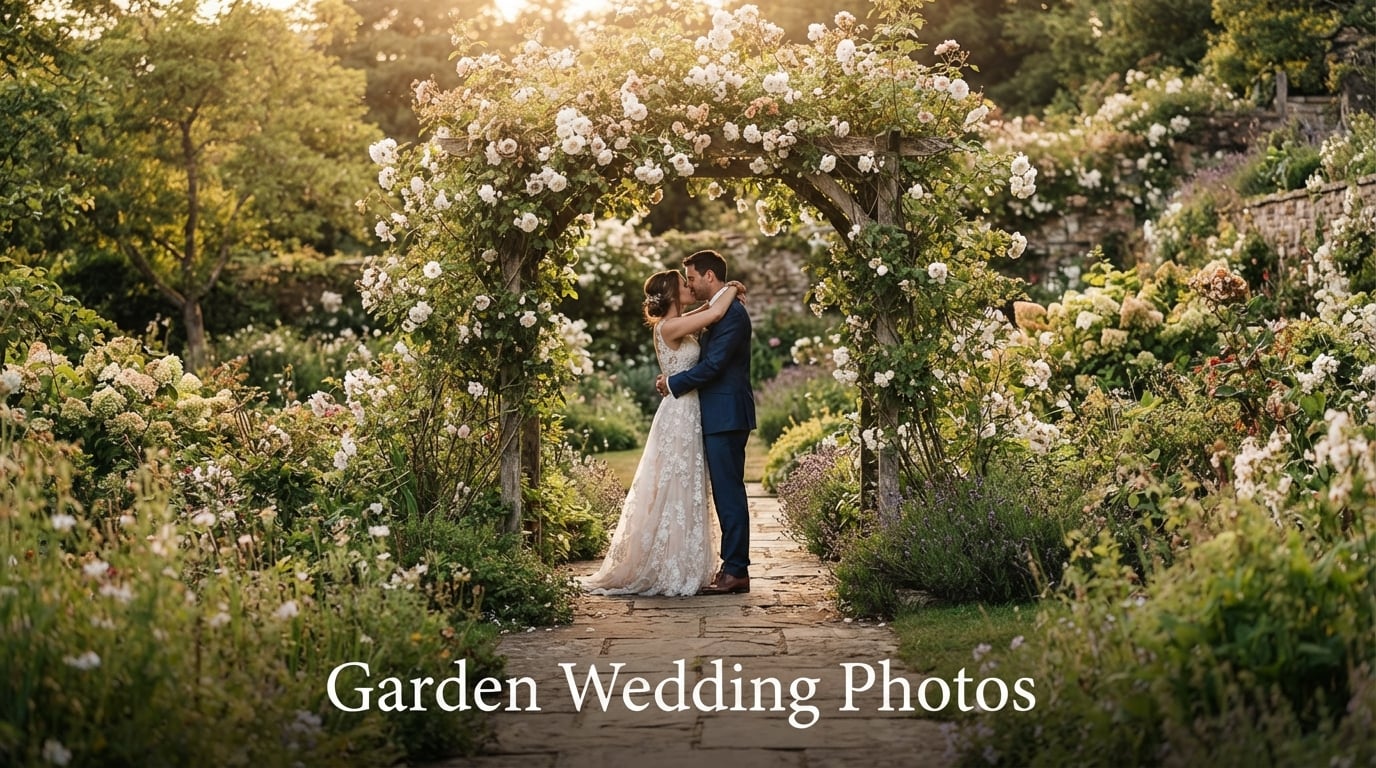
When I shot my first garden wedding eight years ago, I underestimated how different it would be from indoor work. The light kept moving, a sudden gust scattered petals across the aisle, and a bee nearly photobombed the first kiss. By the end of that day, I had learned more about outdoor wedding photography than in months of practice indoors.
That is what makes garden wedding photos so rewarding. They are alive. Every frame carries wind, light, and the small surprises of nature. In this 2026 guide, I will walk you through everything our team has learned from shooting more than 200 outdoor ceremonies, so your photos can capture that same magic without the steep learning curve.
You will learn what defines a garden style wedding, the best times of day to shoot, poses that use natural surroundings, how to handle harsh sunlight, seasonal strategies, gear recommendations, and what to do when the weather changes. Whether you are a couple planning your own celebration, a photographer building your portfolio, or a coordinator designing a timeline, this guide gives you a clear path.
Table of Contents
What Is Garden Wedding Photography?
A garden style wedding is an outdoor ceremony and reception held in a cultivated landscape such as a botanical garden, private estate, backyard, vineyard, or public park. The defining feature is the use of living plants, flowers, trees, and architectural garden elements as part of the visual story. Garden wedding photos document this setting by combining portrait, candid, and detail photography with the natural environment as a key subject.
Unlike beach or rooftop weddings, garden weddings sit inside an enclosed, often intimate space. This gives photographers the freedom to use plant walls, trellises, fountains, and stone paths as compositional anchors. The result feels less like a venue and more like a living set designed for the couple.
I have shot weddings in citrus groves, rose gardens, French-style parterre estates, and even a working herb farm. Each location shares one trait: the greenery is not decoration. It is the room itself.
Best Times of Day for Garden Wedding Photos
The single biggest decision you make on a garden wedding day is when you press the shutter. Natural light in outdoor settings changes every hour, and each window creates a different mood in your images.
Golden hour, the 60 to 90 minutes before sunset, is the gold standard. The light turns warm, shadows lengthen, and skin tones glow. Our team schedules the couple’s portrait session during this window whenever the timeline allows. You get that backlit hair glow, soft wraparound shadows, and rich color saturation in the foliage that defines the best garden wedding pictures.
Blue hour, the 20 minutes after sunset, brings its own rewards. Garden string lights and lanterns begin to glow, the sky holds a deep indigo, and exposures of 1 to 3 seconds reveal the venue in a romantic way indoor lighting never can. We usually capture wide venue shots and a few intimate close-ups during this window.
Midday sun, between 11 a.m. and 2 p.m., is the most challenging period. Light comes straight down, creates harsh under-eye shadows, and forces subjects to squint. Avoid scheduling portraits here. Use this window for ceremony coverage under a canopy, detail shots in shaded rooms, or group photos in covered pavilions. If the timeline leaves no choice, position subjects in open shade and use a reflector or fill flash to soften the contrast.
Overcast days are a quiet gift. Clouds act as a giant softbox, giving even illumination across faces and saturated greens in the foliage. We push ISO a little higher in these conditions, but the resulting images look magazine-ready with almost no editing.
Essential Poses for Garden Wedding Photography
Posing in a garden is different from posing against a wall. The environment gives you props, frames, and depth. These are the seven poses our team uses most often, and they work in any season.
- The archway frame – Have the couple stand beneath a rose arbor, wooden trellis, or pair of trees. Shoot from a low angle so the foliage creates a natural frame around their faces.
- The walk and whisper – Ask the couple to walk slowly down a stone or gravel path while whispering to each other. Capture from the side with a long lens. The motion adds life, and the path gives leading lines.
- The hidden kiss – Position the couple behind a tall hedge, floral wall, or cluster of grasses. Shoot through the leaves so they appear to be sharing a private moment. Foreground bokeh turns the garden into a soft veil.
- The seat together – Find a garden bench, stone ledge, or vintage chair. Have them sit close, leaning in. Garden seating adds intimacy and gives the couple somewhere to rest their hands.
- The bouquet toss silhouette – Backlight the couple against bright greenery or sky at golden hour. Have them lift the bouquet between them. The result is a romantic silhouette with pops of color.
- The reading moment – Place the couple on the ground among low flowers or under a tree. Have one read a letter aloud while the other listens. Genuine emotion almost always shows up in these frames.
- The reflective pool – When a fountain or pond is nearby, crouch low and capture the couple’s reflection. It doubles the garden in the frame and adds a painterly quality.
I always shoot two versions of each pose. The first is the planned shot. The second happens right after, when the couple relaxes and forgets the camera. That second frame is usually the keeper.
Dealing with Lighting Challenges in Outdoor Settings
Outdoor lighting is unpredictable. Even on a clear forecast, a passing cloud, a shift in wind, or a tall hedge can change the scene in seconds. Garden wedding photographers who succeed plan for these shifts in advance.
Harsh midday sunlight creates strong shadows under brows, noses, and chins. The fastest fix is finding open shade under a tree, canopy, or pavilion. Turn the couple so the light hits them from the front rather than above. If shade is unavailable, use a 5-in-1 reflector to bounce light into the eyes. A small on-camera fill flash dialed down two stops also works wonders without looking artificial.
Backlighting happens when the sun is behind your subject. Position yourself so the sun grazes the side of the couple’s face. Expose for their skin and let the background fall into a soft glow. Set your meter to spot metering on the face, then lock exposure with exposure lock. Backlit hair at golden hour is the single most requested look from our couples.
Mixed lighting shows up when you photograph a couple in shade with bright sunlight in the background. The contrast can blow out skies or crush shadows. Either expose for the shadows and let the highlights clip slightly, or use a graduated ND filter to balance the scene. Many modern mirrorless cameras also handle this well with their HDR or highlight priority modes.
Reflections from water features and glass can confuse autofocus and create unwanted hot spots. Polarizing filters cut glare on water and deepen the greens of foliage. I keep one on my main lens for almost every garden shot.
Wind and movement are not lighting problems, but they affect light in practice. Hair, veils, and fabrics catch sun differently when moving. Use a continuous wind to add motion. A sudden gust at the wrong moment can blow a veil into a face. Embrace it. The candid recovery is often the best image of the day.
Seasonal Garden Wedding Photography Ideas
Each season changes a garden in ways that affect both the setting and the mood of your photos. Our team plans a different approach for each calendar window, and so should you.
Spring Garden Weddings
Spring delivers fresh greens, blooming bulbs, and soft pastels. Tulips, daffodils, cherry blossoms, and wisteria create natural backdrops. Light tends to be soft because of frequent cloud cover. Position couples among the blossoms and lean into pale color palettes.
Summer Garden Weddings
Summer brings bold color, long days, and the strongest sun. Roses, hydrangeas, and lavender peak in early summer. Late afternoon golden hour starts later in the day, which actually helps. Plan ceremonies for late afternoon so portraits can flow into evening light. Bring a reflector and shade plan, because midday heat stresses both guests and lenses.
Fall Garden Weddings
Autumn turns the garden into a palette of gold, rust, and crimson. Maples, oaks, and burning bushes become the stars. Midday light is easier to manage because the sun sits lower. Capture leaves on stone paths, use wheat fields and apple orchards nearby if the venue allows, and lean into warm tones in editing.
Winter Garden Weddings
Winter gardens feel quieter but no less beautiful. Bare branches create graphic lines, evergreens add depth, and frost turns leaves into silver. The light is soft and low all day. Use architecture and structural elements as your main backdrop since flora is sparse. Misty mornings produce some of the most romantic garden wedding photos of the year.
Background Selection and Composition
A good background should support the couple without competing for attention. Garden settings offer more options than any other venue type, which makes the choice both easier and harder.
Look for three layers in every frame. The foreground holds the couple. The midground carries a path, bench, or floral cluster. The background gives depth through trees, a hedge, or architectural element. This three-layer approach is what turns a snapshot into a portrait.
Use selective focus to control where the eye lands. A wide aperture of f/1.8 to f/2.8 on a 50mm or 85mm lens turns the garden into soft color and pulls all attention to the faces. Stop down to f/5.6 or f/8 when you want to show the full setting, especially for wide venue shots.
Watch the edges of the frame. Distracting branches, bright sky patches, or a stray garden hose at the corner can ruin a perfect shot. Scan the perimeter before pressing the shutter, and ask an assistant to hold back branches if needed.
Color also guides composition. Cool greens and warm skin tones naturally complement each other. If the couple wears blue or lavender, the green foliage pops. If they wear warm tones like rust or cream, position them against evergreens or deeper shadows for contrast.
Weather Contingency Planning for Garden Weddings
No guide on garden wedding photos is complete without an honest plan for bad weather. Our team has shot in drizzle, heat waves, and one memorable hailstorm. Preparation saves the day.
Light rain is often a gift. Umbrellas become props, wet leaves deepen in color, and reflective surfaces appear everywhere. Carry clear umbrellas for the couple and white ones for guests. Cover gear with rain sleeves and keep microfiber cloths in every pocket.
Heavy rain requires a backup plan. Identify an indoor space, tent, or covered patio before the wedding day. Build the timeline with a 30-minute weather buffer so you can shift indoor if needed.
Strong sun is a planning issue, not a weather emergency. Schedule the ceremony in the most shaded spot available, and ask the venue to set up umbrellas or a sailcloth for guests. Provide sunscreen, sunglasses, and cold water in the getting-ready area.
Wind can ruin hairstyles and veil shots. Stock bobby pins, hair spray, and a small comb in the bridal kit. For photos, use wind to your advantage. Flowing fabrics and veils caught mid-breeze are some of the most-requested garden wedding pictures we deliver.
Recommended Gear for Outdoor Wedding Photography
The right gear makes outdoor work smoother, but the camera does not need to be the most expensive model. Our team shoots with two mirrorless bodies and a focused lens kit. Here is what we bring to every garden wedding.
Two camera bodies. One on a wide zoom for ceremony and group shots, one on a fast prime for portraits. If one body fails, the wedding continues.
A 24-70mm f/2.8 zoom covers ceremony, group shots, and most details. The constant aperture keeps depth consistent when light shifts.
A 70-200mm f/2.8 telephoto handles ceremony moments from the back of the aisle, candid reactions across the venue, and tight portraits with creamy background separation.
An 85mm f/1.4 or 50mm f/1.4 prime for couple portraits. Both produce the soft background and flattering compression that define beautiful garden wedding photos.
A 5-in-1 reflector in 32-inch or 42-inch size. White, silver, gold, and translucent panels handle every lighting condition we face outdoors.
A small speedlight with a diffuser for fill during harsh sun or shaded ceremonies. Dial it down so it feels natural rather than flash-flat.
Memory cards, batteries, and rain covers. We carry double what we expect to need. Outlets are rare at garden venues, so labeled battery cases keep us organized.
Polarizing and neutral density filters. A circular polarizer deepens greens and cuts glare on water. A 3-stop ND lets us use wide apertures in bright sun for shallow depth of field.
Frequently Asked Questions About Garden Wedding Photos
What is a garden style wedding?
A garden style wedding is an outdoor ceremony and reception held in a cultivated landscape such as a botanical garden, estate garden, vineyard, or backyard. The setting itself, including flowers, trees, hedges, stone paths, and water features, becomes part of the visual design rather than just a backdrop. Garden wedding photos use these natural elements as compositional anchors throughout the day.
What time of day is best for garden wedding photos?
The 60 to 90 minutes before sunset, known as golden hour, produces the most flattering light for garden wedding photos. The sun sits low, shadows soften, and skin tones glow. Blue hour right after sunset is ideal for romantic venue shots with string lights. Midday between 11 a.m. and 2 p.m. is the most challenging because overhead light creates harsh shadows and squinting.
How do photographers handle harsh sunlight at garden weddings?
Photographers handle harsh sunlight by moving couples into open shade under trees or canopies, turning them so the sun grazes the face rather than coming from above, and bouncing light with a reflector or a small fill flash dialed down two stops. Backlighting during golden hour is another technique that turns harsh light into a romantic halo around the couple.
What should couples wear for garden wedding photos?
Couples should wear colors that complement the natural setting. Soft pastels, earth tones, dusty blues, and creams photograph beautifully against green foliage. Avoid pure white in heavily shaded spots where it can read gray, and avoid very dark colors that absorb warm light. Lightweight fabrics move gracefully in outdoor breezes and add motion to portraits.
What happens if it rains during a garden wedding?
Light rain often creates magical photo opportunities with umbrellas, wet leaves, and reflective surfaces. Photographers cover gear with rain sleeves, carry clear umbrellas for the couple, and keep microfiber cloths handy. Heavy rain requires an indoor backup plan agreed upon before the wedding day, with a 30-minute buffer in the timeline to shift locations if needed.
Final Thoughts on Capturing Beautiful Garden Wedding Photos
Garden wedding photos reward preparation and patience more than any other style we shoot. The light, the weather, and the plants all become collaborators when you plan ahead, and they all become obstacles when you do not. Use the timing, posing, lighting, seasonal, and gear strategies above as a starting point, then adapt them to the unique garden you are working in.
If you are planning your own garden wedding, build your timeline around golden hour portraits, share a backup plan with your photographer, and choose colors that flatter the natural setting. If you are a photographer just starting with outdoor work, shoot in your own backyard first, study the light at every hour, and let the garden teach you. The most beautiful garden wedding photos we deliver almost always come from couples and photographers who treated the outdoors as a partner, not a backdrop.