
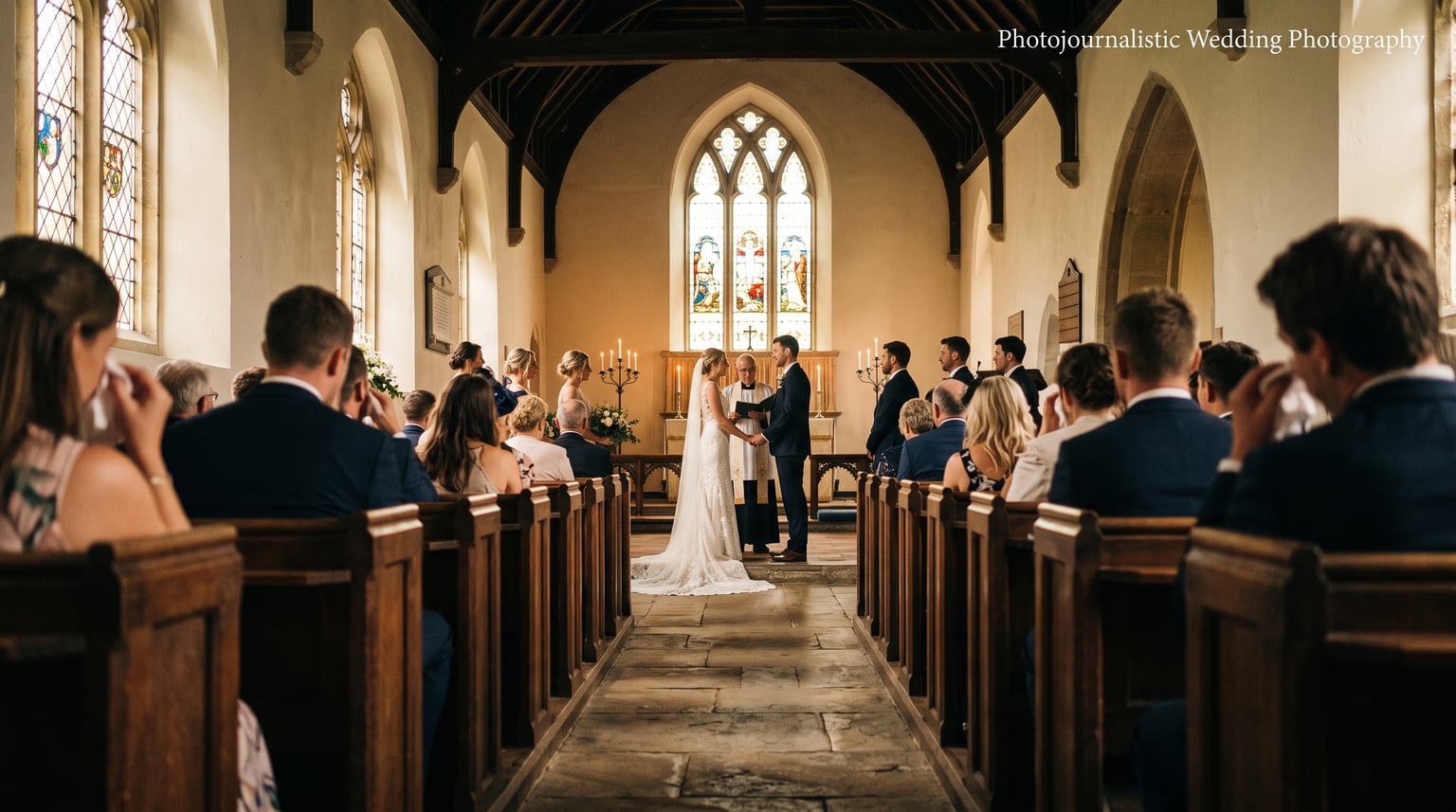
When couples look back at their wedding photos years later, the images that stop them cold aren’t the perfectly posed portraits in front of the altar. They’re the laugh that turned into tears during the vows, the way the groom’s best friend grabbed his shoulder at exactly the right second, the flower girl who abandoned her petal basket entirely and started spinning in circles. These are the moments that photojournalistic wedding photography was built to catch.
Photojournalistic wedding photography is a documentary-style approach where the photographer acts as an impartial observer, capturing raw, unposed moments in real time without directing or staging scenes. Rather than arranging you for the camera, the photographer anticipates and records the genuine emotions, candid interactions, and fleeting moments that tell the authentic story of your wedding day exactly as it unfolded.
In this guide, I’ll walk you through what this style actually means, how it compares to other popular approaches, what separates a true wedding photojournalist from a photographer who just uses the label, and what you can do as a couple to create the conditions for extraordinary candid images throughout your day.
Table of Contents
What is Photojournalistic Wedding Photography?
Photojournalistic wedding photography borrows its core philosophy directly from documentary journalism. Just as a news photojournalist covers an unfolding story without shaping or interfering with events, a wedding photojournalist documents your day exactly as it happens — raw, real, and unfiltered.
The term is often used interchangeably with “documentary wedding photography” and “reportage wedding photography,” and all three describe the same fundamental commitment: the photographer observes rather than directs. They aren’t arranging you in flattering positions or asking you to hold a particular expression. They’re watching, waiting, and working to be in the right place before a moment fully unfolds.
This approach traces its roots to the great documentary photographers of the last century — photojournalists who embedded themselves in real situations and brought back images of life as it was truly lived. Applied to weddings, that same philosophy means your photographer is less interested in manufacturing a beautiful photo than in preserving a real one.
The term gained significant traction in the early 2000s with the formation of professional bodies like the Wedding Photojournalist Association (WPJA), which established standards for what genuine documentary wedding coverage looks like. Today in 2026, photojournalistic wedding photography has become one of the most sought-after styles among couples who want their day remembered honestly rather than artfully arranged.
The Philosophy Behind the Approach
At the core of photojournalistic wedding photography is a belief that authenticity is more powerful than perfection. A technically perfect portrait is beautiful. But a slightly imperfect image where your grandmother is laughing so hard she’s covering her face — that’s the one that goes on the wall.
This approach creates what photographers call a visual narrative: a sequence of images that tells a complete, cohesive story. When you look through the gallery from a skilled wedding photojournalist, it should feel less like browsing photos and more like reading a story with a beginning, middle, and end — getting ready in the morning, the nervous walk down the aisle, the first dance that became something nobody planned, the late-night moments when the formal structure of the day gave way to something looser and more real.
The phrase used consistently across professional photography organizations is “impartial observer.” Your photographer should move through your day like a shadow — present for everything, intrusive for nothing. That’s the standard a genuine practitioner of this style holds themselves to.
Key Characteristics of Photojournalistic Wedding Photography
Not every photographer who calls themselves a photojournalist actually practices this style consistently. Understanding the defining characteristics helps you know what to look for in a portfolio and what to press on during consultations before you commit.
1. Candid and Completely Unposed
The defining feature of photojournalistic wedding photography is the complete absence of posing. The photographer never asks you to stand a certain way, turn toward the light, or repeat a moment for the camera. If it didn’t happen naturally, it doesn’t get captured.
This is harder than it sounds. Posed photography gives the photographer full control — they can adjust until the light, angles, and expressions are exactly right. Documentary photography requires the photographer to find and capture all of those elements simultaneously in a single fleeting moment they didn’t control and cannot repeat.
The result, when it works, looks nothing like a posed photo. The composition is real. The expressions are real. The emotion is real. The frame might not be technically perfect. That imperfection is part of what makes it so powerful — you can feel the truth of the moment.
2. Emotionally Driven Documentation
A photojournalistic photographer isn’t chasing beautiful light or perfect symmetry — they’re chasing emotion. Their instinct is always to move toward the most charged moment in the room, whether that’s a quiet conversation in the corner or a full-blown dance floor moment at midnight.
This emotional focus is what separates strong photojournalistic galleries from average ones. Anyone can photograph a couple exchanging rings. The skill is in capturing the best man’s expression while the rings are being exchanged, the flower girl who fell asleep in her grandfather’s arms during the ceremony, the mother of the groom quietly watching from the side of the room while everyone else is watching the couple.
Across wedding photography communities, the most consistent trust signal couples mention when reviewing photojournalistic photographers is this: galleries that contain specific moments the client hadn’t even noticed were happening during the day itself. That’s the mark of a photographer who is documenting rather than just shooting.
3. Unobtrusive Presence
A true wedding photojournalist should be nearly invisible during your wedding. They use longer focal length lenses that allow them to work at a distance without crowding into moments. They move quietly and deliberately. They don’t shout directions or interrupt conversations to get a shot.
This unobtrusiveness serves two purposes. First, it allows moments to develop naturally without the photographer’s presence changing them. Second, it means your guests can relax and simply be themselves rather than performing for whoever is holding the camera.
The thing couples mention most often after receiving their photojournalistic galleries is that they forgot the photographer was there for much of the day. That’s exactly the goal — to be so present in the room that you become part of the fabric of the day rather than a feature of it.
4. The Art of Anticipation
This is the skill that separates good photojournalistic photographers from truly great ones, and it’s almost never discussed openly. Capturing a candid moment isn’t just about being fast with the shutter. It’s about being in the right position before the moment happens at all.
Skilled wedding photojournalists read body language and room energy constantly. They notice when someone’s eyes are filling up before the tears fall. They see two people drifting toward each other on the dance floor and position themselves before the embrace. They watch for the building laugh in a group of friends and frame the shot before anyone else in the room even sees what’s about to happen.
This requires a deep understanding of human behavior, genuine empathy, and years of pattern recognition. It’s why the best photojournalistic photographers often come from backgrounds in news or documentary work — they’ve trained themselves to see what’s about to happen, not just what’s happening right now. You can’t fake this skill, and it shows very clearly in the work.
5. Sequential Storytelling
The final defining characteristic of authentic photojournalistic wedding photography is its commitment to telling a complete story, not just collecting individual strong images.
This means photographing the unremarkable alongside the magnificent. The quiet coffee in the getting-ready room. The nervous fidgeting during the ceremony. The relief on your face when it’s over and you’re officially married. These in-between moments are the connective tissue of a great photojournalistic gallery — they give the landmark moments context and make the whole album feel like a real day unfolding, not a highlight reel assembled afterward.
When reviewing a photographer’s portfolio with this in mind, pay attention to whether you feel like you’re watching a day unfold or simply looking at a collection of standout shots. Both can be beautiful. Only one tells the full story of who you were and what your wedding actually felt like to live through.
Photojournalistic vs. Traditional vs. Editorial Wedding Photography
One of the biggest sources of confusion for couples is understanding where photojournalistic wedding photography sits relative to the other major styles. Here’s a clear breakdown of what distinguishes each approach and who each style is actually right for.
Traditional Wedding Photography
Traditional wedding photography is what most people’s parents have in their wedding albums — formal portraits, posed family groupings, the couple looking directly at the camera. The photographer takes an active, directing role throughout the day, arranging people and scenes to create specific, planned shots.
Traditional photography produces reliable, classic images. Every important person gets a proper photo. Everyone looks presentable and composed. The trade-off is that the images can feel stiff or constructed, because by design, they are. You’re unlikely to get a photo that captures the electric feeling of the room during the first dance, but you’re very likely to get a beautifully composed image of the two of you together in front of the venue.
Editorial Wedding Photography
Editorial photography — sometimes called fine art wedding photography — sits closer to a fashion shoot than a news story. The photographer takes an active role in crafting scenes, but rather than directing traditional poses, they’re creating visually sophisticated, magazine-style images. Think dramatic lighting, artistic compositions, and a strong aesthetic throughline across the entire gallery.
Editorial photography produces visually striking images that often feel cinematic or aspirational. The trade-off is that they can feel less personal — the aesthetic vision of the photographer sometimes takes precedence over the authentic moments of the couple. An editorial photographer might miss a genuine emotional moment while setting up a visually beautiful scene in a different part of the venue.
Side-by-Side Comparison
| Feature | Traditional | Photojournalistic | Editorial |
|---|---|---|---|
| Posing | Heavily directed | None | Loosely directed |
| Emotional authenticity | Lower | Highest | Medium |
| Visual consistency | High | Medium | Highest |
| Storytelling depth | Low | Highest | Medium |
| Photographer’s role | Director | Observer | Art director |
| Gallery image count | Curated selection | Comprehensive coverage | Curated selection |
| Best for couples who… | Want classic, structured portraits | Hate posing, want authentic moments | Love a strong visual aesthetic |
The Hybrid Approach: When Blending Styles Works Best
In practice, most couples and photographers end up with some version of a hybrid approach — and this is often the right call. Pure photojournalism is extraordinary for ceremony coverage, reception moments, and the organic in-betweens of the day. But most couples also want a handful of beautiful portraits together, which requires some degree of direction.
The key distinction is finding a photographer who excels at the photojournalistic elements first and can also handle directed portraits competently. A photographer who primarily shoots traditional photography and “also does candid shots” is fundamentally different from a genuine wedding photojournalist who can pull off a few beautiful portraits when the couple asks for them.
The WPJA recommends asking potential photographers what percentage of their coverage is documentary versus directed. A true photojournalist will typically describe their work as 80% or more documentary, with directed shots limited to formal family portraits and perhaps a brief couples session at a particularly beautiful moment during the day.
The hybrid approach also directly addresses one of the most common concerns I hear from couples considering this style: the worry about missing important formal moments with a purely candid approach. With a primarily documentary photographer who can shift briefly into directed mode for specific shots, you get the authentic storytelling you want and the portraits your family expects.
How to Find and Hire a Photojournalistic Wedding Photographer
The challenge couples run into most often — and it comes up constantly across wedding photography forums — is distinguishing a genuinely photojournalistic photographer from someone using the label as a marketing angle. Here’s how to find the real thing.
Evaluating Their Portfolio
The first thing I look for in any portfolio is storytelling coherence. Don’t just evaluate individual images in isolation — look at how the images work together across a full wedding. Does the gallery take you through a day from beginning to end? Do you feel the emotional progression of the day? Are there quiet, mundane, in-between moments alongside the obvious highlights?
Look specifically for evidence of the anticipation skill I described earlier. Were they in position to catch moments before they peaked, or do the photos mostly show reactions after the fact? The best photojournalistic portfolios contain images where you genuinely wonder how the photographer managed to be in that exact position at that exact second.
Be thoughtful about portfolios that look too polished. If every single candid appears perfectly lit and ideally composed, the photographer may be staging “candid” moments rather than capturing real ones. Authentic photojournalistic work has some inherent imperfection — slightly uneven lighting, an unconventional angle — because real moments don’t pause and wait for perfect conditions to happen.
Questions to Ask Before You Book
The questions you ask during a consultation will tell you almost everything about whether a photographer is genuinely photojournalistic or just using the label. Here are the ones I recommend pressing on:
What percentage of your coverage is documentary versus directed? A genuine photojournalist will say the vast majority is documentary and will be specific about it rather than vague.
Can I see a complete wedding gallery, not just highlights? A highlight reel always looks good. Seeing a full wedding from start to finish shows you what the actual experience of working with this photographer produces.
How do you handle formal family portraits? Even documentary photographers need a system for formals — ask how they manage them efficiently without consuming too much of the day’s natural flow.
What do you do during the downtime between events? Great photojournalists keep shooting during transitions and quiet moments. This is often where the most genuine candid moments actually happen.
How do you approach getting-ready coverage? This is where less committed photographers tend to get lazy. Skilled photojournalists find rich, emotional material in getting-ready moments and know how to draw it out.
Do you bring a second shooter? For complete documentary coverage, a second photographer means fewer moments are missed — especially when the bride and groom are getting ready simultaneously in different locations.
Red Flags to Watch For
There are consistent patterns that should give you pause when evaluating photographers. If a photographer becomes defensive when you ask to see a full wedding gallery rather than just highlights, that’s a concern. If their portfolio is heavy on dramatically lit artistic shots and noticeably thin on genuine emotional candid moments, they may not be practicing the style they claim.
Watch for photographers who describe themselves as photojournalistic but whose packages and pricing are organized entirely around specific “portrait sessions” and “formal coverage” rather than hours of documentary time. A photographer who truly practices this style thinks in terms of time spent documenting, not specific shot lists to be delivered.
Also pay close attention to the word “lifestyle” used as a synonym for photojournalistic. Lifestyle photography involves some degree of direction and prompting — asking people to walk together, sit close, interact in a specific way. It’s a beautiful and legitimate style, but it isn’t documentary. The distinction matters when what you want is authentic documentation of your day.
If you’re worried about feeling awkward or stiff in photos — this is a very real concern I hear from couples considering any photography style — photojournalistic is actually often the most forgiving approach. There’s no posing, no “now look natural,” no pressure to perform for the camera. Your photographer is looking for the moments when you forget the camera exists at all, and those are almost always the best moments anyway.
How to Create Space for Unscripted Moments
Even the most skilled photojournalistic photographer can only document what unfolds in front of them. As a couple, there are concrete things you can do to create the right conditions for extraordinary candid moments on your wedding day.
Unplug Your Ceremony
Ask your officiant to announce an unplugged ceremony — no phones or cameras from guests during the ceremony itself. When guests are raising their devices, your photographer is constantly working around screens and extended arms instead of faces and emotions.
More importantly, an unplugged ceremony means your guests are actually present rather than documenting. Their emotions are more visible, their reactions more genuine, and their faces are fully available for your photographer to capture. The difference in ceremony coverage between plugged and unplugged weddings is substantial — I’ve seen photographers describe it as shooting two completely different kinds of events.
This single decision costs nothing and can significantly improve some of the most important images from your day: the ones where the people who love you most are visibly, genuinely feeling it.
Build Buffer Time Into Your Day
Rushed timelines are the enemy of good photojournalistic coverage. When everything is tightly scheduled and everyone is constantly being moved from one location to another, there’s no space for organic moments to develop between the set pieces.
Build in 10-15 minute buffers between the major events of your day. These transition periods are where some of the most genuine moments emerge — a spontaneous toast in a hallway, a private moment between you and your new spouse before you walk into the reception, siblings catching up in a corner without anyone directing them.
Share your full day timeline with your photographer well in advance. A skilled documentary photographer will flag where the gaps are too tight and help you think through where the timing needs room to breathe. That conversation before the wedding day is worth having.
Trust Your Inner Circle
Tell the people closest to you — the wedding party, parents, siblings — that your photographer will be working in a documentary style. Ask them to interact normally and genuinely, rather than performing for the camera or directing other guests toward the photographer.
This matters more than most couples expect. When guests are aware there’s a photographer present, many unconsciously put on a slightly different version of themselves. Letting your key people know that the goal is genuine interaction — not posed photos — removes one of the biggest barriers to authentic moments throughout the day.
It also helps to prepare your wedding party for the reality that group posed shots will be minimal. Some people genuinely stress about whether they’ll get enough formal photos — reassuring them upfront prevents the situation where someone interrupts natural documentary flow to ask the photographer for specific portraits.
Prepare Family Members for the Approach
One of the most practical challenges couples face with a photojournalistic approach is managing family expectations around formal portraits. Aunts, grandparents, and older family friends often expect a traditional photo session, and if they don’t experience one, they can feel overlooked regardless of how beautiful the documentary coverage is.
The solution is clear communication before the wedding day. Let key family members know that the photography style is documentary, explain what that means in plain terms, and confirm there will be a brief formal portrait session so nobody feels forgotten. Give your photographer a specific, organized shot list for family formals and set a defined time block for them — typically 20-30 minutes is enough when the list is organized in advance — so the rest of the day can flow without interruption.
Getting family formals handled efficiently isn’t the most exciting topic, but it genuinely matters. A clear, fast portrait session frees your photographer to spend the rest of the day doing the documentary work that makes photojournalistic coverage worth having.
What to Expect in Your Final Gallery?
Understanding what a photojournalistic wedding gallery actually looks like in practice helps you decide whether this style is right for you — and helps you evaluate whether what you receive from your photographer matches what was promised.
A complete photojournalistic wedding gallery typically contains several hundred images spanning the full day, from early getting-ready moments through late-night reception candids. Unlike a traditional gallery curated down to a selection of formal portraits and milestone shots, a photojournalistic gallery documents the day comprehensively — including images that might seem unremarkable in isolation but contribute to the full storytelling arc when seen as part of the complete album.
Expect natural variation in composition and lighting. Because the photographer is working in documentary mode rather than controlling the environment, conditions vary widely across the day. Some images will be beautifully lit. Others will be shot in challenging indoor light or the chaos of a crowded dance floor at midnight. This variation is authentic, not a quality issue — it reflects the real range of your wedding day as it actually unfolded.
Gallery delivery timelines tend to run longer for photojournalistic coverage than for traditional photography — there are simply more images to review and cull, and the editing process takes proportionally more time. Discuss expected delivery timelines with your photographer before you book and ask what their approach is to selecting which images make the final gallery.
The strongest photojournalistic galleries share a particular quality: when you sit down and look through them, you feel like you’re re-experiencing the day rather than just viewing photos of it. The images transport you back to specific moments and specific feelings, not just what everything looked like. That’s the real benchmark for genuinely well-executed photojournalistic wedding photography.
Frequently Asked Questions
What is photojournalistic wedding photography?
Photojournalistic wedding photography is a documentary-style approach where the photographer acts as an impartial observer, capturing raw, unposed moments as they happen without directing or staging scenes. The photographer anticipates genuine emotions and candid interactions to tell the authentic story of your wedding day exactly as it unfolded, creating a visual narrative from beginning to end.
How is photojournalistic wedding photography different from candid photography?
Candid photography simply means unposed shots — a photographer can take candid shots within an otherwise traditional or directed approach. Photojournalistic wedding photography goes much further: it is a complete documentary philosophy with narrative intent, storytelling structure, and a commitment to covering the entire day as an impartial observer. A true wedding photojournalist commits to documentary coverage as the core methodology from getting ready through the last dance, not just as a supplement to posed work.
What are the 3 C’s of photojournalism?
The 3 C’s of photojournalism are Content, Composition, and Context. Content refers to the emotional truth and subject matter captured in the image. Composition describes how elements are arranged within the frame to communicate the story effectively. Context ensures each image is understood within the larger narrative being told — in wedding photography, this means every image should contribute to the complete story of the day rather than standing alone as an isolated shot.
What is the 30/5 rule for weddings?
The 30/5 rule is a practical wedding photography guideline for managing formal family portraits: allow approximately 30 minutes for the full formal portrait session, with roughly 5 minutes allocated per family grouping or distinct setup. Following this structure keeps the formal portrait portion efficient and predictable, preventing it from running over and reducing the time available for documentary coverage of genuine moments throughout the rest of the day.
Is photojournalistic wedding photography right for every couple?
Photojournalistic wedding photography works best for couples who are comfortable in their own skin, who prefer natural moments over posed portraits, and who want their wedding day documented as it truly was. If having a substantial number of formal portraits and structured shots is very important to you or your family, a hybrid approach — working with a primarily documentary photographer who can also deliver a focused formal portrait session — is typically the best fit for most couples.
Bringing It All Together
Photojournalistic wedding photography isn’t about getting lucky with candid shots — it’s a complete approach to wedding documentation built on skill, anticipation, and a genuine commitment to telling your story the way it actually happened.
The best practitioners of this style are the photographers your guests forget are there. They’re reading body language at 2 in the afternoon and at midnight. They’re finding the quiet moments between the big ones — the moments that give the whole day its emotional texture. And when you receive that gallery weeks later, the images they’ve collected should feel less like a photo album and more like a time machine.
If what you want from your wedding photos is the truth of who you were on that day and what it genuinely felt like to live through it, photojournalistic wedding photography is the style built to deliver exactly that — and nothing less.