
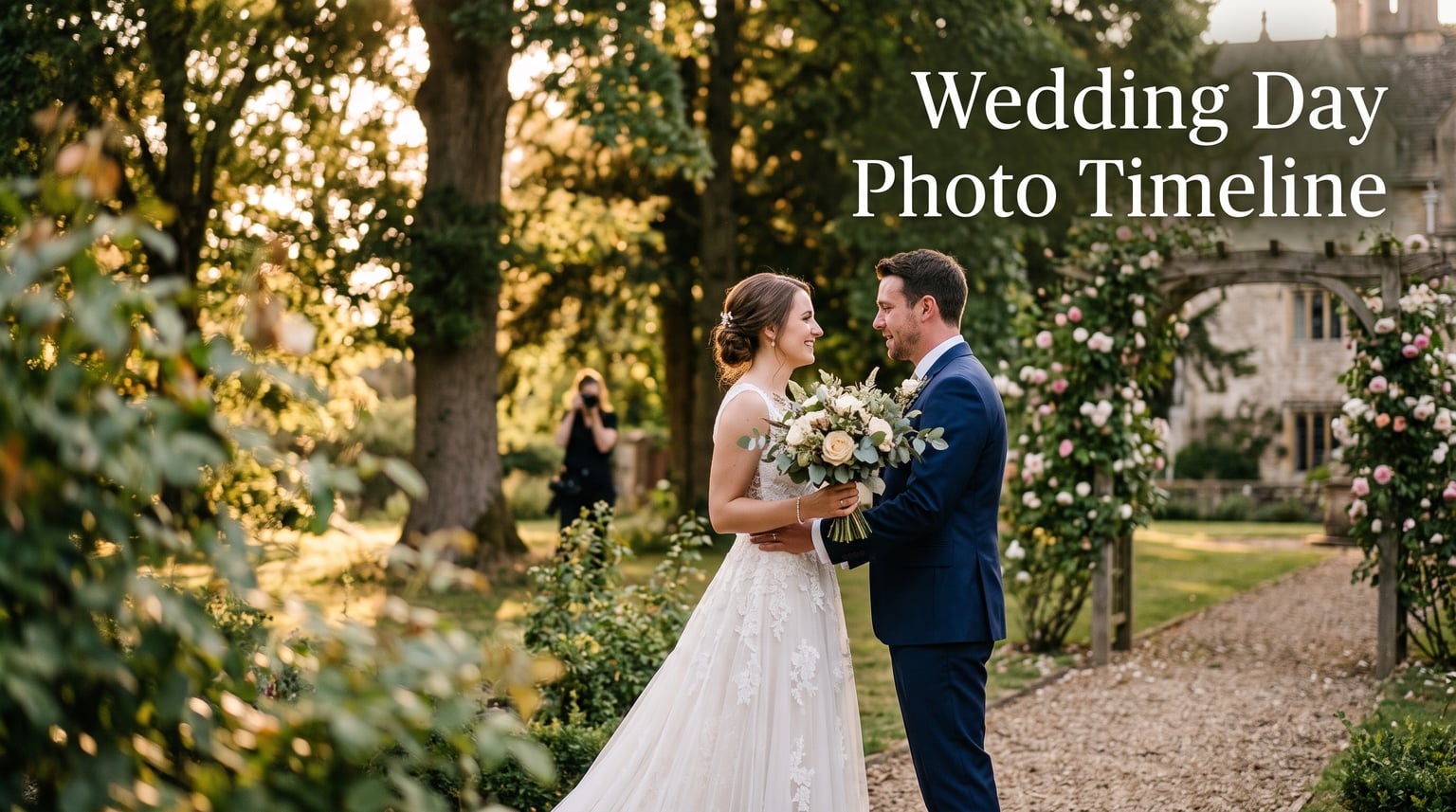
If you’ve ever asked your photographer “how long does everything take?” and gotten a vague answer, you’re not alone. Planning a wedding day photo timeline is one of the most confusing parts of the whole process — and getting it wrong means rushed portraits, stressed family members, and moments you’ll wish you had captured.
I’ve been photographing weddings for years, and the couples who enjoy their day most have one thing in common: they built a realistic, detailed photo timeline before the wedding, not on the morning of it.
This guide walks you through every segment of your wedding day from a photography standpoint. You’ll get specific time allocations, two complete wedding day photo timeline templates, and practical advice for handling the things that always go sideways.
Table of Contents
Why Your Wedding Day Photo Timeline Makes or Breaks the Day
A poor timeline doesn’t just mean fewer photos. It creates a domino effect that ripples through your entire day.
When getting ready runs long, your first look gets cut short. When the first look runs late, family formals feel hurried. When family formals overrun, your couple portrait session evaporates — and those are the images most couples say they wish they had more of.
A well-planned timeline does the opposite. It gives your photographer permission to work slowly and thoughtfully in each segment. It lets your guests actually enjoy cocktail hour instead of waiting around for you. And it removes the low-grade stress that follows couples who are watching the clock all day.
Getting Ready Photos — How Much Time You Actually Need
Getting ready photos tell the story of your morning. The details — your grandmother’s ring, the handwritten note from your partner, your bridesmaids zipping up your dress — are images you will look at for decades. Don’t rush them.
For the bride’s side, plan on 1.5 to 2.5 hours of coverage. That sounds like a lot, but consider what’s happening in that window: hair finishing touches, makeup, individual portraits, bridesmaids in robes, the dress reveal, and every small moment in between.
A few things that help enormously on the getting ready side:
Have your dress on a hanger near a window before the photographer arrives. Window light gives these detail shots a clean, editorial look.
Lay out your accessories, shoes, invitation suite, and florals in one spot so your photographer can shoot them without hunting around the room.
Book your hair and makeup to finish at least 30 minutes before the photographer needs you dressed. Stylists always run over.
For the groom’s side, 30 to 45 minutes is usually enough. That covers getting dressed, lapel flowers, cufflinks, individual portraits, and candid shots with the groomsmen. Ask the groomsmen to arrive 15 minutes before the photographer so nobody is still putting on their tie when the session starts.
One thing I always tell couples: if your hair and makeup team isn’t finished before your photographer arrives, you’re already behind. Build your timeline backward from the moment you need to be ready, not forward from when you wake up.
First Look vs. No First Look — The Decision That Shapes Your Entire Timeline
The first look question comes up in almost every consultation I have. It’s a personal decision, but it has a major impact on how your wedding day photo timeline flows — so it’s worth understanding both sides clearly.
A first look means you and your partner see each other before the ceremony, usually in a private location your photographer has scouted. It’s an emotional moment, often more raw and genuine than the aisle reveal because there are no 150 guests watching.
From a timeline standpoint, a first look unlocks enormous flexibility. Because you’ve already seen each other, you can complete your couple portraits, wedding party photos, and family formals entirely before the ceremony. Your guests go straight to cocktail hour when the ceremony ends, and you join them within 30 minutes instead of disappearing for an hour and a half of post-ceremony portraits.
Without a first look, all portrait sessions shift to after the ceremony. That means your cocktail hour carries the full load of family formals, wedding party shots, and couple portraits — and 90 minutes is a tight window for all three.
Here’s a real experience shared by couples on wedding planning forums: many who skipped the first look felt that cocktail hour wasn’t enough time for all the photos they wanted. Those who did a first look consistently described a calmer, more enjoyable evening because portraits were done before they walked down the aisle.
That said, the aisle reveal is a genuinely powerful moment and some couples simply aren’t willing to give it up. If that’s you, the solution is to be extremely disciplined about your post-ceremony portrait schedule — and to prep your family photographer list in advance.
Family Portrait Sessions — Planning the Groupings Without Losing Your Mind
Family formals are the segment most likely to eat your timeline alive. Gathering 12 different family combinations across two families, some of whom haven’t seen each other in years, is a logistical challenge even on the best days.
The standard rule is 2 minutes per grouping. A family formal session with 15 groupings takes 30 minutes under ideal conditions. Add in grandparents who move slowly, a toddler who won’t cooperate, and a missing uncle who wandered to the bar, and that 30 minutes becomes 50.
Here’s how to protect your timeline during family portraits:
Prepare a written family photo list before the wedding and give a copy to your photographer and your designated family wrangler. List the exact groupings in the order you want them, starting with the largest group and working down to smaller combinations.
Assign a family wrangler — someone who knows both families well and can actually get Uncle Steve to put down his drink. Your photographer can’t do this and shoot at the same time.
Start with the most mobile family members (typically the grandparents) so you can release them to cocktail hour first if they need to sit down.
Keep the list to 15 groupings or fewer. Every grouping beyond that adds meaningful risk to your timeline.
If you have a particularly large or complex family, consider doing grandparent photos before the ceremony as a separate mini-session. It takes 10 minutes and eliminates the highest-pressure grouping from your post-ceremony crunch.
Wedding Party Photos — Keeping Everyone on Track
Plan on 30 minutes for wedding party photos. That covers the full group together, bridesmaids alone, groomsmen alone, and a few fun candid variations.
The biggest time wasters in wedding party sessions are: tracking down people who wandered off, traveling between too many locations, and trying to force too many creative setups into a short window. Pick one or two locations your photographer has pre-scouted and keep everyone together from the moment family formals end until wedding party photos are done.
I always ask couples to remind the wedding party at the rehearsal dinner: “After the ceremony, the photographer needs everyone for 30 minutes. No slipping away to the bar.” A quick heads-up the night before saves 10 minutes of rounding people up on the day itself.
Couple Portraits and Golden Hour — The Photos You Will Cherish Forever
Couple portrait time is the most commonly underestimated segment of the wedding day. Couples often allocate 20 minutes and then wonder why the images feel rushed.
Plan for at least 45 minutes to 1 hour of dedicated couple portrait time. If you can split this into two sessions — one before the ceremony and a golden hour session near sunset — you’ll have the widest variety of lighting and settings in your final gallery.
Golden hour is the 30 to 60 minutes before sunset, when the sun drops low and casts everything in warm, flattering light. It’s not a style choice — it’s physics. Photographs taken in golden hour light simply look better than those taken at high noon or under overcast midday skies.
The challenge is that golden hour happens at sunset, which is often right in the middle of your dinner or first dances. The solution most photographers recommend is a “sneak-away” — slipping out of the reception for 15 to 20 minutes with your photographer while guests are eating. Your guests barely notice, and the images you bring back are often the most stunning of the entire wedding gallery.
Check the sunset time for your wedding date and location. If golden hour falls at a convenient moment in your reception schedule, build it in. If it falls during toasts or cake cutting, talk to your photographer about whether a quick escape makes sense.
Ceremony Coverage — What to Expect and How Long It Takes
Ceremony length varies more than any other part of the wedding day. A civil ceremony can be done in 12 minutes. A full Catholic mass can run two hours or more.
Your photographer will be shooting throughout the ceremony: the processional, the moment you see each other at the altar, the ring exchange, the first kiss, and the recessional. These images don’t require any time allocation from you — they happen naturally.
What does affect your timeline is what happens immediately after the ceremony. A formal receiving line, where every guest shakes hands with the wedding party, can take 30 to 45 minutes. That’s 30 to 45 minutes subtracted from your cocktail hour portrait window. If a receiving line matters to you, plan for it explicitly — or consider a less formal greeting during dinner instead.
For the photo timeline, mark your ceremony end time as your actual expected finish time, not the scheduled start time. Ceremonies rarely begin exactly on time.
Reception Key Moments — Never Miss These Shots
Your photographer should have a clear list of must-capture reception moments. Build these into your timeline with approximate start times so they don’t sneak up on anyone.
The standard reception photography checklist includes:
Grand entrance — alert your photographer 5 minutes before so they’re in position
First dance — usually 3 to 5 minutes
Parent dances — 3 to 6 minutes depending on how many
Toasts — variable, but photographers need to be at a specific angle to capture reactions
Cake cutting — 5 minutes; schedule this before heavy dancing starts, not after
Bouquet and garter toss — optional, but flag it if you’re doing it
Golden hour sneak-away — if applicable, coordinate with your DJ or MC so they keep guests entertained
Talk to your DJ or coordinator about giving your photographer a heads-up before each event. A 2-minute warning lets your photographer move into position and change settings without missing the shot.
Wedding Day Photo Timeline Templates
Below are three complete wedding day photo timeline templates you can adapt for your own day. Adjust the start times based on your ceremony time and coverage package.
8-Hour Wedding Photography Timeline With First Look (4:00 PM Ceremony)
This template assumes your photographer arrives at 11:00 AM and coverage runs until 7:00 PM. It prioritizes completing all portraits before the ceremony so your cocktail hour is stress-free.
11:00 AM — Photographer arrives. Detail shots: rings, shoes, invitation suite, florals, dress hanging near window light.
11:30 AM — Bride’s getting ready photos. Hair finishing touches, makeup application, candid moments with bridesmaids.
12:30 PM — Bride in dress. First look with bridesmaids, individual bridal portraits.
1:00 PM — Groom and groomsmen getting ready photos. Suits on, cufflinks, lapel flowers, candid group shots.
1:30 PM — First look at pre-scouted location. Private moment photographed from a distance.
1:45 PM — Couple portraits (1 hour). Multiple locations, varied compositions, relaxed pace.
2:45 PM — Wedding party photos (30 minutes). Full group, bridesmaids, groomsmen.
3:15 PM — Family formal portraits (30 to 45 minutes). Work through shot list with family wrangler.
4:00 PM — Buffer and travel time. Couple freshens up. Pre-ceremony candids of guests arriving.
4:00 PM — Ceremony begins.
4:45 PM — Ceremony ends. Guests move to cocktail hour. Couple takes a short break or does additional portraits.
5:30 PM — Grand entrance to reception.
5:45 PM — First dance, parent dances.
6:00 PM — Dinner served. Photographer captures table shots, candid guest moments.
6:30 PM — Toasts begin.
7:00 PM — Coverage ends. (Extend if you want cake cutting and dancing covered.)
8-Hour Wedding Photography Timeline Without First Look (4:00 PM Ceremony)
This template assumes coverage from 1:00 PM to 9:00 PM. Because the couple doesn’t see each other before the ceremony, all portrait sessions shift to after the ceremony.
1:00 PM — Photographer arrives. Detail shots and bride’s getting ready coverage.
2:00 PM — Groom and groomsmen getting ready photos.
2:30 PM — Separate wedding party photos: bridesmaids (without bride present), groomsmen (without groom).
3:00 PM — Bride’s final prep, veil and accessories, bridal portraits alone.
3:30 PM — Guests begin arriving. Photographer captures candid arrivals, venue details.
4:00 PM — Ceremony begins.
4:45 PM — Ceremony ends. Family formal portraits begin immediately while guests go to cocktail hour.
5:30 PM — Full wedding party photos with both bride and groom (30 minutes).
6:00 PM — Couple portraits (30 to 45 minutes). This is your primary couple session.
6:45 PM — Grand entrance to reception.
7:00 PM — First dance, parent dances, toasts.
7:30 PM — Dinner. Cake cutting before guests finish eating.
8:00 PM — Golden hour sneak-away (15 to 20 minutes if sunset timing works).
8:30 PM — Dancing. Bouquet toss if applicable.
9:00 PM — Coverage ends.
6-Hour Wedding Photography Timeline (With First Look, 3:00 PM Ceremony)
Six hours is a common package for smaller weddings or couples on a tighter budget. It works, but requires careful planning. With a first look, it’s much more manageable.
12:00 PM — Photographer arrives. Quick detail shots (30 minutes maximum).
12:30 PM — Bride getting ready final touches, into dress (45 minutes).
1:15 PM — First look and couple portraits (1 hour). This is your primary portrait window.
2:15 PM — Wedding party photos and family formals combined (45 minutes). Keep the family list tight — 10 groupings maximum.
3:00 PM — Ceremony begins.
3:45 PM — Ceremony ends. Guests move to cocktail hour.
4:00 PM — Cocktail hour candids, details, guest portraits.
4:30 PM — Grand entrance, first dance, parent dances.
5:00 PM — Dinner, toasts, cake cutting.
5:30 PM — Golden hour portraits if sunset timing aligns (15 to 20 minutes).
6:00 PM — Coverage ends.
For 6-hour coverage without a first look, you’ll need to make hard choices about what to skip. Most photographers recommend at least 8 hours if you’re not doing a first look, simply because the post-ceremony portrait window is already under time pressure.
Buffer Time and the 30-5 Rule — Why Padding Your Timeline Matters
No wedding runs exactly on schedule. Hair and makeup run over. The florist arrives late. The limo gets stuck in traffic. Building buffer time into your timeline is the single most effective thing you can do to protect your photo time.
The 30-5 rule is a practical guideline some photographers use: add 30 minutes of buffer somewhere in the first half of the day, and build in 5-minute transitions between each activity. Those 5-minute gaps sound insignificant but they accumulate into the breathing room that prevents a cascade of delays.
Travel time is one of the most overlooked elements in wedding day planning. If your ceremony and reception are at different venues, or if portrait locations require driving, map the routes in advance and add 20% to Google Maps’ estimate. Wedding day traffic, parking logistics, and everyone needing to use the restroom before getting in the car all add time that couples never account for.
Common timeline busters to watch for:
Hair and makeup running 20 to 30 minutes late
Family members not being where they need to be for formals
Ceremony starting late (guests still arriving, officiant delayed)
Receiving lines after the ceremony that weren’t in the plan
The wedding party disappearing to the bar between portrait segments
When building your timeline with your photographer, ask them: “Where are our buffer zones?” If there aren’t any, add them.
What to Do When Your Wedding Day Runs Late
Even with perfect planning, things slip. The key is responding quickly rather than hoping things will fix themselves.
The moment you realize you’re running behind, tell your photographer. They can start making real-time decisions: combining portrait groups, adjusting the shot list, or identifying which images to prioritize. What they can’t do is recover time they didn’t know was lost.
If you’re running 30 minutes behind and can’t make it up, here’s the order to protect: couple portraits first, then family formals, then wedding party photos. Couple portraits are the images most unique to you and most difficult to replicate. Family formals are important but can be thinned if needed. Wedding party shots are fun but the least irreplaceable in your gallery.
Accept that imperfect coverage of your actual wedding beats perfect coverage of a photo session that swallowed your day. Some of the best wedding photos I’ve ever taken came from chaotic days where we had to adapt.
Weather Contingency Planning — A Step Most Couples Skip
Every outdoor portrait plan needs an indoor backup, and most couples don’t think about this until it’s raining on the morning of their wedding.
Walk through your venue or portrait location with your photographer before the wedding day. Identify at least one strong indoor option that has good light — a staircase, a window-lit hallway, a covered porch, or an interesting architectural detail. Know that location before you need it.
Here’s the reframe that changes everything: overcast light is actually beautiful for portraits. It acts like a giant softbox, eliminating harsh shadows and creating flattering, even light across faces. Many photographers prefer overcast days to bright sun for this reason. Rain can produce some of the most dramatic, memorable wedding images — umbrellas, puddle reflections, moody skies.
If weather forces you to adjust your portrait locations, the timeline logic stays the same. You may need to reduce travel time between spots, which often means shorter portrait sessions per location. Discuss this scenario with your photographer before the wedding so you both know the plan without having to figure it out in the moment.
FAQs
What is the 30-5 rule for weddings?
The 30-5 rule is a photographer’s guideline for building buffer time into your wedding day. It means adding a 30-minute buffer block somewhere in the first half of your day, and building 5-minute transition gaps between each activity in your timeline. These small cushions prevent one delay from cascading into the next segment, protecting your portrait time.
Is 2 hours enough time for wedding photos?
Two hours is enough for a focused portrait session if you have a clear shot list and everyone is in the right place at the right time. However, most photographers recommend planning for at least 3 to 4 hours across all portrait segments — getting ready, couple portraits, family formals, and wedding party shots. Two hours is workable for couples who did a first look and completed portraits before the ceremony.
How long do wedding photos take after the ceremony?
Post-ceremony photos typically take 60 to 90 minutes if you’re completing all portrait segments after the ceremony. That window covers family formals (30 minutes), wedding party photos (20 to 30 minutes), and couple portraits (20 to 30 minutes). If you did a first look and completed portraits before the ceremony, post-ceremony coverage can be as short as 10 to 15 minutes for any remaining shots.
How much time should I set aside for family photos at a wedding?
Plan 30 minutes for family formal portraits. Use the 2-minutes-per-grouping rule when building your shot list — 15 groupings equals 30 minutes under ideal conditions. Designate a family wrangler who knows both families and can gather people quickly. Limit your list to 15 groupings or fewer to stay on schedule, and consider doing grandparent photos before the ceremony as a separate mini-session if grandparents have mobility challenges.
Can I get all my photos done during cocktail hour without a first look?
It’s possible, but tight. A typical cocktail hour is 60 to 90 minutes, and post-ceremony portraits covering family formals, wedding party photos, and couple portraits can easily take 90 minutes or more. Most couples who skip the first look report feeling rushed during this window. To make it work, keep your family photo list under 10 groupings, skip a formal receiving line, and have your wedding party ready to go the moment the ceremony ends.
Putting Your Wedding Day Photo Timeline Together
A solid wedding day photo timeline isn’t something you build in 10 minutes the week before your wedding. It’s a conversation with your photographer that starts months earlier and gets refined as your day takes shape.
Share this guide with your photographer at your planning meeting. Work through the timeline templates together and adapt them to your ceremony time, venue locations, and family situation. Build in the buffer time, identify your golden hour window, and decide on your first look approach.
When your wedding day photo timeline is done well, you won’t think about it on the day itself. That’s the goal — a plan so solid that you can simply be present and let the moments happen, knowing your photographer has everything covered.