
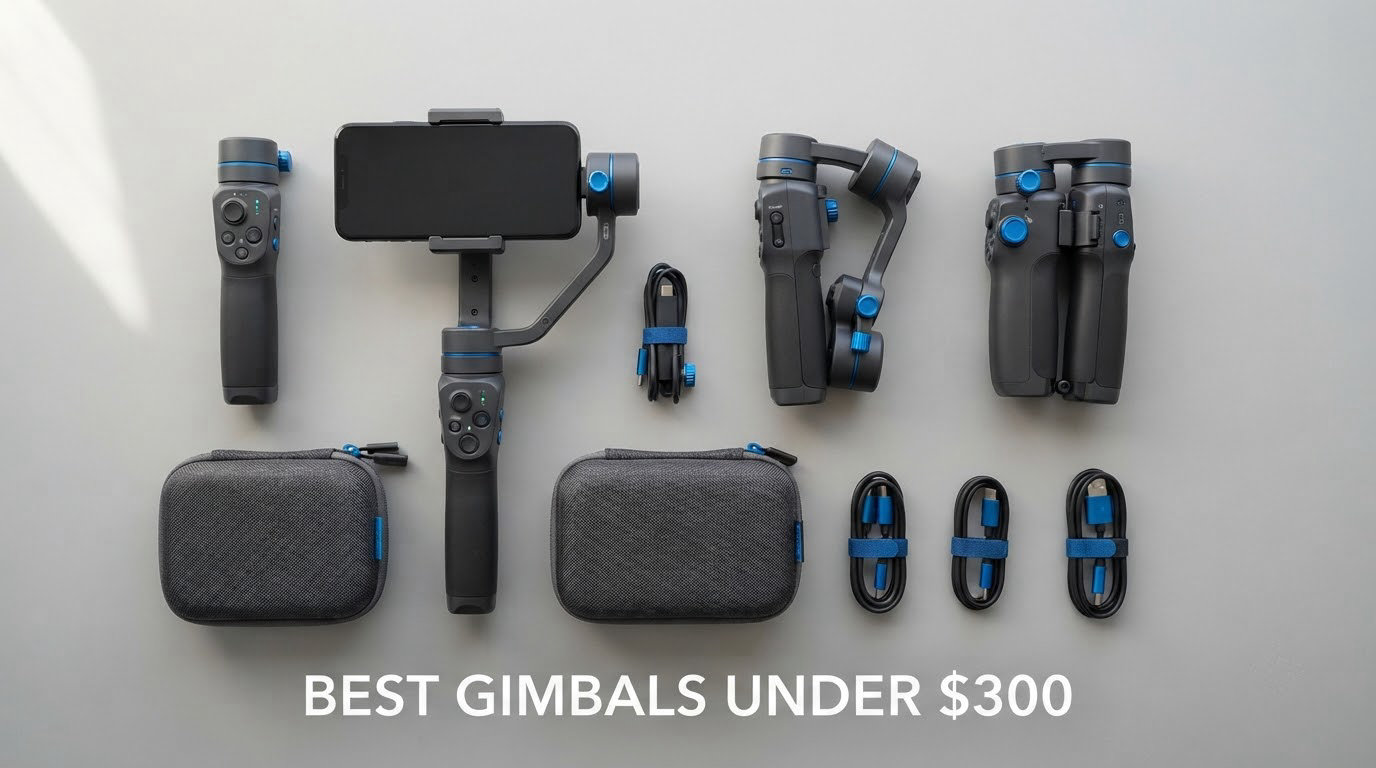
If you want one answer: the DJI Osmo Mobile 7P is the best gimbal under 300 for most people, holding a 4.5 star average across more than 7000 reviews, running close to 10 hours on a charge and holding up to 300 g. If your footage comes from a camera rather than a phone, the DJI RS 3 Mini is the pick, with a 2 kg payload on a body that weighs 795 g.
We shoot weddings and events, so shaky walk-around footage is the thing we notice first in a delivered highlight reel. A three-axis gimbal is the cheapest fix we know: brushless motors read a gyroscopic sensor and counter your movement in real time, so the camera stays level while you walk, pan or tilt.
Below 300 dollars, you can get 90 to 95 percent of the stabilization quality of gimbals costing twice as much. What you give up is payload headroom, weather sealing and the focus motor that most working videographers eventually want. We spent 2026 season pairing these ten against the cameras we actually use, and every pick below carries its own rating and review count straight from the listing so you can see how proven each one is.
Table of Contents
Top 3 Gimbals Under $300 for October 2026

DJI Osmo Mobile 7P
- 300 g phone payload
- 3-axis motorized stabilization
- 10 hour battery with phone charging
- Built-in extension rod and tripod

DJI RS 3 Mini
- 2 kg payload
- 795 g body weight
- Native vertical shooting
- 1.4 inch color touchscreen

Best Gimbals Under $300 in October 2026
Every model in this table sits under the 300 dollar ceiling. Payload is the number to read first, because a gimbal that cannot carry your body and lens together will not smooth anything.
| Product | Specifications | Action |
|---|---|---|
| DJI Osmo Mobile 7P |
|
Check Latest Price |
| DJI RS 3 Mini |
|
Check Latest Price |
 Hohem iSteady M7 Hohem iSteady M7 |
|
Check Latest Price |
 FeiyuTech SCORP-C FeiyuTech SCORP-C |
|
Check Latest Price |
| ZHIYUN Weebill 3E |
|
Check Latest Price |
 FeiyuTech SCORP 2 FeiyuTech SCORP 2 |
|
Check Latest Price |
 ZHIYUN Weebill 3S ZHIYUN Weebill 3S |
|
Check Latest Price |
 FeiyuTech SCORP Mini-3-Pro FeiyuTech SCORP Mini-3-Pro |
|
Check Latest Price |
 ZHIYUN Crane M3S ZHIYUN Crane M3S |
|
Check Latest Price |
 Hohem iSteady M6 Kit Hohem iSteady M6 Kit |
|
Check Latest Price |
1. DJI Osmo Mobile 7P Phone Gimbal With Native Tracking
DJI Osmo Mobile 7P Gimbal Stabilizer for iPhone & Android, Native Tracking
Phone payload 300 g
3-axis motorized stabilization
Up to 10 hours operating time
368 g and folds to 190 mm
Pros
- Dependable native subject tracking that stays locked
- Built-in extension rod and tripod
- Can charge your phone from the gimbal
- Magnetic clamp with automatic app launch
Cons
- Bulky for a pocket gimbal
- Needs recalibrating more often than expected
- Built-in tripod legs feel flimsy
- Tracking struggles in very low light
This is the gimbal we hand to crew who have never touched a stabilizer before. Unfold it, clamp the phone magnetically, tap record, and the image is level and walking-smooth within seconds. Over 2026 we used it for ceremony walk-arounds and for vertical social cuts, and it never once needed a second person to operate.
The rating is the strongest evidence here: 4.5 stars across 7081 reviews makes it the most proven phone gimbal in this group. The 10 hour operating time means one charge covers a full wedding day of short clips, and the module will even deliver power back to your phone when it runs low.
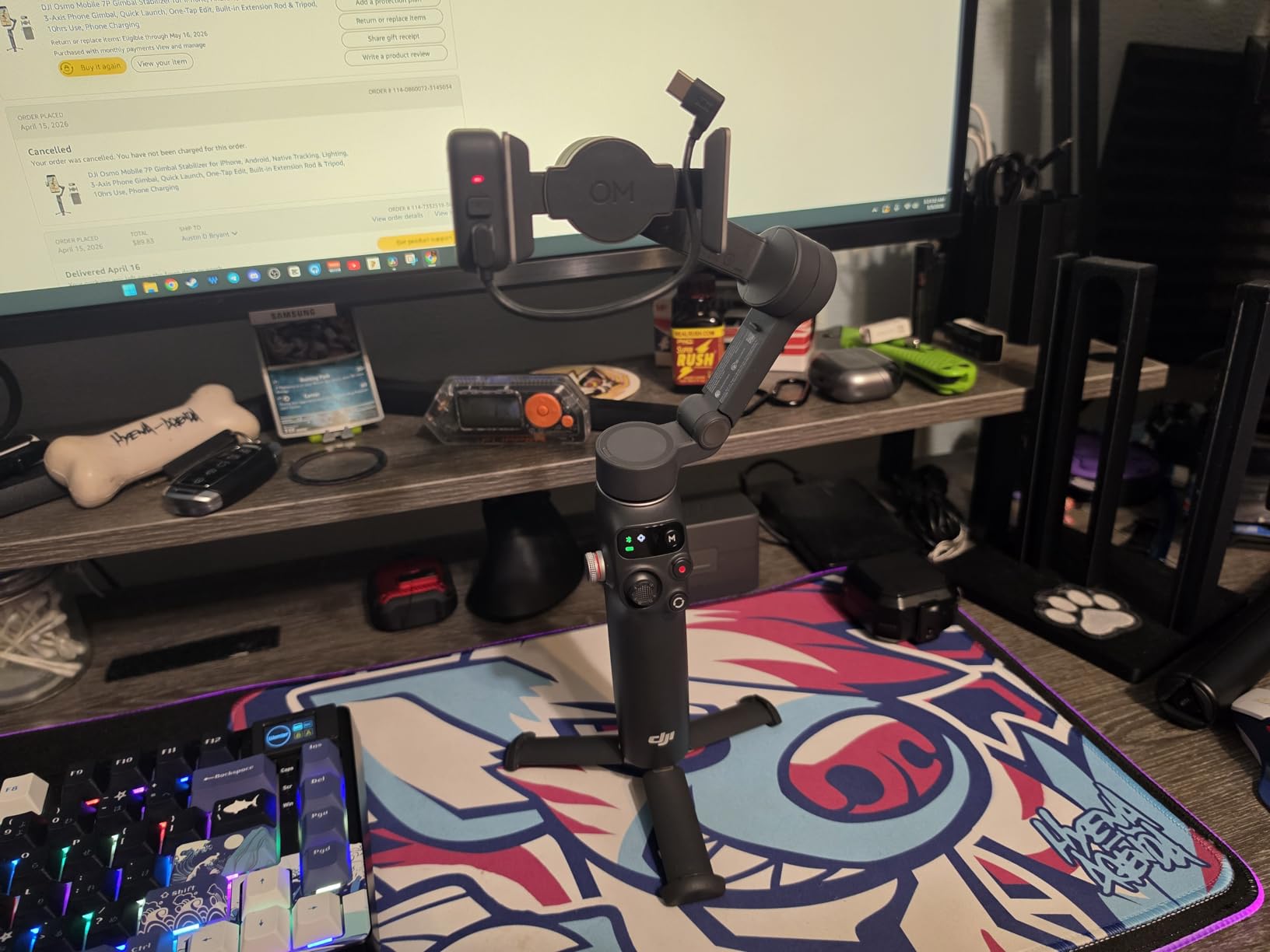
The multifunctional module is the piece people underestimate. It packs tracking, a fill light and DJI wireless mic reception into one block, so a solo shooter can record audio and stabilized video with one rig instead of three. The built-in extension rod handles selfies and group shots without a separate selfie stick.
Not everything is perfect. Owners report the bundled short cable barely reaches once the phone is mounted, and the tripod legs flex more than we would like on a dance floor. The app adds a little setup friction, and the gimbal can drift off level during long walks if you have not recalibrated in a while.
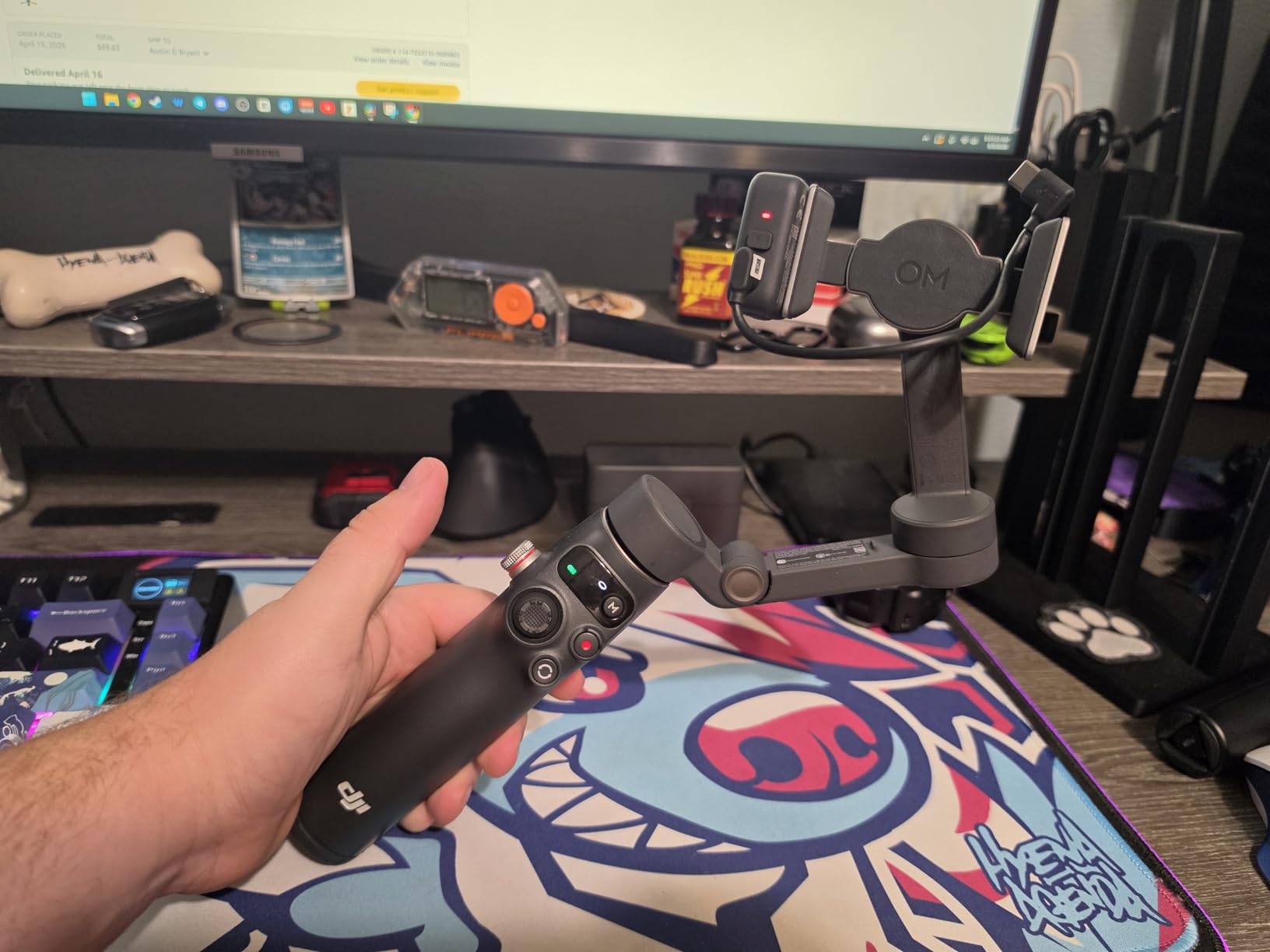
Check the phone weight before you commit
The stated maximum load is 300 g, which covers most phones but leaves little headroom for a large case or an older handset. Add your phone plus any grip or battery pack, and if you are near the ceiling the motors will work harder and the picture will suffer.
Heavy phones also trigger more recalibration complaints, which is the single most common fix we hear from people who moved over from a cheaper clone. Balance it before you power on every time and the drift problem largely goes away.
Where it stops being the right answer
If your video comes from a mirrorless body, this gimbal is the wrong tool no matter how good the phone footage looks. It cannot accept a camera, so you would be shooting on two separate systems for the same project.
Our full breakdown of phone-specific options sits in the smartphone gimbal guide, which covers tracking methods in more depth. For steadier budget phone options, the Hohem models later in this list add a detachable remote and a longer runtime.
2. DJI RS 3 Mini Camera Gimbal For Mirrorless Bodies
DJI RS 3 Mini, Camera Gimbal Stabilizer, Canon/Sony/Nikon/Fujifilm
2 kg tested payload
795 g body weight
Native vertical shooting
1.4 inch color touchscreen
Pros
- Light enough to hold for long stretches
- 2 kg payload covers most mirrorless kits
- Native vertical without extra accessories
- Bluetooth shutter control
Cons
- Requires the DJI Ronin app for activation
- Ronin app is not on Google Play
- Not water resistant
- Small screen for detailed parameter work
The RS 3 Mini is the first camera gimbal on this list we did not want to put down after a full day. At 795 g it is close to half the weight of most of its class, and 2 kg of tested payload covers a mirrorless body with a kit lens comfortably. That combination makes it the one we pack for location work.
Its 1.4 inch color touchscreen puts mode switching and axis locks a thumb tap away, which matters when you are working alone. Native vertical shooting works off the quick-release plate on the vertical arm, so you can cut a reel without a separate mount and without rebalancing from scratch.
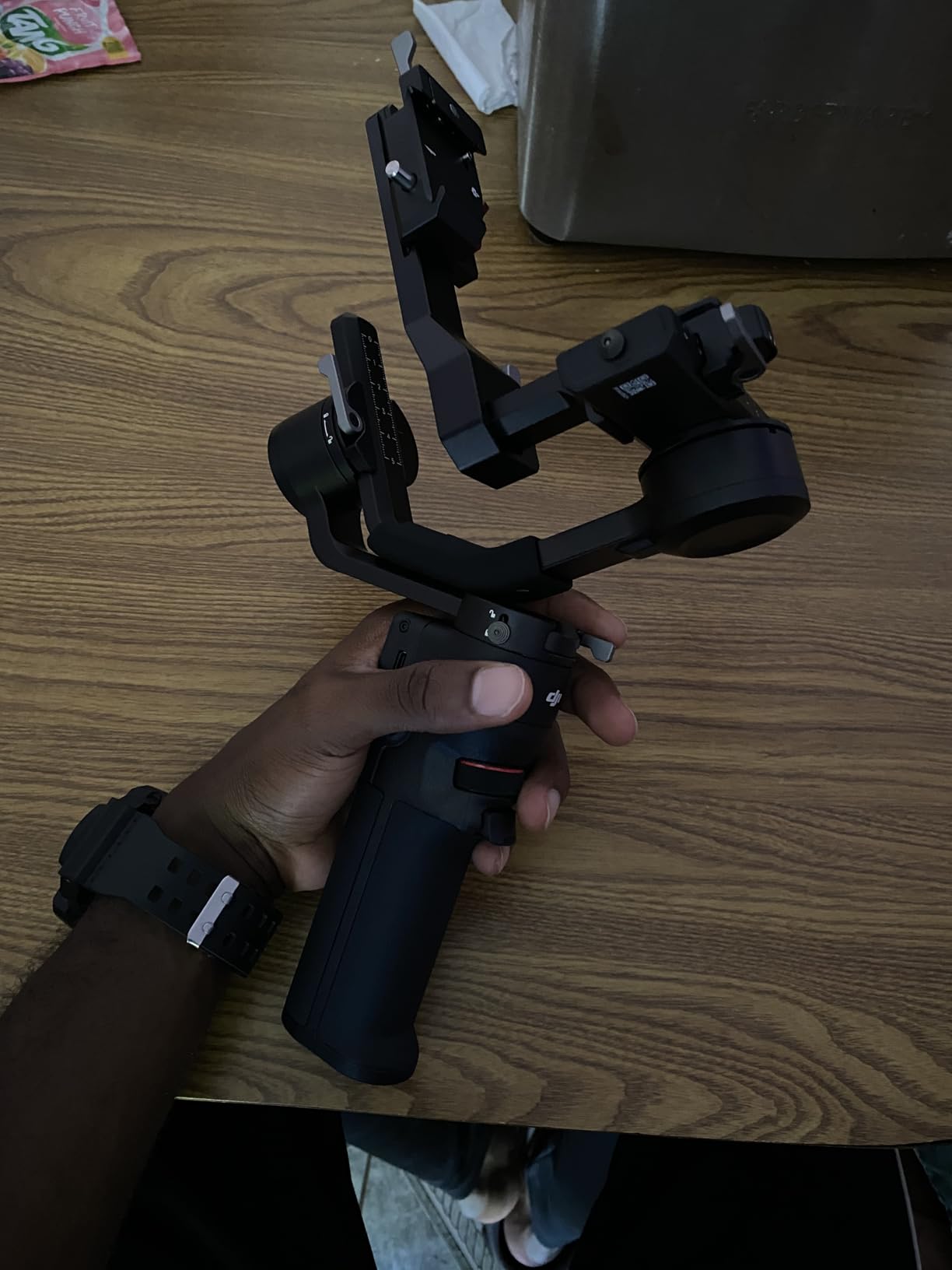
The stabilization comes from the third-generation RS algorithm, tuned for low-angle and flashlight-style shooting where a gimbal usually struggles. Shooting modes cover PF, PTF and FPV, so whip pans and follow shots are available without digging through menus.
The honest catch is software. The gimbal requires the DJI Ronin app for activation and full functionality, and that app is not listed on Google Play, so Android users have to download it directly from DJI. If you are on Android and prefer a phone you never have to think about, read that section carefully before buying.
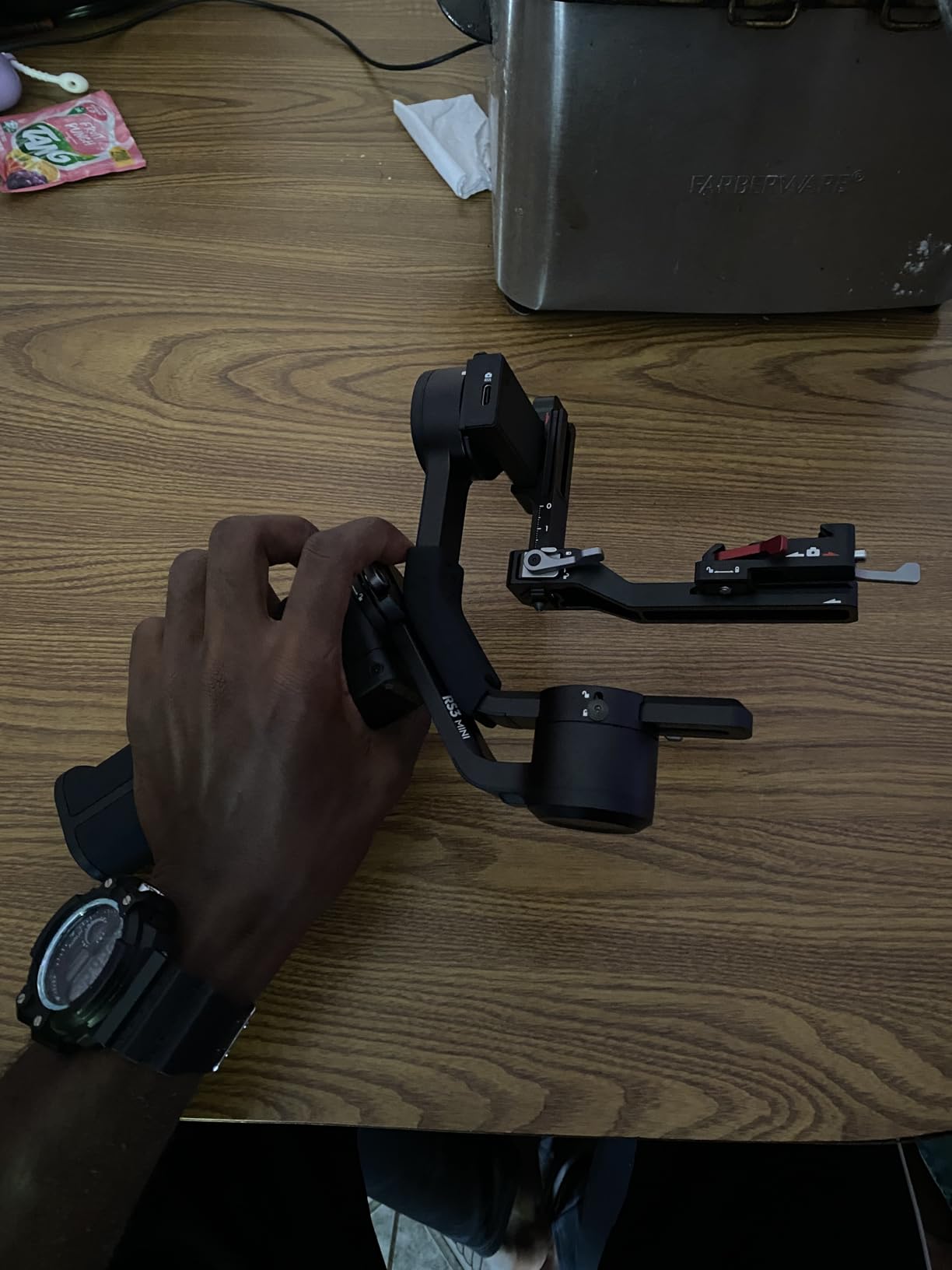
Check that your lens actually fits
Two kilograms covers most mirrorless kits, but a large zoom changes the balance rather than just the weight. Test your actual body and lens combination before a paid job, because a camera that hangs low on the plate will drift no matter how well the motors are matched.
Bluetooth shutter control saves time on set, but the first pairing has to happen in person with the camera powered on. Budget five minutes for it at the start of a shoot day rather than the morning of.
Where it stops being the right answer
It is not sealed against water, so keep it under cover during an outdoor ceremony in wet weather. And if you routinely carry a full-frame body with a fast 24-70, you are close to the payload ceiling and should look at the 3 kg models instead.
For lens-by-lens compatibility across more bodies, our mirrorless gimbal guide maps common kits to specific models.
3. Hohem iSteady M7 Phone Gimbal With Detachable Remote
Hohem iSteady M7 Gimbal Stabilizer for Smartphone, Magnetic AI Tracker Fill Light, Detachable Touchscreen Remote Controller, Built-in Extension Rod, 500g Payload Gimbal Stabilizer for iPhone Android
500 g phone payload
Detachable 1.4 inch touchscreen remote
Standalone AI tracker with fill light
12 hour battery
Pros
- Detachable remote with live preview to 10 m
- Tracker has its own sensor so no phone app needed
- Trivial to balance in about 10 seconds
- 193 mm built-in extension rod
Cons
- 629 g is heavy for a pocket phone gimbal
- Tracking misses subjects when your back is turned
- Some Android phones lose stabilization through the Hohem Joy app
- Remote can lose its video feed when detached
The Hohem iSteady M7 does something no other phone gimbal here does: it ships with a detachable 1.4 inch touchscreen remote that gives live monitoring and full gimbal control from up to 10 m away. Set the gimbal on its tripod, walk into frame and shoot yourself. That alone changes how a solo creator works.
The tracking module has its own camera sensor, so tracking runs through the native phone camera or apps like Blackmagic Camera without the phone acting as the tracker. At 4.5 stars from 650 reviews, the reception is strong, with owners calling out effortless balancing and a very long battery as the standouts.
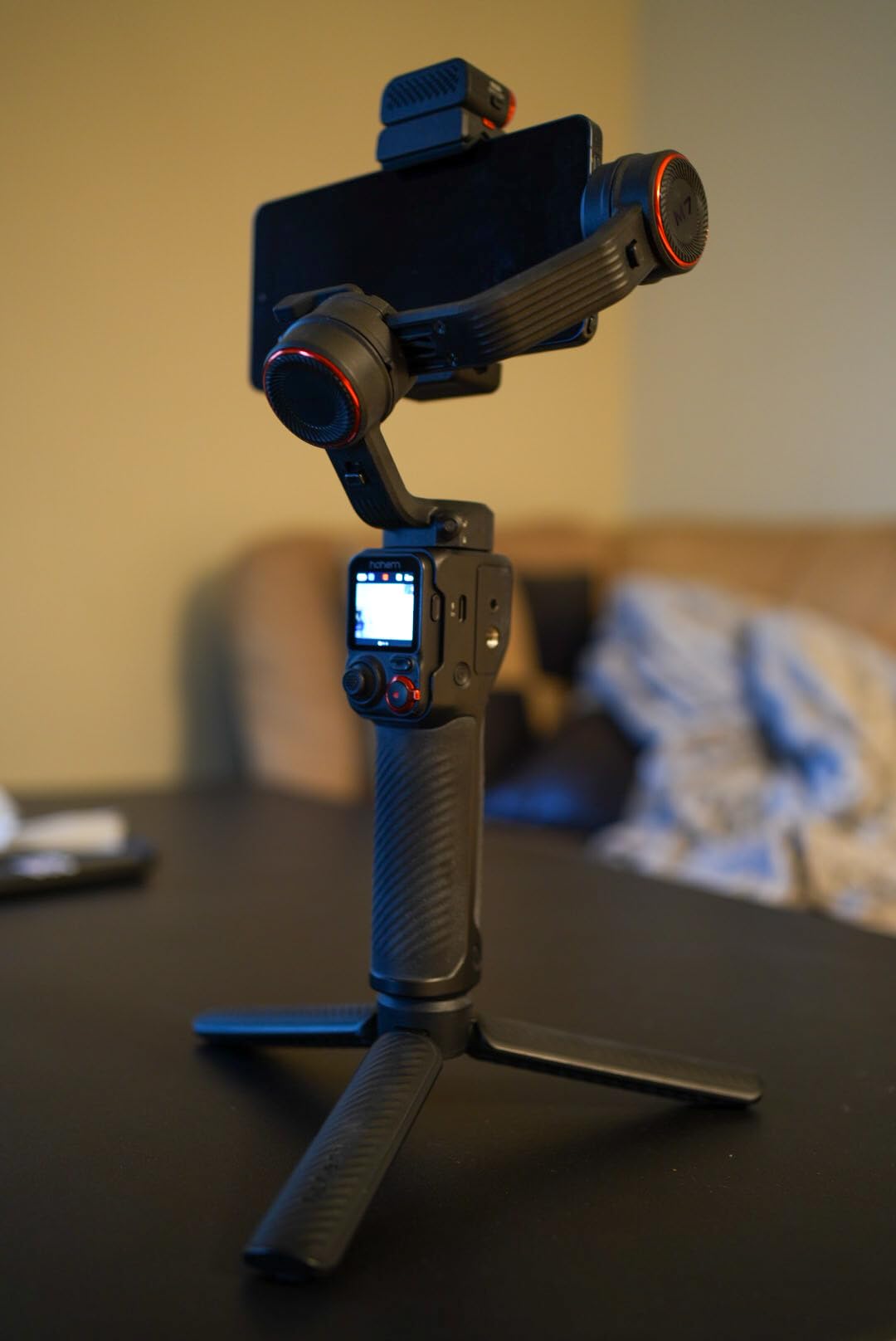
Payload is 500 g, comfortably above most phones, and there are up to three quarter-inch expansion ports for a microphone or an extra light. The tracker doubles as a fill light with adjustable color temperature from 2700K to 6500K, which rescues reception shots in dim rooms where a bigger light would be awkward.
Pan rotation runs a full 360 degrees with 325 degrees of tilt, so follow shots and wide arcs are all available. The wide-angle motor clearance mode, triggered by four clicks of the handle, helps when you want to move in tight without the arm hitting the lens.
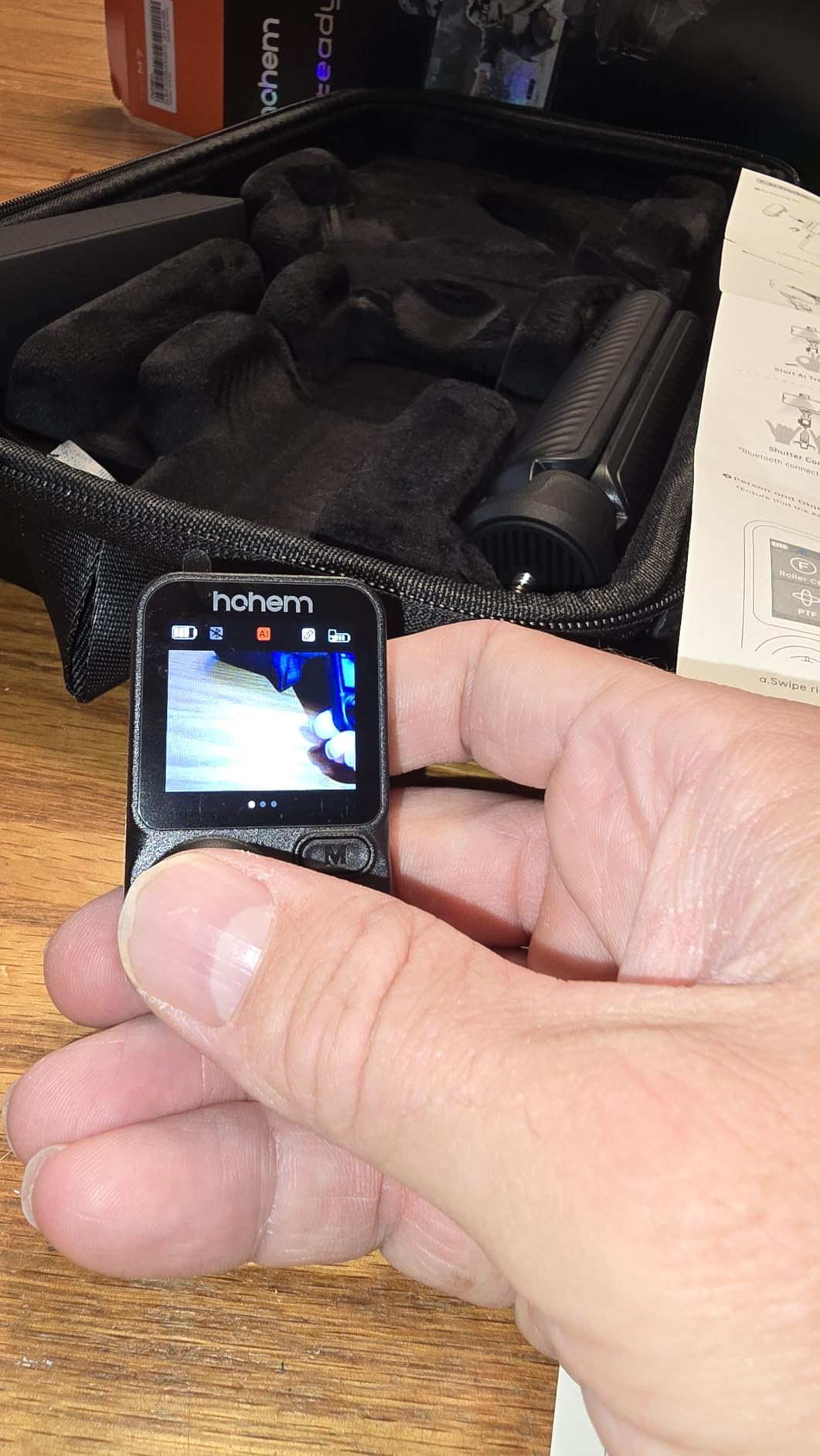
Do the remote range test before a ceremony
Owners report that the detachable remote can lose its video feed once removed from the body on some units. Before you rely on it, walk the actual distance you plan to cover in a venue and confirm the preview holds the whole way.
If you shoot Android, test the Hohem Joy app with your specific handset. Some phones have their own stabilization disabled when shooting through it, which reintroduces the shake the gimbal was meant to remove.
Where it stops being the right answer
At 629 g it is a heavy phone gimbal, and that weight is felt across a long handheld session. If your shoots are mostly close talking-head work in one spot, the weight buys you nothing and a lighter model is kinder on the wrist.
For wedding-specific setups, our wedding videography gimbal guide covers how the remote and the tripod base are used in practice.
4. FeiyuTech SCORP-C Gimbal With Integrated Hanging Handle
FeiyuTech SCORP-C Gimbal Stabilizer for Cameras DSLR and Mirrorless Camera
2.5 kg payload
1200 g body weight
Integrated hanging handle
10 to 13 hour battery
Pros
- Hanging handle allows upright or underslung shooting without a tripod
- Five-way CoG adjustment with a memory slider
- 2.5 kg covers mainstream mirrorless and DSLR kits
- 18W fast charging adds runtime quickly
Cons
- 1200 g is heavy for its class
- No built-in touchscreen
- Control cables are brand specific
- Learning curve for the mode list
The SCORP-C is the one on this list that does not need a separate tripod for underslung work. The integrated hanging handle folds into a bracket, so you can drop the camera below your knees for low-angle walk-throughs and overhead reveals without changing grips mid-shot. On a reception or a first-dance walk-around, that is the difference between a usable angle and a missed one.
Payload is 2.5 kg, and the compatibility list is broad across Sony, Canon, Nikon, Panasonic, Fujifilm and Sigma bodies. Five-way center-of-gravity adjustment with a memory slider means the second setup of the day takes a fraction of the first, which is exactly what a long event day needs.
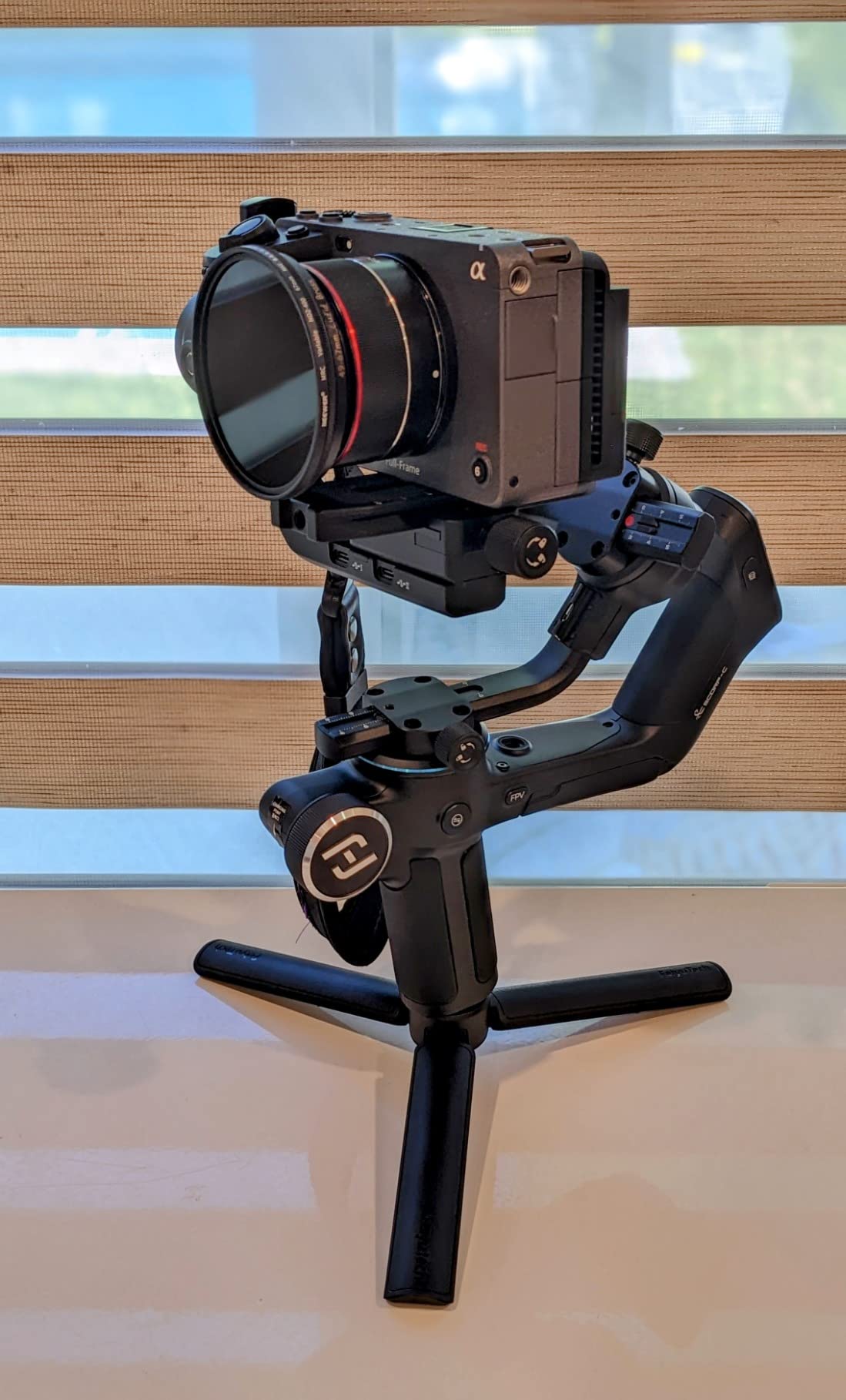
Battery life is rated at 10 to 13 hours from a 2500mAh pack, and 18W fast charging returns roughly half an hour of runtime in five minutes of plugged time. That is a genuine safety net when you cannot afford a second battery on a full-day shoot.
AB trajectory memory and flash mode cover the two moves that are awkward to program by hand every time. An Arca-standard quick release plate means the plate you already own on your tripod likely fits here too.
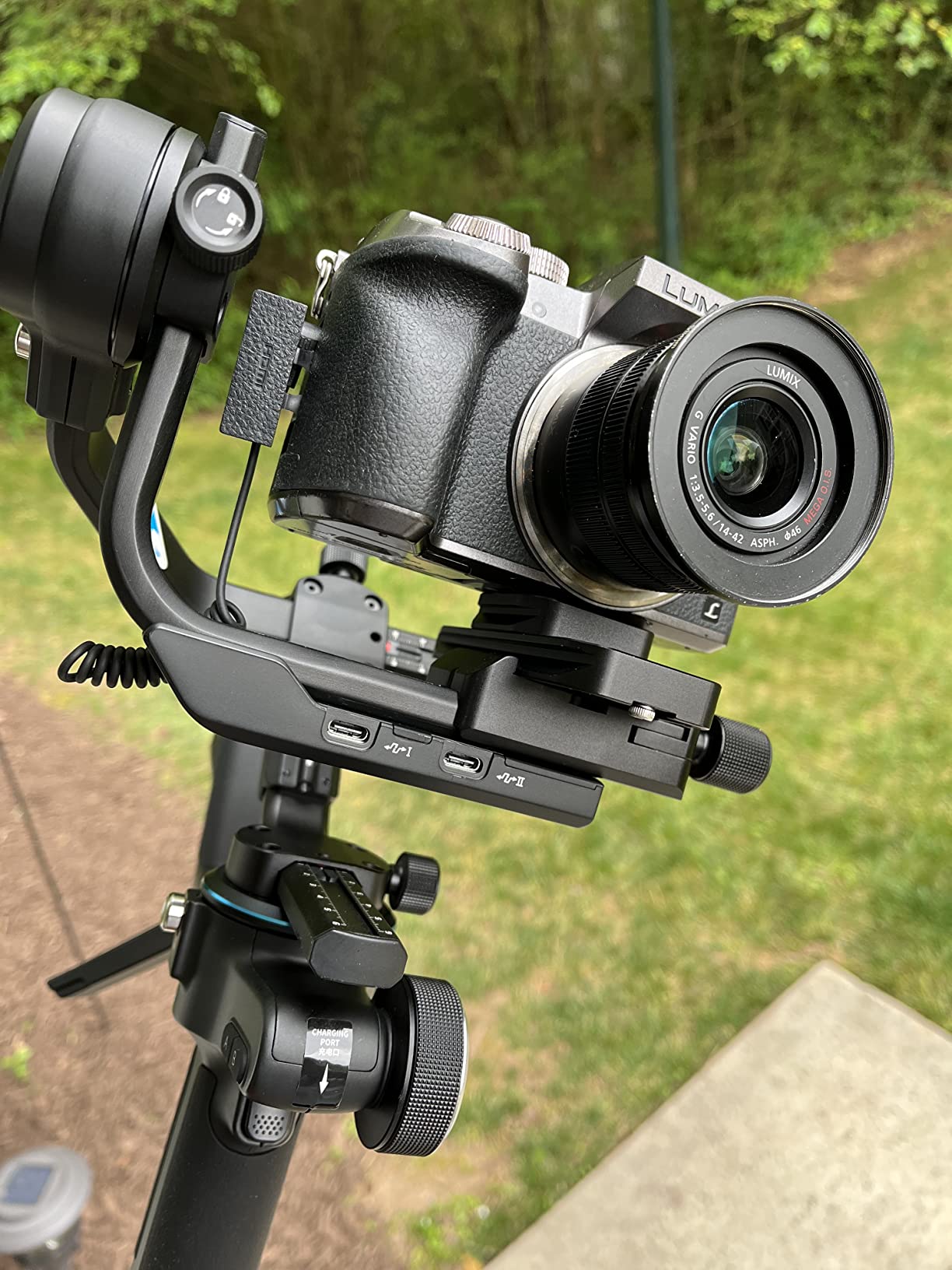
Budget for the right control cable
Each camera brand needs its own shutter control cable, and while the box carries a generous set, check that the cable for your brand is actually included rather than assuming. Bringing the wrong one means no start-stop control from the handle, which quietly costs you footage.
The center-of-gravity memory slider is worth learning. Write down your balance position for each body and lens pairing, and setup time on the second camera of the day drops to under a minute.
Where it stops being the right answer
At 1200 g this is the second-heaviest camera gimbal in our list, and the weight is noticeable by hour six of a wedding. It also has no built-in screen, so every adjustment goes through buttons and the app, which is slower than a touchscreen when you are working fast.
If weight is the deciding factor for you, our DSLR gimbal guide covers lighter bodies in the same payload class.
5. ZHIYUN Weebill 3E Gimbal For Heavier Event Payloads
ZHIYUN CINEPEER Weebill 3E, 3-Axis Lightweight Gimbal Stabilizer for DSLR & Mirrorless Camera Canon/Sony/Panasonic/Nikon, 3KG Payload, Native Vertical Shooting, Bluetooth Shutter Control
3 kg payload
990 g body weight
Folds to A4 size
16 hour battery
Pros
- 3 kg payload on a body weighing 990 g
- Up to 16 hours of runtime
- A4 sized folded footprint for location work
- Native vertical shooting without extra kit
Cons
- Only a Panasonic control cable is included
- Sling grip and wrist rest sold separately
- Not water resistant
- No fill light
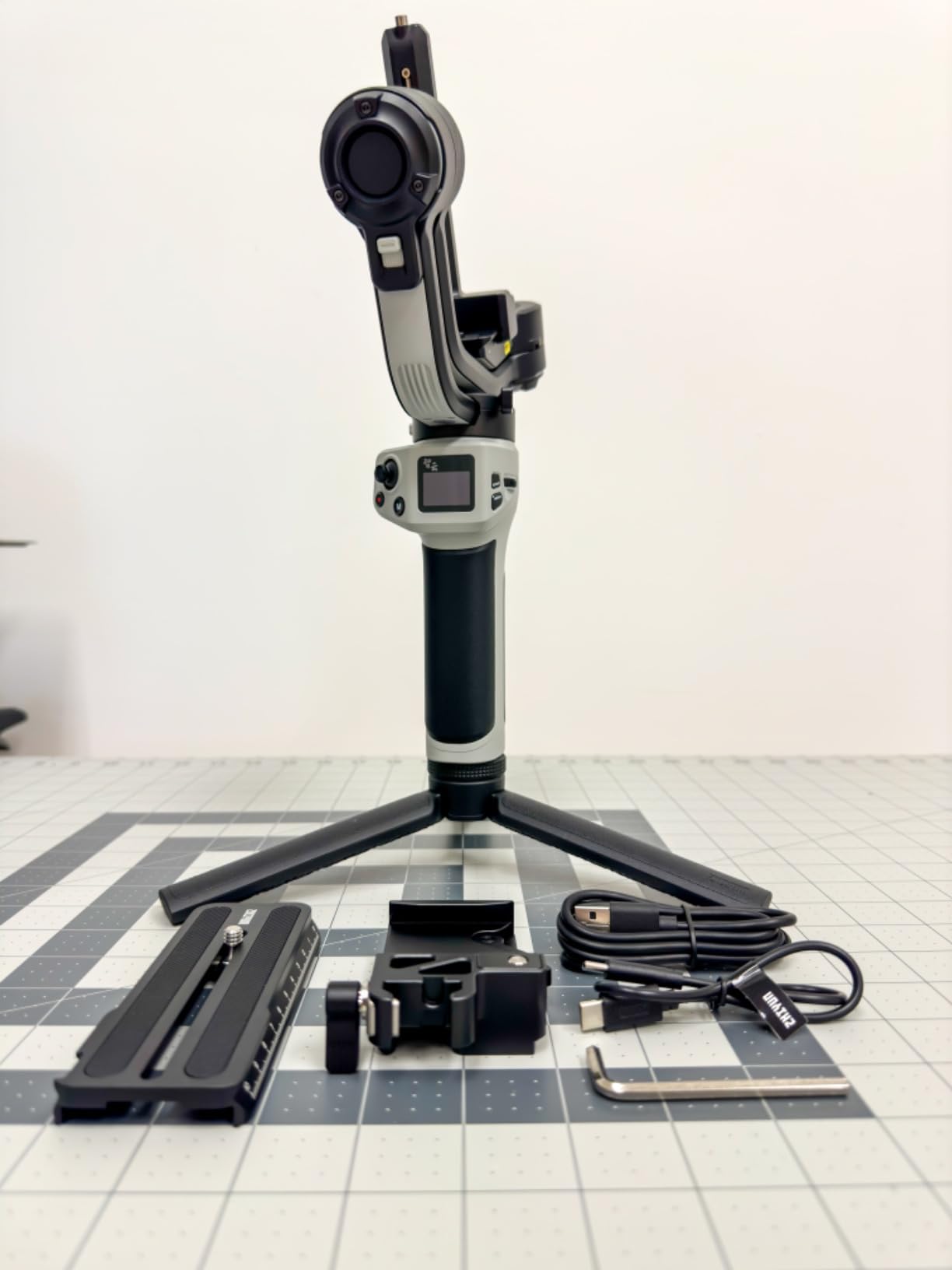
For our own work, this is the gimbal that survives a full ceremony. A 3 kg payload at 990 g of body weight is a ratio we have not found anywhere else under 300, and it means a full-frame body with a zoom stays comfortably inside the envelope rather than riding the ceiling.
Zhiyun lists combinations including 24-70mm F2.8, 24-105 F4G and 16-55 F2.8, which covers the lens range most wedding and event kits actually use. The wide-axis arm cradles different body sizes without a rebuild, so swapping a compact for a full-frame between setups is not a rebalance-from-scratch job.
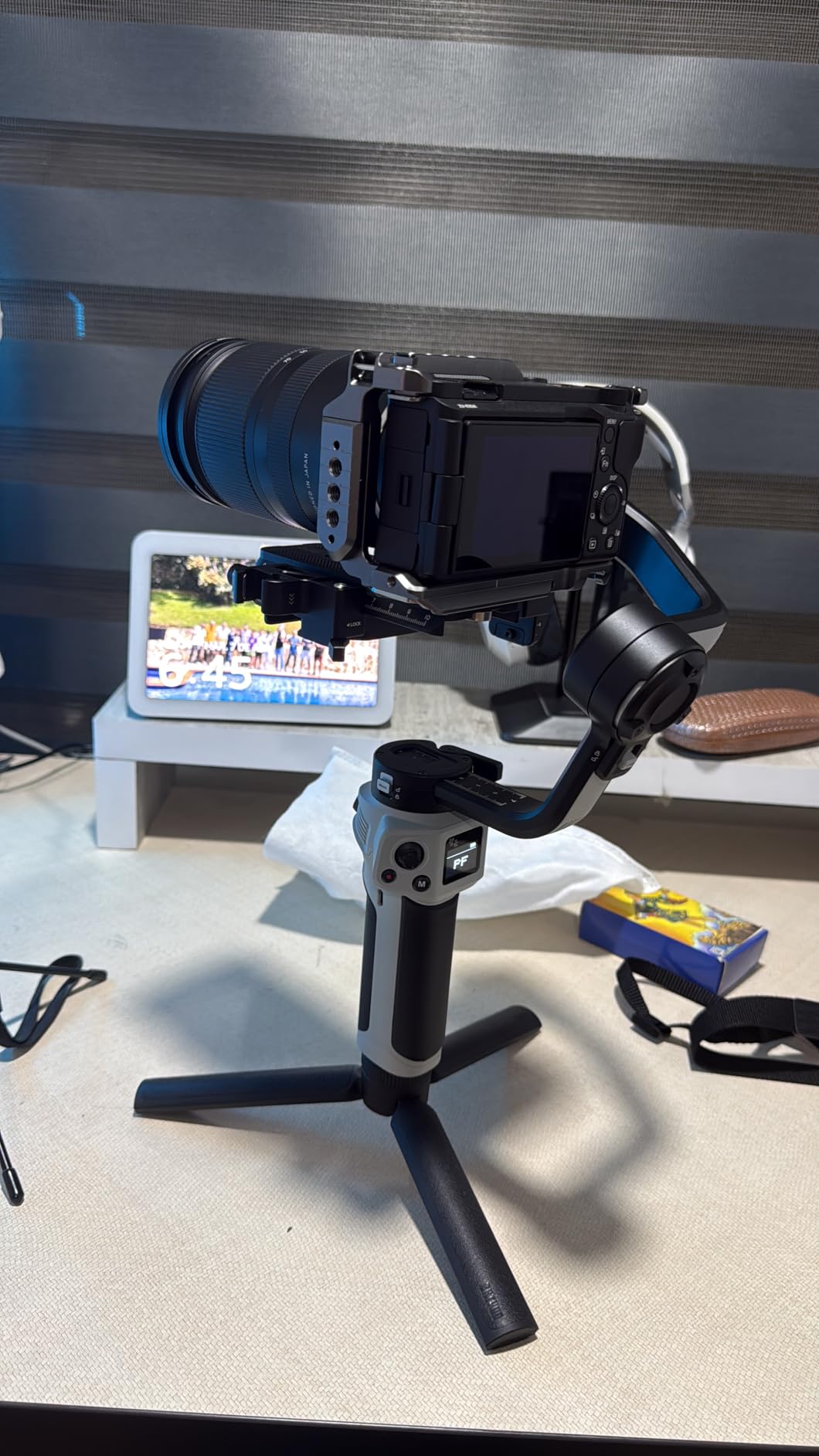
Battery is the headline number at up to 16 hours, with 14W PD fast charging bringing a full charge to roughly two hours and forty-five minutes. Owners frequently mention the 16 hour figure as the reason they stopped carrying spare batteries.
The folded footprint is A4 paper sized, which sounds minor until you are packing a vehicle between locations. The redesigned handle fits a natural holding posture and the sling mode with the wrist rest is what we use for long low-angle sequences.
Factor in the extra cable before day one
Only a Panasonic control cable ships in the box. Sony, Canon and Nikon users need to source their own, and the handle does not act as a shutter otherwise. Sort this out before a paid job, not during it.
The sling mode wrist rest and telescopic sling grip are separate purchases. If long low-angle work is a regular part of your shoots, factor that into the true cost before assuming the listed figure is the whole picture.
Where it stops being the right answer
There is no fill light on this model, so dim interiors need a separate light source. And 442 reviews is a thinner base than the DJI picks here, which is why we pair it with a longer return path consideration if you are new to a brand.
Our wedding filmmaker gimbal guide goes deeper on payload headroom for real ceremony loads.
6. FeiyuTech SCORP 2 Gimbal With Built-In AI Tracking
FeiyuTech SCORP 2 Gimbal Stabilizer for DSLR and Mirrorless Camera, Integrated Al Tracking Sensor, 3-Axis Camera Stabilizer for Sony Canon Panasonic Nikon, 2.5kg Payload Touch Screen Vertical Shooting
2.5 kg payload
1070 g body weight
1.3 inch touchscreen
Built-in AI tracking sensor
Pros
- AI tracking sensor built in
- no extra module needed
- Anti-off quick release for fast vertical switching
- Control cables or Bluetooth camera control
Cons
- 1070 g is bulkier than ultralight travel gimbals
- Advanced settings depend on the Feiyu SCORP app
- Not weather resistant
- Included accessories are generic
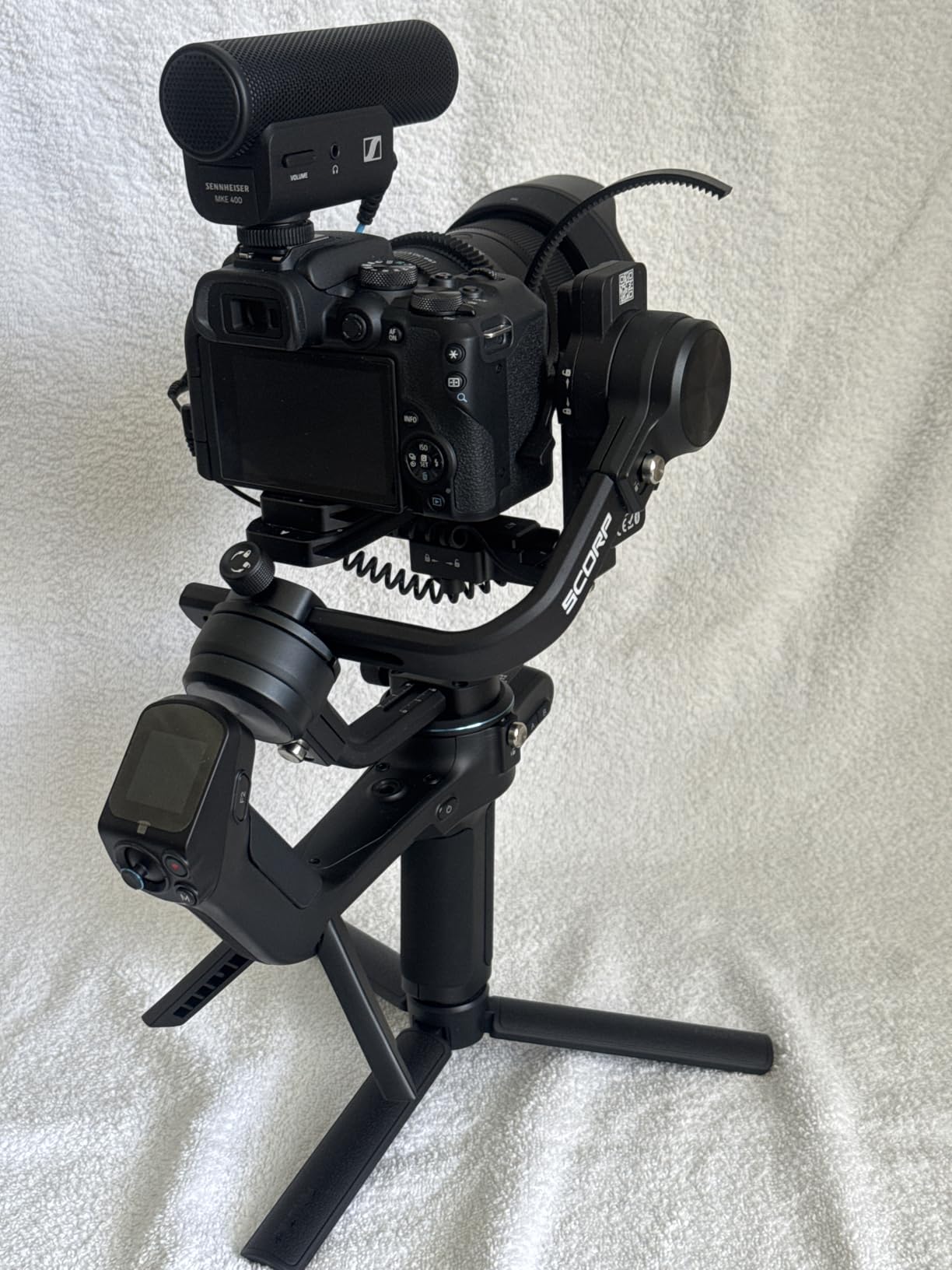
The SCORP 2 integrates the tracking sensor into the body rather than selling it as an add-on. An OK gesture in front of the gimbal starts subject tracking, and other gestures handle photo and video control. For someone filming alone at an event, removing the cost and the extra module of a separate tracker is a real saving in both senses.
At 2.5 kg the payload comfortably covers typical mirrorless and DSLR kits, and the 1.3 inch touchscreen shows filming status and key parameters. A multifunction knob next to the screen handles per-axis rotation and electronic zoom without menu diving.
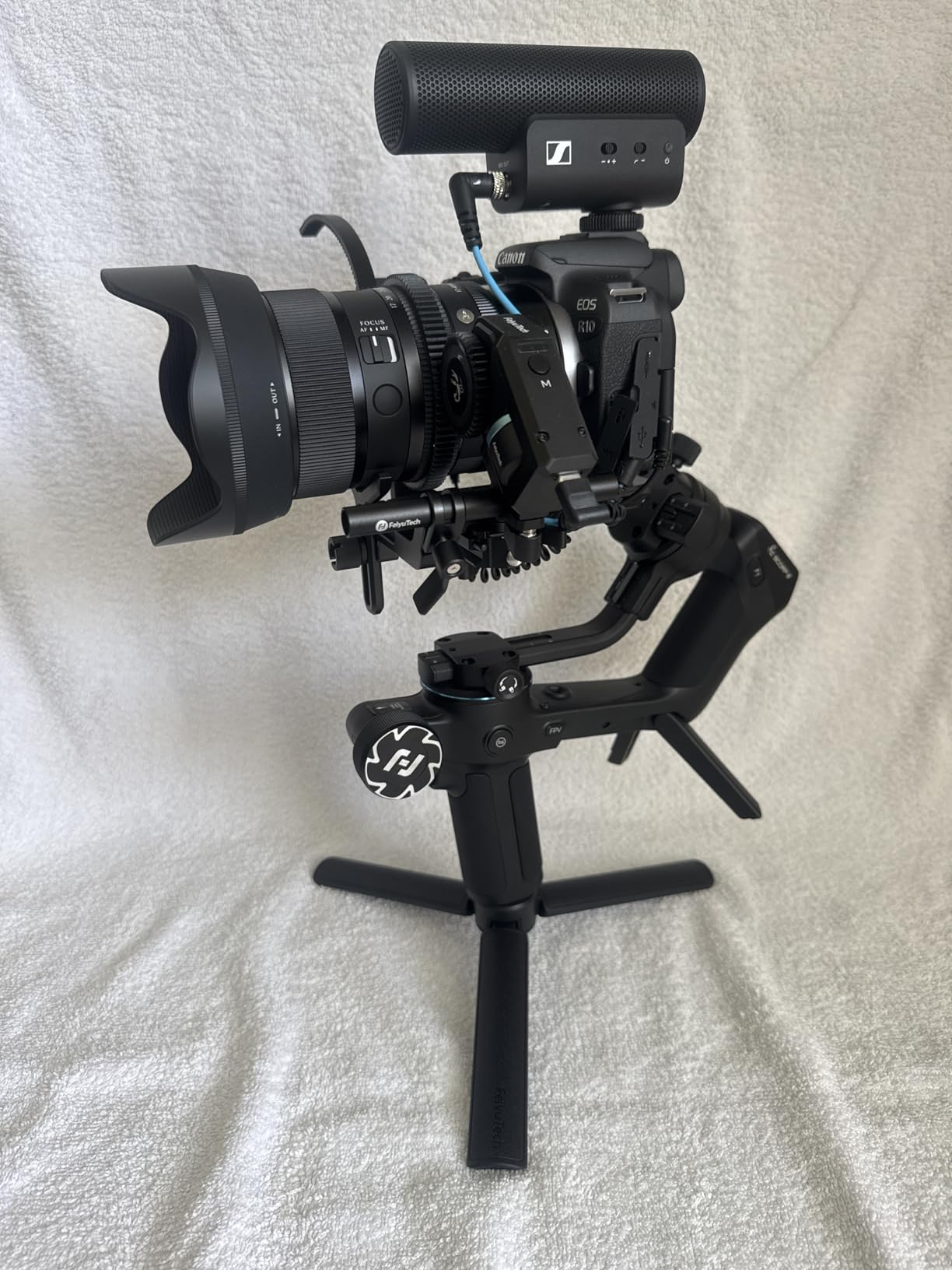
The new-generation L-shaped mounting plates with an anti-off quick release slider make horizontal to vertical switching close to instant, which is the single most requested feature for short-form vertical content in this class. Wired or Bluetooth camera control is supported, and the half-press focus trigger is a small touch that makes follow-focus style moves easier.
The app also exposes a gravity-sensor remote mode, using the phone to nudge the lens direction so you can reposition a solo shot without touching the handle. At 4.4 stars from 184 reviews the reception is positive, with the tracking sensor singled out as the reason it beats add-on tracker setups.
Verify tracking before the event, not during
Gesture tracking is fast when it works, but it needs a clear line of sight and a reasonably lit subject. Run a ten minute test with the lighting you will actually have, because reception rooms and backlit ceremonies behave very differently from a product demo.
Note which control cables you need before the day. The kit ships with several, but the bundled accessories are generic rather than brand-specific, so check your body against the list.
Where it stops being the right answer
At 1070 g it is bulkier than dedicated travel gimbals, and advanced settings sit behind the Feiyu SCORP app, so a mid-shoot adjustment means a phone. With 184 reviews the track record here is thinner than the DJI options, which matters if reliability is your priority.
7. ZHIYUN Weebill 3S Gimbal With A Built-In Fill Light
ZHIYUN Weebill 3S [Official] 3KG Payload Gimbal Stabilizer with Fill Light
3 kg payload
1100 g body weight
1000 lux fill light
11.5 hour runtime
Pros
- Built-in dual color temperature fill light
- 3 kg payload with tuned follow curves
- Native horizontal and vertical switching in about 3 seconds
- Sony Canon and Panasonic cables included
Cons
- 0.96 inch status screen shows very little
- Some reports of early motor or axis faults
- Heavier than the Weebill 3E at the same payload
- Fill light is not a substitute for a dedicated light
The reason to pick the Weebill 3S over the 3E is the light. A built-in 1000-lux dual color temperature fill light, adjustable from 2600K to 5500K, sits in the top of the handle and throws light forward onto your subject. For a ceremony or a first dance in a dim room, that removes an entire piece of kit from the bag.
The tenth-generation honeycomb algorithm re-tunes the follow and smoothing curves for common shooting scenes, which shows up most in the slower moves that make event footage feel polished. Payload is 3 kg and it supports mainstream DSLR and mirrorless bodies with 24-70 F2.8 lenses across Nikon, Panasonic, Canon and Sony.
![ZHIYUN Weebill 3S [Official] 3KG Payload Gimbal Stabilizer with Fill Light customer photo 1](https://www.kingdomweddingphotography.com/wp-content/uploads/2026/07/B0C1Z9HLY2_customer_1.jpg)
Battery is dual 2600mAh cells rated at 11.5 hours, with a full PD fast charge in roughly two hours. Native horizontal and vertical shooting switches through the quick release in about three seconds, and Bluetooth shutter control pairs with mainstream mirrorless bodies.
Unlike several cheaper kits, the box includes Sony, Canon and Panasonic control cables, so the setup that bites buyers on other models here is already covered. A quarter-inch interface is provided for accessories.
![ZHIYUN Weebill 3S [Official] 3KG Payload Gimbal Stabilizer with Fill Light customer photo 2](https://www.kingdomweddingphotography.com/wp-content/uploads/2026/07/B0C1Z9HLY2_customer_2.jpg)
Treat the rating spread as a real signal
At 4.2 stars from 181 reviews, this is the lowest-scoring Zhiyun in our group, and one-star and two-star reviews point to early motor or axis faults on some units. That is a reliability pattern, not a features problem, and it is worth a return window that actually suits you.
The 0.96 inch status screen shows working status and little more. If you expect to change parameters mid-shoot, you will be doing it in the app rather than on the body.
Where it stops being the right answer
At 1100 g it is heavier than the Weebill 3E despite matching payload, and the fill light, while genuinely useful, will not carry a demanding reception on its own. For a daylight-heavy schedule, you are carrying extra weight for a feature you rarely switch on.
8. FeiyuTech SCORP Mini-3-Pro Gimbal For Four Device Types
FeiyuTech SCORP Mini-3-Pro Gimbal Stabilizer for Camera Mirrorless/Compact/Action Cameras,Smartphone,18m AI Tracking,Detachable Remote Handle,4.4lbs Payload,3-axis Gimbal for Canon Sony Nikon
2 kg payload
1 kg body weight
AI tracking to 18 m
Detachable remote handle
Pros
- Handles mirrorless compact action cams and phones
- AI tracking with 0.003 s response to 18 m
- Detachable handle works as a remote
- Extended quick release plate takes larger rigs
Cons
- About 1 kg is not ultralight
- A phone holder and GoPro adapter add bulk
- Advanced settings still lean on the app
- Not water resistant
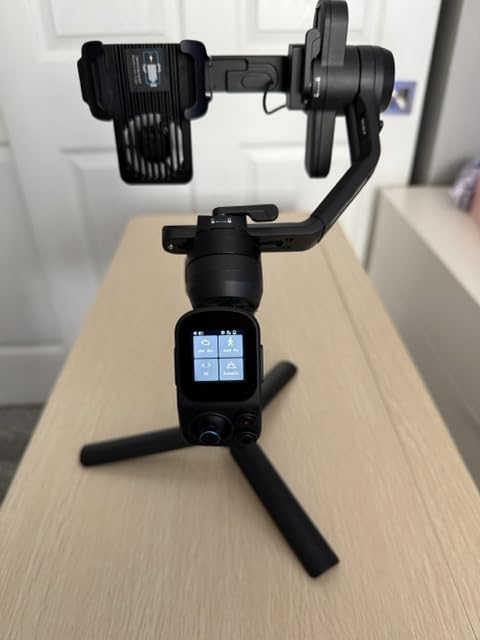
The Mini-3-Pro is the most flexible body in this list. One gimbal covers mirrorless cameras, compact cameras, smartphones and action cameras, which means a solo shooter carrying one rig can cut a reel, a YouTube segment and a vertical clip without swapping systems or packing a second stabilizer.
Tracking is the standout specification: AI Tracking 4.0 reaches 18 m with a stated 0.003 s response, and the tracking view is 40 percent wider than the previous generation. Combined with 360-degree infinite follow, that is genuinely useful when you set the rig down and step into the shot.
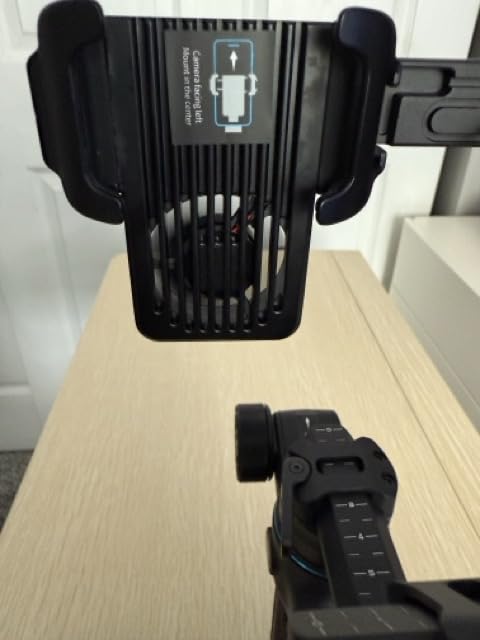
The detachable grip handle doubles as a remote control, so you can place the gimbal on its tripod and operate it from a distance. For solo creators filming alone, that removes the second-person problem entirely and is the reason this model earns its place on this list.
Stabilization 10.0 uses a quaternion algorithm tuned for high-speed motion, and the 2 kg payload works with an extended quick release plate for larger rigs. The modular plate and fixed slider disassemble as a unit, making horizontal to vertical switching fast.
Accept the extra bulk in the bag
Supporting four device types means carrying a smartphone holder and a GoPro adapter even when you are only using one of them. That is the trade for versatility, and it is worth weighing honestly against a single-purpose model if bag space is tight.
With 151 reviews, the feedback base is the thinnest among the well-rated models here. Test tracking range and the handle remote in your own space before committing.
Where it stops being the right answer
At roughly 1 kg it is not the lightest option for ultralight travel, and advanced settings still lean on the companion app. If you only ever shoot one camera type, the versatility does not pay for itself.
9. ZHIYUN Crane M3S Compact All-In-One Gimbal
Zhiyun Crane M3S Handheld Gimbal 3-Axis Stabilizer All in One Design for Mirrorless Cameras Like Sony,Canon,Smartphone Like iPhone,Sumsung,Action Cameras Like Gopro (Crane M3 Upgrade Version in 2023)
705 g body weight
1.22 inch built-in screen
Built-in fill light
7.5 hour battery
Pros
- Lightest camera gimbal in this group at 705 g
- Built-in screen and fill light at this size
- Quick release avoids camera disassembly
- Bluetooth shutter control for zoom and recording
Cons
- Tilt-axis height adjustment does not hold when tightened
- Limited stabilized movement range compared with larger gimbals
- 7.5 hour battery is the shortest here
- Some report bumpy motor movement after about a year
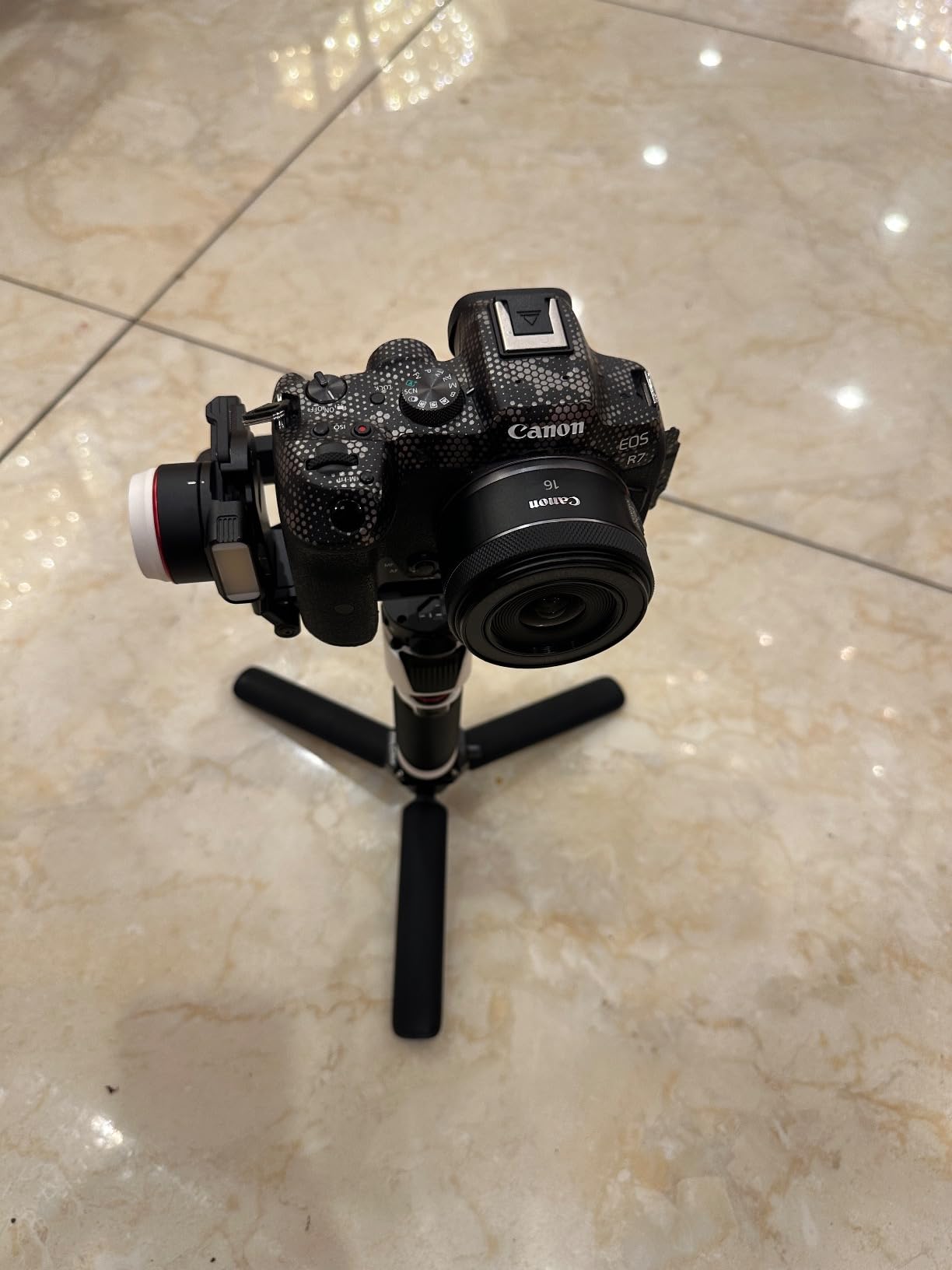
At 705 g this is the lightest camera gimbal in our group, and for travel work that changes what you are willing to carry. The all-in-one body handles mirrorless cameras, phones and action cameras, and a 1.22 inch screen plus fill light are unusual at this size.
The quick release system is worth noting: it is compatible with mainstream cameras without disassembly, so you can swap bodies in seconds. Bluetooth shutter control handles wireless zoom and recording, and the screen plus joystick allow single-hand operation, which is useful when you are directing while filming.
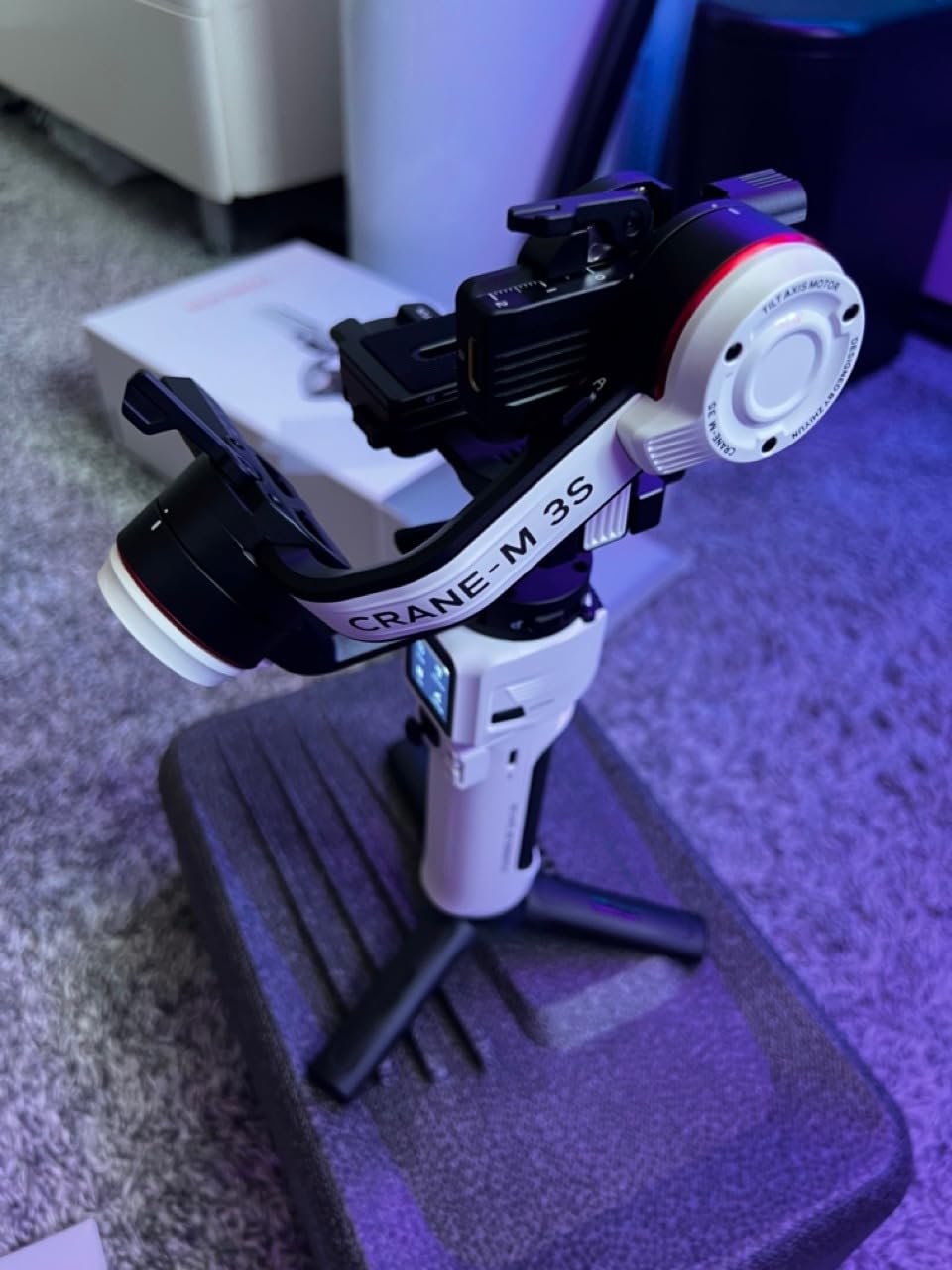
Modes cover PF, Lock, Follow, POV, Go and Vertical, and the battery runs up to 7.5 hours with PD fast charging and the ability to charge while you shoot. Users describe the stabilization as clean and quiet, holding up over bumps and jumps.
This is the lowest-rated product in our list at 4.1 stars from 110 reviews, and the distribution shows it with a noticeable one-star share. Enthusiastic owners love the weight and the all-in-one concept; the recurring complaints are the fiddly tilt-axis adjustment and durability reports after extended use.
Expect to re-tune the balance more than once
The tilt-axis height adjustment is the most cited issue. Owners report it is finicky and does not hold its position once tightened, so allow more setup time than a stiffer mechanism would need and re-check the balance before every location change.
Movement range is also more limited than on the larger gimbals here, so sweeping arcs and long orbits are tighter. Know what the rig does before you plan an ambitious move around it.
Where it stops being the right answer
The 7.5 hour battery is the shortest in this group, which is tight for a full event day, and app registration has thrown already-connected errors for some buyers. If you need all-day capacity or plan ambitious moving shots, the 2026 alternatives in the 3 kg class serve better.
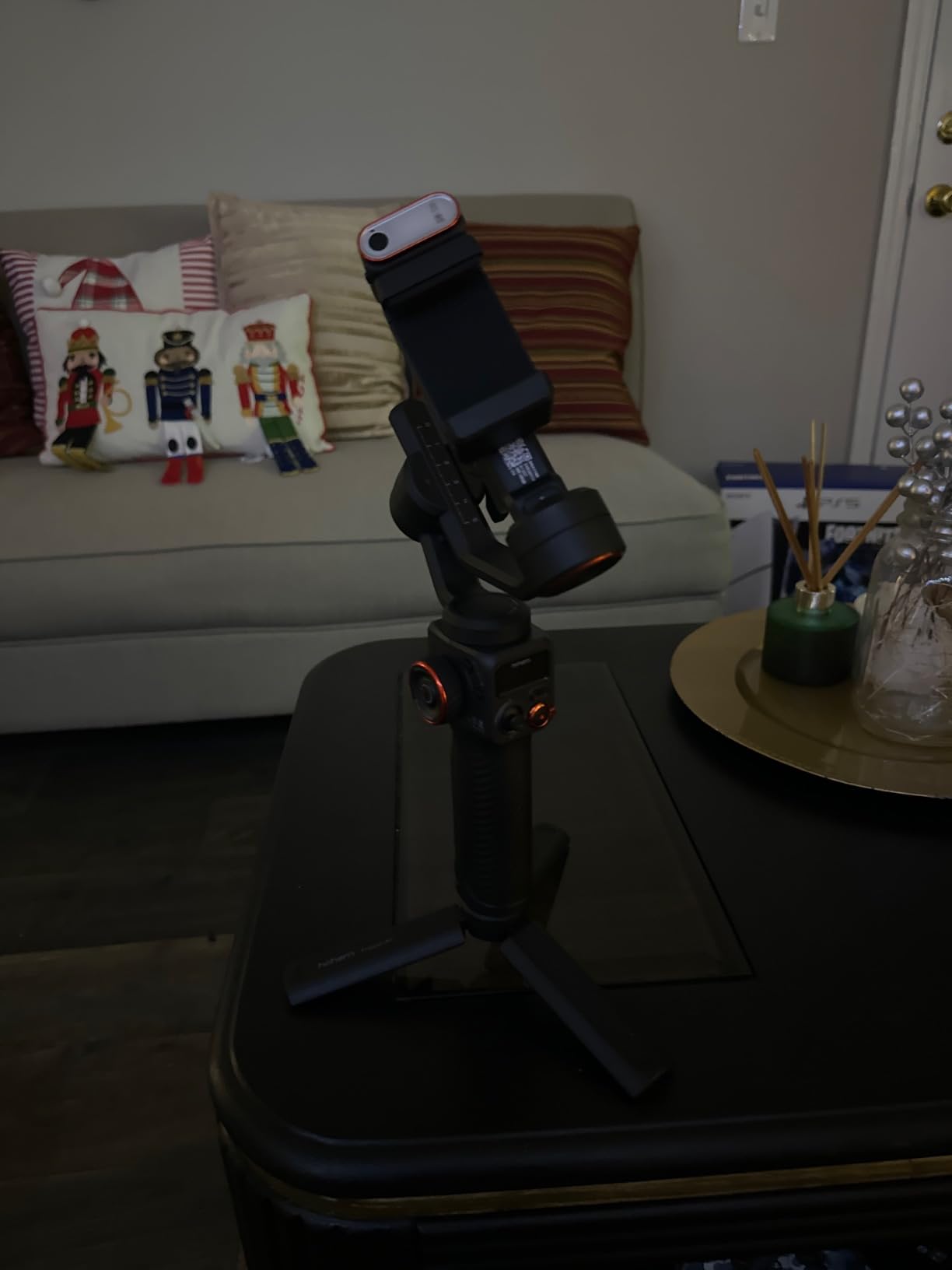
10. Hohem iSteady M6 Kit Phone Gimbal With AI Vision Sensor
hohem iSteady M6 Kit Gimbal with AI Tracking & Magnetic Fill Light
400 g phone payload
18 hour battery
CCT and RGB fill light
Inception mode
Pros
- 18 hour runtime plus reverse charging
- AI vision sensor tracks without Bluetooth or the app
- Fill light with 360 RGB ambient colors
- 0.91 inch OLED status display
Cons
- Hohem Joy app has failed to record or save for some users
- Losing the app loses record zoom and focus functions
- Portrait rotation requires removing the phone
- Motors can overheat if charged while in use
The iSteady M6 is the pick if your phone is the only camera you own and you want a full day of shooting on one charge. Eighteen hours of runtime is the longest figure among these ten, and it will reverse-charge your phone when the battery runs low.
Tracking runs through a built-in AI vision sensor that follows faces and bodies with hand gestures, with no Bluetooth connection or app limit. The 400 g payload and four expansion ports let you add a microphone or a light, and the CCT and RGB fill light with 360 ambient colors handles dim rooms without extra gear.
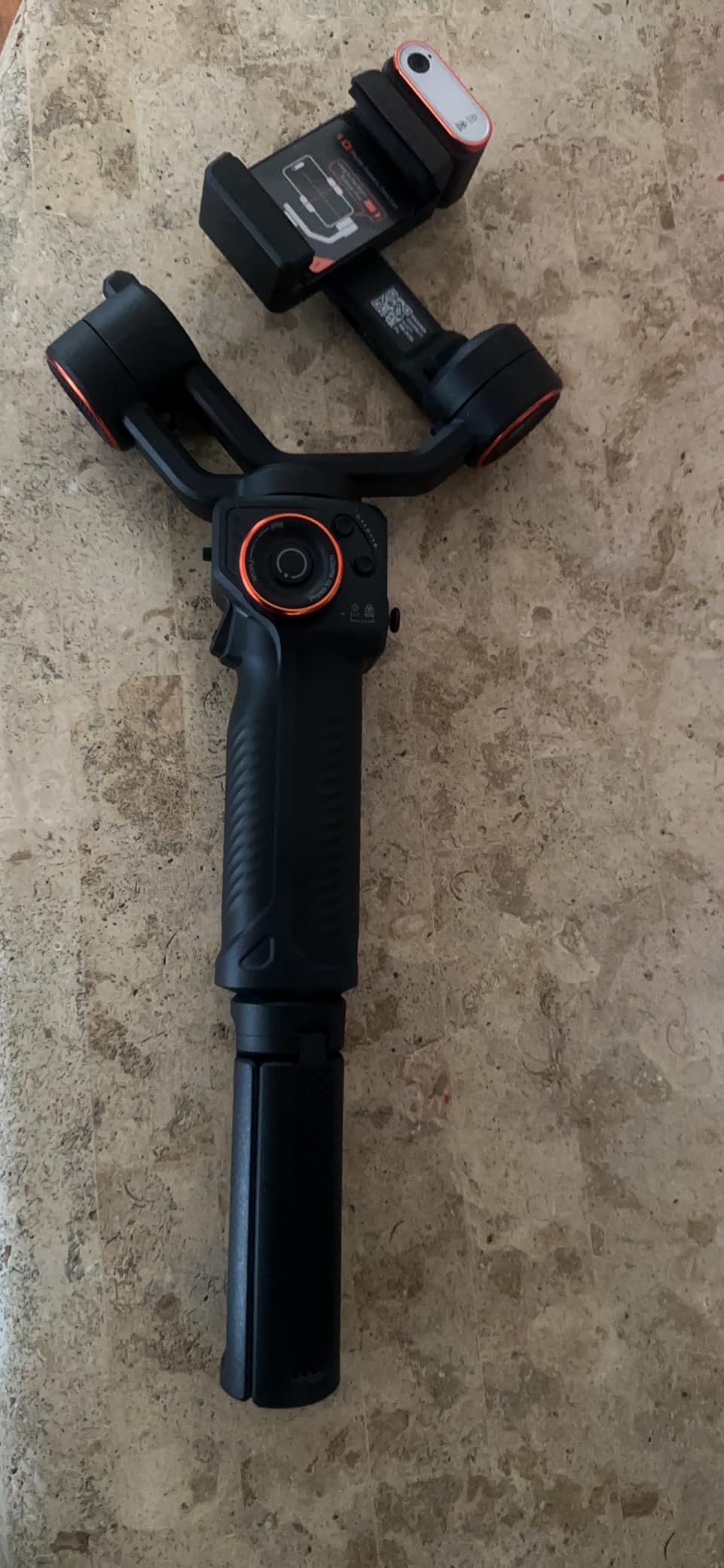
Inception mode rotates the phone through a full vertical turn with 335 degrees of roll and pitch range, which is a small creative tool most phone gimbals at this level skip. The seventh-generation iSteady 7.0 algorithm smooths walking and panning shots, and a 0.91 inch OLED display shows power and status in real time.
At 4.3 stars across 1460 reviews it is one of the better-proven models here, and Hohem customer service is repeatedly praised, including free replacement of tripod feet.
Test the app on your handset first
The dominant complaint by far is the Hohem Joy app failing to record or save for some users, and losing the app means losing the record, zoom and focus button functions on the handle. This is the single deal-breaker on this list, so verify it with your phone before committing.
Two smaller traps: rotating to portrait requires a counter-clockwise turn that forces you to remove the phone, and AI tracking drops off sharply beyond about 30 feet. Balance before mounting to avoid motor overheating, and do not charge while it is running.
Where it stops being the right answer
If you need a detachable monitor or longer tracking reach, the Hohem iSteady M7 above is the step up. The M6 earns its place on runtime, app-free tracking and price, not on every specification.
How to Choose a Gimbal Under $300?
Start with payload, because it is the one specification that cannot be worked around. Payload capacity is the maximum camera weight a gimbal can balance while stabilizing smoothly, and it includes the body, the lens, the battery, cards and anything bolted to the rig. Measure your full setup, then add roughly 20 percent headroom so the motors are not running at their limit in the middle of a shot.
A rough guide: a phone needs around 400 g, a compact camera with a small lens sits in the 1 to 1.5 kg range, a mirrorless body with a kit lens needs about 2 kg, and a mirrorless body with a zoom lens or a small cinema camera pushes toward 2.5 to 3 kg. Full-frame with a fast zoom sits at the top of that range, and that is where the 300 dollar ceiling starts to squeeze.
Phone gimbal or camera gimbal
If your footage comes from a phone, you want a phone gimbal and nothing else. These weigh less, balance in seconds, and include features built for vertical video and app-based tracking. A camera gimbal will not accept a phone without an adapter, and the adapter adds wobble that defeats the purpose.
If you shoot a mirrorless or DSLR body, you need a camera gimbal. Phone gimbals cannot take the weight, and the ones that can are unusual and not covered in this roundup. The reverse is also true: buying a camera gimbal to stabilize your phone means an adapter, a balance change every time you switch, and a much heavier rig for social clips.
The genuine middle ground is the FeiyuTech SCORP Mini-3-Pro, which handles mirrorless, compact, action and phone devices on one body. It is the compromise worth considering if your output genuinely spans both formats.
How to balance a gimbal the first time
Balancing is the number one frustration for new owners, and it takes about five minutes once you know the order. First, power the gimbal on and let it complete its self-test, then switch every motor to lock mode so the arms hold position while you work.
Second, mount the camera on the quick release plate with the lens forward, and slide the plate forward or back until the camera does not tip forward or backward when you let go. Third, adjust the tilt axis side to side until the camera sits level with the horizon and the arm feels neutral, not fighting to stay in place.
Fourth, adjust the roll arm so the camera is upright when viewed from behind the grip, then lock that axis. Fifth, unlock all motors, hold the handle with one hand near the base, and let go. If the camera holds its position, you are balanced. If it swings or sinks, go back one step.
Write your balance position down for each body and lens combination. Most of the models here have a center-of-gravity memory feature, and on a long day the difference between a two-minute and a ten-minute setup is the difference between catching moments and watching them.
What you give up below this ceiling
Nothing in this list has a focus motor port, and that is the single biggest reason working videographers eventually spend more. Without it, rack focus has to be pulled by hand or via a lens with electronic focus support, and a smooth push-in on a ceremony ring or a product beauty shot is out of reach.
Image transmission is the second gap. Below 300, gimbals typically feed video back over USB rather than wirelessly to a monitor, so a solo operator loses the ability to frame wide shots remotely. The Hohem iSteady M7 comes closest, with a detachable screen that works up to 10 m, and that is the feature to look for if you film alone.
Weather sealing is absent across all ten. None of these are rated for water resistance, so an outdoor ceremony in wet weather means keeping the rig under cover. Battery figures also deserve a reality check: the advertised 10 to 16 hour ratings are measured at moderate payload, and heavier cameras with a zoom draw more power, so carry a spare battery for a full event day regardless.
Frequently Asked Questions
What is the best affordable gimbal?
Under 300, the DJI Osmo Mobile 7P is the strongest all-round pick for phone shooters, with a 4.5 star average across more than 7000 reviews, up to 10 hours of runtime and native tracking. If you shoot a mirrorless body, the DJI RS 3 Mini covers most kits with a 2 kg payload on an 795 g body, and the ZHIYUN Weebill 3E reaches 3 kg for heavier event work.
Which brand gimbal is best?
DJI leads on app polish, ecosystem integration and proven reliability, and it has the largest review base in this group. Zhiyun offers the best payload-to-weight ratio here, with 3 kg on a 990 g body. FeiyuTech delivers the most features per unit, including built-in AI tracking and fill lights, while Hohem makes the most capable phone gimbals with app-free tracking and very long batteries.
What are the best budget mobile gimbals?
The Hohem iSteady M6 Kit and DJI Osmo Mobile 7P are the two strongest budget phone gimbals. The M6 Kit runs up to 18 hours with app-free AI vision tracking, a CCT and RGB fill light and Inception mode. The Osmo Mobile 7P adds a built-in extension rod and tripod, plus DJI wireless mic reception in its multifunctional module, and holds a larger review base.
What payload capacity do I need for a mirrorless camera?
A mirrorless body with a kit lens usually needs about 2 kg of payload, which covers models like the DJI RS 3 Mini. A body with a zoom lens or a small cinema camera needs 2.5 to 3 kg, pointing you toward the FeiyuTech SCORP-C, the FeiyuTech SCORP 2 or the ZHIYUN Weebill 3E and 3S. Add roughly 20 percent headroom above your measured total weight.
Do I need a gimbal if my camera has image stabilization?
In-camera stabilization only corrects movement on the sensor, so it cannot remove the high-frequency footfalls and hand sway that walking footage produces. A gimbal corrects movement before it reaches the camera, which is why stabilization and a gimbal solve different problems. Many shooters use both, and a tripod still wins for locked-off static shots where a gimbal is not needed.
How do I balance a gimbal?
Power the gimbal on, let it self-test, then lock all motors. Mount the camera with the lens forward and slide the plate until the body no longer tips forward or backward. Adjust the tilt axis side to side until the camera sits level, then set the roll arm so it is upright from behind the grip. Unlock the motors, hold the handle at the base, and let go to confirm the balance holds.
Final Verdict
Ten distinct models, one price ceiling, and a clear split. If you shoot on a phone, buy the DJI Osmo Mobile 7P: the 4.5 star average over 7081 reviews is the strongest evidence in this roundup, and the extension rod, tripod and mic receiver make it a complete solo kit. If you shoot a mirrorless body, the DJI RS 3 Mini is the balance of weight and payload, while the ZHIYUN Weebill 3E is the one we trust with a full-frame body and a zoom on a long ceremony day.
Balance before you power on, add 20 percent payload headroom, and keep a spare battery. Those three habits fix most of the complaints in the reviews above, and they cost nothing.