
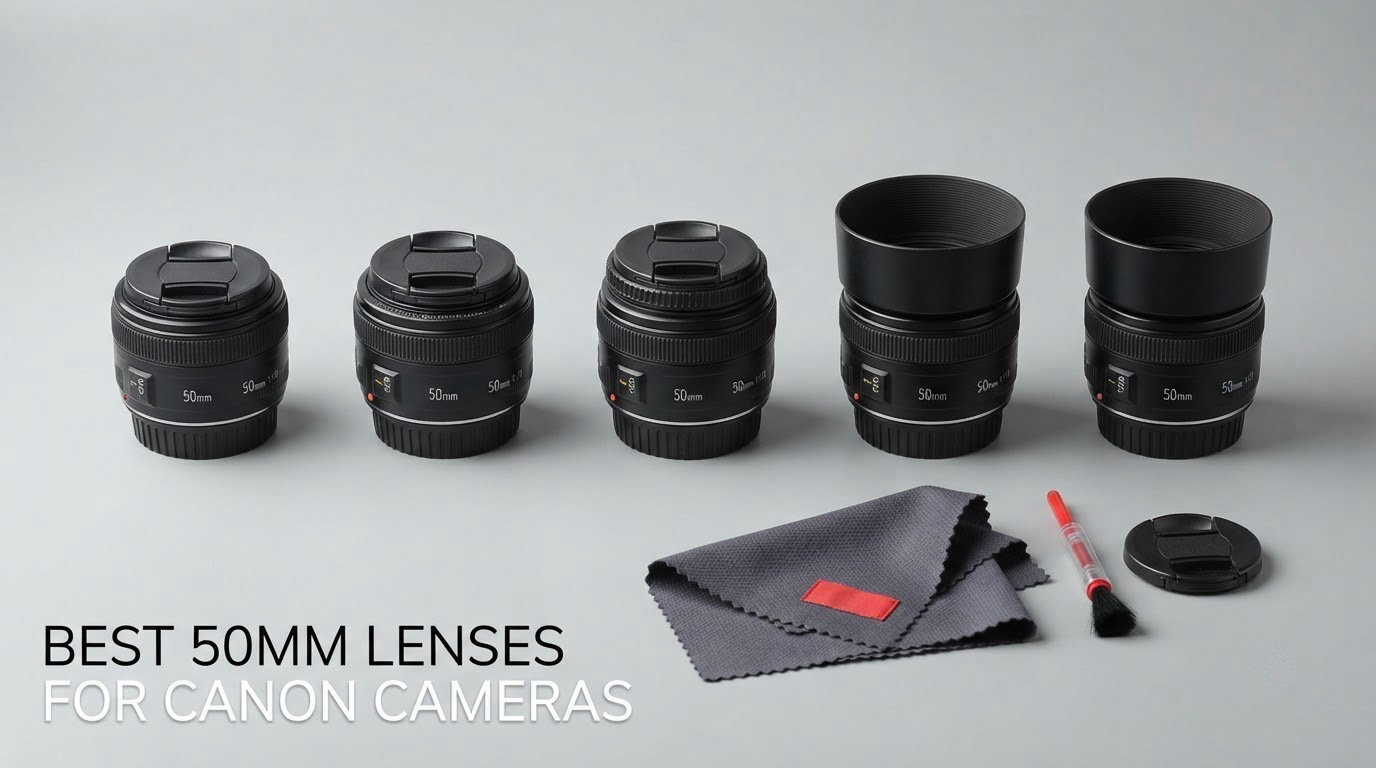
A 50mm lens is a fixed-focal-length prime that reproduces roughly the field of view of the human eye on a full-frame camera, which is why photographers also call it a standard lens or a nifty fifty. On Canon’s 1.6x APS-C bodies the same lens frames like an 80mm, so it doubles as a short portrait lens. We shoot weddings every weekend, and the best 50mm lenses for Canon cameras fall into a very predictable ladder: f/1.8, f/1.4, f/1.2, in both EF and RF mounts.
That ladder is the whole problem. Two of the most common questions we get are whether the jump from f/1.8 to f/1.4 is worth it, and whether an EF lens is still a sensible buy in 2026. Our answer is that the aperture step is worth it only if you shoot dim rooms without flash, and that EF glass still makes sense on almost any Canon body with an adapter in hand. If you are still building a first kit, start with our beginner’s guide to 50mm lenses.
Below is the roundup we actually use. Ten 50mm primes mount to Canon bodies, covering the budget f/1.8 plastic through the L-series glass, plus the third-party EF and RF options that never make the big magazine lists. Each pick gets a verdict, the reasons to buy it, and the reasons to skip it. We have compared all ten across Canon bodies, and we lean on owner review data alongside our own frames.
Table of Contents
Our Top 3 Canon 50mm Picks in October 2026
The three lenses below cover the range most Canon shooters actually need. The EF 50mm f/1.8 STM is the default answer for almost everyone, the RF 50mm f/1.8 STM is the mirrorless equivalent, and the Sigma 50mm F1.4 Art is the one to buy if sharpness wide open matters more than weight.

Canon EF 50mm f/1.8 STM
- 50mm f/1.8 maximum aperture
- Only 5.6 ounces in weight
- Near-silent STM autofocus motor
- 0.35 m minimum focusing distance

Canon RF 50mm F1.8 STM
- 50mm f/1.8 on the RF mount
- 43 mm filter thread
- Gear-type STM focusing
- Control ring for direct setting changes

Sigma 50mm F1.4 Art DG HSM
- f/1.4 aperture with 9 rounded blades
- Sharp wide open at f/1.4
- Ring-type ultrasonic HSM focusing
- 77 mm filter thread
Canon 50mm Lenses at a Glance in October 2026
This table lists all ten primes in the roundup with their key specs. Use it to narrow the field, then read the individual write-ups for the trade-offs.
| Product | Specifications | Action |
|---|---|---|
| Canon EF 50mm f/1.8 STM |
|
Check Latest Price |
 YONGNUO YN50mm F1.8 YONGNUO YN50mm F1.8 |
|
Check Latest Price |
 Canon EF 50mm f/1.4 USM Canon EF 50mm f/1.4 USM |
|
Check Latest Price |
| Canon RF 50mm F1.8 STM |
|
Check Latest Price |
| Sigma 50mm F1.4 Art DG HSM |
|
Check Latest Price |
 Canon EF 50mm f/1.2L USM Canon EF 50mm f/1.2L USM |
|
Check Latest Price |
 Canon RF 50mm F1.2L USM Canon RF 50mm F1.2L USM |
|
Check Latest Price |
 Canon RF50mm F1.4 L VCM Canon RF50mm F1.4 L VCM |
|
Check Latest Price |
 Yongnuo YN50MM F1.8 II Yongnuo YN50MM F1.8 II |
|
Check Latest Price |
 Brightin Star 50mm F1.4III APS-C Brightin Star 50mm F1.4III APS-C |
|
Check Latest Price |
1. Canon EF 50mm f/1.8 STM – The Best All-Rounder
Canon EF 50mm f/1.8 STM Lens, Black, Compatible with Canon EOS DSLR Cameras
50mm f/1.8
5.6 oz
49 mm filter thread
STM autofocus
Pros
- Sharp in the centre wide open
- Smooth bokeh from seven rounded blades
- Very quiet focusing for video
- Lowest weight in the group
- 49 mm filters are inexpensive
Cons
- Corners stay soft wide open on full frame
- Focus-by-wire manual focus
- No stabilisation and no hood included
- Not weather sealed
This is the lens we hand to every assistant who joins the team, and it is the first upgrade most Canon owners make. It weighs 5.6 ounces, focuses down to 0.35 m, and stops down to f/22 if you want the whole aperture range available. On a full-frame body the horizontal angle of view is 40 degrees, which is the natural, honest field of view you want for a standard prime.
Owner reviews are overwhelmingly positive, sitting at 4.8 stars across more than eighteen thousand ratings. The recurring theme is that people coming off a kit zoom are astonished by the background separation. The second theme is the quiet STM motor, which is one of the reasons this lens doubles as a video prime despite having no electronic contacts for aperture control.

The centre is genuinely sharp at f/1.8, and the seven rounded aperture blades render out-of-focus highlights smoothly. Chromatic aberration is mild for a design of this age. The optics are a simple six elements in five groups, which is exactly why it stays so small.
Where it falls short is the corners of the frame. Stopped down to about f/2.8, the edges catch up and the whole image evens out. Manual focusing is focus-by-wire with no mechanical coupling, so precise manual focus takes practice. There is no stabilisation, no included hood, and no dust or weather sealing, which matters if you shoot outdoor ceremonies in wind.

Why we recommend it to almost everyone
Nothing else in this roundup combines a top-tier owner rating with this much review history and this little weight. If you are replacing a kit zoom, this is the least risky purchase in photography. Our portrait guide also uses it as a backup prime because the f/1.8 gives you a stop and two thirds more depth of field than the fast L-series glass when you need a group shot.
Who should skip it
Skip it if you work outdoor weddings in bad weather and cannot tolerate an unsealed barrel, or if you need to shoot moving children at very fast shutter speeds where the STM motor is slower than a USM design. If you already own it, our teleconverter guide for Canon lenses covers what to add next.
2. YONGNUO YN50mm F1.8 – The Low-Cost EF Entry Point
YONGNUO YN50mm F1.8 Lens Large Aperture Auto Focus Lens Compatible with Canon EF Mount Camera
50mm f/1.8
4.2 oz weight
6-blade diaphragm
0.45 m minimum focus
Pros
- Very low cost for a fast EF prime
- Multi-coated glass gives usable background blur
- Works on full-frame and APS-C bodies
- Lighter than the Canon f/1.8
- Focus distance indicator for depth of field
Cons
- Autofocus accuracy is inconsistent on many bodies
- Closest focus is longer than the Canon EF 50mm f/1.8
- Entry-level manual focus ring with little feel
- Not weather sealed or stabilised
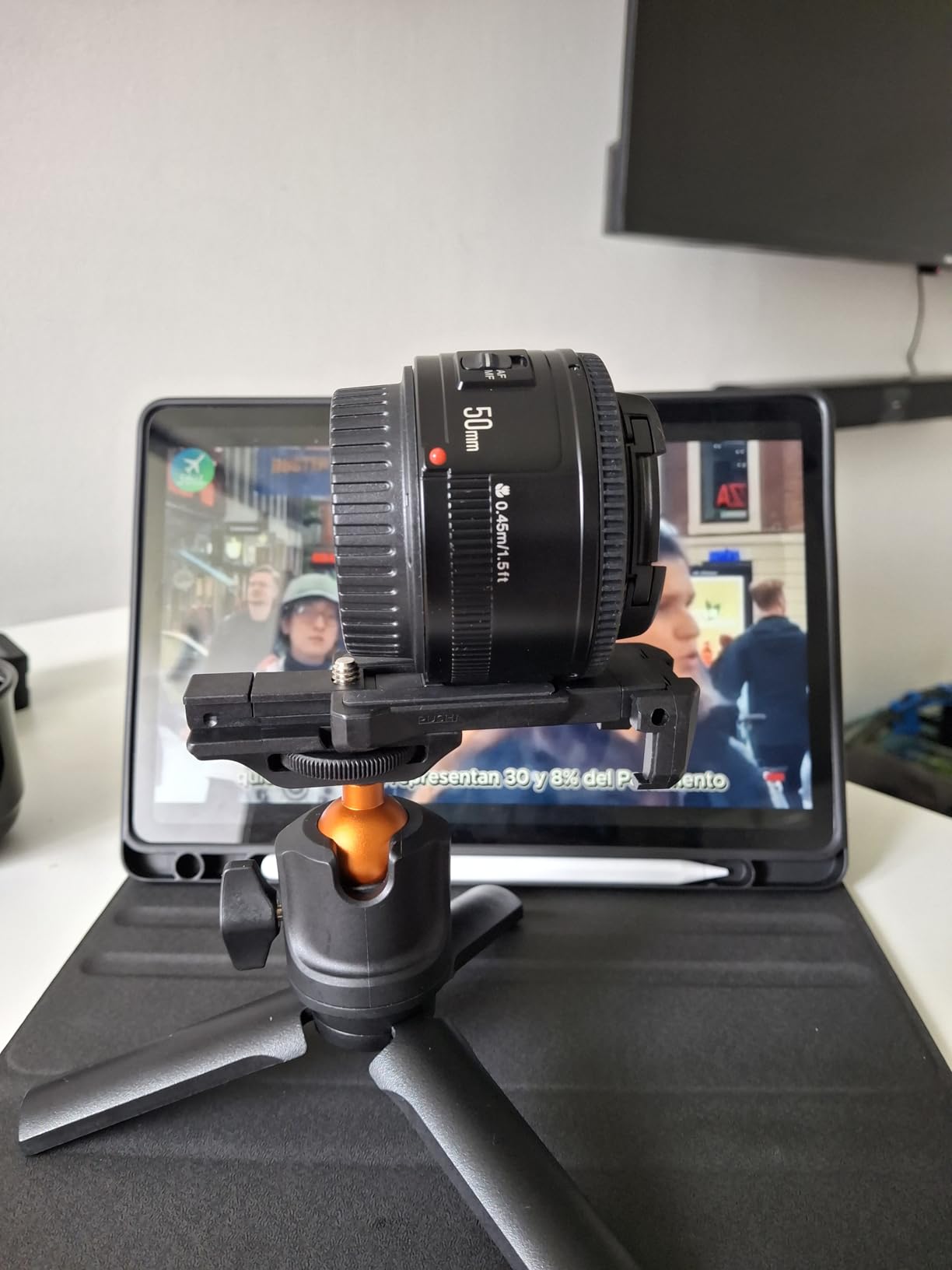
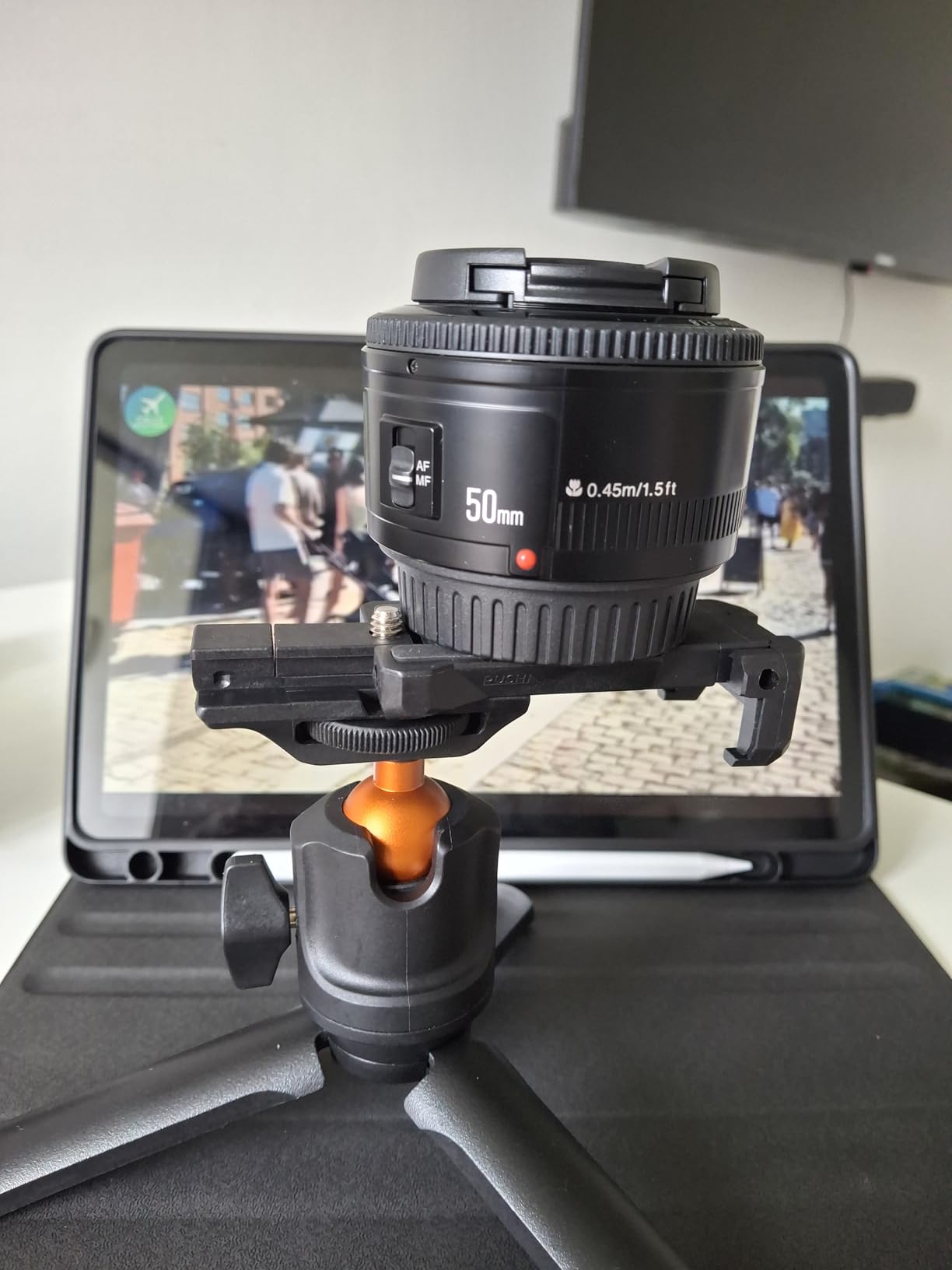
This is the cheapest way to leave a kit zoom behind, and at 4.4 stars from more than five thousand ratings it holds a respectable owner score. It weighs just over 4 ounces, mounts to Canon EF, and shoots on both full-frame and APS-C bodies. Gold-plated contacts carry the aperture data into the EXIF.
The optics are multi-coated and the separation at f/1.8 is a genuine step up from a kit zoom. Reviewers often note that the rendering is close to the Canon EF 50mm f/1.8 STM, with a similar 46 degree diagonal angle of view.
The sticking point is autofocus. Owners describe it as spotty, snapping or hunting on a number of bodies, and many end up shooting it manually. The six-blade diaphragm also produces less rounded bokeh highlights than the seven- and eight-blade Canon primes.
Closest focus is 0.45 m, which is longer than the Canon’s 0.35 m, so it is less useful for detail and food work. The focus ring is entry-level, and there is no weather sealing or stabilisation to think about.
Where it makes sense
If your budget is the deciding factor and you already know you will upgrade later, this is a reasonable first fast prime. It also makes a cheap second body lens, because the weight is negligible. If you want more detail on close-focus work, our macro lens roundup for Canon cameras covers the better choices.
Who should skip it
Skip it if you shoot moving subjects, because inconsistent autofocus will cost you frames you cannot get back. Photographers who mostly shoot still life or landscapes on a tripod can ignore the focusing complaints entirely and save the difference.
3. Canon EF 50mm f/1.4 USM – The Full-Frame DSLR Sweet Spot
Canon EF 50mm f/1.4 USM Standard and Medium Telephoto Lens for Canon SLR Cameras, Fixed
50mm f/1.4
290 g weight
58 mm filter thread
USM autofocus
Pros
- One more stop of light over the f/1.8
- Fast and quiet ultrasonic autofocus
- Superior peripheral brightness and low fringing
- Eight blades give cleaner bokeh
- Feels more solidly built than plastic primes
Cons
- Soft wide open at f/1.4
- Vignetting and mild barrel distortion at f/1.4
- No stabilisation and no sealing
- No hood included
The EF 50mm f/1.4 USM is the lens most Canon full-frame shooters end up owning, and the owner rating of 4.6 from more than five thousand ratings reflects why. It weighs 290 g, takes 58 mm filters, and focuses as close as 0.45 m. The ring-type ultrasonic motor is fast, accurate and quiet, with full-time manual focus override.
Compared with the f/1.8, the extra stop of light is the headline. In a dim church with no flash, that stop is the difference between a usable frame and a pushed ISO mess. Super multi-layer coating cuts flare, and the two high-refraction elements plus moulded aspherical elements suppress astigmatism and coma.

Owners consistently report better peripheral brightness and virtually no lateral chromatic aberration relative to the entry-level primes. The eight aperture blades also give visibly rounder bokeh, which is why wedding photographers gravitate here for reception portraits.
The common complaint is behaviour at full aperture. It is noticeably soft wide open at f/1.4, and most owners stop down to f/2.8 for daily work. Vignetting and mild barrel distortion show up at f/1.4 through f/1.8, and without a hood you can pick up flare from bright windows.

Why it still earns its place
Long-time owners on photography forums describe it as nearly as sharp as the f/1.8 after stopping down, while being far more light and convenient than the fast L-series options. For a full-frame DSLR shooter on a wedding, that balance is exactly right. It also adapts to any EOS R body we own.
Who should skip it
Skip it if you need weather sealing, since this older design has neither sealing nor stabilisation, and the box has no hood. If you shoot a lot of video, note the focus ring can feel loose to some users, and manual de-click is not a feature here.
4. Canon RF 50mm F1.8 STM – The Best Value Mirrorless Prime
Canon RF50mm F1.8 STM Lens
50mm f/1.8 on RF
5.6 oz weight
43 mm filter thread
Gear-type STM
Pros
- Compact and very light RF-mount prime
- Quiet gear-type STM focusing for video
- Close focusing handles product and detail work
- 43 mm filters keep glass costs low
- Control ring for direct setting changes
Cons
- Corner softness
- coma and astigmatism at f/1.8
- Visible chromatic aberration at the edges
- No image stabilisation
- Plastic build feels basic
On a full-frame mirrorless body, this is the lens we recommend first. It weighs 5.6 ounces, carries an f/1.8 aperture, and takes tiny 43 mm filters, which makes a polariser or a variable ND genuinely inexpensive. The gear-type STM motor gives smooth continuous autofocus during video recording.
Owners rate it 4.7 from more than three thousand ratings, and one photographer on r/photography described it as creating a really balanced setup on an R body with near-silent focusing. Compatibility runs from the EOS R100 and R50 up through the R5, R6 Mark II and R3.

The close-focusing behaviour is better than the price suggests, handling product and detail work that would normally demand a dedicated macro prime. Coatings are tuned for colour balance and ghosting control, and the control ring lets you change settings directly on the barrel.
Wide open is where it shows its limits. Corners go soft with visible coma and astigmatism, which appears as wing-shaped flares around bright points, and there is chromatic aberration toward the frame edges. There is no optical stabilisation, and the plastic construction feels plainer than older EF glass.

Best for mirrorless shooters on a budget
Pair it with a 24-70mm f/2.8 and you have a two-lens kit that covers an entire wedding day without a second body. It is also the natural companion to a compact APS-C body, though the field of view is tighter there. Our Canon 90D lens guide covers the DSLR equivalent choices.
Who should skip it
Skip it if you need edge-to-edge sharpness wide open, or if you shoot long exposures handheld and need stabilisation. On small APS-C RF bodies the tight field of view can feel restrictive in a reception room.
5. Sigma 50mm F1.4 Art DG HSM – The Sharpest EF 50mm
Sigma 50mm F1.4 Art DG HSM Lens for Canon
50mm f/1.4
1.3 lb weight
77 mm filter thread
9-blade diaphragm
Pros
- Very sharp wide open with good corner consistency
- Fast and near-silent ultrasonic HSM focusing
- Nine rounded blades for smooth circular bokeh
- All-metal build with a large front element
- Full-time manual focus override
Cons
- Heavier and bulkier than the Canon 50mm primes
- No image stabilisation
- Not weather sealed
- 77 mm filters are expensive
- Needs an adapter for RF bodies
If you want the sharpest 50mm that mounts to Canon EF, this is the one. Owners at 4.7 stars with 89 percent five-star scores describe outstanding sharpness and contrast wide open, with good corner-to-centre consistency. The ring-type ultrasonic HSM is fast and quiet, and full-time manual focus lets you override at any time.
Three Special Low Dispersion glass elements and a floating system handle chromatic aberration well, and the 46.8 degree angle of view is a touch wider than the Canon primes. Nine rounded diaphragm blades render smooth, circular bokeh, and the all-metal body feels balanced in the hand.

On Canon APS-C bodies it frames like 80mm, which is a flattering portrait length. The lens also works with the Sigma USB Dock for firmware and customisation, a detail that enthusiasts appreciate.
The trade-offs are physical. It weighs 1.3 pounds, noticeably heavier than the Canon primes, and the 77 mm filter thread means real money for a polariser. There is no stabilisation and no weather sealing, and RF mirrorless bodies require an EF adapter.
Why shooters pick it over the Canon f/1.4
Owners frequently compare it favourably with the Canon EF 50mm f/1.4 at a similar outlay, and the resolution difference is easy to see in matched-aperture crops. For studio portraits and headshots on a tripod, sharpness is everything and the weight matters far less. A dpreview wedding thread also noted the f/1.4 focusing more accurately, which is worth weighing.
Who should skip it
Skip it if you hang a lens on your body for a twelve-hour wedding day, because the weight adds up fast. Anyone on a strict filter budget should price the 77 mm thread before committing.
6. Canon EF 50mm f/1.2L USM – The Classic Wedding Workhorse
Canon EF 50mm f/1.2L USM
50mm f/1.2
1.8 lb weight
72 mm filter thread
Weather-resistant
Pros
- Exceptional subject separation and creamy bokeh
- Professional-grade sharpness and colour
- Fast and quiet ultrasonic autofocus
- Weather-resistant construction
- Solid on every Canon EF body
Cons
- Very heavy and front-heavy for a prime
- Depth of field is razor thin at f/1.2
- No optical stabilisation
- High outlay for a hobbyist
This L-series f/1.2 is the classic Canon standard prime for professionals, and the review pattern is consistent: extraordinary light gathering, smooth out-of-focus rendering, and sharpness across the frame once you stop down a little. It weighs 1.8 lb, uses a 72 mm filter thread, and focuses as close as 0.45 m.
What makes it different from every cheaper prime here is the two-thirds of a stop over the f/1.4. In a dim reception with coloured lighting, that extra light is what lets you hold a fast shutter and keep ISO in a range that still looks good in colour. The construction is weather-resistant, which none of the f/1.8 options can claim.

The eight-blade diaphragm and the aspherical element optimised for portraits give smooth, creamy backgrounds. Ultrasonic autofocus with full-time manual focus is quick and quiet enough for event work.
Wide open, the depth of field is so thin that a focus miss is easy, particularly for a subject who moves toward the camera. It is front-heavy, so balance on smaller bodies is not neutral, and there is no optical stabilisation in this design.

Why we still carry one for outdoor ceremonies
Weather sealing is the deciding factor for us. When a ceremony moves outside and the forecast is uncertain, an unsealed barrel is a real risk, and only two of the ten lenses here carry a sealed build at this aperture. On an r/canon thread the EF 50L is the most nominated EF 50mm, with focus shift as the acknowledged catch.
Who should skip it
Skip it if your work is mostly daylight portraits where f/1.4 already separates the background enough, or if the weight is a problem on a long day. It also needs an adapter on RF bodies, which adds length to an already large lens.
7. Canon RF 50mm F1.2L USM – The Definitive Canon Portrait Look
Canon RF50mm F 1.2L USM Standard Lens, Black
50mm f/1.2
2.1 lb weight
77 mm filter thread
12-pin RF
Pros
- Highest rated in the group at 4.8 stars
- Exceptional sharpness across the frame at f/1.2
- Fast and near-silent autofocus tracking
- Control ring for direct setting changes
- Native RF mount with full communication
Cons
- The highest outlay of any 50mm here
- Very heavy and front-heavy at 2.1 lb
- Razor-thin depth of field at full aperture
- No built-in stabilisation
- 77 mm filters are costly
This is the highest-rated lens in the roundup, sitting at 4.8 stars with 92 percent five-star scores, and it produces what owners consistently call the definitive Canon portrait look. It is a native RF design, so there is no adapter in the optical path and the 12-pin communication carries full EXIF and body features.
Three aspherical elements and one UD element deliver sharpness across the frame even at f/1.2. The 46 degree angle of view and a minimum focusing distance of 1.31 ft or 0.40 m make it a genuine close-focusing portrait lens. The control ring changes aperture and other settings directly.
Subject isolation and bokeh quality are the standout strengths, and autofocus tracks moving subjects reliably and quietly. For studio portraiture on a tripod, this is the shortlist answer every time.
The cost is the clear obstacle. It is the most expensive 50mm here by a wide margin, and photographers on r/canon specifically raise price shock, noting that the lens can cost about as much as a whole EOS R body. At 2.1 lb it is the heaviest in the group, and the depth of field at full aperture is extremely thin.

When it earns its place
Buy it if portraits are central to your business and the sessions are controlled. On a tripod, a beauty dish, and a subject who can hold still, the f/1.2 gives you background separation nothing else in this list matches. The RF 50mm f/1.4 L VCM gets close for far less.
Who should skip it
Skip it if you shoot handheld events, where the weight and razor-thin focus make it tiring and unforgiving. Anyone who wants stabilisation in the lens should look elsewhere, because there is none built in.
8. Canon RF50mm F1.4 L VCM – The Best Hybrid for Video
Canon RF50mm F1.4 L VCM
50mm f/1.4
9-blade diaphragm
Iris ring
Weather-resistant
Pros
- Very sharp wide open with smooth bokeh
- Focus breathing under 2.5 percent mechanically
- Silent linear VCM rear focus motor
- Dedicated iris ring for manual aperture control
- Lighter than the RF 50mm f/1.2L
Cons
- One early owner reports a light plastic build and a vibrating barrel
- Same review says it needs stopping down to about f/4
- No image stabilisation
- Narrower field of view limits general shooting
This is the newest Canon 50mm in the roundup and the one built for people who shoot both. The review base is still small at 55 ratings and 4.6 stars, so treat the consensus carefully, but the design intent is clear: a Nano USM handles floating focus while a linear voice coil motor drives rear focus for video smoothness.
Focus breathing is under 2.5 percent mechanically across the range, and electronic breathing correction brings it within 1.0 percent. For hybrid shooters chasing racking focus, that is a headline feature, and no other Canon 50mm here offers it. The dedicated manual iris ring also gives direct aperture control, which the RF f/1.8 and f/1.2L lack.
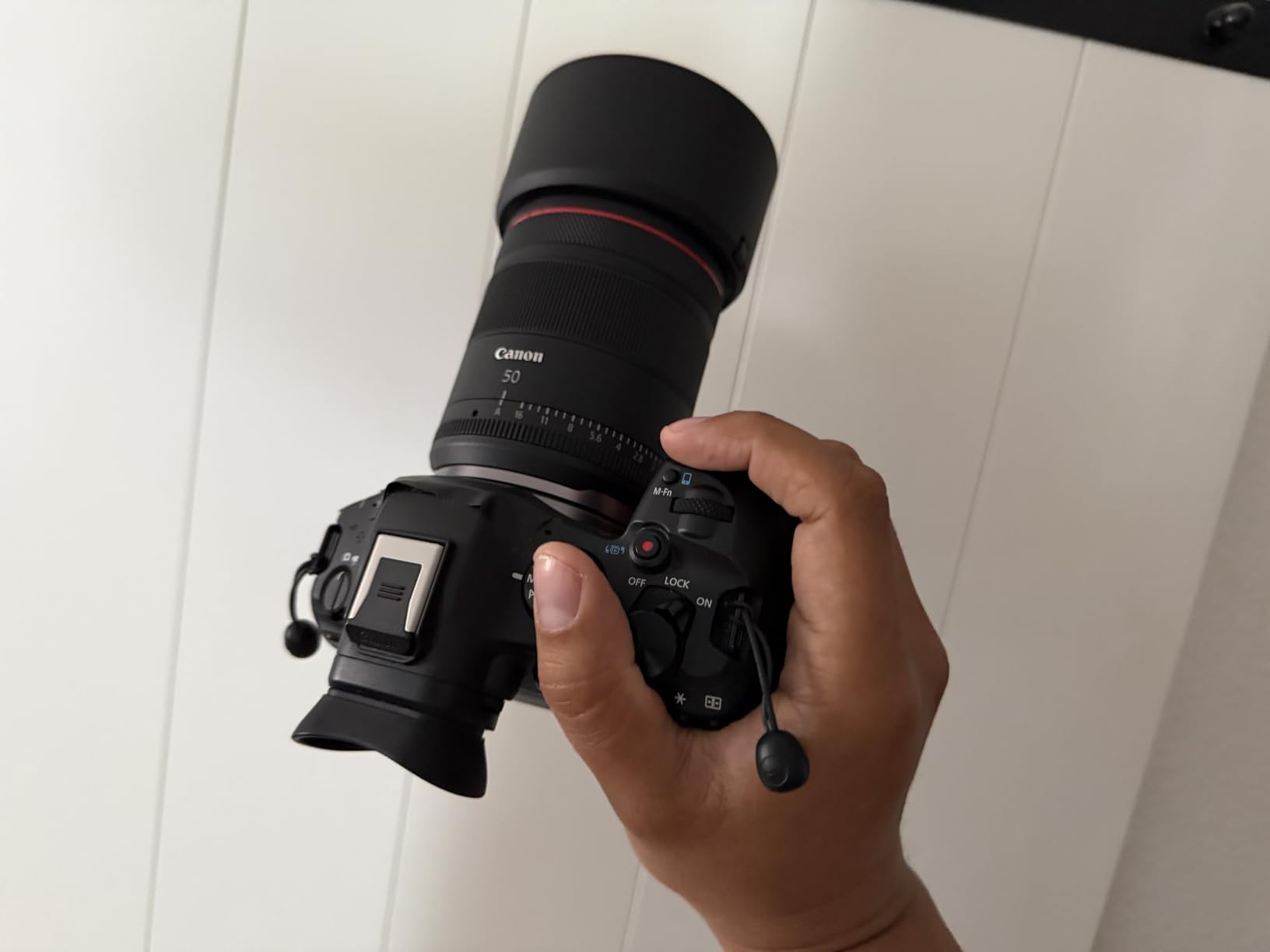
Owners describe it as very sharp wide open with pleasing bokeh at f/1.4, and lighter than the RF 50mm f/1.2L while delivering a similar look. The nine-blade diaphragm and Air Sphere Coating reduce ghosting and flare, and the build carries L-Series durability and weather resistance.
The one-star report is worth repeating: that owner describes light plastic construction, an easily scratched hood, a barrel that vibrated, and a need to stop down to about f/4 for a sharp image. There is no stabilisation, and the tighter field of view limits everyday shooting. The one-way RF dust caps also slow lens changes for some users.

Why video shooters gravitate here
Focus breathing, a silent motor and a clicky iris ring are exactly the three things a hybrid shooter needs and cannot get from the older primes. On r/canon, one commenter put the RF 50mm f/1.2 against the f/1.4 for wedding work and said they would not choose the f/1.4 over the f/1.2 unless they were purely using it for video. The f/1.4 L VCM is the direct answer to that caveat.
Who should skip it
Skip it if you want a broad review history to lean on, because the sample here is thin. General-purpose shooters who need a wider everyday view will find the field of view restrictive, and video users who need stabilisation will be disappointed.
9. Yongnuo YN50MM F1.8 II – The Sleeper Tight-Budget Option
Yongnuo YN50MM F1.8 II AF/MF 0.35M Focus Distance Standard Prime Lens Black for Canon EF Mount EOS Cameras 5D IV 1DX I 200D II 850D 7D 6DII
50mm f/1.8
159 g weight
58 mm filter thread
9-blade diaphragm
Pros
- Rendering and separation rival lenses costing far more
- Very affordable way to leave a kit zoom
- Nine-blade diaphragm gives round bokeh
- Close focus at 0.33 m
- Durable metal mount
Cons
- Autofocus is slow and hunts on many bodies
- Poor on DSLRs without Dual Pixel AF
- Mostly plastic construction
- No stabilisation or weather sealing
- Sharpness falls off at the edges
This second-generation Yongnuo is the sleeper of the roundup at 4.5 stars from 428 ratings. Owners repeatedly say the rendering, subject separation and background blur are close to Canon’s own 50mm f/1.8, and the nine-blade diaphragm produces pleasantly round bokeh for the class. It weighs 159 g and focuses to 0.33 m.
The improvements over the original version are a metal mount and new coating technology. A focus distance indicator helps you estimate distance and depth of field, and the lens includes front and rear caps plus a manual.
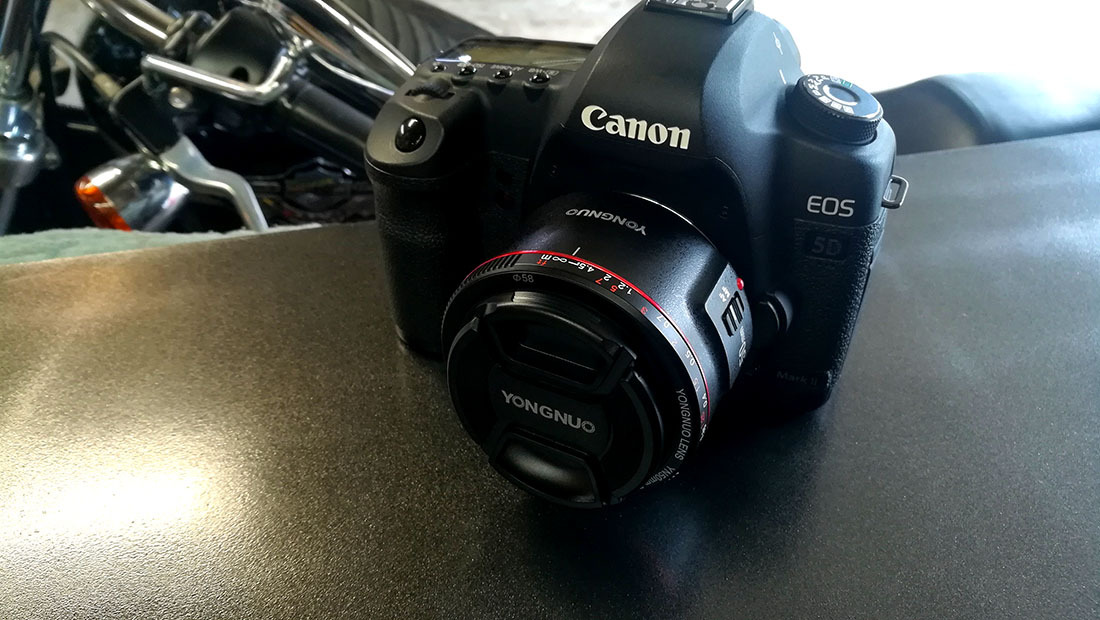
Where it fails is autofocus. Reviewers call it slow, and say it hunts, with several noting it performs poorly on DSLRs that lack Dual Pixel AF. That pushes a lot of owners to shoot it manually, which is workable for a subject who stays put.
Build is mostly plastic and feels light and slightly loose in the hand. The focus ring lacks grip, there is no stabilisation or sealing, and sharpness and contrast fall off noticeably toward the edges of the frame.

Best used as a beater lens
Treat it as a travel or backup prime, or as a lens for a body you use on a tripod. If you are learning manual focus, the aperture ring and depth of field indicator make it a cheap way to practise. Manual-focus crossover interest is real on forums, and this sits at the accessible end of it.
Who should skip it
Skip it if your work depends on reliable autofocus, especially on an older DSLR. The edge sharpness falloff also rules it out for wide prints or large sensor output.
10. Brightin Star 50mm F1.4III APS-C – Manual Focus With Character
Brightin Star 50mm F1.4III APS-C Lens for Canon RF Mount, Manual Focus MF Prime Large Aperture Mirrorless Camera Lens Fit for Canon EOS RP, R, R5, R7, R6, R3, R10
50mm f/1.4
APS-C coverage
Manual focus only
9-blade diaphragm
Pros
- f/1.4 gives genuinely shallow cinematic depth of field
- Characterful bokeh and vintage-style rendering reviewers enjoy
- Build quality feels above the price bracket
- Smooth manual focus with peaking and magnification
- 24-month warranty
Cons
- Manual focus only with no electronic contacts
- Lowest average rating here at 4.2 stars
- Some units reported loose internal screws or a rattling barrel
- APS-C coverage gives a tight field of view
- No weather resistance
This is the only manual-focus option in the roundup, and that is the whole point. It is built for APS-C Canon RF bodies such as the RP, R, R5, R7, R6, R3 and R10, covering a 27.18 degree angle of view. The optical design uses 6 elements in 5 groups with one ED and one HD element under multi-layer AR Coating II.
Owners who like it praise the f/1.4 look, the characterful rendering and the creamy bokeh, plus a metal build that feels more expensive than the outlay suggests. Manual focusing is smooth when you pair the lens with peaking and magnification. The warranty runs 24 months.

The negative reviews cluster around quality control rather than optics. Buyers report loose internal screws, a rattling barrel, and one unit that came apart after a few uses, and 10 percent of ratings are one-star. The score of 4.2 is the lowest in the group.
There are no electronic contacts, so you get no aperture readout in the viewfinder and no autofocus at all. Several owners report that autofocus simply does not work or is unsupported on their bodies. APS-C coverage on a full-frame body also gives a very narrow field of view.

When the manual-focus look matters
It suits a photographer who wants deliberate focusing and a distinctive rendering rather than speed. The nine-blade diaphragm and the f/1.4 aperture make it a good fit for still portraits on a tripod. If you shoot video, the lack of electronic contacts rules out aperture control from the body.
Who should skip it
Skip it if you photograph people who move, or if you rely on EXIF aperture data for exposure logs. The quality control complaints and the lowest rating in the roundup make this a pick with a real risk attached.
How to Choose a 50mm Lens for Canon in 2026
Choose by aperture first, then by mount, then by everything else. The maximum aperture decides what kind of work you can do, the mount decides which bodies the lens fits, and the remaining specs decide how pleasant it is to carry. Work through those three in that order and the rest of the list narrows quickly.
The aperture ladder and what each step actually buys you
The gap from f/1.8 to f/1.4 is two-thirds of a stop, and f/1.4 to f/1.2 is another one-third. That sounds small until you set it against shutter speed. Every stop lets you keep the shutter one step faster or drop ISO one step lower, and in event work that is usually the difference between a clean frame and a noisy one.
In practice, f/1.8 handles daylight portraits and casual indoor work comfortably. f/1.4 is the first tier that feels relaxed in a dim church or a reception room. f/1.2 is the point where you can hold 1/200s in poor light without pushing ISO, which is why professional event shooters keep one in the bag even when they carry an f/1.4 as their working lens. The trade-off runs the other way too: at f/1.2 the depth of field is so thin that a focus miss costs you the frame.
STM, USM and VCM autofocus motors explained
STM is a stepping motor, and it is fast, quiet and cheap. USM is an ultrasonic motor, and it is quicker on moving subjects with full-time manual focus override. VCM is a voice coil motor, used on the RF 50mm f/1.4 L VCM for smooth rear focus in video. For video, STM and VCM both win on silence; for action, USM wins on speed.
Weight, size and portability on a long shooting day
The f/1.8 primes weigh roughly 5.6 ounces, the EF f/1.4 sits at 290 g, the Sigma Art is 1.3 pounds, and the two f/1.2L lenses are 1.8 and 2.1 pounds. That spread is the gap between a lens you forget you are carrying and one that shows up in your neck by hour eight. If you shoot two bodies all day, the light options win on balance alone.
Image stabilisation, minimum focus distance and filter thread
None of the ten lenses here has optical stabilisation, so low shutter speeds depend on your body or on technique. Minimum focus distances range from 0.33 m to 0.45 m, and the RF 50mm f/1.2L gets closest at 0.40 m despite the large front element. Filter threads matter more than buyers expect: 43 mm filters are inexpensive, while 77 mm glass is a real line item every time you replace a polariser.
Which 50mm works best for weddings and events
For a wedding, prioritise weather sealing, weight and close focus in that order. Sealing matters because ceremonies move outdoors, weight matters because you will carry the lens for twelve hours, and close focus covers the detail shots and the gift table. Our own two-lens kit is a 24-70mm f/2.8 zoom plus one fast 50mm, and the 50mm covers the reception while the zoom handles the ceremony. If you shoot video as well as stills, put the RF 50mm f/1.4 L VCM at the top of your list for the focus breathing and iris ring alone.
EF vs RF: Which Canon 50mm Should You Buy in 2026?
Buy an RF lens if your camera is an EOS R-series body and you want the newest glass, full electronic communication and no adapter. Buy an EF lens if your camera is a DSLR, if you want a wider choice of affordable third-party options, or if you already own EF glass and want to keep one adapter in your bag.
EF lenses mount to every EOS R body through the EF-EOS R adapter, and the ones in this roundup all focus correctly and pass aperture and EXIF data through the adapter. The practical cost is added length and weight on the front of the body, plus the loss of any EF-specific features.
The third-party picture splits along the same line. The Sigma 50mm F1.4 Art, the two Yongnuos and the Canon EF primes are all EF mount, so an RF shooter needs an adapter for them. The Brightin Star and the Canon RF primes are native RF, so nothing is needed. If you are still deciding between mounts, our 50mm lens guide for beginners covers the older designs in more detail.
Canon APS-C Bodies: Is a 50mm the Right Choice?
On an APS-C Canon body a 50mm frames like an 80mm, which is a flattering portrait length but a tight one indoors. If you shoot events on an R50 or an R10, a 50mm will feel narrow in a reception room, and a wider zoom will serve you better for the wide shots.
For portraits and street work on APS-C, though, the 80mm equivalent is exactly what many photographers want. The Canon EF 50mm f/1.8 STM and the RF 50mm F1.8 STM both work on APS-C bodies, and the Yongnuo lenses are also compatible. Every full-frame 50mm prime here, including the RF 50mm F1.2L, mounts and focuses normally on APS-C bodies; the only coverage caveat is the Brightin Star, which is APS-C only and will not cover a full-frame sensor.
If your APS-C body is entry-level and your budget is limited, the RF 50mm F1.8 STM is the light, quiet, affordable option. If you specifically want a manual-focus look on a small RF body, the Brightin Star is built for APS-C RF coverage. Our Canon 90D lens guide covers the DSLR side of the same question.
Frequently Asked Questions
Which Canon 50mm lens is considered the best?
For most Canon shooters the Canon EF 50mm f/1.8 STM is the best all-round choice, rated 4.8 stars by more than eighteen thousand owners. Mirrorless users get the same idea from the Canon RF 50mm F1.8 STM, and professionals who need the widest aperture usually end up with an f/1.2L.
Is there a big difference between 1.4 and 1.8 aperture?
The step is two-thirds of a stop, and it is a real difference in dim rooms. It lets you keep the shutter one step faster or ISO one step lower, which matters for indoor events. In good light you will rarely notice, so many owners buy the f/1.8 and stop down to f/2.8 for everything.
Which Canon 50mm lens is better, the EF or the RF?
Buy an RF lens for an EOS R body if you want the newest glass, full electronic communication and no adapter in the optical path. Buy an EF lens for a DSLR, for a wider range of affordable third-party primes, or if you want to keep one EF-EOS R adapter and reuse existing glass.
Is the Canon 50mm f/1.2 worth it?
It is worth it when you shoot indoors without flash and need to hold a fast shutter, since the extra light over an f/1.4 is roughly one-third of a stop. It is not worth it for daylight portraits where an f/1.4 already separates the background, and the weight and razor-thin depth of field wide open are real costs.
Is a 50mm lens good for wedding photography?
Yes, and it is one of the most useful focal lengths on a wedding day. It handles the ceremony groupings and the reception portraits, and it pairs well with a 24-70mm f/2.8 as a two-lens kit. For indoor receptions without flash, prioritise the widest aperture you can comfortably carry.
What is the sharpest 50mm lens for Canon?
At the EF f/1.4 tier the Sigma 50mm F1.4 Art is the sharpest option, with owners reporting outstanding sharpness and contrast wide open and good corner consistency. Among Canon primes, the RF 50mm F1.2L delivers exceptional sharpness across the frame at f/1.2, and the RF 50mm f/1.4 L VCM is very sharp wide open for its class.
What lens should I get for my Canon EOS R50?
The Canon RF 50mm F1.8 STM is the natural match for an R50. It is light, quiet, affordable, and its 43 mm filter thread keeps glass costs low. Remember that on an APS-C body a 50mm frames like an 80mm, so a wider zoom is still useful for indoor event coverage.
The Best 50mm Lenses for Canon in 2026: Final Word
The Canon EF 50mm f/1.8 STM is the lens we recommend to most Canon shooters in 2026. It is small, quiet, sharp in the centre, and carries the largest owner base in this roundup, which means you will find used examples and advice for almost any body. On a mirrorless body, take the Canon RF 50mm F1.8 STM instead, and add the RF-EOS R adapter only if a third-party prime catches your eye.
Move up the ladder when the work demands it. The Canon EF 50mm f/1.4 USM is the step for dim venues, the Sigma 50mm F1.4 Art is the step for maximum sharpness, and the f/1.2L primes are the step for professional indoor event work. If portraits are your main output, our 50mm portrait picks go deeper on framing and background separation.
Whichever tier you land on, a 50mm is the one prime that earns its place in almost every camera bag. Pick the lightest one that handles your darkest room, and let the zoom cover the rest.