
The best Canon cameras for beginners are the Canon EOS R50, the Canon EOS R100 and the Canon EOS M50 Mark II. The R50 is the one I recommend to almost everyone: a 24.2-megapixel APS-C sensor, subject-detecting autofocus and uncropped 4K video in a body small enough to carry all day. The R100 is the cheapest sensible route into Canon RF lenses, and the M50 Mark II wins if you plan to be in front of the camera as often as behind it.
I shoot weddings and events for a living, and roughly half of the questions I get asked involve someone buying their very first Canon. Which body? Kit lens or body only? Mirrorless or the old-fashioned DSLR? Most of those questions collapse into three things: how fast the camera focuses on a moving person, how small it is after nine hours of carrying, and whether the lenses you start with will still be useful in five years.
This guide covers eight Canon bodies that all make sense as a first camera for different reasons, plus the ones I would steer you away from. I have deliberately left the flagship bodies out, because a first camera should fit your hands and your learning curve rather than a studio rental cart. Where a body is a step too far for a beginner, I will say so plainly.
If your first Canon is going to earn money on the side rather than sit in a cupboard, jump to the best Canon cameras for wedding photography section near the end, then come back and read the reviews.
Table of Contents
Top 3 Canon Camera Picks for Beginners in October 2026
The R50 is the strongest all-round beginner Canon, the R100 is the cheapest sensible entry into the RF lens system, and the M50 Mark II is the best small Canon for anyone filming as well as shooting. Those three cover nearly every first-camera situation we see.
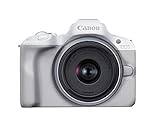
Canon EOS R50 Kit
- 24.2MP APS-C sensor
- 651-zone subject detection
- Uncropped 4K at 30 fps
- 16 ounces

Canon EOS R100 Kit
- 24.1MP APS-C sensor
- 143-zone AF with eye detect
- 6.5 fps
- Smallest EOS R body
All Eight Canon Cameras Compared Side by Side for October 2026
Scan the viewfinder and autofocus details first, because those two specs change how a camera feels far more than the megapixel count does. Every body below is a current-generation or recently refreshed Canon.
| Product | Specifications | Action |
|---|---|---|
| Canon EOS R50 with 18-45mm |
|
Check Latest Price |
| Canon EOS R100 with 18-45mm |
|
Check Latest Price |
| Canon EOS M50 Mark II |
|
Check Latest Price |
 Canon EOS Rebel T7 with 18-55mm Canon EOS Rebel T7 with 18-55mm |
|
Check Latest Price |
 Canon EOS R10 with 18-45mm Canon EOS R10 with 18-45mm |
|
Check Latest Price |
 Canon EOS R7 body only Canon EOS R7 body only |
|
Check Latest Price |
 Canon PowerShot SX740 HS Canon PowerShot SX740 HS |
|
Check Latest Price |
 Canon EOS M50 renewed kit Canon EOS M50 renewed kit |
|
Check Latest Price |
1. Canon EOS R50 with RF-S 18-45mm – the Best Canon Camera for Beginners
Canon EOS R50 Mirrorless Camera RF-S18-45mm F4.5-6.3 is STM Lens Kit
24.2MP APS-C with DIGIC X
651 AF zones
Uncropped 4K at 30 fps
12 fps burst
16 ounces
Pros
- Subject detection for people
- animals and vehicles
- Uncropped 4K is rare at this level
- Light at 16 ounces and easy to carry all day
- Guided auto modes plus full manual control when ready
- Reliable Wi-Fi transfer and app remote control
Cons
- Grip feels cramped with larger hands
- Small battery means spares for long days
- Bundled 18-45mm is average in low light
The R50 is the best Canon camera for beginners, and it is the body we hand to people who already suspect they will outgrow an entry model within a year. A 24.2-megapixel APS-C sensor feeds a DIGIC X processor, and the Dual Pixel CMOS AF II system covers the whole frame with 651 zones.
That autofocus is the real story. Deep-learning subject detection recognises people, animals and vehicles and holds them while they move, which turns candid shots of guests crossing a lawn or children running at you into the point-and-shoot case rather than the frustrating one. It shoots up to 12 fps on the electronic first curtain and 15 fps on the electronic shutter.
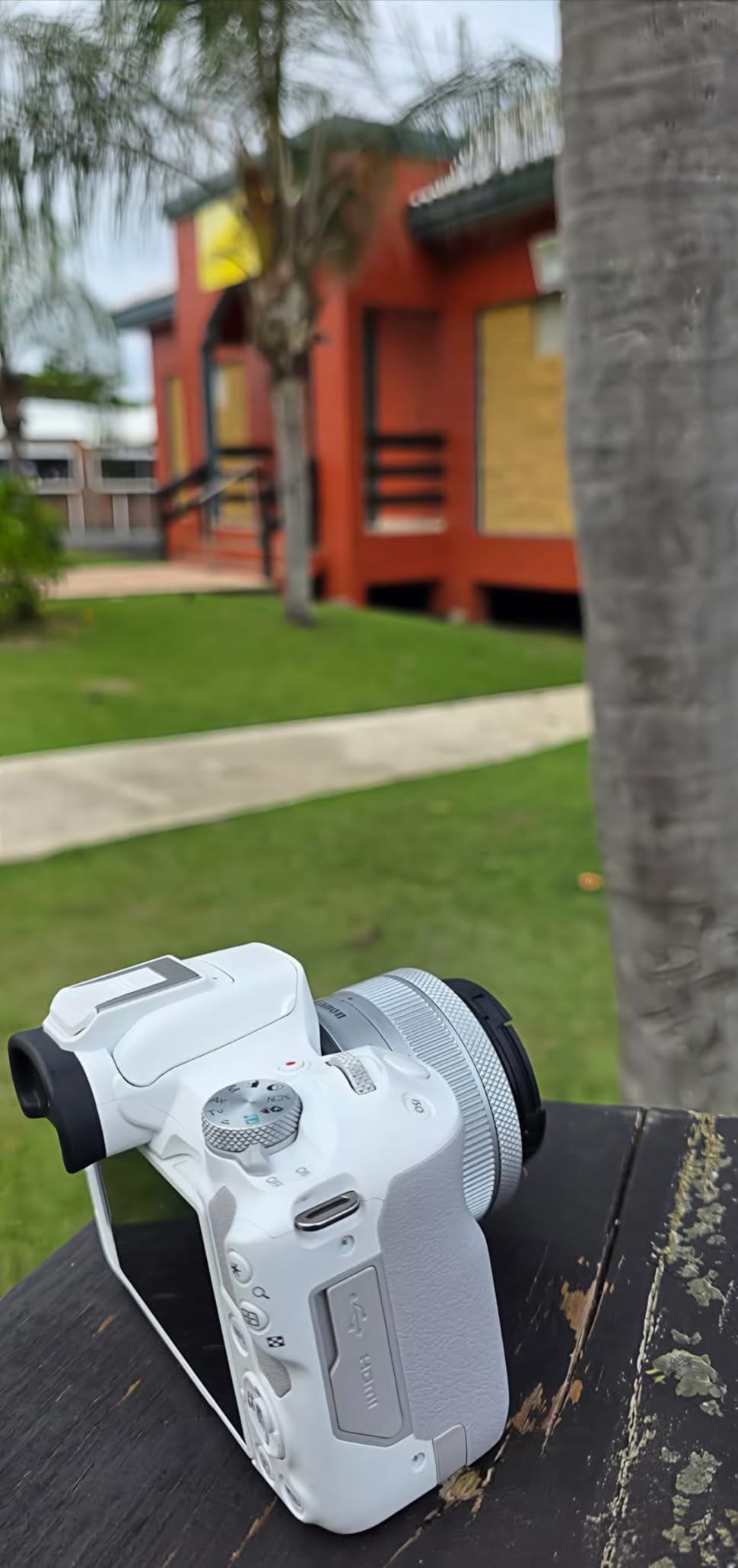
The video side is unusually strong for the class. The R50 records 6K oversampled uncropped 4K at up to 30 fps, so you keep the full width of the sensor instead of the heavy crop many Canon bodies apply in 4K, and Full HD runs to 120 fps. The 2.36-million-dot electronic viewfinder is bright and the Clear View LCD II tilts out to the side.
Owners consistently single out image quality, tracking and phone connectivity. The most common complaints are physical rather than electronic: the body is small with a tight grip, the battery is small, and the bundled 18-45mm is an average lens that many people replace within a year.

Why I recommend the R50 first
The R50 is the only body here that gives you modern tracking, strong video and a full manual mode at the same time, while still offering guided automatic settings for the weeks when you do not want to think. That combination is what makes it both a safe first Canon and a sensible second Canon.
It is also where the wider beginner community converges. In r/Cameras threads, photographers repeatedly tell newcomers that stepping up from the Rebel T7 to the R50 is worth it and leaves them miles better off, which matches what we see when these bodies come back through rental hires.
Where the R50 disappoints
The grip is genuinely cramped for large hands, so if you are coming straight from a phone, handle it in person first. The small battery means a second or third cell is sensible for a full shooting day. And with a crop sensor plus a slow kit lens, indoor reception work pushes the ISO higher than you would like.
If you already know you will be shooting long paid events, look at the R10 next. It is a slightly larger body with the same idea and more headroom.
2. Canon EOS R100 with RF-S 18-45mm – the Best Value
Canon EOS R100 Mirrorless Camera RF-S18-45mm F4.5-6.3 is STM Lens Kit
24.1MP APS-C with DIGIC 8
143-zone AF
6.5 fps
Fixed non-touch LCD
Pros
- Lowest-cost route into Canon RF and RF-S lenses
- Sharp vibrant images from day one
- Small and light for travel and small bags
- Reliable Wi-Fi transfer straight to a phone
- Guided modes that grow into manual and RAW
Cons
- No in-body image stabilisation
- Fixed LCD with no touchscreen articulation
- 6.5 fps and 143 zones trail newer bodies
The R100’s real argument is not the photographs, it is the mount. It is the cheapest way to own an RF-mount body, which means every RF and RF-S lens Canon releases is available to you, including the fast primes you will want later. The R7 and R10 owners in this guide share that exact glass.
Inside is a 24.1-megapixel APS-C sensor with a DIGIC 8 processor, Dual Pixel CMOS AF across 143 zones with face, eye, animal and vehicle detection, 4K at up to 24 fps, Full HD at 60 fps and HD at 120 fps, plus 6.5 fps continuous shooting with one-shot AF.

Owners emphasise crisp image quality, quick autofocus, low weight and guided menus that help new photographers understand exposure modes, with an 81 percent five-star share. The recurring drawbacks are the absence of a touchscreen, the lack of stabilisation, the modest burst rate and the limited reach of the 18-45mm.
The fixed 3.0-inch LCD is the biggest everyday annoyance. It does not tilt and it is not a touchscreen, so self-recording and ground-level framing are awkward. Several buyers also note that not every kit includes a charger, so check the box contents.

When the R100 is the smart buy
Buy it if your budget is firm, if you want access to RF lenses from day one, and if you plan to shoot stills far more than video. The guided modes leave room to learn, and nothing about the mount closes a door later.
It works well as a first body for travel, family documentation and everyday shooting, and the small size means you will actually take it out rather than leave it on a shelf.
When the R100 is the wrong buy
Skip it if you shoot video, because a fixed non-touch screen and no stabilisation make it a frustrating hybrid for anything beyond clips. Skip it if you need a fast tracking system for events, since 143 zones and 6.5 fps trail the R50 and R10 noticeably.
Our honest view is that the R100 and the R50 sit close enough together that most beginners should step up. Buy the R100 when the price gap between them is wide, and otherwise the R50 is the better first Canon.
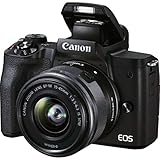
3. Canon EOS M50 Mark II – the Small Canon Built for Vlogging
Canon EOS M50 Mark II + EF-M 15-45mm is STM Kit Black
24.1MP APS-C CMOS
ISO 100-25600
143 AF points with eye detect
4K 24p and 120p
Vari-angle screen
Pros
- Eye detection that works for stills and video
- True vari-angle screen for vlogging
- Light at 351 g with the kit lens
- Guided on-screen descriptions help newcomers
- 4K plus 120 fps slow motion
Cons
- EF-M lens range is limited
- No in-body image stabilisation
- Menu system takes time to learn
The M50 Mark II is the camera I recommend to beginners who want to film as well as shoot, because the fully rotating screen and the eye-detection autofocus solve two problems at once. You can hold the camera at arm’s length, see yourself, and let the camera keep your face sharp while you talk.
Inside is a 24.1-megapixel APS-C sensor with ISO 100-25600 expandable to 51200, a DIGIC 8 processor, and 143 autofocus points with eye detection that works in stills and in movie servo modes. It records 4K UHD at 24p and Full HD at up to 120 fps for slow motion.

At 351 g with the EF-M 15-45mm attached, it disappears in a bag. That matters more than it sounds, because a camera you carry is a camera you shoot, and for many beginners the real obstacle is not the settings but the excuse of not wanting to lug a kit around.
Long-term owners report thousands of photographs with no reliability problems, and the guided on-screen descriptions walk a first-time user through what each mode actually does. The complaints we see all concern the lens system rather than the body.
Where the M50 Mark II earns its place
Choose it for vlogging, online teaching, travel content and any situation where you are in the frame. The vari-angle screen, the silent shooting options and the reliable eye detection make it a genuine content camera rather than a compromise.
It also works as a second body for anyone who shoots events, because a small silent shutter is useful during ceremonies where shutter noise would be distracting.
Where it falls short
If your priority is a large lens ecosystem and a long upgrade path, look at the RF-mount bodies instead, because the EF-M roadmap is thin and the mount is no longer where Canon is investing. And there is no in-body stabilisation here, so you depend on stabilised glass.
Our beginner vlogging camera guide covers the alternatives in more detail if you expect to film more often than you shoot.
4. Canon EOS Rebel T7 with 18-55mm – the Simplest Canon to Learn On
Canon EOS Rebel T7 DSLR Camera EF-S 18-55mm f/3.5-5.6 is II Lens Kit
24.1MP APS-C CMOS
ISO 100-6400
9-point AF
Optical viewfinder
Full HD video
Pros
- Optical viewfinder costs no battery
- Lowest-effort controls for a new shooter
- Wi-Fi and NFC for phone transfer
- Light at one pound
- 5360 owner reviews
Cons
- 9-point AF is dated with no subject tracking
- No touchscreen and no flip screen
- Full HD video only with 3 fps burst
The Rebel T7 is the easiest Canon I have ever handed to a complete beginner, and it is still the body I reach for when I want to think about the photograph rather than the camera. Everything is where a DSLR owner expects it, the menu language is plain, and the optical viewfinder lets you frame in a dim venue without touching the battery.
The 24.1-megapixel APS-C sensor produces files with real detail, and the bundled EF-S 18-55mm f/3.5-5.6 IS II covers everything from wide interiors to short portraits. That single lens is genuinely useful, which is more than can be said for some kit zooms.

What you give up is speed. The 9-point autofocus system has one cross-type point in the centre and no face, eye or animal detection, so tracking a person walking toward you means keeping that centre point on them manually. The burst rate is 3 fps and video stops at Full HD.
Neither matters for posed portraits or a family gathering around a table. Both matter the moment you are chasing a toddler across a garden or want to film a speech, and the fixed non-touch screen means self-framing needs a separate monitor.

Who the Rebel T7 suits
Buy the T7 if your photography is mostly people at rest, family photos, holidays and landscape work, and if you would rather learn exposure on a camera that never surprises you. The dials and the optical viewfinder give you a direct, tactile link to the settings.
It also suits anyone who owned a DSLR twenty years ago and wants to return to one cheaply, or who is buying for a relative who will never open a menu.
Who should skip the Rebel T7
Skip it if you shoot moving subjects, events where people approach from across a room, or any video beyond home clips. Reddit consensus in r/Cameras is blunt on this, with photographers repeatedly telling beginners the T7 is a dead end compared with spending a little more on a modern mirrorless body.
Skip it if you already own EF or EF-S lenses and plan to grow into the system, because all of that glass works on an R-series body instead.
5. Canon EOS R10 with RF-S 18-45mm – the Body That Grows With You
Canon EOS R10 Mirrorless Camera Lens Kit
24.2MP APS-C with DIGIC X
15 fps mechanical burst
651-zone AF with subject detection
Vari-angle touchscreen
Pros
- Fast dependable autofocus that tracks moving subjects
- Compact yet the grip feels solid
- Fully articulating screen for vlogging and low angles
- 15 fps and 10-bit 4K in this class
- Battery charges in-camera over USB
Cons
- Wi-Fi photo transfer is reported as slow
- Bundled 18-45mm is average in low light
- Single card slot rather than mirrored backup
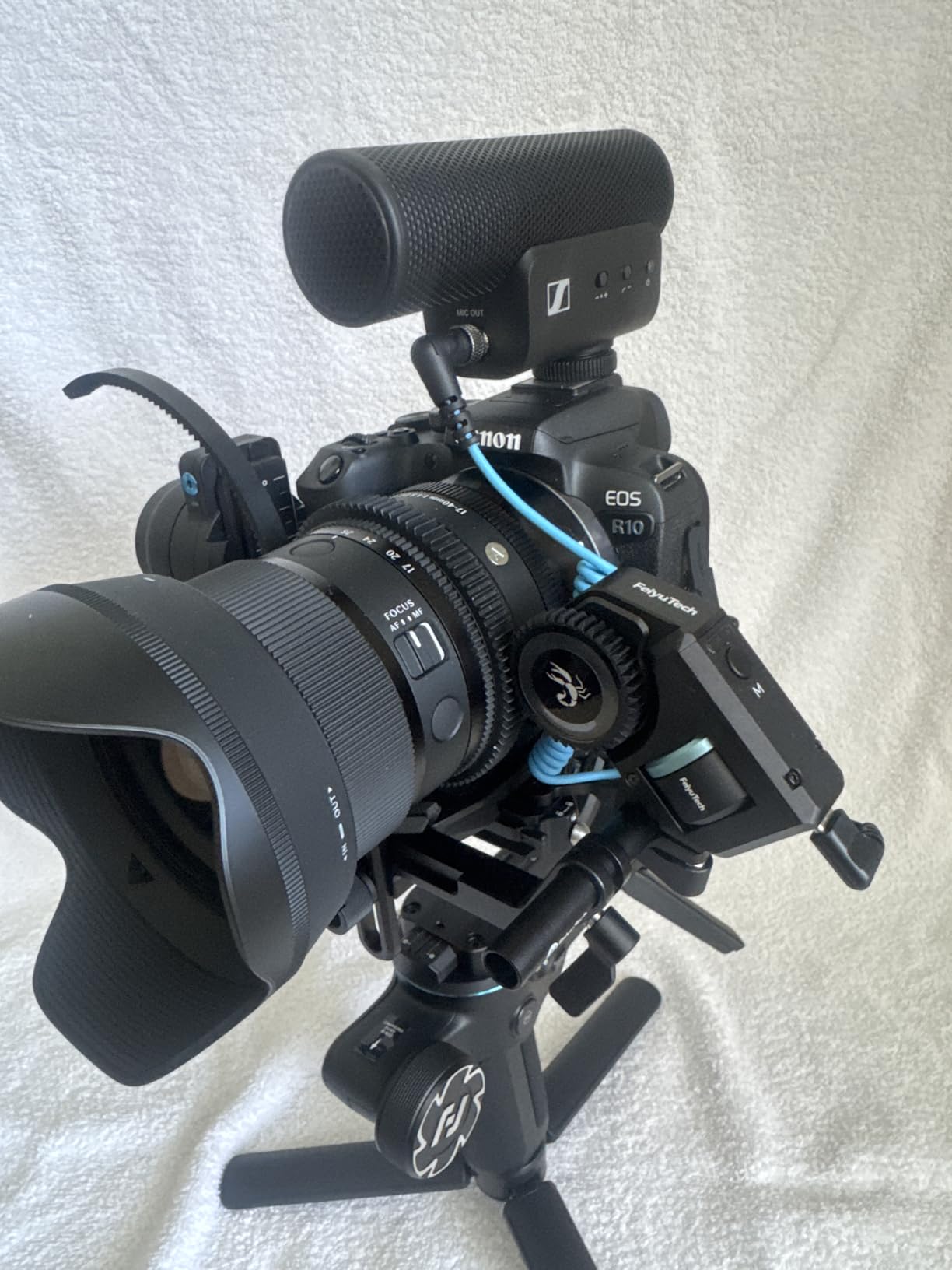
The R10 is the model we recommend to people who intend to do this properly, and the one I would buy if I could pick a single body for a career in events. A 24.2-megapixel APS-C sensor sits beside a DIGIC X processor, with ISO 100-32000 expandable to 51200 and 10-bit 4K recording.
The autofocus is the R50’s system, up to 651 zones across roughly the full frame, working down to EV -4, with detection for people, animals and vehicles. It runs 15 fps on the mechanical shutter and 23 fps electronically, with RAW Burst pre-shooting to catch the frame before the button press.
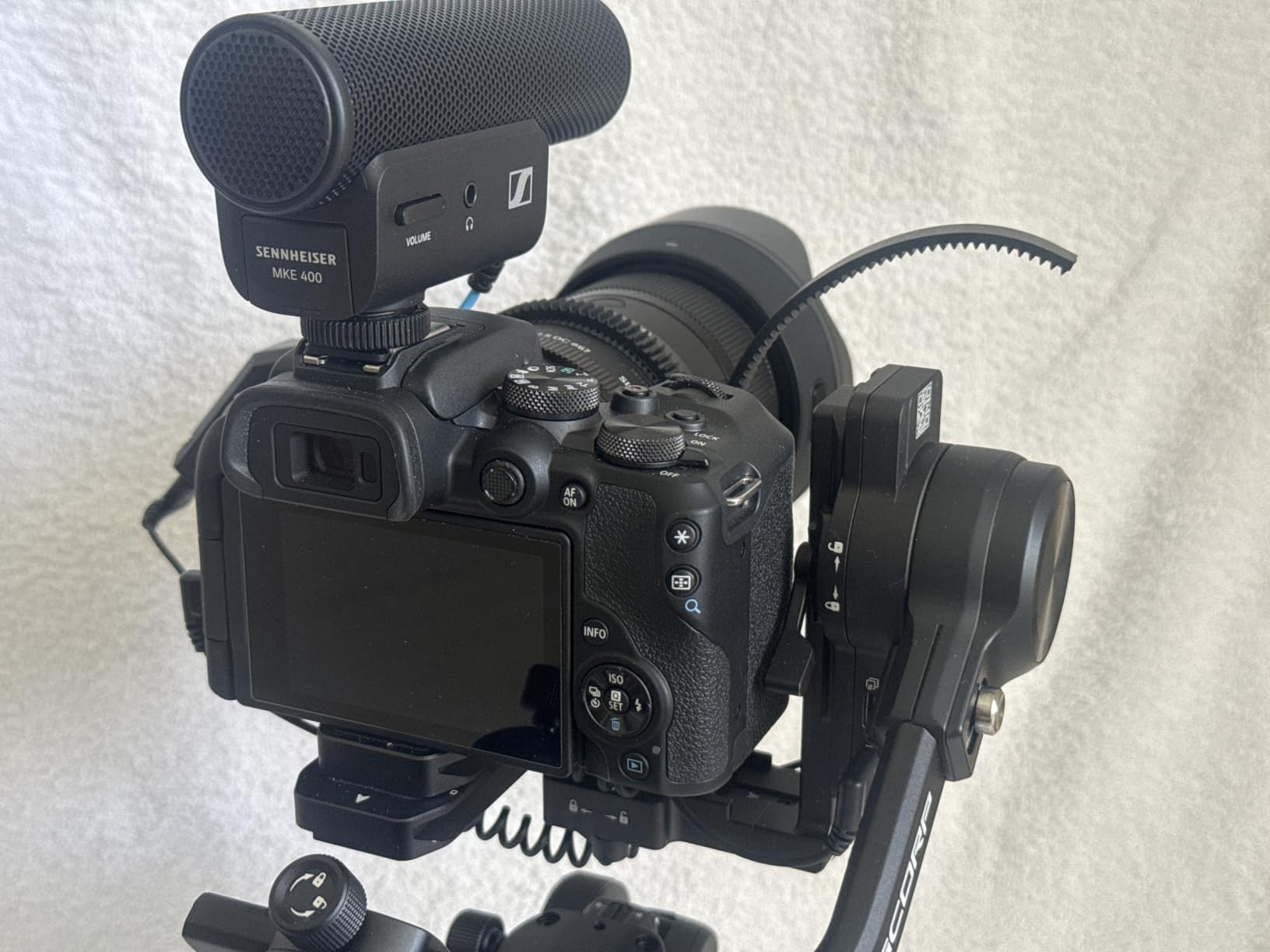
Physically it is the balance point of this list. It is compact and light at 0.43 kg, but the grip is a size up from the R50 and does not feel cramped, and the anti-smudge coated screen is fully articulating rather than only tilting. The LP-E17 battery can be topped up in-camera through the PD-E USB power adapter, which matters on a twelve-hour wedding day.
EF and EF-S DSLR lenses mount on it through the Mount Adapter EF-EOS R, so anyone arriving from a Canon DSLR can bring a drawer of glass with them. Owners describe it as the sweet spot between capable and approachable, and report no reliability problems.
When the R10 is the right buy
Buy it if you are shooting paid work now or clearly heading that way, or if you want a camera that will take fast primes for events without a second body. The articulating screen also makes it a credible vlogging camera.
It is the natural second step from a Rebel, since your old EF-S lenses come with you through the adapter.
When the R10 is more than you need
There is one UHS-II card slot rather than two, so it lacks the mirrored backup the R7 gives you. Wi-Fi transfer is reported as slow, and a cable or card reader will be faster. The bundled 18-45mm is the same average kit zoom as the R50’s, so budget for a real lens soon.
Check the seller carefully, because some units are third-party imports without a Canon USA warranty.
6. Canon EOS R7 – for Wildlife and Sports Shooters With a Plan
Canon EOS R7 Mirrorless Camera (Body Only)
32.5MP APS-C CMOS
5-axis in-body stabilisation
15 fps mechanical and 30 fps electronic
Dual UHS-II slots
Pros
- 32.5MP resolves detail for heavy cropping
- 30 fps electronic burst with RAW pre-shooting
- In-body stabilisation steadies long lenses
- Subject detection for people and animals
- Dual card slots mirror your files
Cons
- Body only
- so a lens is an extra cost
- APS-C is behind full-frame for extreme low light
- 10-bit video is modest
- Feature set exceeds most beginners' needs
The EOS R7 is the answer for a specific beginner, which is the one who shot their first family event on a phone and now wants birds, motorsport or their kid’s football. The 32.5-megapixel APS-C sensor is the highest resolution in this guide, and the crop factor gives you extra reach from any lens you already own.
It shoots 15 fps mechanically and 30 fps on the electronic shutter, with a RAW Burst mode that buffers half a second of frames before you press the button, so you do not miss the moment you reacted to. Dual Pixel CMOS AF II offers up to 651 zones covering roughly the full frame, working down to EV -5.0 in poor light.

The 5-axis in-body image stabilisation is the feature most beginners underestimate. It means handheld shots at slow shutter speeds with a long wildlife lens, which is exactly the frame you cannot crop your way out of later. Auto-level keeps horizons straight when you frame low to the ground.
Two UHS-II card slots mean you can put a card in each and mirror your files, which is how a lot of working shooters set up a backup. That is a genuine professional habit available on a body many beginners could justify.

Why the R7 is worth stretching for
Choose it if you already know your subject and your frustration is a frame rate or a focus system that cannot keep up. Owners highlight the 30 fps burst, the reliable tracking and the effective stabilisation, with an 84 percent five-star share among reviews.
Choose it if you plan to crop hard. At 32.5 megapixels a 300mm lens gives you roughly the field of view of 480mm, and you still have detail left in the file afterwards.
Why most beginners should not buy it
This is a body-only listing, so you must budget for an RF lens as well, and that changes the total considerably. The stabilisation and the burst rate also solve problems a first-year shooter rarely has yet.
Unless your subject is small and moving, put the extra money toward a lens instead. Glass changes your photographs more than a resolution bump does.
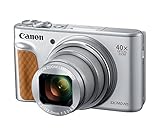
7. Canon PowerShot SX740 HS – the Pocket Camera With a 40x Zoom
Canon PowerShot SX740 HS, Point and Shoot Digital Camera, Optical Zoom, 4K Video, Silver
20.3MP 1/2.3-inch CMOS
40x optical zoom
9.76 ounces
4K video
180 degree tilt screen
Pros
- 40x optical reach in a pocketable body
- Light and genuinely easy to carry
- Tilt-up screen helps with selfies and low angles
- Built-in flash and full manual controls
- 4K video and time-lapse capture
Cons
- Small sensor softens at long zoom and low light
- No viewfinder of any kind
- A tripod is essential at full reach
The PowerShot SX740 HS solves one problem better than anything else in this guide: getting a telephoto lens into a coat pocket. Forty times optical zoom takes you from a 24mm wide angle to a 960mm equivalent, with optical image stabilisation and Zoom Framing Assist to hold the subject, and the whole thing weighs under 10 ounces.
For travel, birding, school sports and family events where you cannot get close, that is transformative. The 3.0-inch screen tilts up 180 degrees for selfie framing, there is a built-in flash, and you still get full manual control plus 4K video and 4K time-lapse.

The trade-off is the 1/2.3-inch sensor. Twenty megapixels sounds impressive on paper, but the small chip is why output softens noticeably at the far end of the zoom and in dim light. Enthusiasts who buy this camera for birding set their expectations correctly, and most one-star reviews concern third-party seller listings rather than the camera itself.
There is no optical or electronic viewfinder, so in bright sun you shoot off the tilting screen, and at full 960mm reach you really do need a tripod. The Canon smartphone app is also widely described as unintuitive.

When to buy the PowerShot SX740 HS
Buy it as a travel camera, a light wildlife option or a family event camera, and pair it with a phone for low light. If your photography is people at close range, the phone in your pocket will beat it.
It is also a sensible first camera for a teenager or a relative who will lose a proper camera bag. The cost of that risk is small.
When to leave it on the shelf
Skip it if you care about background blur, because a small sensor and a built-in lens cannot produce the separation an interchangeable-lens camera gives you. It is also the wrong tool for weddings, where flash sync, low light and a fast prime matter far more than reach.
It is the least future-proof camera here, because no lenses attach to it. That is a fair trade for a coat pocket.
8. Canon EOS M50 Renewed Kit – the Sensible Used Buy
Canon EOS M50 Mirrorless Camera Kit w/EF-M15-45mm and 4K Video (Black) (Renewed)
24.1MP APS-C CMOS
OLED electronic viewfinder
Eye detection AF with 143 points
4K 24p
90-day warranty
Pros
- Viewfinder-equipped APS-C Canon without new-body pricing
- Effective eye detection for the class
- 4K 24p plus 120 fps slow motion
- Accepts EF
- EF-S and EF-M lenses
- Small and light at 13.7 ounces
Cons
- 90-day limited warranty only
- EF-M lens roadmap is limited
- No in-body image stabilisation
A renewed M50 is how you get a viewfinder-equipped APS-C Canon with eye detection without buying new, and for a beginner working from a fixed budget it is a defensible choice. You get the 24.1-megapixel sensor, the improved Dual Pixel CMOS AF with eye detection across 143 points, an OLED electronic viewfinder with touch and drag focusing, and 4K at 24p.
The body weighs 13.7 ounces, the 3.0-inch touchscreen tilts for selfies and vlogging, and it accepts EF, EF-S and EF-M lenses, which widens your options for used glass. A 64 GB card is included in the kit.

Renewed buyers generally report good results for travel, everyday photography and casual video, with a 78 percent five-star share. The most common caution is the short warranty, and several reviewers point out the limited EF-M roadmap when planning future upgrades.
Because this is a renewed listing, expect some cosmetic wear and check the sensor, the lens mount and the battery compartment carefully on arrival. Treat it as a two-year starter rather than a five-year tool.

Who the renewed M50 works for
Buy it if your priority is a viewfinder and eye detection at the lowest sensible outlay, particularly for travel and family documentation. It is also a decent low-cost second body that lives in a bag as a backup.
It suits a beginner who mainly wants to learn and does not mind a generation-old autofocus system.
Who should avoid a renewed body
Skip it if you are buying it as a professional tool, because a 90-day limited warranty is not a foundation for paid work. Skip it if you want in-body stabilisation or a modern lens mount.
And skip it if you can wait, because a newer body with a viewfinder and a current mount is the better long-term home for the same money over five years.
DSLR or Mirrorless: Which Canon Style Suits a Beginner?
Mirrorless wins for most beginners, because every current Canon mirrorless body gives you a tilting or rotating screen, modern subject detection and usable video, and the whole system is where Canon is investing. The Rebel T7 with an optical viewfinder is the exception, and it is a good exception for people who want zero complexity.
The reason the DSLR still appeals is honest and physical. An optical viewfinder never lags, never runs flat and never blacks out in bright sun, which matters if you are shooting a long event in direct sunlight. Battery life is a genuine advantage too, since a T7 comfortably outlasts a mirrorless body with small cells.
The video argument is one-sided. The Rebel T7 records Full HD only, with no 4K and no continuous autofocus worth relying on. If you want to film a ceremony, a first birthday or a travel vlog at all, a mirrorless body is the only sensible answer.
There is a middle path worth knowing: an EF or EF-S DSLR lens from an older body works on an R-series Canon through the Mount Adapter EF-EOS R, and the M50 accepts EF, EF-S and EF-M lenses directly. That is the single strongest argument for choosing Canon as a beginner, and r/photography threads repeat it constantly. We have a fuller look at Canon macro lenses for Canon if you want to see how the glass ecosystem plays out in practice.
What to Look for in Your First Canon Camera
Look at autofocus first, because autofocus decides whether you come home with photographs you like. On modern Canons, any system labelled Dual Pixel with face and eye detection will hold a person sharp while they move. A nine-point system like the Rebel T7’s will not.
Look at the screen next. A tilting or fully articulating touchscreen is what makes low-angle ceremony shots, product photos and self-recording possible at all. A fixed non-touch screen limits where you can put the camera.
Look at the mount before anything long-term. Canon RF bodies take RF and RF-S lenses, and EF and EF-S lenses come along through an adapter. The older EF-M system used on the two M50 bodies here has a small and slowing lens roadmap.
Look at stabilisation. In-body image stabilisation steadies the camera, while optical stabilisation steadies the lens. Canon’s entry bodies, including the R50 and R100, have no in-body stabilisation, so a stabilised lens matters on those. The R7 has five-axis in-body stabilisation, which is a large part of why we choose it for long lenses.
Look at the kit lens honestly. The bundled 18-45mm covers a wide angle through a short telephoto and is the reason these kits are sold, but it is slow, so indoor work pushes the ISO. The 18-150mm covers far more and is the recommendation that keeps coming up in r/WeddingPhotography for a first event kit, paired with a 50mm f/1.8.
Look at the cards. The R7 has dual UHS-II slots for mirrored backup, which is the setup many working shooters use as insurance. The R10, R50 and both M50 bodies use a single slot.
Finally, look at the battery. Small bodies take small cells, and a full event day needs more than one. Canon’s battery grips add capacity and a vertical shutter release, and our battery grip guide for Canon cameras covers the compatible models.
Canon Models to Buy Carefully as a Beginner
Buy carefully with any entry DSLR kit that pairs a current body with a dated 18-55mm and a 9-point autofocus system. The Rebel T7 is the obvious example, and while it is a perfectly good first camera, it is a dead end you will outgrow quickly.
Be careful with the EOS M100 and other first-generation EOS M bodies. Their autofocus and video sit behind everything else in this guide, and their native lenses barely appear on the used market.
Be careful with very old kit lenses sold as a bargain. Expect manual focus only, and electronic contacts that drive autofocus may be worn or corroded.
Be careful with multi-lens kits advertised as huge value. You will rarely use the telephoto, and one fast prime improves every photograph you take for the rest of your life.
Be careful with third-party seller listings that strip the manufacturer warranty or ship grey imports. On a camera, the local warranty is part of the purchase, not a formality.
Canon vs Nikon for a First Camera
Canon is the easier recommendation for a first camera, mainly because of the lens ecosystem and the sheer volume of used EF and EF-S glass. Nikon’s Z mount is excellent, but the affordable first Z bodies land in a different bracket and the used lens market is thinner.
Canon’s menu system, guided modes and Dual Pixel autofocus are also more approachable for a complete beginner, and the vari-angle screens on the M50 Mark II and R10 are genuinely useful. Nikon’s handling is very good and the Z bodies are smaller, but the learning curve is a touch steeper.
Whichever brand you choose, do not overthink it. The camera teaches you the fundamentals, and the fundamentals transfer between brands. Our full Canon cameras for wedding photography guide covers the bodies we actually shoot with.
Canon Cameras for Wedding and Event Photography
The shortlist for a first Canon used on events is the R50, then the R10, then the Rebel T7. The R50 leads because it combines modern subject detection, uncropped 4K for the ceremony recording and a body small enough to still be on your hip at hour nine.
Low light matters more than sensor size at a reception, and that is the point r/canon veterans make repeatedly. A well-handled APS-C body with a fast prime and good autofocus will beat a heavier full-frame body you struggle to focus. Control the light first and shoot wide open before you reach for ISO.
Treat a second body as insurance rather than an upgrade. Once a body is paid for, a second one costs less and removes a single point of failure, and the R7’s dual UHS-II slots let you mirror every file onto two cards as you shoot.
Light matters more than a second body. Our speedlight guide for Canon cameras covers the models that pay for themselves within a single booking, and off-camera flash is what turns a small sensor into reception-quality images.
Frequently Asked Questions
Which Canon camera is best for beginners?
The Canon EOS R50 is the best Canon camera for beginners for most people. Its 24.2-megapixel APS-C sensor, subject detection that tracks people and animals, and uncropped 4K video make it the most capable all-round first Canon, and it stays small enough to carry all day.
Which Canon camera is the best under a budget?
The Canon EOS R100 with the RF-S 18-45mm is the budget pick because it is the lowest-cost way to own an RF-mount body and therefore the cheapest route into Canon RF and RF-S lenses. A renewed Canon EOS M50 kit is the alternative if you want a built-in viewfinder for less and are comfortable with a 90-day warranty.
Which Canon camera is better, the Canon EOS R50 or R100?
The R50 is better in almost every measurable way: 651 AF zones against 143, 12 fps against 6.5, a vari-angle touchscreen against a fixed screen, and uncropped 4K at 30 fps against 4K at 24 fps. The R100 only makes sense when the price gap between the two bodies is wide.
Is a Canon R50 a good beginner camera?
Yes. The R50 is the body most photographers in beginner communities recommend, and it is the one we hand to people who expect to outgrow an entry model within a year. You get guided automatic modes while you learn, modern subject tracking and full manual control when you are ready, and manual is never locked away.
Which Canon camera is best for wedding photography?
For a first Canon used on paid events, the EOS R50 leads because of its fast subject detection and small body, with the EOS R10 a close second thanks to its larger grip, articulating screen and in-camera battery charging. The Rebel T7 works for static work. Low light handling and off-camera flash matter more than sensor size.
Do old Canon EF and EF-S lenses work on the EOS R50 and R100?
Yes. EF and EF-S DSLR lenses mount on RF-mount bodies such as the R50, R100, R7 and R10 through the Mount Adapter EF-EOS R. That is a major reason to choose Canon as a beginner, because lenses you own now or inherit from a family member stay usable as you upgrade.
Is the Canon Rebel T8i discontinued?
The Rebel T8i generation sits at the end of Canon’s DSLR range, and Canon has moved its beginner offering to the EOS R-series mirrorless cameras. The T8i is a capable 24-megapixel DSLR with a vari-angle touchscreen, but its autofocus and Full HD-only video are well behind current mirrorless bodies, so we would not start there today.
Conclusion: Which Canon Should You Buy First?
Buy the Canon EOS R50 if you want one camera that handles stills and video, tracks people and animals, and leaves room to grow. Buy the R100 if your budget is firm and you want the cheapest door into Canon RF lenses, and buy the M50 Mark II if you plan to be in front of the camera as often as behind it.
Whatever you choose, the fundamentals are the same: shoot in Auto to learn, then move to aperture priority and keep pushing the ISO before you add light. That is how you get the most out of the best Canon cameras for beginners without spending your budget on the wrong body.