
If you want one camera that answers the question, the Canon EOS Rebel T7 kit with the EF-S 18-55mm f/3.5-5.6 IS II lens is the best DSLR camera for beginners in 2026. It pairs a 24.1 MP APS-C sensor with a 9-point autofocus system, an optical pentaprism viewfinder and a guided on-screen Feature Guide that explains each setting as you shoot.
That recommendation matters more in 2026 than it did five years ago, because a DSLR is no longer the automatic first camera. Mirrorless bodies at the same money now beat every DSLR here on autofocus speed, video resolution and screen technology. Choosing a DSLR anyway means choosing the optical viewfinder, the physical dials, the deep used lens pool and a body you can learn on for years. Our team handles weddings and events, so we put every camera here through the kinds of shooting where a body either keeps up or drops frames.
Across this list of the best DSLR cameras for beginners, you will find two-lens kits, renewed bodies and one step-up model for people who shoot video. All ten carry an optical viewfinder, an APS-C sensor and physical controls, which is the common thread that separates a DSLR from everything else. If you shoot mainly video, read our beginner camera guide for vloggers first, because only one DSLR on this list records 4K.
Table of Contents
Top 3 DSLR Picks for Beginners in October 2026

Quick Overview of the Best DSLR Cameras for Beginners in October 2026
| Product | Specifications | Action |
|---|---|---|
| Canon EOS Rebel T7 Kit |
|
Check Latest Price |
 Nikon D3400 Kit Nikon D3400 Kit |
|
Check Latest Price |
 Nikon D5600 Kit Nikon D5600 Kit |
|
Check Latest Price |
 Nikon D3300 Two-Lens Kit Nikon D3300 Two-Lens Kit |
|
Check Latest Price |
 Nikon D3500 Renewed Nikon D3500 Renewed |
|
Check Latest Price |
 Nikon D3000 Kit Nikon D3000 Kit |
|
Check Latest Price |
 Canon EOS 90D Kit Canon EOS 90D Kit |
|
Check Latest Price |
 Nikon D5000 Kit Nikon D5000 Kit |
|
Check Latest Price |
 Nikon D7500 Two-Lens Bundle Nikon D7500 Two-Lens Bundle |
|
Check Latest Price |
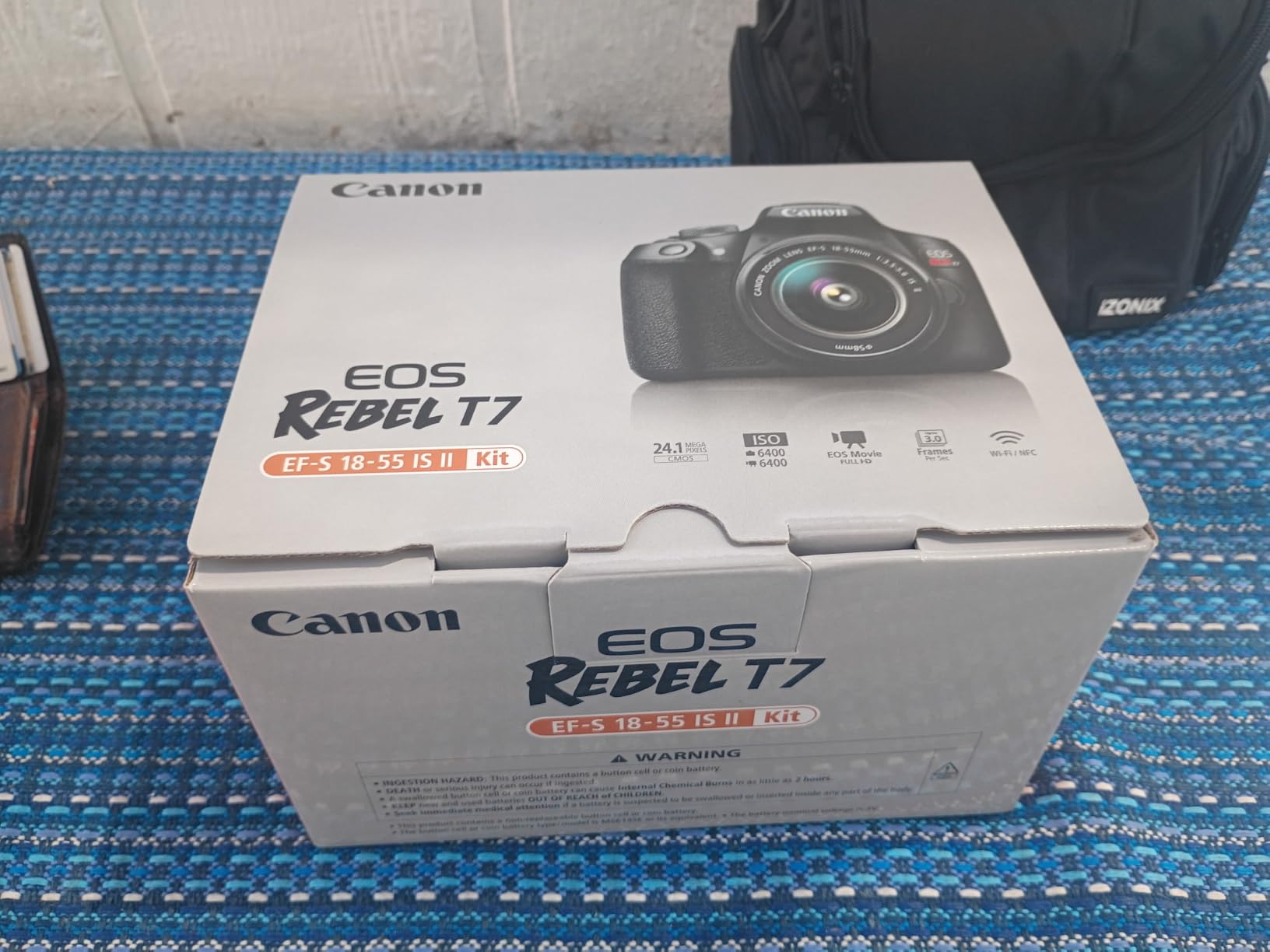
 Canon Rebel T7 Double-Lens Bundle Canon Rebel T7 Double-Lens Bundle |
|
Check Latest Price |
The 10 Best DSLR Cameras for Beginners, Reviewed
1. Canon EOS Rebel T7 Kit – the Best DSLR Camera for Beginners Overall
Canon EOS Rebel T7 DSLR Camera EF-S 18-55mm f/3.5-5.6 is II Lens Kit
24.1 MP APS-C CMOS
ISO 100-6400
9-point AF
1080p video
920k-dot LCD
Pros
- Guided Feature Guide teaches settings as you shoot
- Lightweight body with a secure grip
- Built-in Wi-Fi for phone transfer
- Versatile 18-55mm stabilized kit lens
Cons
- 3 fps burst is slow for action
- Dated 9-point autofocus
- No 4K video
We handed the Rebel T7 to several people who had never held a DSLR, and the Feature Guide did most of the teaching. It explains what the setting does on the back of the camera while you shoot, which removes the usual first-week frustration of staring at a manual.
The 24.1 MP APS-C sensor produces files that hold up well in daylight and at moderate low light, and the 14-bit RAW gives you room to adjust exposure later. Image quality is a genuine step up from a phone, particularly in the detail the sensor resolves.

Autofocus is the honest weak point. Nine phase-detect points with one center cross-type point cover a small area, so anything away from the middle needs a repositioning. Reviewers also report occasional focus hunting when light drops, which is normal for this tier.
Burst shooting runs at 3 fps. That is fine for portraits and family photos and a problem the moment you try to catch a kid mid-sprint across a soccer field.

Buy the Rebel T7 if you want the cheapest complete first kit
This is the pick for someone who wants to learn exposure without a big invoice and without a menu system that fights back. The dial, the shutter button and the mode dial are all where your fingers expect them, and the whole package is light enough to carry on a long walk.
It is also the one we recommend to shooters moving from a phone who want to shoot weddings on the side. Our beginner DSLR guide for wedding photography uses this body as the baseline for ceremony coverage with a single slot.
Skip the Rebel T7 if video or fast action is the point
Full HD 1080p is the ceiling, and there is no microphone input, so recorded audio is the internal microphone. If your plan involves video clips for social, that is a hard stop.
Wi-Fi transfer also takes a few taps through the Canon Camera Connect app and leaves the camera showing a blank screen while it works. Budget for a card reader instead of trusting the wireless path.
2. Nikon D3400 Kit – the Lightest Body Here with the Best Detail Retention
Nikon D3400 w/AF-P DX NIKKOR 18-55mm f/3.5-5.6G VR (Black)
24.2 MP DX CMOS
ISO 100-25600
395 g
11-point 3D tracking
1080p
Pros
- No low-pass filter captures fine detail
- Very light 395 g body
- Guide mode shortens the learning curve
- Images hold up for casual print work
Cons
- Only 11 AF points near the center
- Fixed screen with no touchscreen
- Kit may ship without battery or card
The D3400 weighs 395 grams, which makes it the lightest body in this roundup by a wide margin. On a twelve-hour shooting day that difference is felt in the wrist, and reviewers consistently single the weight out as a reason they kept the camera.
The 24.2 MP DX sensor has no optical low-pass filter, so it resolves noticeably more fine detail than the Canon Rebel T7 at a similar resolution. Native ISO runs to 25,600, which is where the low-light advantage really shows.

Guide mode walks a new owner through the settings step by step, and the menu layout is forgiving. Continuous autofocus during video is the weaker side of the package compared with Canon’s Dual Pixel systems.
Check the box contents carefully before you order. Some packages ship without a battery and memory card, and the included USB cable is not the right one for the D3400 port.
Choose the D3400 if light weight and clean files matter most
This is the pick for travel and street work where you carry the camera all day. Pairing it with an older 35mm AF-S prime is the move most owners make once they outgrow the 18-55mm, and both lenses autofocus on this body.
It also suits a parent documenting a growing child, since the light body does not cause wrist strain over a long event at an indoor party.
Look elsewhere if you need a touchscreen or a second card slot
The 3.0-inch 921,000-dot screen is fixed and has no touch input, so framing from low angles means crouching rather than tilting. All 11 autofocus points cluster near the center, which limits tracking subjects near the frame edge.
SnapBridge has also had reliability problems after iOS updates. Treat the Bluetooth transfer as a backup, not a workflow.
3. Nikon D5600 Kit – the Best DSLR for Framing Low and High Shots
D5600 DX-Format Digital SLR w/AF-P DX NIKKOR 18-55mm f/3.5-5.6G VR
24.2 MP DX CMOS
39-point AF
3.2-inch vari-angle touchscreen
ISO 100-25600
Pros
- Vari-angle touchscreen makes low angles easy
- 39-point AF tracks far better than entry bodies
- 1080p at 60 fps
- Wide native ISO to 25600
Cons
- No 4K video
- Single card slot with no backup
- Heavier than Nikon's smaller bodies
The flip-out 3.2-inch 1,037,000-dot capacitive touchscreen is the feature that changes daily shooting. Framing a low shot of a flower bed or a high-angle shot at a reception no longer means lying on the floor or holding the camera over your head blind.
Autofocus is the other upgrade. Thirty-nine phase-detect points with nine cross-type cover far more of the frame than the 11-point cluster in the D3400, and tracking a walking subject is straightforward.

Video records Full HD at up to 60 fps, which is slow enough to be usable for short clips where the D3400’s 30 fps is not. It remains capped at 1080p with no 4K option.
The EXPEED 4 processor and 24.2 MP sensor are the same generation as the D3400, so image quality per pixel is familiar. The body is noticeably heavier than Nikon’s smaller entry models, which is a fair trade for the screen.

Choose the D5600 if you shoot from awkward angles or track moving subjects
This is the body we recommend for a beginner who has already spent a season on an entry model and knows which limits are getting in the way. The autofocus upgrade alone changes how many usable frames you keep.
For interiors and real-estate work, the tilt screen pairs well with a wide prime. Our beginner camera guide for real estate photography covers the lens side of that pairing.
Skip the D5600 if video or card redundancy is the priority
There is one SD slot and no dual-card backup. For long paid events that is a real operational risk, and owners of higher-tier bodies cite card redundancy as the first thing to check.
Wi-Fi setup is fiddly on the first attempt. Do it once with the camera near your router, before you leave the house for a shoot.
4. Nikon D3300 Two-Lens Kit – the Best Starter Bundle if You Want Two Lenses
Nikon D3300 DX-format DSLR Kit w/ 18-55mm VR II & 55-200mm Zoom Lenses and Case (Black)
24.2 MP DX CMOS
18-55mm plus 55-200mm
11-point 3D tracking
5 fps
Pros
- Wide angle through telephoto out of the box
- Battery charger strap and case included
- 5 fps handles casual action
- Light 460 g body
Cons
- 12-bit RAW on an older processor
- Fixed screen with no touch
- Wired only without an adapter
- 1080p video only
Most beginners buy a kit zoom and then spend three months wishing they had a telephoto. This bundle closes that gap in one box with the 18-55mm f/3.5-5.6G VR II and the 55-200mm f/4-5.6G VR II, both stabilized.
Reviewers point out the practical detail that matters most on day one: the battery, charger, strap and case are all in the box. You can start shooting the afternoon it arrives rather than ordering three accessories first.

Eleven autofocus points with 3D tracking lock onto a moving subject reliably enough for a soccer game or a pet. Continuous shooting runs at 5 fps.
The 12-bit RAW pipeline and EXPEED 3 processor are an older generation, and the 3.0-inch 921,000-dot screen is fixed. Wi-Fi needs the optional WU-1a adapter, so connectivity is wired out of the box.

Choose the D3300 kit if you want reach without a second purchase
If you know you will photograph sports, wildlife or stage events, the telephoto removes the single most common early frustration. Buying the second lens later usually costs more than it does here.
The included accessories also mean a beginner who has never owned a camera does not get stuck at checkout wondering what else is required.
Skip the D3300 kit if you need modern connectivity or maximum crop latitude
The 55-200mm is slow at f/5.6, so low light is where this kit feels its age. Wedding receptions and indoor events push that limit quickly, and a fast prime is the fix.
For large prints and heavy cropping, 24.2 MP at 12-bit will not give you the headroom that a current body does.
5. Nikon D3500 Renewed – the Best Value When You Can Accept a Shorter Warranty
Nikon D3500 24.2MP DSLR Camera with AF-P DX NIKKOR 18-55mm f/3.5-5.6G VR Lens (1590B) – (Renewed)
24.2 MP DX no low-pass filter
EXPEED 5
5 fps
90-day warranty
Pros
- Renewed pricing on a current-generation body
- Full original accessory set in the box
- No low-pass filter keeps fine detail
- 5 fps and 11-point AF handle everyday work
Cons
- Cosmetic wear on some units
- 90-day warranty only
- Fixed screen with no touchscreen
- Smallest review base in this set
The renewed D3500 is the same 24.2 MP no-low-pass-filter sensor and EXPEED 5 processor found in the new body, with native ISO to 25,600 and 5 fps shooting. For a beginner, the picture quality is effectively identical to buying new.
Every original accessory is in the box, including the EN-EL14a battery, MH-24 charger, strap, eyecup and the AF-P 18-55mm VR lens. That completeness is unusual in the secondhand market and removes the usual first-week shopping list.
The tradeoff is warranty length. Renewed units carry a 90-day limited warranty rather than a full year, which means a shutter or AF fault surfacing in month four is your problem.
Expect cosmetic wear on a used body. It does not affect image quality, but it does affect how the camera feels to handle.

Choose the renewed D3500 if your budget is fixed and the box is complete
This is the pick for someone who wants a modern DX sensor and a full accessory set without stretching. Renewed buyers describe it as a value purchase, and the star spread is wider simply because fewer people review it.
Ask for a return window you can live with. Inspect the sensor and the lens mount under light before the return period closes.
Skip it if warranty length is your main concern
A 90-day warranty is a genuine risk on a mechanical camera with a mechanical shutter. Forums discussing used DSLR buying repeatedly warn that warranty-backed refurbished stock beats untested private sales for exactly this reason.
The fixed 921k-dot screen with no touchscreen is the same limitation as the new body, so nothing is gained or lost there.
6. Nikon D3000 Kit – the Best DSLR for Learning the Modes From Scratch
Nikon D3000 10.2MP Digital SLR Camera with 18-55mm f/3.5-5.6G AF-S DX VR Nikkor Zoom Lens
10.2 MP DX CCD
11-point AF
Guide mode and help button
No video recording
Pros
- Help button explains every setting on demand
- Full auto mode works as a point-and-shoot
- No shutter lag at 3 fps
- Lightweight body with good ergonomics
Cons
- 10.2 MP sensor shows grain above ISO 800
- No video and no Live View
- 230k-dot screen is soft
- Only AF-S lenses autofocus
The teaching value is the whole point of this camera. The question mark button and Guide mode explain what each setting does on the back of the camera, so a total beginner can shoot in full auto on day one and still understand why the picture came out the way it did.
Long-term owners report years of reliable service from this body. The 11-point Multi-CAM1000 autofocus and multi-segment metering were a step up from the cameras that preceded it.

Image quality is the limit. The 10.2 MP CCD sensor shows visible grain above ISO 800, which rules it out for indoor receptions and evening events where ISO climbs fast.
There is no video recording at all and no Live View. The 3.0-inch 230,000-dot screen is soft by any modern standard, and only AF-S lenses autofocus on this mount.
Choose the D3000 if you are starting from zero and want to be talked through
If the person buying the camera is not the person who will use it, and the user is a child or a complete beginner, the built-in explanations are genuinely useful. The mode dial also has genuinely simple positions.
Only AF-S lenses autofocus, so if you later add glass, check the AF-S designation before buying.
Skip it if you need video or any low-light capability
A camera with no video function rules out an entire category of work in one line of the spec sheet. If you might ever want short clips, that alone ends the consideration.
The plastic body and mount feel less solid than the newer bodies here, which is expected for a body of this vintage.
7. Canon EOS 90D Kit – the Best DSLR Here if Video Is Part of the Plan
Canon DSLR Camera [EOS 90D] with 18-135 is USM Lens | Built-in Wi-Fi, Bluetooth, DIGIC 8 Image Processor, 4K Video, Dual Pixel CMOS AF, and 3.0 Inch Vari-Angle Touch LCD Screen, Black
32.5 MP APS-C CMOS
4K UHD 30p and 120p Full HD
45-point cross-type AF
10 fps
Pros
- Only body here recording genuine 4K
- 45-point all cross-type AF plus Dual Pixel CMOS AF
- 10 fps with no viewfinder blackout
- Vari-angle touchscreen
- Can run as a webcam
Cons
- Single SD slot with no backup
- Not sealed to professional standards
- Plastic body feels light for the class
- Overkill for an absolute beginner
The 90D is the only DSLR in this list that records 4K UHD at 30p, and it also captures Full HD at 120p for slow motion. The included EF-S 18-135mm f/3.5-5.6 IS USM covers a very wide range without a second lens.
Autofocus combines 45 all cross-type viewfinder points with Dual Pixel CMOS AF in Live View, which is why owners report reliable subject tracking in both stills and video. Continuous shooting runs up to 10 fps with no viewfinder blackout.
![Canon DSLR Camera [EOS 90D] with 18-135 is USM Lens | Built-in Wi-Fi, Bluetooth, DIGIC 8 Image Processor, 4K Video, Dual Pixel CMOS AF, and 3.0 Inch Vari-Angle Touch LCD Screen, Black customer photo 1](https://www.kingdomweddingphotography.com/wp-content/uploads/2026/08/B07WHV3HXL_customer_1.jpg)
Wi-Fi and Bluetooth are built in, and EOS Utility Webcam Beta turns the camera into a plug-and-play webcam on Mac and Windows. If you plan any talking-head work, our shotgun microphone guide for DSLR video covers the audio side, and our beginner vlogging camera guide covers framing.
It also supports a UHS-II card in its single slot, so the buffer can be fed properly at those burst rates.
![Canon DSLR Camera [EOS 90D] with 18-135 is USM Lens | Built-in Wi-Fi, Bluetooth, DIGIC 8 Image Processor, 4K Video, Dual Pixel CMOS AF, and 3.0 Inch Vari-Angle Touch LCD Screen, Black customer photo 2](https://www.kingdomweddingphotography.com/wp-content/uploads/2026/08/B07WHV3HXL_customer_2.jpg)
Choose the 90D if you will shoot stills and video on the same body
For a beginner who already knows they want motion work, this is the only DSLR here that does not force a compromise. The 32.5 MP sensor also crops well, which matters for event work.
Many owners describe it as the satisfying step up from a Rebel body once they outgrow one, so it works as a two-year-first-camera rather than a final one.
Skip the 90D if cost is the deciding factor
Several buyers specifically note that this is more camera than a first-time photographer needs. The single SD slot means no card redundancy for long paid events, and the body is not sealed to professional standards.
The rear control wheel is also small. If your hands are large, try one in person before committing.
8. Nikon D5000 Kit – the Cheapest Way to Get a Flip-Out Screen
Nikon D5000 12.3 MP DX Digital SLR Camera with 18-55mm f/3.5-5.6G VR Lens and 2.7-inch Vari-angle LCD
12.3 MP DX CMOS
Vari-angle 2.7-inch LCD
720p D-Movie
One-button Live View
Pros
- Vari-angle screen and one-button Live View at a low entry price
- 12.3 MP DX sensor still produces clean files
- Optical VR in the kit lens
- Cheapest route into interchangeable-lens shooting
Cons
- 720p video only
- 2.7-inch 230000-dot screen is small
- No Wi-Fi or Bluetooth
- No battery or card included
The D5000 is the lowest-rated pick here, and the reason is consistent across reviews. It was an advanced model when it launched, and its 12.3 MP sensor, small screen and 720p video now sit several generations behind.
What it still does well is the vari-angle 2.7-inch LCD and one-button Live View, both rare at this entry price. Those two features let you frame from low and high angles without a separate accessory.

Images from the 12.3 MP DX sensor are clean and detailed enough for screen viewing and small prints, which is where this body makes sense today.
The AF-S DX 18-55mm f/3.5-5.6G VR kit lens includes optical stabilization. Battery and memory card are not included, so plan for those.
Choose the D5000 if the budget is the deciding factor
This is a low-cost way to learn interchangeable-lens photography, and the flip-out screen is the feature you will miss most if you buy a fixed-screen body instead.
It suits someone who wants to learn framing angles and exposure on a mechanical camera without spending much.
Skip it if you print large, transfer wirelessly or shoot video
720p with no 1080p and no 4K ends the video question immediately, and there is no built-in Wi-Fi or Bluetooth to move files off the card.
The 11-point AF system is very dated, and the small screen makes image review frustrating at anything above ISO 1600.
9. Nikon D7500 Two-Lens Bundle – the Best DSLR Here for Sports and Low Light
Nikon D7500 DX-Format Digital SLR w/AF-P NIKKOR 18-55mm f/3.5-5.6G VR Lens + -P 70-300mm f/4.5-6.3G ed + 64GB Memory Card, TriPod, Flash, 3pc Filter Kit, Case, More, Black
20.9 MP DX CMOS
51-point AF
8 fps
Native ISO 51200
4K UHD 30p
Pros
- 51-point AF with group area AF tracks well
- 8 fps for up to 100 frames
- Native ISO 51200 for indoor and low light
- Two lenses plus card tripod flash filters and bag
Cons
- No built-in flash
- Single card slot with no backup
- Not weather resistant
- Bundle leans on accessories over camera and lens quality
The D7500 is the strongest all-rounder in this roundup on paper. Fifty-one autofocus points with group area AF, 8 fps for up to 100 frames, and native ISO 51,200 expanded to 1,640,000 for indoor and low-light work.
The bundle pairs the body with the 18-55mm f/3.5-5.6G VR and the 70-300mm f/4.5-6.3G ED, plus a 64GB card, tripod, slave flash, filter kit and bag. Reviewers with the smallest review base in this set judge it mainly on what arrives in the box.

Video records 4K UHD at 30p, and the 3.2-inch 922k-dot tilting touchscreen handles low framing. Owners praise the combination of reach and low-light capability for the money.
One practical catch: there is no built-in flash on this body. A speedlight is in the bundle, which covers the gap, but the body alone will not light an indoor subject.

Choose the D7500 bundle if you shoot movement or dim rooms
Soccer games, pets, stage performances and evening receptions are exactly the situations that punish a 9-point or 11-point autofocus cluster. The 51-point system with group area AF handles them.
The 70-300mm gives you reach without a second transaction, and the 64GB card and bag remove setup friction entirely.
Skip it if you need weather sealing or card redundancy
The body is not water resistant and has a single SD/SDHC slot. Long paid events in unpredictable conditions are exactly where those two limits bite.
The large box is dominated by accessories rather than by camera or lens quality, so compare the body-only configuration before settling.
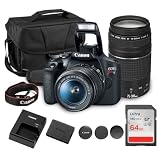
10. Canon Rebel T7 Double-Lens Bundle – the Best Value Two-Lens Canon Setup
Canon EOS Rebel T7 DSLR Camera with 18-55mm & 75-300mm Double Lens Bundle
24.1 MP APS-C CMOS
18-55mm plus 75-300mm
9-point AF
1080p at 30p
Pros
- Two stabilized lenses including a 75-300mm telephoto
- 64GB card bag and battery included
- 24.1 MP sensor gives crisp accurate color
- Scene modes make it approachable
- Sensors and AF match the standard T7 kit
Cons
- Oldest 9-point AF design in the lineup
- Fixed screen with no touchscreen
- No 4K video and no microphone input
- 3 pounds with both lenses
This bundle is the standard Rebel T7 kit with an EF 75-300mm f/4-5.6 III telephoto added, so the body performs exactly like the entry model every owner recommends. The reason to choose it is the second lens.
The 64GB memory card, shoulder bag and battery mean the kit works the moment it arrives. Reviewers describe it as the best value option against big-box retail configurations, and the scene modes make it approachable from the first frame.

The 24.1 MP APS-C sensor produces crisp images with accurate color, and both included lenses carry optical image stabilization, which matters for the long end of the telephoto.
At 3 pounds with both lenses mounted, this is a bulky carry for hiking. The telephoto is also slow at f/5.6, so distant low-light shots are weak.
Choose this bundle if you want a telephoto in the box for Canon
If you are starting with Canon and already know you will want reach, this saves you the second purchase and the second round of learning which lens to mount. Sports, school events and outdoor portraits are the obvious fits.
For tripod-free handheld video work, our gimbal guide for DSLR cameras covers stabilization options that pair with this weight class.
Skip it if video or compact travel is the priority
There is no 4K video and no microphone input, and switching between stills and video means turning the mode dial. Audio quality from the internal microphone is the limiting factor, not the sensor.
The 9-point autofocus and fixed screen are the oldest designs in this roundup, so you accept them or you move up a class.
Buying Guide: What Actually Matters in Your First DSLR
Rank the criteria in this order and most purchase mistakes disappear. Sensor size and lens cost dominate everything else on this list, and megapixels barely register.
1. APS-C sensor and RAW capture. Every camera here shoots an APS-C sensor, which gives you the depth of field and high ISO behavior that separates a DSLR from a phone. Make sure RAW is on, not just JPEG.
2. Lens mount cost. The body is a one-time decision; the mount is a decade of spending. Nikon F-mount and Canon EF are the cheapest used ecosystems to enter. Pentax K-mount is excellent and expensive in glass. Check lens prices before you commit to a body.
3. Autofocus points and coverage. Nine points clustered at the center restrict where you can frame a moving subject. Thirty-nine or more points with cross-type coverage is where real tracking begins.
4. Handling and grip. Owners with larger hands repeatedly report that small mirrorless bodies no longer fit their grip. Try a body in person with the lens you intend to use, and check that the card door and battery grip are comfortable.
5. Screen articulation. A vari-angle touchscreen changes what you can photograph. If you shoot low-angle details, high-angle event shots or your own children, this is worth more than extra resolution.
6. Video capability. Eight of these ten cameras cap at 1080p, and none of the entry bodies has a microphone input. If video is more than an occasional clip, read our DSLR video audio guide before you buy anything.
7. Battery and card. Budget for two batteries and a fast UHS-I card as part of the purchase, not as an afterthought. A body with no built-in flash, such as the D7500, changes your accessory list too.
Used vs New: Where to Spend and Where to Save
Saving money on a DSLR is reasonable, but only when you know what to inspect. The used DSLR market is deep and cheap because the technology stopped advancing years ago, which is a genuine advantage for a first camera.
A renewed body with a warranty-backed refurbishment is the safest middle path. It gives you current-generation electronics with a shorter warranty than a new unit, and the return window is where your inspection time actually happens.
For private-party used sales, check the shutter count on the body menu, look for fungus in the lens elements under a light source, and confirm there is no separation in the sensor. Forum advice repeats the same three checks for a reason.
Save on the body if you are patient and willing to inspect. Save less on the lens, because a hazy or fungus-infested kit lens can end a purchase faster than any body defect. Spend on a fast 35mm or 50mm prime before anything else.
Frequently Asked Questions
What is the best DSLR camera for a beginner?
The Canon EOS Rebel T7 kit with the EF-S 18-55mm f/3.5-5.6 IS II lens is the best all-round first DSLR. It has a 24.1 MP APS-C sensor, a 9-point autofocus system, an optical viewfinder and a Feature Guide that explains settings as you shoot.
Is a DSLR still worth buying in 2026?
Yes, for stills. Canon and Nikon have ended new DSLR development, so firmware and bodies will age, but an optical viewfinder, physical dials and a deep used lens pool remain real advantages. Mirrorless wins on autofocus and video at the same price.
Why is DSLR being phased out?
Canon ended DSLR camera development and Nikon shipped its last new DSLR flagship before 2026, with both companies redirecting engineering toward mirrorless and RF and Z mounts. Because lenses keep working, existing DSLR systems are shrinking rather than disappearing.
What is better, DSLR or mirrorless for a beginner?
Mirrorless is better for beginners who shoot video or moving subjects, because autofocus tracking and 4K recording are far ahead. A DSLR is better if you want an optical viewfinder, physical dials, a deeper grip and the cheapest used lens pool.
Is a used DSLR a good idea for a beginner?
Yes, if you inspect it. Check the shutter count, look for lens fungus under a light source, confirm the sensor has no separation, and prefer a warranty-backed refurbishment over an untested private sale. You will get a better body for less than a new entry model.
What is the best value DSLR camera for beginners?
The Canon Rebel T7 double-lens bundle and the Nikon D3300 two-lens kit offer the strongest value, because both include a telephoto lens, a memory card and a bag. The renewed Nikon D3500 is the cheapest route to a modern 24.2 MP sensor.
Bottom Line: Which DSLR Camera for Beginners Should You Buy First?
For most people, the Canon EOS Rebel T7 kit is the right first DSLR: the sensor is current enough, the guided controls shorten the learning curve, and the optical viewfinder never stalls. If you want a lighter body and sharper detail, step up to the Nikon D3400. If you shoot from low angles, the Nikon D5600’s flip-out touchscreen is the feature you will thank yourself for.
Buy the Nikon D7500 bundle for sports and dim rooms, the Canon EOS 90D if video matters, and one of the two-lens kits if you already know you will want a telephoto. Whatever you choose, spend your next budget on a fast 35mm or 50mm prime rather than on a better body.