
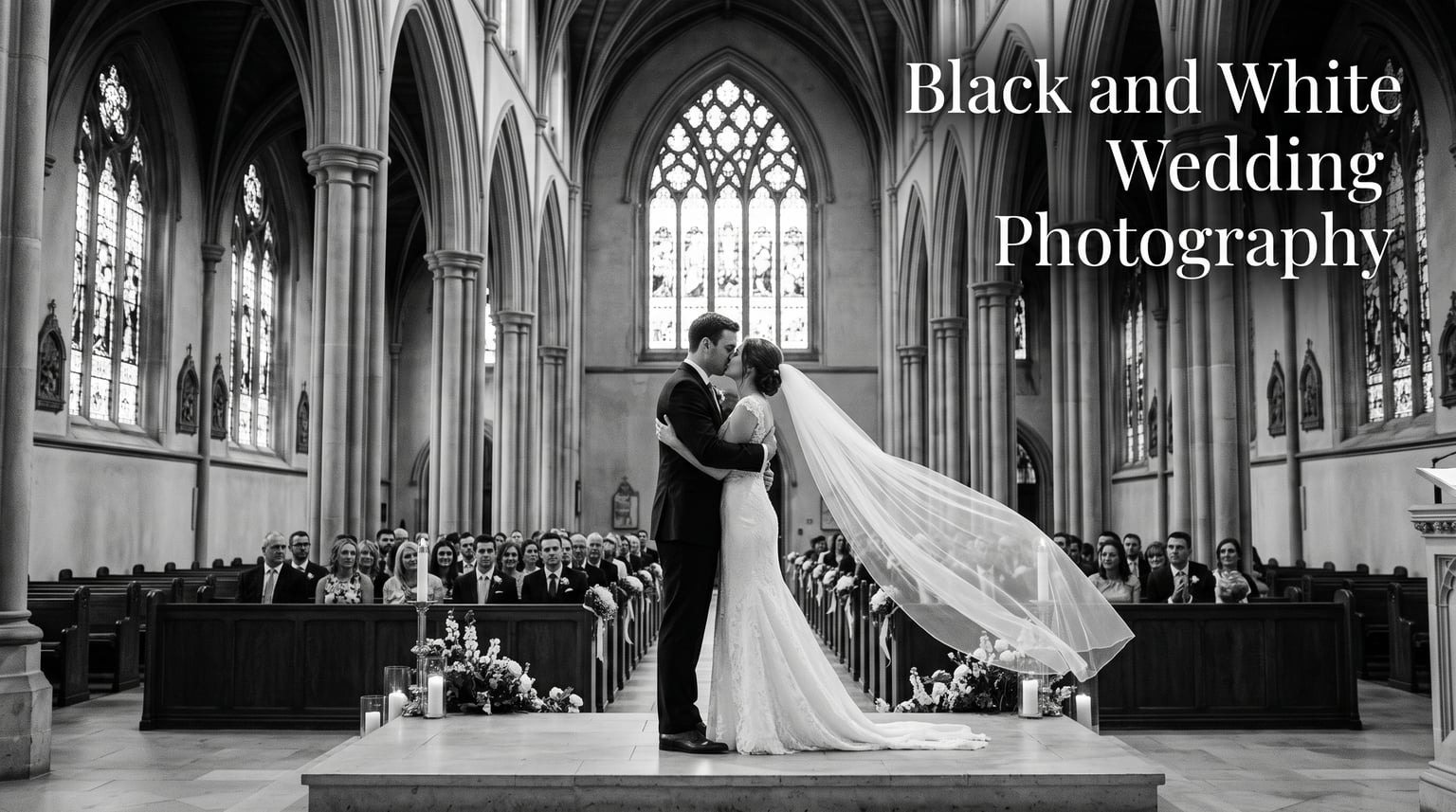
Some wedding photographs become heirlooms. Others become wallpaper on a phone that gets replaced in two years. The difference, more often than not, comes down to one decision: color or monochrome.
Black and white wedding photography has endured for over a century, and in 2026 it remains one of the most requested styles by couples who want images that feel permanent rather than trendy. Photographers champion it. Albums built around it end up on living room walls for decades. The finished images stop people mid-scroll in a way that color photos sometimes don’t.
But why? What is it about stripping color from a wedding photo that makes the result feel more powerful, more emotionally honest, more worthy of framing?
In this guide, I’ll walk through everything worth knowing about monochrome wedding photography — from the artistic reasons photographers reach for it, to the specific moments where it shines, to how you can communicate your preferences clearly before the big day. Whether you’re a couple planning your wedding or a photographer refining your approach, there’s a lot here to work with.
Table of Contents
Black and White Wedding Photography
Black and white wedding photography is a photographic style where images are presented using only tones of gray — from pure black through to pure white — without any color information. The goal is to tell the story of a wedding day through light, shadow, form, and expression rather than through color.
Most modern photographers shoot entirely in color and then selectively convert chosen images to black and white during post-processing. The decision to convert an image isn’t accidental or automatic — it reflects a creative judgment about which moments benefit from the absence of color and which are better served by keeping it.
The result is photographs that feel less anchored to a specific era, trend, or lighting condition. They read as art before they read as documentation, which is precisely why couples continue to seek them out and why so many end up printed large and hung on walls rather than filed away in a digital folder.
The Timeless Aesthetic: Why Monochrome Never Goes Out of Style
Color photography carries timestamps. The specific hues of a bridesmaid dress, the warm amber tones of an Instagram-era edit, the heavily desaturated presets popular in the early 2010s — all of these date a photo. If you look at color wedding images from 20 years ago, you can often identify the decade almost immediately.
Black and white removes most of those timestamps. Without color, an image loses its connection to fashion cycles, editing trends, and the visual conventions of whatever period produced it. A black and white wedding photograph could have been taken in 1965 or last week — that ambiguity is exactly what makes it feel genuinely timeless.
This matters for wedding photography in a way it doesn’t always matter for other kinds of photography, because your wedding images are meant to outlast your marriage anniversary. They’ll be looked at in 10 years, 30 years, by people who weren’t there. Color choices that feel elegant and modern right now can look dated in five years. Black and white sidesteps that problem entirely — it belongs to every era and no particular era simultaneously.
Fine art wedding photographers lean into this quality heavily. Their work is designed to hang on walls, appear in leather-bound albums handed to grandchildren, and feel worthy of a gallery context. Monochrome is a natural fit for that ambition. It carries a formality and visual weight that color photography often struggles to match.
There’s also something worth acknowledging about psychology here: black and white images feel older than they are, and older often means more significant. When we see monochrome photographs in a family archive, we associate them with important history. Applying that visual grammar to a wedding creates an immediate sense of weight and meaning that color alone rarely produces.
Emotional Emphasis: How Black and White Pulls You Into the Moment
Color is powerful. But color is also a distraction. When you look at a photograph of someone crying with joy at an altar, your eyes may be drawn to the yellow flowers in the background, the gold pattern on the officiant’s vestments, or the blue light filtering through stained glass windows. All of those details are present and competing for your attention.
Strip those colors away and something changes. Suddenly there’s nowhere to look except the person’s face. The tears become more visible. The tightness in their jaw, the tremor in their lip, the slight collapse in their shoulders — all of it reads more clearly when the composition has been simplified down to light and dark.
This is the emotional power of monochrome wedding photography: it removes visual competition and forces the viewer into a more direct encounter with the moment itself.
Photographers who work in a documentary or photojournalistic style use black and white as a tool for exactly this reason. When a father sees his daughter for the first time in her wedding dress, what matters isn’t the color of that dress — it’s the expression on his face. When a couple exchanges vows, the emotional truth lives in their posture and their eyes, not in the color palette of the room surrounding them.
There’s also something about black and white that amplifies authenticity in candid photography. The unplanned, unposed moments — a grandmother wiping her eyes, two groomsmen leaning on each other in a hallway, a flower girl asleep on a chair — carry a raw documentary energy in monochrome that color occasionally softens. The absence of color feels honest, as if the image is showing you only what actually matters and nothing extra.
I’ve heard photographers describe this repeatedly: certain moments just ask to be black and white. You know it when you see the image in post-processing. The color version feels like a record; the monochrome version feels like a memory. That distinction is difficult to explain technically, but it’s remarkably consistent in practice.
Contrast, Light, and Texture: The Technical Beauty of Monochrome
Beyond the emotional and aesthetic case for black and white, there’s a technical argument that doesn’t get discussed enough in conversations couples have with their photographers.
In monochrome photography, contrast is the primary structural element. The relationship between light areas and dark areas creates depth, form, and visual interest. A well-exposed black and white photograph uses its full tonal range — from rich, deep blacks to bright, luminous whites — to create an image that feels three-dimensional on a flat surface. When that tonal range is handled well, the result has a visual presence that color photography achieves through different means.
Texture becomes far more visible in black and white than in color. The fine weave of a wedding dress, the grain of a wooden church pew, the roughness of stone walls in a castle venue — these details emerge with particular clarity in monochrome because color is no longer competing with them for the viewer’s attention. If your wedding has beautiful textural environments, black and white will show them off in ways your color images might not.
Light and shadow are the two things a monochrome photographer thinks about above everything else. The way a beam of window light cuts across a face, the dramatic shadows that architectural columns throw across a reception floor, the soft gradient that diffused light creates on skin — in black and white, these become the composition itself, not just supporting elements.
There’s also a very practical technical reason wedding photographers reach for black and white conversion during editing: it rescues images taken in genuinely difficult lighting conditions. Reception halls with mixed color temperatures are a common challenge — warm incandescent candle light competing with cool blue LED uplighting and the strobing colors from DJ equipment. That combination produces color casts that are frustrating and sometimes impossible to correct cleanly in post-processing. Converting those images to black and white eliminates the color problem entirely and often produces results that feel cinematic and deliberate rather than technically compromised.
The Best Wedding Moments for Black and White Photography
Not every moment in a wedding is equally suited to monochrome treatment. Understanding which types of shots tend to work best helps you communicate more specific preferences to your photographer and gives you a clearer picture of what your final gallery might look like.
Ceremony Moments
Ceremony photographs are some of the most emotionally concentrated images from any wedding. The first look down the aisle, the exchange of vows, the moment of the kiss, the signing of the register — these are points of pure feeling, and black and white photography serves them exceptionally well.
Ceremony spaces also tend to present complex lighting conditions. Stained glass creates colored light that can look beautiful in some directions and unflattering in others. Dark church interiors with bright windows behind the altar create challenging backlight situations. Mixed natural and artificial light sources produce competing color temperatures. Black and white handles all of these conditions elegantly, producing clean, readable images even where color processing would struggle.
Portraits and Formal Shots
Portrait photography has a long and distinguished history in monochrome. The tradition of black and white portraiture reaches back to the very origins of photography as a medium, and for good reason: without color, a portrait concentrates entirely on the person’s face, their expression, the quality of light on their skin, and the relationship between the subject and their environment.
Black and white wedding portraits — of the couple, the wedding party, or family groups — tend to have an editorial quality that feels sophisticated and intentional. They sit comfortably in an album or on a wall in a way that not all color portraits achieve. If you want your formal portraits to look like something from the pages of a photography book rather than a candid family snapshot, black and white is worth discussing with your photographer.
First Dance and Reception Highlights
The first dance is a particularly strong candidate for black and white treatment. It’s a moment of physical and emotional closeness between two people, captured in the middle of challenging and variable light. DJ lighting, dance floor ambiance, colored up-lights, candlelight — all of this can produce beautiful color images, but it can also pull the viewer’s attention toward the environment rather than the couple.
In black and white, the first dance becomes intimate and focused. The movement of fabric, the closeness of two people, the expressions visible in the angles of their heads — these elements take center stage without the visual noise of colored lighting effects. Some of the most striking wedding images I’ve encountered are first dance photographs in monochrome, and the reason is almost always the same: with color gone, you can’t look anywhere except the two people.
Candid and Documentary Shots
Candid photography is where black and white most consistently produces extraordinary results. The unposed moments — a grandmother putting on her reading glasses to look at the order of service, children disappearing under reception tables, guests caught mid-laugh at a table — carry a raw, witnessed energy in monochrome that color photographs sometimes diffuse.
Documentary-style wedding photographers often prefer black and white for candid shots because it reinforces the feeling that something real was witnessed and preserved rather than arranged. The images feel less like photographs and more like actual memories. If you’re hiring a photographer specifically for their documentary approach, asking to see their black and white candid work specifically is one of the most revealing things you can do in a consultation.
Black and White vs Color Wedding Photography: How to Choose
The question most couples wrestle with isn’t whether to have black and white wedding photos — it’s how to balance them alongside color images in a way that feels coherent rather than arbitrary.
The straightforward answer from most working photographers: you don’t have to choose exclusively between the two. Most professional wedding photographers shoot in color throughout the day and then make selective decisions during editing about which images are better served by black and white conversion. Your gallery will typically contain both, with the balance reflecting the photographer’s aesthetic judgment and any preferences you’ve communicated in advance.
Understanding when each approach is stronger helps you have a more specific conversation.
Black and white tends to work better when:
- The emotional content of the moment is more important than the visual details of the setting
- Lighting is complex, mixed, or unflattering when processed in color
- The background is visually cluttered or contains distracting elements you can’t remove
- You want to emphasize form, texture, or composition over color relationships
- The venue has strong color elements that compete with or overwhelm the subjects
- The moment has a documentary quality — something real happened that deserves to look witnessed, not styled
- You’re working in extremely high or extremely low contrast light that renders poorly in color
Color tends to work better when:
- Flowers, dress details, or other color-specific elements are central to what’s being documented
- The venue has a beautiful, consistent color palette that contributes to the story of the day
- Detail shots — place settings, stationery, jewelry, shoes — are being captured and the color is part of the point
- Natural light is beautiful and the color it produces is worth preserving
- The season and location are part of the visual story (autumn color, beach sunsets, garden settings)
- The couple’s outfits are particularly striking in their color and you want that on record
Most photographers deliver somewhere between 5% and 15% of a full wedding gallery in black and white as their default approach. If you want a higher percentage, or want specific types of moments prioritized for monochrome treatment, communicating that before the wedding is essential — photographers can’t adjust their approach after the fact.
There are also photographers who offer black and white only packages, delivering every image in monochrome. This approach suits couples with a strong fine art or editorial aesthetic who want complete visual consistency throughout their gallery. It also streamlines the editing workflow, which sometimes makes these packages available at a different rate structure. If the idea appeals to you, ask specifically whether your photographer offers or is comfortable with this kind of full-monochrome delivery.
One last thing worth considering: if you’re drawn to a particular editorial look in black and white — dark and moody with deep shadows, high-contrast with bright whites, soft and luminous fine art tones — look at the photographer’s portfolio carefully. The way different photographers handle the tonal range in black and white images varies enormously. The depth of the blacks, the texture in the midtones, the treatment of highlights — these are stylistic signatures that don’t transfer between photographers. Make sure what you see in their work is what you want in yours.
How Photographers Convert Photos to Black and White
Modern wedding photographers almost always shoot in color — specifically in RAW format — and convert selected images to black and white during post-processing. This approach gives them complete creative control over the final result in a way that in-camera black and white modes simply can’t match.
The conversion process involves far more than removing saturation from an image. A photographer doing careful black and white work will typically be making adjustments across several dimensions:
- Luminosity channel mixing: Different colors in the original image map to different gray tones in the black and white conversion. Red fabrics can render dark or light depending on how the luminosity channels are adjusted. Skin tones, sky, grass, fabric — all of these respond differently. A photographer who knows what they’re doing uses these channels to shape the entire tonal distribution of the image, not just remove color uniformly.
- Contrast curves: The overall distribution of tones from black to white determines the mood and character of the image. High contrast with deep blacks and bright whites produces a dramatic, bold result. A flatter tonal curve with compressed shadows and highlights reads as soft and filmic. This is one of the most significant variables in a photographer’s black and white style.
- Local adjustments: Selective brightening or darkening of specific areas within the image — lightening a face while darkening the background behind it, for example — guides the viewer’s eye through the composition in ways that weren’t possible with global adjustments alone.
- Grain and texture: Many photographers add a subtle, film-like grain to black and white images to give them a tactile quality that connects them to analog photography and differentiates them from the clinical cleanliness of digital monochrome. The size, roughness, and distribution of grain is another significant stylistic variable.
The primary software tools used for black and white conversion include Adobe Lightroom, Capture One, and Silver Efex Pro. Each offers different strengths in terms of tonal control, and experienced photographers often develop strong preferences for particular workflows after years of working in the same tools. If you’re evaluating photographers, their black and white processing quality is visible in their portfolio — look for depth, nuance, and consistency rather than just whether the image is technically in black and white.
Communicating Your Black and White Preferences to Your Photographer
One of the clearest lessons that comes through from couples discussing wedding photography in online communities is this: gaps between what couples expected and what photographers delivered — specifically around black and white — are common, and almost all of them are preventable.
Couples sometimes receive galleries where they wanted far more color and instead got substantial black and white treatment. Others wanted extensive monochrome coverage and got only a handful of converted images. Both situations result from the same root cause: the preference was never clearly communicated before the day.
Here’s how to handle that conversation well:
- Ask about their default approach first. Find out what percentage of images they typically deliver in black and white, and in which situations they tend to make those conversions. This tells you their natural inclination and gives you a baseline for understanding how much adjustment you’re asking for.
- Share specific reference images. If you’ve found black and white wedding images you genuinely love — from their portfolio or elsewhere — show them. Visual references communicate aesthetic intent far more accurately than verbal descriptions. Words like “dramatic” and “classic” mean different things to different photographers; a reference image leaves no room for misinterpretation.
- Identify the moments that matter most. If there are specific situations you particularly want in black and white — the ceremony, the first dance, all formal portraits, the majority of candid shots — say so directly. Specific direction is easier to act on than general preferences.
- Ask about post-delivery flexibility. Some photographers include the ability to request additional black and white conversions after you’ve seen the full gallery. Others offer this as a paid add-on. Knowing upfront whether this option exists removes anxiety about the final gallery not matching your vision.
- Mention it in your contract. If black and white photography is genuinely important to you, include a note about it in your contract — not as a point of distrust, but as a shared written record of what you’ve agreed on. A phrase like “approximately 30% of delivered images in black and white” is clear, measurable, and easy for both parties to refer back to.
- Ask specifically to see their black and white portfolio. A photographer who produces beautiful color work may not have the same depth of skill in black and white conversion. Ask to see their monochrome images specifically, and look for the qualities you actually want — not just that they know what black and white is, but that they do it at a level that matches your expectations.
If you receive your gallery and feel the balance isn’t right, reach out to your photographer promptly. Most are willing to revisit specific images for black and white conversion, particularly when you’ve discussed preferences in advance. Leaving it too long before raising the concern makes any resolution more complicated.
A Brief History of Black and White in Wedding Photography
Black and white isn’t just a stylistic option for wedding photography — it’s the original form. For the first century of photography’s existence as a medium, monochrome was the only possibility. The earliest formal wedding photographs, taken in the 1840s and 1850s as daguerreotypes, were captured through extremely long exposures and presented with remarkable tonal detail in silver and gray. Looking at them today, the formal compositions and the quality of light feel sophisticated in ways that wouldn’t look out of place in a contemporary fine art portfolio.
Color photography became commercially viable in the early 20th century, but it remained expensive, technically demanding, and color-unstable for many decades. Black and white dominated professional wedding photography well into the 1960s and 1970s — which is why so many of the wedding albums now preserved in family collections carry that distinctive monochrome quality. Those images don’t feel dated; they feel historical, which is a different thing entirely.
By the 1980s, color had overtaken black and white as the expected standard in wedding photography. But monochrome never went away. Instead, it shifted from being the technical default to being a deliberate creative choice — and that shift actually increased its artistic significance. When everything around you is in color and you choose to remove it, you’re making a statement about what you consider essential in an image.
Photographers like Richard Avedon and William Eggleston influenced generations of documentary and portrait photographers, including many who went on to specialize in weddings, toward a more intentional, monochrome-friendly aesthetic. The fine art wedding photography movement that developed significant momentum through the 2010s placed black and white at the center of what many couples now identify as the most desirable style in wedding documentation — not as nostalgia, but as a genuine commitment to photographs that function as art.
Frequently Asked Questions About Black and White Wedding Photography
Why do wedding photographers do black and white?
Wedding photographers convert images to black and white to emphasize emotion, eliminate color distractions, and create photographs that feel timeless rather than tied to a specific era or editing trend. Black and white also solves a practical problem: reception lighting with mixed color temperatures — candles, DJ lights, LED uplighting — can be extremely difficult to correct in color. Converting those images to monochrome removes the color problem entirely and frequently produces cinematic, intentional-looking results.
What are the rules for black and white photography?
Black and white photography doesn’t have rigid rules, but experienced photographers follow consistent principles: prioritize strong contrast between light and shadow areas; seek out texture and form since color no longer carries visual interest; ensure the subject separates clearly from the background tonally; compose with leading lines and geometric structure; and select moments where emotional content matters more than color detail. The tonal range — the spread from deep blacks to bright whites — is the single most important technical consideration in a well-executed monochrome image.
What is the 30 5 rule for weddings?
The 30-5 rule is a pacing guideline used by wedding photographers to manage formal portrait sessions: spend approximately 30 minutes on the formal family portrait sequence and allow about 5 minutes per grouping. It helps photographers move through formal portraits efficiently so the session doesn’t overrun and cut into reception time. The rule isn’t specifically related to black and white photography, but it’s useful context for understanding how photographers structure the portrait portion of a wedding day.
Can I convert black and white wedding photos back to color?
No — a black and white image file cannot be accurately converted back to color because the color information isn’t stored in the processed file. However, if your photographer shot in RAW format (as most professionals do), they can return to the original RAW file and produce a full-color version of any image they delivered in black and white. Always ask your photographer about this option before assuming that black and white delivery is permanent. Most photographers retain their RAW files for a set period and are willing to produce color versions of specific images on request.
Conclusion
Black and white wedding photography endures not because it’s fashionable in a given year, but because it works — consistently, across venues and lighting conditions and decades. It removes the things that distract and preserves the things that matter: expression, light, form, and the human truth of specific moments.
Whether you want a small selection of monochrome images woven through a predominantly color gallery, or you’re drawn to the idea of a fully committed black and white collection, the most important step is knowing what you want and saying so clearly before the day arrives. Your photographer can only deliver on a vision they know about.
The best black and white wedding images don’t feel like a stylistic choice at all. They feel like the only possible way those particular moments could have been shown — which is exactly what great photography is supposed to do.