
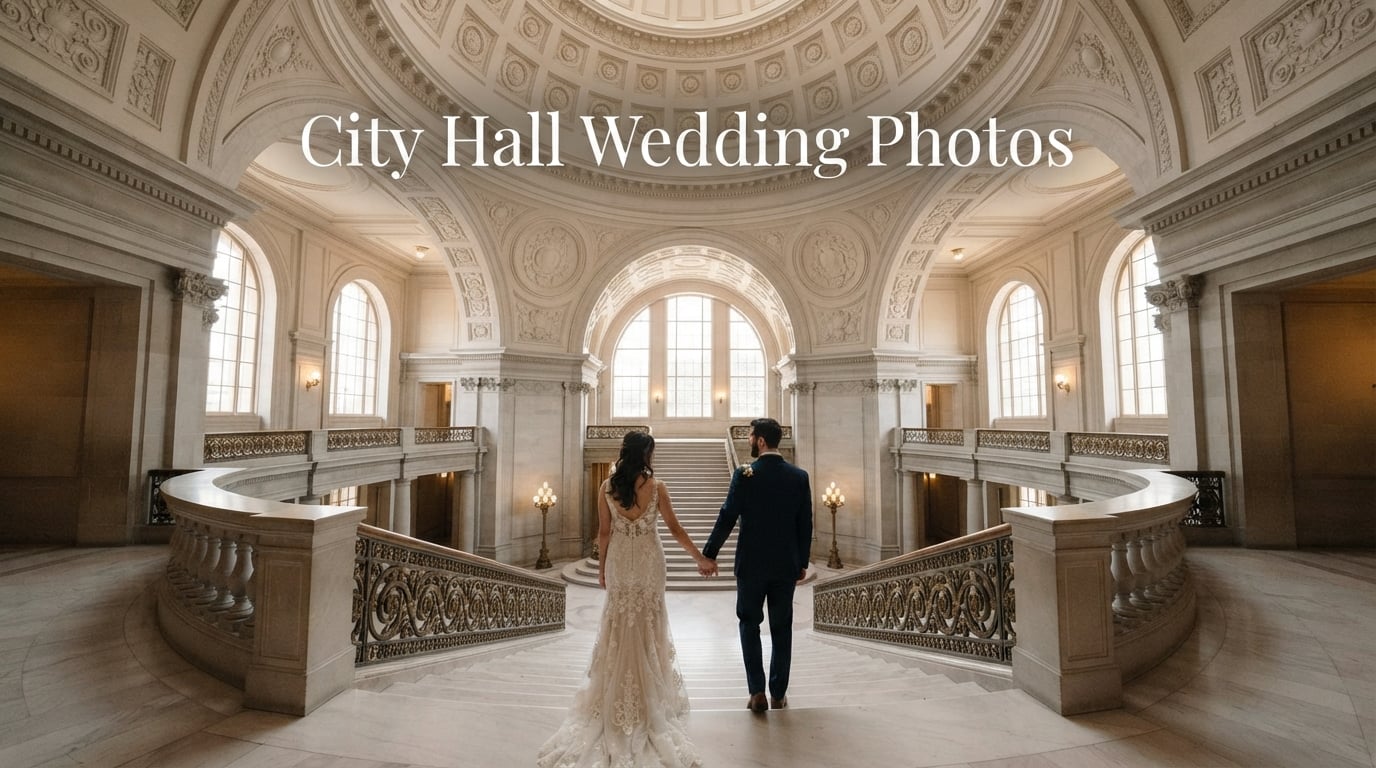
City hall wedding photos capture one of the most meaningful days of your life inside some of the most beautiful public buildings in America. I have photographed couples through marble rotundas, down sweeping grand staircases, and under arched windows that turn ordinary portraits into works of art. This guide pulls together everything I have learned over years of civil ceremony photography so you can plan, prepare, and show up ready for gorgeous photos.
If you are planning an intimate wedding, an elopement, or simply want professional documentation of your civil ceremony, the tips below will help. I cover the legal process, booking steps, what to bring, the best photo locations, attire, timing, and how to make the day feel special without adding stress. By the end, you should know exactly what your day will look like and how to make it unforgettable.
Table of Contents
What Are City Hall Wedding Photos?
City hall wedding photos are professional photographs taken during and around a civil ceremony performed at a municipal building. Unlike traditional wedding photography, these sessions lean heavily on architectural backdrops: rotundas, grand staircases, arched windows, marble galleries, and historic corridors. The building itself becomes the venue, the decor, and the personality of the photo set.
I think of city hall weddings as a hybrid of intimate elopement photography and documentary portraiture. You get the romance of a small ceremony with the grandeur of a building designed to impress. Most city halls were built to evoke civic pride, which means heavy columns, soaring ceilings, soft natural light, and details you cannot find anywhere else. For couples who want meaningful photos without a 200-person guest list, city hall is hard to beat.
This guide is for couples who are actively planning, photographers who want a quick-reference breakdown, and family members trying to understand what to expect. Whether you are getting married in San Francisco, New York City, Chicago, or any other municipality, the principles below apply. Local rules vary, but the photo opportunities and the prep work follow a similar pattern.
Marriage License and Legal Requirements
Before any photos happen, you need a valid marriage license. This is the legal foundation of your day, and skipping steps here is the fastest way to throw your timeline off. I always tell couples to lock down the paperwork first and the photography second.
Marriage License vs Marriage Certificate
These are not the same document. Your marriage license is the application that authorizes the ceremony. Once the officiant signs it, it becomes your marriage certificate. The certificate is what you use to change your name, update your records, and prove you are legally married. You will leave city hall with the signed license and request the certified certificate later, sometimes by mail.
NYC Process
In New York City, you apply through the Manhattan Marriage Bureau or one of the borough offices using the online Project Cupid portal. Both partners need valid government identification. There is a 24-hour waiting period between receiving the license and the ceremony, plus the license expires after 60 days. The application fee is small, and you do not need to be a New York resident.
San Francisco Process
San Francisco requires both partners to appear in person at the County Clerk’s office to apply. You will show ID, sign the application, and pay the fee. There is no waiting period, but the license expires after 90 days. Walk-in appointments work for many couples, though booking ahead saves time on busy Saturdays.
Chicago Process
In Chicago, you apply at the Cook County Clerk’s office downtown. Both partners need to appear together with valid ID. Cook County has no waiting period, and licenses are valid for 60 days. Online pre-registration speeds up the in-person visit by about 20 minutes.
Whatever city you are in, double-check the current rules before you book anything. Clerk offices update hours, fees, and ID requirements regularly, and I have seen couples show up with the wrong documents more than once. A 10-minute check the week before saves a wasted trip.
How to Book Your City Hall Wedding
Booking a city hall wedding follows a predictable pattern across most municipalities. The exact portal and fees change by city, but the sequence does not. Here is the workflow I walk every couple through.
Confirm both partners have valid government photo ID and any required documents (divorce decrees, death certificates, or name change orders if applicable).
Apply for your marriage license at the local clerk’s office, either online or in person depending on the city.
Wait out any required waiting period (24 hours in NYC, none in SF or Chicago).
Book your civil ceremony appointment through the city portal. Weekday mornings fill up fastest.
Book your photographer for at least 90 minutes before and after the ceremony slot.
Confirm witness requirements. NYC requires one witness; SF and Chicago do not for civil ceremonies, but always bring one anyway.
Pick up any final documents, parking passes, or building access notes the day before if possible.
Most city hall ceremonies last 10 to 20 minutes once you are in front of the officiant. The total time at the building runs longer because of security lines, ID checks, and the wait for your slot to be called. I budget 90 minutes on the building side and another 60 to 90 minutes for portraits after.
What to Bring to a City Hall Wedding
Packing the right bag the night before saves stress the morning of. I have watched couples turn around to go home for forgotten IDs more times than I can count. Here is the checklist I share with every client.
Government photo IDs for both partners (driver’s license or passport)
Printed marriage license or license confirmation number
Witness ID if your witness is not already in your booking
Phone with the appointment confirmation and officiant contact
Vows on paper or phone, even if you have them memorized
Small touch-up kit: lipstick, comb, safety pins, stain remover pen
Comfortable shoes for walking between photo spots
Water bottle and a light snack, especially for late-morning ceremonies
Backup rings if your engagement ring or wedding band is being sized
Cash or card for any last-minute certificate fees or parking
Leave rings, vows, and IDs with the photographer if you have a day-of coordinator. I have seen too many panicked texts about rings left in hotel safes.
Best Photo Locations Inside City Hall
Photo location is the single biggest decision you will make besides hiring a photographer. The right corner of the right room can turn a quick portrait into the photo you frame above your fireplace. Here is how I think about location across the cities I shoot most.
The Grand Staircase
Every grand city hall has one, and it is almost always the strongest single shot in the building. Look for a staircase with railings that catch light, marble treads, and a vanishing point you can shoot down. The eye sees depth, and the architecture frames the couple without needing extra props. Early morning sessions before crowds arrive give you the staircase empty, which is rare during business hours.
The Rotunda
The rotunda is the round room under the dome. Most city halls have at least one. The curvature gives you soft, even light and creates natural leading lines from any angle. For group photos after the ceremony, the rotunda handles 8 to 12 guests without anyone being pushed against a wall. For couple portraits, the rotunda gives you that iconic wide-angle view that says “we got married somewhere important.”
4th Floor Gallery
San Francisco’s 4th floor gallery is famous for a reason: the light is even, the floors are quiet, and the arched windows line up perfectly with portraits. Other city halls have equivalents, often on upper floors that function as overflow event space. Ask your photographer which upper-floor spaces are open to the public and when they are least busy.
Mayor’s Balcony
When the Mayor’s Balcony is open for ceremonies, it doubles as a stunning photo location. The balcony view gives you the city skyline as a backdrop, with the architectural framing of the building itself. Most city halls limit balcony access to private ceremonies. If you are booking a private ceremony and your budget allows, the balcony is worth the upgrade.
Arched Windows
Arched windows are everywhere in older city halls and they are a photographer’s best friend. They act as natural softboxes, wrapping light around faces and adding depth to portraits. Look for windows facing north if you want soft, even light all day. South-facing windows give you warmer tones in late afternoon but harsh shadows at midday.
NYC-Specific Spots
For NYC City Hall wedding photos, the Brooklyn Bridge is the obvious stop, but I also love Worth Street for the cobblestone texture, City Hall Park for greenery in spring, and the steps of the Tweed Courthouse for a quieter, less crowded vantage point. The Manhattan Marriage Bureau itself is small, so plan on most of your portrait time outside the building.
SF-Specific Spots
For SF City Hall wedding photos, the Polk Street entrance has the cleanest facade for portraits, and the Civic Center Plaza across the street gives you a wide-angle city hall backdrop. The Asian Art Museum across the plaza is another underused option for portraits, especially during golden hour when the stone facade glows.
What to Wear for City Hall Wedding Photos
What you wear matters more at city hall than at a backyard wedding, because the architecture is doing half the visual work. You want outfits that complement, not compete with, the space. Here is how I guide couples on attire.
Think polished but not formal. A tailored jumpsuit, a tea-length dress, or a suit with no tie all read beautifully in marble halls. Floor-length gowns and full tuxedos also work, but be ready to navigate stairs and crowds. If you want to wear white, ivory, or cream, you will blend into the marble in some lighting. Soft blush, sage, navy, or warm earth tones photograph against the architecture with more contrast.
For guests, ask them to dress in similar tones so group portraits look cohesive. Two or three colors max keeps the photo from looking busy. Avoid large logos, neon colors, and busy patterns that pull attention away from faces.
Shoes matter more than people expect. You will walk between photo spots, stand on marble for portraits, and possibly climb stairs. Block heels, loafers, or flats photograph well and let you move comfortably. Save the stilettos for portraits only if you must.
Best Times for City Hall Wedding Photos
Timing is the difference between empty staircases and crowds in the background of every shot. Here is what I have learned from years of shooting city hall weddings across multiple cities.
Early morning sessions between 8:00 and 10:00 AM give you the softest light, the fewest tourists, and the shortest security lines. The downside is that some buildings do not open until 9:00, and clerk offices may not issue licenses that early. Mid-morning from 10:00 AM to noon is the next best slot. The crowds build steadily after noon and peak between 1:00 and 3:00 PM.
For natural light inside the building, north-facing windows give you the most consistent results. East-facing windows are best in the morning, west-facing in the late afternoon. If your ceremony is at 11:00 AM, plan portraits in the east wing first, then move to the rotunda and north-facing windows as the light shifts.
Day of the week matters more than most couples expect. Mondays and Fridays are the calmest days at city hall. Tuesdays through Thursdays are busier because weddings and government business overlap. Saturdays are reserved for private ceremonies in most cities and have a totally different feel.
How to Make Your City Hall Wedding Special
Couples sometimes worry a small civil ceremony will feel less meaningful than a traditional wedding. I have photographed hundreds of city hall weddings and the truth is the opposite: with the right intentional touches, the day feels more personal, more romantic, and more memorable. Here are the ideas my couples love most.
Write personal vows, even if you only share them with each other during a quiet moment before the ceremony.
Bring a small bouquet. A single trailing orchid, a tight posy of ranunculus, or a bouquet of dried flowers all photograph beautifully against marble.
Schedule a champagne toast right after the ceremony, even if it is in the car. The photos of you popping a bottle matter.
Invite one or two guests beyond the witness. Parents, siblings, or your best friend make the photos feel like a celebration.
Add a confetti moment outside the building. Biodegradable confetti is allowed in most city parks.
Plan a romantic dinner the night of. A reservation at your favorite restaurant makes the day feel like a destination event.
Get ready together. So many couples separate for portraits and miss the joy of getting ready side by side.
The details that make a city hall wedding feel special are rarely expensive. They are intentional. Choose one or two of these ideas and commit to them fully. Trying to do everything usually backfires because the day feels overstuffed.
Where to Take Photos After Your City Hall Ceremony
Once the ceremony wraps up, you usually have 60 to 90 minutes of portrait time. Use it well by picking two or three nearby locations and staying at each one for 15 to 20 minutes rather than rushing through six spots. Here are my favorite post-ceremony locations by city.
In NYC, the Brooklyn Bridge gives you iconic skyline views with a 10-minute walk from City Hall. For something quieter, the South Street Seaport has cobblestones and waterfront light. Central Park is worth the cab ride if you want greenery, but budget 30 minutes of travel each way.
In San Francisco, the Civic Center area gives you multiple options within a five-minute walk. The Asian Art Museum across the plaza is one of the most underused portrait locations in the city. If you have a car, the Painted Ladies at Alamo Square are a 10-minute drive and worth the trip.
In Chicago, Millennium Park is right next to the clerk’s office and gives you the Bean, lush gardens, and skyline in one walk. The Chicago Riverwalk a few blocks north is another quiet option for couples who want a less crowded feel.
Planning Your City Hall Wedding Budget
City hall weddings are popular partly because they save money compared to traditional weddings. The savings can disappear fast if you do not plan. Here is a realistic budget breakdown for a city hall wedding with professional photography.
Marriage license fees run from $30 to $100 depending on the city. Civil ceremony fees are typically $25 to $50 if you book through the public slot. Private ceremonies at city hall run $400 to $2,500 depending on the room and duration. Photographer coverage runs $1,500 to $2,500 for 2 to 3 hours, which is the standard length for a city hall wedding. Flowers for a small bouquet and boutonniere run $100 to $250. Officiant gratuity, if you use a private officiant rather than the city-provided one, runs $50 to $150.
For a clean, simple city hall wedding with professional photography, you should plan for $2,500 to $4,500 total. This is a fraction of the national average wedding cost, but it is real money and worth treating with the same care as a larger budget. Couples who skip the budget step tend to overspend on upgrades they did not actually want.
FAQs
What to wear when getting married at City Hall?
Wear polished, not overly formal outfits. Tailored suits, jumpsuits, or tea-length dresses photograph beautifully against marble halls. Soft blush, sage, navy, or warm earth tones give better contrast than white or cream. Choose comfortable shoes since you will walk between photo spots.
How to make a courthouse wedding more special?
Write personal vows, bring a small bouquet, schedule a champagne toast right after the ceremony, invite one or two guests beyond the witness, and plan a romantic dinner the night of. Choose one or two intentional touches rather than trying to do everything.
How long is a City Hall wedding ceremony?
The civil ceremony itself lasts 10 to 20 minutes. Total time at the building runs 60 to 90 minutes including security, ID checks, and waiting for your slot. Plan for 60 to 90 minutes of portrait time after.
How to book a City Hall wedding?
Apply for your marriage license first, wait out any required waiting period, then book your civil ceremony appointment through the city portal. Book your photographer for at least 90 minutes before and after the ceremony slot, and confirm witness requirements.
What to bring to a City Hall wedding?
Bring government photo IDs for both partners, the printed marriage license, witness ID, vows on paper or phone, a small touch-up kit, comfortable shoes, water, backup rings, and cash or card for any last-minute fees.
Can I bring guests to a City Hall wedding?
Yes, most city halls allow a small number of guests beyond the required witness. NYC public ceremonies allow up to 6 guests in addition to the couple. SF and Chicago public ceremonies are more flexible. Private ceremonies can accommodate 20 or more depending on the room.
Where are the best photo spots at City Hall?
The grand staircase, the rotunda under the dome, the 4th floor gallery, the Mayor’s Balcony when accessible, and arched windows throughout the building. Outside, look for nearby parks, bridges, or plazas within a 10-minute walk.
How early should I arrive for my City Hall wedding?
Arrive 20 to 30 minutes before your scheduled ceremony time. This buffer covers security lines, ID checks, and finding the right office. Your photographer should arrive 90 minutes early to scout light and capture pre-ceremony portraits.
Final Thoughts on City Hall Wedding Photos
City hall wedding photos are some of the most rewarding images to make because the architecture does half the work and the couple’s joy does the other half. With the right prep, the right photographer, and a few intentional touches, your civil ceremony can produce portraits you will frame and return to for the rest of your marriage.
The biggest takeaways from this guide: lock down the paperwork first, book an early-morning slot when you can, choose one or two photo locations and stay long enough to enjoy them, and pick at least one detail that makes the day feel like a celebration rather than an errand. Couples who follow these steps consistently end up with photos they love and a day they remember.
If you are ready to talk through your city hall wedding photography, our team is happy to answer questions about timing, locations, and what to expect in your city. The best city hall wedding photos come from planning that feels easy, not overstuffed.