
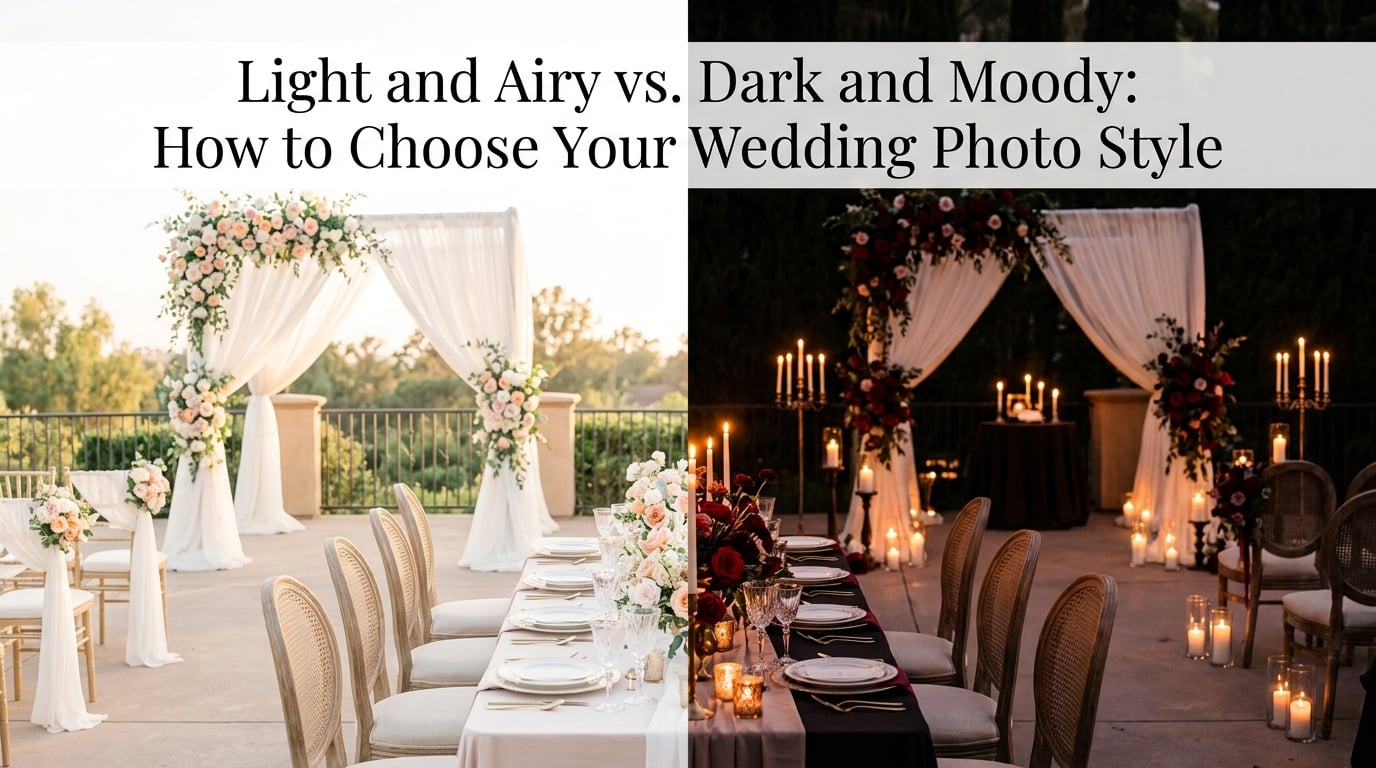
If you have spent any time browsing wedding photography portfolios online, you have probably noticed two distinct looks dominating the industry. Couples gravitate toward either light and airy wedding photography with its bright pastels and ethereal glow, or dark and moody wedding photography with cinematic shadows and rich tones.
You may love both styles. That is actually a common starting point, and it makes the decision harder, not easier. We help couples work through this every year, and the choice becomes much clearer once you understand what each style really is, how your venue affects what is achievable, and what style will look most like you twenty years from now.
In this guide, I will walk you through a plain-language breakdown of both editing styles, the environmental factors that push one style over another, and the questions to ask any photographer before you book. By the end, you should have a confident answer for your own wedding.
Table of Contents
What Is Light and Airy Wedding Photography?
Light and airy wedding photography is a bright, soft editing style characterized by pastel tones, lifted highlights, and minimal shadows. Photographers often shoot in natural light, then apply post-processing that brightens shadows, softens contrast, and pushes colors toward delicate pinks, creams, and whites.
Imagine a bride in a white gown against creamy greenery, with sunlight kissing the scene just enough to create a fairytale glow. That is the aesthetic. The mood feels romantic, whimsical, and soft.
Key Visual Characteristics of Light and Airy
Bright, almost overexposed highlights that lift the entire image
Pastel color palette: soft pinks, creams, whites, dusty blues, sage greens
Minimal deep shadows, with detail visible in every corner
Low contrast between light and dark elements
Ethereal, airy feel with a slightly faded or lifted blacks look
Light and airy images feel happy, romantic, and storybook-like. Many brides describe them as timeless because the palette has been associated with classic wedding imagery for decades.
What Is Dark and Moody Wedding Photography?
Dark and moody wedding photography is a dramatic editing style featuring deep shadows, muted or rich tones, and cinematic contrast. Photographers using this style let shadows fall dark, push colors toward earthy or jewel tones, and lean into warm or cool cinematic color grading.
Picture a candlelit reception where the bride is half-lit by warm amber, the background fades to near-black, and the emotion reads almost like a film still. That is the dark and moody world.
Key Visual Characteristics of Dark and Moody
Deep, dramatic shadows that create depth and intimacy
Rich color palette: burgundy, forest green, amber, deep blue, gold
Strong contrast between highlights and shadow areas
Often inspired by film emulation, with subtle grain or color shifts
Cinematic, romantic, sometimes nostalgic mood
Dark and moody images feel intentional, intimate, and a little cinematic. Couples drawn to this style often describe it as romantic in a different way: not fairy tale, but emotionally charged.
Light and Airy vs Dark and Moody: A Side-by-Side Comparison
The two styles sit at opposite ends of the wedding photography spectrum, and seeing them side by side makes the differences obvious. Here is a quick comparison of how the same kind of scene would look in each style.
| Characteristic | Light and Airy | Dark and Moody |
|---|---|---|
| Overall brightness | Very bright, lifted | Deep, often darker overall |
| Shadows | Soft, lifted, low contrast | Deep, dramatic, high contrast |
| Color palette | Pastels and soft neutrals | Earth tones, jewel tones, muted saturation |
| Skin tones | Bright, creamy, slightly warm | Warm with rich undertones or cool cinematic |
| Mood | Romantic, dreamy, whimsical | Intimate, cinematic, emotional |
| Best lighting | Natural light, golden hour, bright outdoor | Candlelit, low light, indoor |
| Typical shoot style | Lifestyle, fine art | Fine art, film-inspired, documentary |
| Venue fit | Garden, beach, vineyard, sunlit ballroom | Barn, manor house, candlelit hall, moody venue |
Notice how the lighting direction differs. Light and airy leans bright and outdoor. Dark and moody leans intimate and low-light. That is not coincidence. Photographers tune their approach to the light available in each scene.
How Venue and Lighting Affect Which Style Works Best
Your venue is one of the strongest signals for which style will look most natural in your final gallery. The architecture, the windows, the time of day, and the candles on tables all play a role.
Many couples pick the style they love online and then realize their venue fights that style. Here is how to think about venue pairing so your final gallery feels coherent.
Venues That Lean Light and Airy
Outdoor settings: vineyards, coastal cliffs, gardens, fields, beaches
Sunlit ballrooms with large windows and white walls
All-white or all-cream color palettes throughout the venue
Daytime weddings with plenty of natural light
Pastel floral arrangements and bright decor
Venues That Lean Dark and Moody
Historic barns with wood beams and limited windows
Moody manor houses and libraries with dark wood paneling
Candlelit churches or chapels without much natural light
Evening receptions with low ambient lighting
Burgundy, forest, gold, or amber color palettes throughout
Some venues can swing either way. A blank-slate industrial loft can be lit to support either style depending on the photographer’s technique. The trick is to look at how previous weddings at your specific venue were lit and which aesthetic those images carry.
Seasonal and Time-of-Day Considerations
Few couples realize how much season affects achievable style, so this is worth thinking about before you commit. A light and airy goal in a gray, wet December wedding is much harder than the same goal in a June wedding with abundant sun.
Light quality is seasonal, and that should influence which style you commit to.
Season-by-Season Style Fit
Spring and summer weddings typically offer abundant natural light, longer golden hours, and brighter palettes. These conditions support light and airy beautifully and can also make dark and moody easier because the photographer has light to work with during the day.
Fall and winter weddings present different opportunities. The low sun angle creates warmer light in shoulder seasons, candlelit receptions are more atmospheric, and the natural palette skews richer.
Dark and moody feels right at home in late autumn and winter weddings. Light and airy still works but takes more technical skill from the photographer to lift cold, gray light.
Time-of-Day Fit
Golden hour, the hour before sunset, is the favorite for both styles. Light and airy photographers often schedule portraits here to soak up warm pastel sun.
Dark and moody photographers also use golden hour but lean into the contrast, with rich shadows blooming as the sun sets.
Midday light is bright but harsh and tends to favor light and airy styled images. Late-night receptions with candlelight almost automatically push images toward dark and moody.
Editing Style vs Shooting Style: A Critical Distinction
Couples often confuse editing style with shooting style, and this confusion causes frustrating mismatches. Editing style is what happens after the photographer clicks the shutter. Shooting style is how the photographer poses, frames, and directs during the day.
A photographer can shoot with a documentary, photojournalistic style and then deliver light and airy edits. Another photographer can shoot with a fine art, posed approach and deliver dark and moody edits. Both combinations are common.
What matters is that you like both the shooting style and the editing style of whoever you book. Look at full galleries, not just highlight reels.
One more critical point: post-processing cannot reverse style choice. You cannot take a true dark and moody RAW file and brighten it to light and airy without losing structural integrity of the image. The shadows were preserved at shoot time so they could be pulled later. If they were not, they cannot be created.
This is why style selection matters before you book, not after.
Timelessness and Trend Considerations
Couples regularly ask whether light and airy or dark and moody ages better. Honest answer: both can age well, but both can also age badly.
The deciding factor is not the style name. It is whether the execution respects timeless principles.
Timeless wedding photography tends to share certain traits: skin tones that look like skin, white wedding dresses that look white, faces that are well-lit, and emotions that read clearly. When a photographer nails those fundamentals, the trending style around them does not date the image.
When the fundamentals are sacrificed for trend, the image feels stuck in its moment. That is true of heavily faded light and airy galleries that swallow skin tones, and it is true of over-saturated dark and moody edits that crush detail.
Dark and moody wedding photography is on a strong upward trend right now, especially the cinematic and film-inspired look. Light and airy has been a steady favorite for over a decade. Both will continue to look beautiful when executed well.
Pick the style that matches your venue, your personal taste, and your partner’s taste. Trends will move on, but your wedding album will not.
How to Find a Photographer Whose Style Matches Your Vision
The single most important step is the one most couples skip: review a full gallery from a real wedding before booking. Not styled shoots. Not curated highlight reels. A complete wedding day from getting ready through last dance.
A full gallery tells you what your photographer can really do when the lighting is variable, when timelines get tight, when weather turns, and when the venue is average instead of styled. Look at how the images handle the hard parts. How does the photographer shoot a dim reception? What do candlelit portraits look like? How varied are the moments captured?
Questions to Ask in Your Photographer Consultation
Is your default editing style light and airy, dark and moody, or somewhere in between?
Can I see a full real-wedding gallery from a venue similar to mine?
What happens if my wedding day lighting is the opposite of what we planned?
Do you shoot the entire day or hand off to a second shooter? If second shooter, do they match your style?
Can you describe your shooting style and editing style separately?
How do you handle indoor low-light and outdoor bright-light on the same day?
Will my gallery look like the images on your website, or are those your best work only?
What is your backup plan if my venue lighting does not match your style?
You are not trying to interrogate your photographer. You are trying to align expectations. The photographer who answers these questions thoughtfully and shows you complete galleries without hesitation is almost always the one who will deliver.
A Quick Self-Assessment Quiz to Help You Decide
If you are still on the fence after reading this far, answer these five questions. They will reveal which style matches your wedding.
When you imagine your wedding album in 20 years, does it feel like a sunlit garden or a candlelit ballroom?
Is your venue dominated by windows and bright walls, or by wood, stone, and low light?
Are your wedding colors pastels and creams, or are they burgundy, forest, and gold?
Do you dress your wedding day in soft florals or moody florals with deep blooms?
When you flip through magazines, do you stop at bright outdoor weddings or intimate indoor ceremonies?
If your answers split roughly light, you probably lean light and airy. If they split dark, dark and moody.
If you answered some of each, do not panic. Mixed answers usually mean your venue has strong lighting cues. Trust the venue. It will tell you which style suits the day.
FAQs
What is the difference between light and airy and dark and moody wedding photography?
Light and airy wedding photography is a bright, soft editing style with pastel tones, lifted highlights, and minimal shadows that creates a romantic, ethereal feel. Dark and moody wedding photography is a dramatic editing style with deep shadows, muted or rich tones, and cinematic contrast that creates an intimate, atmospheric feel. They sit at opposite ends of the wedding photography spectrum and excel in different lighting conditions.
Which wedding photography style is more timeless?
Both light and airy and dark and moody can be timeless when the photographer nails the fundamentals: accurate skin tones, white wedding dresses that read as white, well-lit faces, and clear emotions. Style does not equal timelessness. Execution does. Pick the style that matches your venue and your personal taste rather than chasing or avoiding the current trend.
How do I choose between light and airy vs dark and moody for my venue?
Look at the lighting and architecture of your venue. Bright outdoor spaces, sunlit ballrooms, and pastel decor favor light and airy styles. Dark barns, candlelit chapels, wood-paneled manors, and rich jewel-tone decor favor dark and moody styles. Ask to see full galleries the photographer has shot at venues similar to yours, and trust what the venue is telling you about available light.
Should I ask my photographer to shoot light and airy or dark and moody?
Ask the photographer what their natural editing style is first, then match your venue and personal taste to that style. Booking a light and airy photographer and asking for dark and moody edits usually produces mediocre results because photographers tune their lighting choices at shoot time to support their editing style. Stay with the photographer whose default style matches your vision.
What is light and airy wedding photography?
Light and airy wedding photography is an editing style that lifts shadows, softens contrast, and pushes colors toward pastel tones such as soft pinks, creams, whites, and dusty blues. Photographers shooting in this style favor natural light and often schedule portraits during golden hour. The result feels romantic, dreamy, and whimsical, like a sunlit storybook.
Choosing Your Wedding Photo Style with Confidence
Choosing between light and airy vs dark and moody wedding photography does not have to feel overwhelming. Once you understand what each style really is, what your venue can support, and which photographer’s natural work matches that combination, the answer becomes obvious.
If you found this guide useful, reach out to us here at Kingdom Wedding Photography to talk through your venue and your taste. Our team will look at your specific lighting situation, walk through our full real-wedding galleries with you, and help you decide which wedding photo style fits your day.
We work with couples across 2026 to make sure the final gallery feels right in the moment and twenty years down the road.