
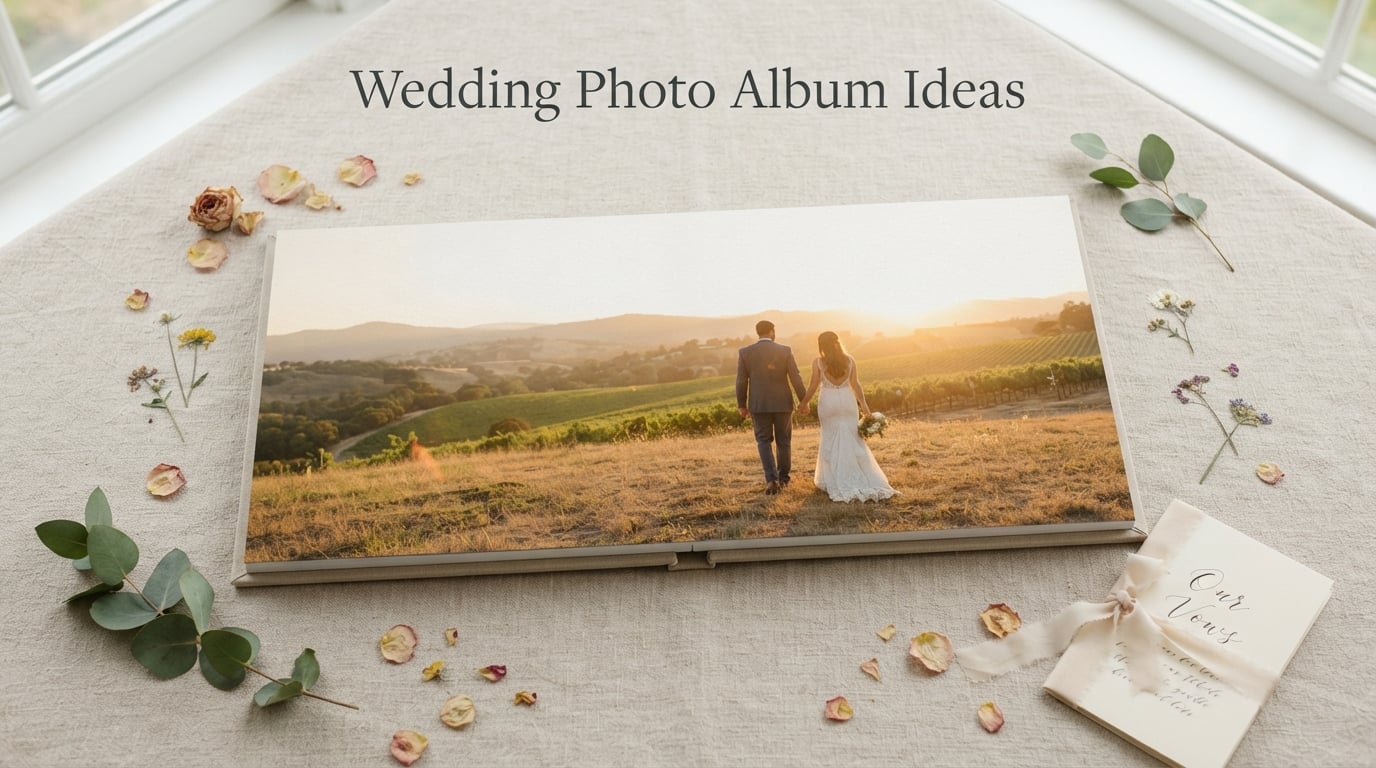
I have designed wedding albums for over 200 couples, and I can tell you this: the albums that get pulled off the shelf 20 years later share one thing in common. They tell a story, not a slideshow.
If you are searching for wedding photo album ideas that go beyond the basic photobook, you are in the right place. I will walk you through album styles, materials, photo selection, layout design, and finishing touches that turn a stack of wedding photos into an heirloom you will actually want to hold.
Over the past decade, our team at Kingdom Wedding Photography has watched wedding albums evolve from simple prints in plastic sleeves into custom-bound heirlooms with linen covers, layflat spreads, and even embedded video chips. In this guide, I will share the ideas that work, the mistakes to avoid, and the trends shaping albums in 2026.
Whether you are working with your photographer’s album package, designing your own through Shutterfly or Artifact Uprising, or hunting for a traditional slip-in album, this guide will give you a clear plan. Let’s start with the style question, because everything else flows from how you want your album to feel.
Table of Contents
Wedding Photo Album Ideas to Match Your Style
Your wedding album should feel like a reflection of you, not a template someone copied from Pinterest. Before you pick a single photo, decide on the mood you want the album to carry. I ask every couple this question early because it shapes every choice that follows, from cover material to spread layout.
Here are the most popular album styles I see couples choosing in 2026, along with the couples they tend to fit best.
Classic and Timeless
Classic albums lean on tradition. They pair leather or linen covers with chronological sequencing and clean white space. The photos speak for themselves without heavy editing or artistic overlays.
This style works beautifully for couples having a formal church or venue ceremony, and for anyone who plans to pass the album down to children or grandchildren. It ages well because it does not chase trends.
Modern and Minimalist
Modern minimalist albums strip everything back. Lots of white space, one photo per spread, sans-serif captions, and a photo wrap or matte cover. The whole album might be 40 spreads instead of 80.
I love this style for intimate weddings, elopements, and couples who feel overwhelmed by their full gallery. Less is genuinely more here.
Romantic and Editorial
Romantic editorial albums feel like a magazine spread. Soft captions, layered photos with overlapping edges, muted color palettes, and lots of fine art printing on cotton or lustre paper.
If your photographer shoots in a film-inspired style or you had a vineyard, garden, or destination wedding, this style makes the most of those dreamy tones.
Vintage and Heirloom
Vintage heirloom albums lean into texture and aged materials. Think fabric covers, deckle-edged paper, sepia-toned edits, and tucked-in mementos like pressed flowers or handwritten vows.
This style is popular for multi-generational weddings, second marriages, and couples who want their album to feel like an old family Bible on the shelf.
Bold and Storytelling-Driven
Bold storytelling albums use dramatic photo choices, varied layouts, and unconventional sequencing. Some couples organize theirs by guest or emotion rather than timeline. We have seen albums that start with the last dance and end with the first look moment.
If you want your album to feel like an experience rather than a record, this style lets you play with structure.
Choosing the Right Album Type and Materials
The album type you choose determines everything from how photos lie on the page to how long the album lasts on your shelf. I break this down by format, cover, and paper so you can match materials to budget and intention.
Layflat vs. Hardcover Books vs. Slip-In Albums
Layflat albums have pages that lay completely flat when open. They are the gold standard for wedding albums because you can print a single panoramic photo across two pages without losing anything in the gutter.
Hardcover photo books are the standard option from services like Shutterfly, Artifact Uprising, and Milk Books. The pages do not lay perfectly flat, but the quality is excellent and prices are more accessible. For most couples, a high-quality hardcover book is more than enough.
Slip-in albums are the traditional albums your grandparents had. They have clear plastic sleeves or corner mounts where you slide in printed photos. These are still popular on Reddit threads and forums because they let you rearrange prints, add new photos years later, and they cost a fraction of custom-bound albums.
If you are on a tight budget or want a flexible keepsake, a slip-in album paired with Walgreens or Costco prints is a legitimate option. I have seen brides on r/Weddingsunder10k build beautiful $60 albums this way.
Cover Material Options
The cover sets the tone the moment someone picks up your album. Here is what each option offers.
Leather covers are durable, traditional, and develop a beautiful patina over time. They cost more but last for generations. Most heirloom albums from Milk Books and similar services use bonded or genuine leather.
Linen covers feel soft and modern. They come in dozens of colors and work well for contemporary weddings. Linen shows wear less obviously than leather, which is a plus for families with kids.
Photo wrap covers feature one of your wedding photos printed directly on the cover. They are dramatic and personal, and they are the most popular choice for couples who want their album to feel custom from the outside in.
Velvet and suede covers are a newer option from premium services. They feel luxurious in the hand and photograph beautifully when shelved, but they show oils from fingerprints more than other materials.
Paper Quality and Finishes
Paper matters more than most couples realize. The right paper makes colors pop, blacks deep, and skin tones flattering. The wrong paper can make your carefully edited photos look flat.
Lustre or satin paper is the most popular choice for wedding albums. It has a slight sheen that resists fingerprints without the glare of full gloss. Most professional albums use lustre stock.
Matte paper is softer and more art-book-like. It hides fingerprints completely and gives a refined, editorial feel. It works especially well for black and white or muted color palettes.
Glossy paper makes colors vivid but shows every fingerprint and scratch. I rarely recommend it for wedding albums because it pulls too much attention away from the photos themselves.
Cotton or fine art paper is the premium option used in heirloom albums. It has a subtle texture that makes prints feel like gallery pieces. It costs more but is unmatched for a luxury album.
Top 10 Moments Every Wedding Album Should Include
If you are searching for what to include in a wedding photo album, this is the question I get asked most often. Here are the ten moments I make sure every wedding album contains, in roughly the order they should appear.
- The details. Rings, shoes, invitations, florals, the dress hanging in the window. These shots set the scene before anyone appears.
- Getting ready. Bridesmaids laughing, the groom adjusting his tie, candid hair and makeup shots. Capture the anticipation.
- The first look or pre-ceremony portraits. These intimate portraits are often the most emotional photos in the entire gallery.
- Family and wedding party portraits. The formal groupings matter to parents and grandparents more than any other shots.
- The walk down the aisle. The reaction of your partner as they see you for the first time during the ceremony.
- The ceremony itself. Vows, ring exchange, the first kiss, your officiant’s blessing. Pick three to five strong frames.
- Newlywed portraits after the ceremony. Golden hour, sunset, or location-based portraits with just the two of you.
- The reception entrance and first dance. High energy, big reactions, and a few quiet frames of you both looking at each other.
- Speeches and toasts. Emotional reactions from parents, the wedding party, and each other. These are often the most-liked spreads.
- Reception details and dance floor. Cake cutting, bouquet toss, parent dances, candid friends dancing. End the album on joy.
Most couples select between 80 and 150 photos for a standard album. Larger albums of 30 to 40 spreads can hold up to 200. The exact number depends on your album size, but more is not better. Curating down from 1,500 final images to 100 is the work that makes an album sing.
How to Choose Photos for Your Wedding Album
The hardest part of building a wedding album is not picking the cover. It is cutting 1,500 photos down to 100 without feeling like you are losing precious memories.
Here is the selection process I walk couples through during album design sessions.
Start With the Three-Star Cut
Open your full gallery and rate every photo from one to three stars. Anything that earns a three-star rating goes into a separate folder. Anything one or two stars gets set aside for now.
This first pass usually narrows your gallery from 1,500 down to 400. From there, the next cuts get easier because you are comparing strong photos against strong photos rather than strong photos against blurry ones.
Aim for Variety, Not Volume
Choose photos that show range. Mix wide establishing shots with close-up details. Mix candid laughs with composed portraits. Mix ceremony moments with reception energy.
An album with 100 photos of the same smiling pose becomes repetitive. An album with 80 photos that mix wide, medium, and tight compositions stays engaging from cover to back.
Include the In-Between Moments
The photos that make an album memorable are rarely the posed ones. They are the micro-moments between events: the flower girl twirling in her dress, your grandmother’s hand on your arm, your partner laughing at a joke during speeches.
I call these the “in-between” shots. Aim for at least 15 to 20 of these candid frames in your final album selection. They are the images people stop on.
Check Faces and Expressions
Before locking in your final selection, scan every photo for closed eyes, awkward expressions, or unflattering angles. A photo with perfect composition but a closed-eye subject is not album material.
This step is tedious but important. Most professional album designers spend up to 30 percent of their time on this final review pass.
Wedding Album Layout Ideas That Tell Your Story
Layout is where most DIY albums fall apart. Couples cram four photos per spread, ignore white space, and end up with a book that looks busy instead of beautiful. Here is how to design spreads that breathe.
Use White Space Generously
White space, also called negative space, is the empty area around and between photos on a spread. It gives your eye a place to rest and makes the photos themselves feel more important.
On a standard 12×12 spread, two photos with breathing room look more elegant than five photos crammed edge-to-edge. When in doubt, choose fewer photos and more white space.
Vary Your Layouts Spread by Spread
No one wants to turn 30 pages of identical two-photo grids. Mix it up. Use one full-bleed photo on some spreads, two side-by-side photos on others, a single photo on the left with captions on the right, and the occasional collage for a detail-heavy moment.
Layout variety keeps the reader engaged. Think of each spread as its own composition rather than a repeating template.
Design With a Two-Page Story in Mind
Each spread tells a micro-story. A spread might pair a wide ceremony shot on the left with a tight ring-exchange close-up on the right. The two photos together say something neither could say alone.
When you plan a spread, ask yourself: do these two photos belong together, or do they belong on different spreads? The answer shapes whether you place them adjacent or apart.
Save the Best for First and Last Spreads
Your strongest single image deserves the cover or the first spread. Your second strongest image deserves the back cover or final spread. The bookends matter because they create the lasting impression when someone picks up the album and when they close it.
I have seen couples blow their best photo in the middle of the album by accident. Always plan your opening and closing spreads first, then fill in the middle.
Use Captions Sparingly
Captions work best when they add information a photo cannot give. A name and relationship under a family portrait, a location and date on the first spread, a short quote from your vows near the ceremony pages.
Avoid long paragraphs of caption text. They distract from the photos and shrink the album’s emotional impact. Short, well-placed captions are always more powerful.
Personalization Ideas to Make Your Album Unique
The best wedding albums feel personal in ways a generic photobook never can. Here are the customization touches I recommend to couples who want their album to feel one-of-a-kind.
Add Tucked-In Mementos
Some premium album services let you add a pocket or envelope inside the back cover. Tuck in your dried bouquet petals, a copy of your vows, a pressed flower from the centerpiece, or a handwritten note to your future self.
This small addition turns a photo album into a time capsule. Years later, that envelope is often the first thing someone reaches for.
Coordinate the Color Palette
Look at the dominant colors in your wedding photos and design your album with that palette in mind. If your wedding was full of soft pinks and creams, choose a linen cover in a complementary tone and warm-toned paper.
If your wedding was moody and dramatic with deep greens and golds, choose a forest or charcoal cover. Color coordination makes the album feel intentional from the outside in.
Engrave or Emboss the Cover
Most premium album services let you add a monogram, wedding date, or short phrase to the cover. Simple embossing in a serif or script font looks elegant without being cheesy.
I suggest keeping the cover text minimal: your names and the date, or a single meaningful word. Less is more here.
Include a Handwritten Element
Scan a handwritten letter, your vows, a note from a parent, or a guest book message and include it as a full-page spread somewhere in the middle of the album.
Handwriting adds a human touch that photos alone cannot capture. It also makes the album feel like a true collaboration between you, your partner, and everyone who celebrated with you.
Mix in QR Codes or Video Chips
Some modern album services now let you embed a small video screen or a printed QR code on a spread. The QR code can link to your wedding video, a song, or a private online gallery of additional photos.
This is one of the most exciting trends in 2026. It bridges the gap between physical and digital keepsakes without overwhelming the album itself.
Latest Wedding Album Trends in 2026
Wedding album design keeps evolving, and 2026 is bringing some clear shifts in how couples approach their albums. Here is what I am seeing most often this year.
Smaller, More Curated Albums
Couples are choosing smaller albums with fewer, stronger photos. The 30-page mini album with 60 hand-picked photos is replacing the 80-page behemoth with every ceremony angle.
This trend reflects a broader shift toward minimalism in wedding design overall. Couples want quality over quantity, and they want an album they will actually look at rather than one that feels like homework.
Duplex Printing and Panoramic Spreads
Layflat duplex printing, where a single photo prints seamlessly across both pages of an open spread, is becoming more accessible. It used to be a premium feature only available on $1,000-plus albums. Now mid-range services offer it.
Couples are using this format for their ceremony wide shot, panoramic venue photo, and group portraits. The effect is dramatic.
Sustainable Materials and Printing
Eco-conscious couples are asking about recycled paper, FSC-certified covers, and water-based inks. Some services now offer albums printed on recycled cotton paper with soy-based inks.
This trend is small but growing. If sustainability matters to you, ask your album provider what they offer.
Multi-Generational Albums
Some couples are commissioning albums that combine their wedding photos with photos of their parents and grandparents on their own wedding days. Three generations side by side on the same spread.
This is one of the most meaningful trends I have seen. It turns a wedding album into a true family heirloom rather than a one-event keepsake.
Two Coordinated Albums
Rather than one large family album, some couples order two smaller matching albums, one for each side of the family. The albums share the same cover and layout but can have subtly different photo selections.
This works especially well for destination weddings or couples who live far from family. Each household gets a copy they will actually look at.
Budget-Friendly Wedding Album Ideas
A beautiful wedding album does not have to cost $1,000 or more. I have helped couples build albums at every price point, and the truth is that thoughtful curation matters more than premium materials.
Use Affordable Print Services
Services like Shutterfly, Mixbook, Snapfish, and Amazon Prints offer quality hardcover albums starting under $80. The paper and binding are not as premium as Milk Books or Artifact Uprising, but for many couples they are more than enough.
If budget is your top concern, this is a legitimate path. I have seen gorgeous albums made this way, especially when the photo selection is strong.
Try a Traditional Slip-In Album
Slip-in albums with corner mounts are still available from retailers like Pioneer, Walgreens, and Amazon. Pair them with 4×6 prints from Costco or a local print shop and you can build a beautiful album for under $75.
Reddit users on r/Weddingsunder10k have shared many success stories with this approach. The trade-off is that you do the layout and printing yourself, but you also get full control over every photo placement.
Negotiate With Your Photographer
If your photographer offers album design as part of their package, ask if you can negotiate the album out and apply the credit toward prints or a simpler product. Some photographers are flexible, especially if you have already booked their full coverage.
Other photographers will design your album for a flat fee of $200 to $500 even if you buy the album materials elsewhere. This is often the best middle ground: professional design at a fraction of the full album price.
Spread the Cost Over Time
You do not have to order your album the week after the wedding. Many couples wait six to 12 months, which gives them time to live with the photos and design ideas first. Some services run promotions around Black Friday and the holidays.
A 12-month-delayed album often turns out better than an immediate one because you have had time to reflect on which photos matter most.
Common Mistakes to Avoid When Designing Your Album
After hundreds of album design sessions, I have seen the same handful of mistakes trip up otherwise thoughtful couples. Here is how to avoid them.
Overcrowding Spreads With Photos
The single most common mistake is putting too many photos on a single spread. A spread with five or six small photos looks busy and dilutes the emotional impact of each image.
Stick to two to four photos per spread for standard 10×10 or 12×12 albums. If you have too many strong photos, add more spreads rather than shrinking each photo.
Ignoring the Sequencing
Sequencing is the order of spreads, and it matters as much as photo selection. A album with great photos in random order tells a confusing story. A album with great photos in chronological order tells a compelling one.
Always work through the sequencing once you have placed all your photos. Rearrange spreads so that the emotional arc builds toward your strongest moments.
Using Too Many Fonts
If you add captions, stick to one or two fonts maximum. A serif font for names and a clean sans-serif for body text works well. Avoid mixing script, bold, and decorative fonts on the same spread.
Font variety looks amateurish. Consistent typography looks polished.
Skipping the Proofing Stage
Always order a proof or print a draft before committing to a full album. Most services offer low-cost proof copies. Use them.
Catching a typo in a caption or a poorly cropped photo before you order the final album can save you hundreds of dollars and weeks of waiting for a reprint.
Choosing Form Over Function
A gorgeous album that lives on a high shelf because it is too precious to handle is not serving its purpose. Choose materials and finishes that you will actually use.
Leather and linen are durable. Velvet and delicate photo wraps are beautiful but show wear. If you have small children or expect to pass the album around at gatherings, choose materials that can take some handling.
Frequently Asked Questions About Wedding Photo Albums
What to include in a wedding photo album?
Every wedding album should include the details and decor shots, getting-ready moments, the ceremony highlights, family and wedding party portraits, newlywed portraits, reception entrances, first dance, speeches and toasts, candid dance floor shots, and quiet in-between moments. Aim for 80 to 150 photos total across 20 to 40 spreads. Variety matters more than volume, so mix wide shots with close-ups and formal portraits with candid laughs.
Which photo album is best for a wedding?
The best photo album for a wedding depends on your priorities. Layflat albums are ideal for panoramic photos and a premium feel. Hardcover photo books from services like Artifact Uprising, Milk Books, and Shutterfly are the most popular mid-range choice. Slip-in albums are the most affordable and flexible option for budget-conscious couples. For heirloom quality, choose a layflat album with a leather or linen cover, lustre paper, and archival inks.
What are the latest wedding album trends?
The biggest wedding album trends for 2026 include smaller curated albums of 30 pages or less, panoramic duplex printing across full spreads, sustainable materials like recycled paper and soy-based inks, multi-generational albums that combine family wedding photos, and the rise of QR codes and embedded video chips that link to digital galleries or wedding videos. Two coordinated albums for each side of the family are also gaining popularity.
What makes a good wedding album layout?
A good wedding album layout uses generous white space, varies the photo arrangements spread by spread, plans each two-page spread as a micro-story, places the strongest photos on the first and last spreads, and uses captions sparingly to add information that photos cannot convey. Aim for two to four photos per spread, mix wide and close-up images, and sequence the spreads so the emotional arc builds throughout the album.
What photos should go in a wedding album?
The most important photos for a wedding album are the details and decor, getting-ready candids, the first look or pre-ceremony portraits, family groupings, the ceremony walk and vows, ring exchange and first kiss, newlywed portraits, reception entrance, first dance, parent dances, speeches and emotional reactions, cake cutting, and candid dance floor moments. Include both posed and candid shots, and aim for variety in composition, emotion, and subject.
Who usually pays for the wedding album?
Traditionally, the couple pays for the wedding album, especially when it is included as part of the photographer’s package. In some families, the parents of the bride or groom gift the album as a wedding present. Photographers typically offer albums as part of their highest-tier packages or as add-on purchases ranging from under $100 for basic photo books to $1,000-plus for premium heirloom albums.
Start Designing Your Wedding Photo Album Today
Wedding photo album ideas come down to three choices: the story you want to tell, the materials that fit your style, and the time you give yourself to do the work well.
If you take one thing from this guide, let it be this: a smaller, well-curated album with strong sequencing will always beat a massive book with every photo included. Choose your favorite 80 to 150 photos, plan your spreads like little stories, and pick materials you will love holding for the next 30 years.
If you are getting married and still deciding on photography coverage, our team at Kingdom Wedding Photography would love to help you think through both the photography and the album design as a single vision. Reach out anytime to talk about your wedding day and how you want to remember it.