
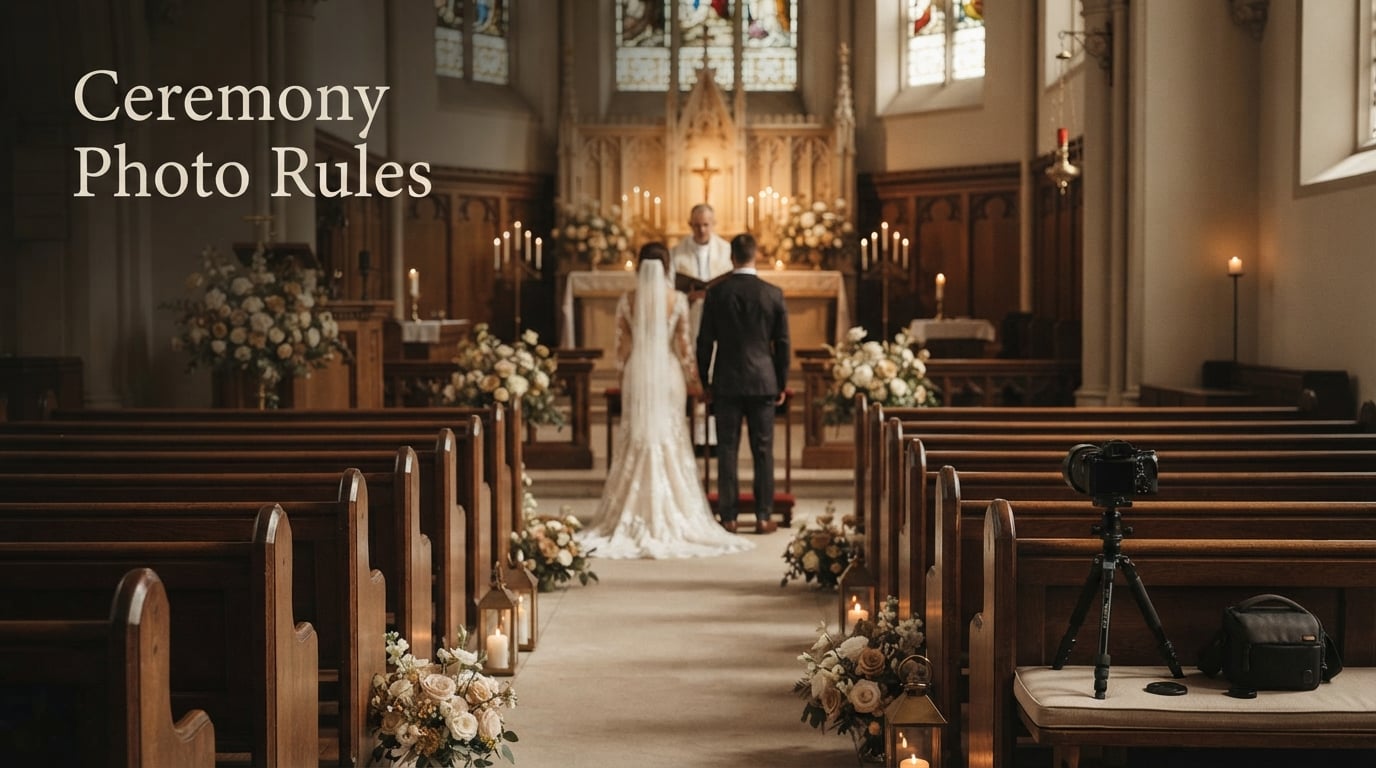
Ceremony photo rules are the guidelines set by venues, officiants, and couples that decide where, when, and how photographs may be taken during a wedding ceremony. They cover everything from flash use and photographer movement to whether guests can use phones at all, and they exist to protect the sanctity of the moment, prevent distractions, and make sure the professional photographer can do their job without interference. In this guide, I’ll walk you through every rule you are likely to meet, how to handle it, and how to talk about it with your officiant before the big day.
Table of Contents
What Are Ceremony Photo Rules and Why Do They Exist
Ceremony photo rules are the boundaries that govern photography during a wedding ceremony, set by the venue, the officiant, or the couple themselves. Most rules fall into three buckets: technical limits (no flash, no movement, no shutter sound), zone restrictions (photographers must stay in a defined area), and behavioural expectations (guests keep phones away, no stepping into the aisle).
These rules exist for practical and emotional reasons. Flash can wash out professional shots, distract the couple, or even be forbidden in historic buildings. Movement restrictions keep the ceremony calm and prevent photographers from blocking guests’ views. And phone-free rules let everyone be present in the moment rather than watching it through a screen. Our team has photographed more than 400 weddings over the last decade, and the ceremonies with the clearest photo rules always run the smoothest.
Common Photography Restrictions at Wedding Ceremonies
The most common photography restrictions at wedding ceremonies are flash bans, movement limits, no-photography zones, and rules about where the photographer may stand. Each one is set by either the officiant, the venue, or the couple, and most photographers find out about them on the day unless the couple has confirmed them in advance.
Flash Photography Rules
Flash photography is the single most restricted action during a wedding ceremony. Churches especially ban flash because it can damage historic artwork, distract the couple during vows, and ruin the warm lighting that professional cameras are set up to capture. Civil venues tend to be more relaxed, but many registrars still ask for flash-free ceremonies because blinking red-eye and bright bursts pull focus from the vows.
Modern mirrorless cameras handle low light well, so flash is rarely needed in a lit venue. If you are a photographer worried about a flash ban, set your ISO to 1600 or 3200, open your aperture to f/2.8 or wider, and use a fast prime lens like a 50mm or 85mm. You will be surprised how clean your files look at moderate ISO in a properly exposed church.
Movement and Positioning Limits
Many officiants and registrars restrict photographer movement to one or two spots during the ceremony. The most common rule is to stay at the front of the aisle and not cross between guests and the couple. In Catholic ceremonies, photographers are often asked to remain at the back until the vows and ring exchange, then move forward only during the sign of peace.
Civil ceremonies are stricter in some ways because the registrar’s office is a small, formal room. I have worked in Bristol Register Office where the smallest room holds four guests, and the photographer must stay in one corner without stepping sideways. Always ask the registrar where they want you to stand before the bride arrives, not during the ceremony.
No-Photography Zones and Total Bans
A few venues prohibit all photography inside the ceremony space. The Tower of London chapel is a famous example: photographers must shoot from outside the chapel doors. Some Buddhist, Hindu, and Muslim ceremonies also restrict photography during sacred parts of the ritual, even though posed portraits afterwards are welcome.
If a total ban applies, ask what you can shoot from your permitted position. Often you can still capture the bride’s entrance from a side door, the recessional as the couple walks out, and a portrait session in an adjoining room. Total bans are rare, and most can be negotiated politely if you ask the officiant in advance.
Church vs Civil Ceremony Photo Rules
Church wedding photo rules are usually stricter than civil ceremony rules because of historic buildings, religious tradition, and formal liturgy. Civil ceremonies follow registrar guidelines and tend to allow more freedom, while outdoor and destination weddings sit somewhere in between depending on the venue’s policy.
Church and Religious Venue Rules
Churches commonly ban flash, limit photographer movement, and sometimes forbid photography during the homily or communion. Catholic, Anglican, and Orthodox ceremonies are the strictest, while non-denominational churches and outdoor chapel weddings tend to be more relaxed. Many vicars will let you shoot from the balcony if one exists, which gives you a beautiful wide angle of the whole ceremony.
Tips that have worked well for our team in churches: arrive 45 minutes early to meet the verger or sexton, dress respectfully, and never enter the sanctuary without being invited. Photographers who treat the venue with respect are almost always given more freedom than those who push boundaries.
Civil Ceremony and Register Office Rules
Civil ceremonies follow the registrar’s office guidelines, which vary by location but generally permit non-flash photography and limited movement. The couple chooses whether to allow guest photography, and many register offices ask guests to remain seated until the ceremony concludes. A few offices, like the Old Marylebone Town Hall in London, have very specific zones marked on the floor for photographers.
Register offices often have very small rooms. The Bristol Register Office’s smallest ceremony room holds just four guests, which means the photographer shoots at a wide focal length from one corner. Talk to the registrar a week before the wedding to confirm your position and any equipment rules, especially tripods or monopods.
Outdoor and Destination Wedding Rules
Outdoor ceremonies usually allow more freedom than indoor venues because there is no historic artwork to protect and no enclosed space to disrupt. The main rules are about staying out of the couple’s sightline and not blocking the photographer’s shot. Destination weddings add logistics: some countries require permits for professional photography in public spaces, and religious sites abroad may have dress codes and equipment restrictions.
For a destination wedding in Italy, for example, many churches require photographers to use only natural light inside and ban tripods in the main chapel. Confirm all rules with the local wedding planner at least 8 weeks in advance so you can plan gear, lenses, and timing around them.
Guest Photography Etiquette During the Ceremony
Good guest photography etiquette during a wedding ceremony means staying seated, keeping phones away until the recessional, and never stepping into the aisle for a shot. The single most important rule is to be present in the moment rather than watching the ceremony through a phone screen.
Here are the seven etiquette rules our team shares with every couple we photograph:
- Stay seated during the entire ceremony unless the couple has asked for a standing moment.
- Keep phones in pockets or bags from the processional to the recessional.
- Never step into the aisle for a photo, even briefly.
- Turn off shutter sounds and flash before the ceremony starts.
- Ask before sharing any ceremony photos on social media.
- If you must take a quick photo, do it silently and from your seat.
- Save group photos and posed shots for the reception.
These rules protect the couple’s experience and the professional photographer’s line of sight. Guests who follow them are remembered fondly; guests who ignore them often end up in the photographer’s complaint list.
Unplugged Weddings: What They Are and Why Couples Choose Them
An unplugged wedding is a ceremony where guests are asked to put phones and cameras away and be fully present. Couples choose unplugged ceremonies to remove the sea of glowing screens, keep the aisle clear for the photographer, and make sure every guest actually witnesses the vows instead of filming them.
Benefits of an Unplugged Ceremony
Unplugged ceremonies create a calmer, more emotional atmosphere. Without 100 phones raised in the air, the couple sees real faces during the vows, the photographer gets an unobstructed view, and grandparents do not have to watch the ceremony through a row of iPads. Many couples also say the unplugged format encourages guests to be mentally present, which makes the whole day feel more connected.
A 2025 survey by The Knot found that 78% of couples who had unplugged ceremonies said they would do it again, mostly because guests stayed engaged and the photographer’s gallery looked much cleaner.
How to Implement an Unplugged Ceremony
Implementing an unplugged ceremony is straightforward: announce it on the wedding website, mention it on the invitation, and have the officiant make a brief announcement before the processional. Many couples also place a small sign near the ceremony entrance that reads “Unplugged ceremony: please be fully present, our photographer will capture everything.”
For guests who still want to take photos, give them a specific moment when it is welcome. Many couples invite guests to take photos during the recessional only, which gives everyone a chance to grab a quick shot without disrupting the ceremony itself.
Where Photographers Should Stand During the Ceremony
The best position for a ceremony photographer is usually front-of-aisle, slightly off-centre, with a clear view of both the couple and the officiant. From this position you can capture the bride’s entrance, the groom’s reaction, the vows, the ring exchange, and the first kiss without moving more than a step or two.
Front-of-Aisle Positioning
Front-of-aisle positioning is the gold standard for ceremony photography. Stand at the front, slightly to the side of the aisle, and use a 35mm or 50mm prime for a wide view of the altar and a 70-200mm zoom for tighter shots of expressions. Ask the officiant if you can kneel or sit during parts of the ceremony so you are less visible to guests.
If the venue only allows one position, choose the groom’s side. Grooms and fathers tend to show more visible emotion during the vows, and shooting from their side gives you a clear view of the bride’s face as she walks down the aisle.
Back and Balcony Options
Some ceremonies require the photographer to stay at the back or in a balcony. Balcony shots are beautiful for wide establishing images but rarely work for vows because you cannot see faces clearly. Use a 70-200mm from the back of the room if movement is restricted, and plan to step forward only during the recessional.
A few venues split photography into two zones: one photographer at the back for the processional, and another at the front for the vows and recessional. This is where a second shooter becomes essential, and most professional packages include one for exactly this reason.
Working With a Second Shooter
A second shooter gives you coverage from two angles simultaneously. While you shoot the couple’s faces, your second shooter captures the guests’ reactions and the wider scene. This is invaluable during the vows because you can never move once they begin, and a second angle lets you tell a complete story.
Position your second shooter opposite you so you are not framing the same shot. If you are at the front-left, put the second shooter at the back-right. That spread gives you editorial-style coverage of every moment.
How to Talk to Your Officiant About Photography
Talking to your officiant about photography early and respectfully is the single best way to avoid surprises on the wedding day. Most officiants are flexible if you ask in advance and reassure them that you will follow their rules.
When to Have the Conversation
Have the photography conversation with your officiant at least 6 to 8 weeks before the wedding. Email is fine for the first contact, but follow up with a phone call if the venue has strict rules. By the time the wedding arrives, your officiant should know your photographer by name and have confirmed any special permissions like flash or movement.
The conversation should cover four points: where the photographer may stand, whether flash is allowed, which moments (if any) are off-limits, and what backup plan exists if a restriction cannot be lifted. Writing these down in a shared document avoids confusion on the day.
Sample Conversation Scripts
If you are the couple, here is a short script that works: “We’re so excited to be married at your venue. Our photographer [Name] would love to capture the ceremony discreetly. Could you let us know any photography rules we should follow, and is there anything we can do to make your job easier?”
If you are the photographer, try: “Hi, I’m [Name], the photographer for [Couple]’s wedding on [Date]. I want to make sure I respect your ceremony and capture it beautifully. Could you share any photography rules I should know, and where you’d prefer me to stand?” Both scripts lead with respect and end with a clear question.
Negotiating Strict Rules
Negotiating strict rules starts with listening. If an officiant says no flash, do not push back. Instead, ask what they would be comfortable with: silent shooting from the back, a single tripod in the corner, or no photography until the recessional. Most strict rules soften once you show that you understand and respect the venue’s needs.
If the rules truly cannot be relaxed, ask for a brief portrait session in an adjoining room or courtyard immediately after the ceremony. Many couples schedule a 15-minute post-ceremony portrait slot that captures the family formals, the couple’s first portraits, and any group shots without rushing.
Capturing the Key Moments Without Breaking Rules
Capturing the key ceremony moments requires planning your shots in advance and trusting the rules you have agreed to. The four moments that matter most are the aisle walk, the vows, the ring exchange, and the first kiss.
The Aisle Walk
The aisle walk is best shot from the front of the room with a 35mm or 50mm lens. Capture the bride’s face as she enters, the groom’s reaction as he sees her, and a wide shot of the full processional. If you can only shoot from one position, prioritise the groom’s expression because the bride’s face will be captured again during the vows.
For longer aisles, a 70-200mm from the back of the room lets you compress the depth and capture intimate moments between father and bride, or bride and partner. Many photographers I know shoot the aisle walk twice: once from the front, once from the back, then pick the strongest frame of each moment.
The Vows and Ring Exchange
The vows and ring exchange are the most intimate parts of the ceremony, and most officiants want them captured cleanly. Use a long zoom like a 70-200mm from your permitted position so you do not have to move. Pre-focus on the couple’s hands for the ring shot and on their faces for the vow reading.
If the officiant allows a brief repositioning, step to the opposite side after the vows so you capture the ring exchange from a fresh angle. Otherwise, hold your position and use the focal length to vary your framing.
The First Kiss and Recessional
The first kiss lasts about 3 to 5 seconds, which is plenty of time to fire 8 to 10 frames on burst mode. Pre-set your exposure and focus so you are not adjusting settings during the kiss itself. After the kiss, the recessional is your chance to move: walk backwards down the aisle ahead of the couple and capture their joy as they walk out together.
Recessional shots are often the most joyful in the entire wedding gallery. Couples are laughing, hugging, and celebrating, and a 24-70mm lens at f/2.8 lets you capture the whole energy of the moment without intruding.
Common Ceremony Photography Mistakes to Avoid
The most common ceremony photography mistakes are not asking about rules in advance, using flash when it is banned, moving during the vows, and ignoring the officiant’s instructions. Each one can ruin a moment that cannot be recreated.
Other frequent errors include: arriving late and missing the bride’s entrance, dressing inappropriately for a religious venue, talking during the ceremony, blocking guests’ views, and failing to coordinate with a second shooter. Every one of these is preventable with a simple pre-ceremony briefing.
Couples make mistakes too. The biggest is not communicating their wishes to guests. If you want an unplugged ceremony, say so on the invitation. If you allow guest photos, set clear boundaries about when and where. Clarity prevents confusion, and confusion is what ruins otherwise beautiful ceremonies.
Ceremony Photo Rules Checklist for Couples
Use this ceremony photo rules checklist to confirm every detail with your venue and officiant before the wedding day:
- Confirm with the officiant whether flash photography is allowed.
- Ask the venue where photographers may stand during the ceremony.
- Decide whether guests can take photos, and communicate that clearly.
- Share the officiant’s rules with your photographer at least 4 weeks in advance.
- Brief your second shooter on the same positioning rules.
- Place a sign or program note about photography expectations for guests.
- Schedule a post-ceremony portrait window in case of restrictions.
- Confirm equipment restrictions (tripods, monopods, lighting).
- Have a backup plan for low-light ceremonies (ISO, lens, settings).
- Thank your officiant after the wedding for accommodating your photographer.
Run through this list with your partner and your photographer during the final planning meeting. It takes about 20 minutes and prevents 90% of the surprises that disrupt ceremonies.
Frequently Asked Questions
Are there any photography restrictions at the ceremony?
Yes, most wedding ceremonies have at least some photography restrictions. Common ones include flash bans in churches, limits on photographer movement, designated standing zones, and rules about whether guests can use phones. The officiant or venue sets these rules, and they vary widely. Always confirm the specifics with your officiant at least 6 weeks before the wedding so your photographer can plan around them.
What is good etiquette for guests taking pictures in wedding ceremonies?
Good guest photography etiquette means staying seated, keeping phones in pockets or bags during the processional and vows, never stepping into the aisle, turning off shutter sounds and flash, and asking the couple before posting any ceremony photos online. The single most important rule is to be fully present rather than watching through a screen. If the couple has asked for an unplugged ceremony, respect that request completely.
What is the 50 30 20 rule for weddings?
The 50 30 20 rule for weddings is a budgeting guideline that allocates 50% of the budget to venue and catering, 30% to photography, attire, and entertainment, and 20% to flowers, decor, and favours. It is not strictly a photography rule, but it is often referenced when couples plan how much to spend on their photographer versus other elements of the day.
What is the 2/3 photo rule?
The 2/3 photo rule in wedding photography means that two-thirds of your final gallery should be candid, documentary-style images, and one-third should be posed or formal portraits. It is a composition guideline rather than a ceremony rule, and it helps couples balance storytelling imagery with the family formals they still want.
How do I tell wedding guests not to take photos during the ceremony?
Tell guests not to take photos during the ceremony by mentioning it on your wedding website, adding a line to the invitation, having the officiant make a brief announcement, and placing a small sign near the ceremony entrance. Phrase it warmly, such as ‘Please be fully present, our photographer will capture every moment.’ Most guests appreciate the clarity and happily put their phones away.
Final Thoughts on Ceremony Photo Rules
Ceremony photo rules exist to protect the moment you have spent months planning, so treat them as a helpful framework rather than an obstacle. Confirm every restriction with your officiant and venue in advance, communicate your wishes clearly to guests, and trust your photographer to deliver beautiful images within the agreed boundaries. With the right preparation, your ceremony photo rules will be invisible on the day and only matter in the calm, confident planning that came before.
For more wedding photography guides and planning advice, browse the rest of our 2026 resources and start building the day you have always imagined.