
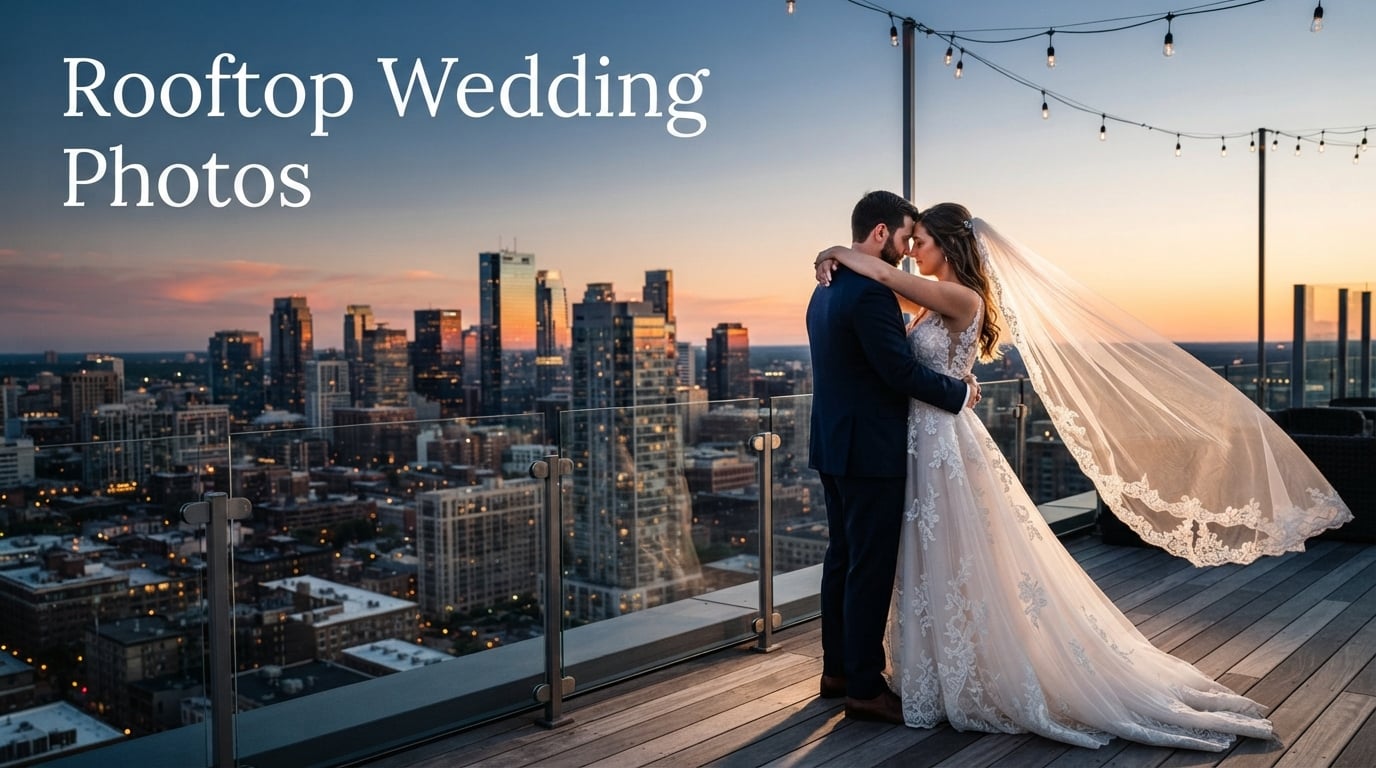
When I photographed my first rooftop wedding seven years ago, I realized something that still drives my work today. A skyline behind two people in love creates a kind of magic that no ballroom, garden, or barn can match.
Rooftop wedding photos have become one of the most requested styles among modern couples. The reason is simple. A wedding album with the city glowing behind you during golden hour tells a story. It says something about who you are as a couple, where you built your life together, and the moment you chose to start something new.
Our team has shot rooftop wedding photos across New York, Los Angeles, Chicago, and Asheville over the past three years. We’ve learned what works, what fails, and the small details that turn a good shot into a frame couples print at 16×20 and hang above the fireplace. This guide shares all of it.
You’ll learn the best times of day to shoot, the lighting techniques that make skylines glow, the poses that survive rooftop wind, and how to plan for weather that doesn’t cooperate. Whether you’re a photographer, a planner, or a couple preparing your own wedding day, the practical advice below will save you hours of trial and error.
Table of Contents
What Makes Rooftop Wedding Photos So Special
Rooftop wedding photos are images taken from elevated outdoor venues, usually in urban settings, where the city skyline or scenic horizon serves as the main backdrop. What separates them from typical wedding photos is the dramatic scale. The buildings, the sky, the open air, all combine to make the couple feel both intimate and powerful at the same time.
I tell every couple I work with that rooftops give you something no other venue can. You get the privacy of an exclusive space, the scale of a city, and a constantly changing light show as the sun moves. The same rooftop looks completely different at noon, golden hour, blue hour, and midnight.
The aesthetic works for almost any wedding style. Modern couples love the clean urban lines. Romantic couples love the cinematic skyline glow. Adventurous couples love the height and the wind in the veil. Even traditional couples appreciate how a rooftop formal portrait looks when framed by Manhattan or downtown Los Angeles behind them.
Rooftops also solve a problem I see constantly in wedding photography. Ground-level venues are crowded with guests, vendors, and visual clutter. A rooftop gives you space to breathe, room for the couple to relax, and a clean backdrop that requires almost no editing to look stunning.
The other thing I love about rooftop wedding photos is how they age. I have clients who got married on rooftops in 2019 who still get compliments on their photos today. City skylines evolve, but the moment captured on that specific day remains timeless. That’s the real magic of elevated wedding photography.
Best Time of Day for Rooftop Wedding Photos
The single biggest factor in rooftop wedding photo quality is timing. I cannot stress this enough. A rooftop at 2 PM and the same rooftop at 6:30 PM look like two completely different locations. The light changes everything.
Golden hour is the most popular choice for rooftop wedding photos, and for good reason. Golden hour refers to the hour right before sunset, when the sun sits low on the horizon and produces warm, soft, directional light. Skin tones glow, the sky turns amber, and buildings catch fire-colored reflections. I have never had a couple dislike a golden hour portrait from a rooftop.
Golden hour timing depends on your latitude and the time of year. In summer, golden hour on a New York rooftop might start around 7:15 PM. In winter, it can begin as early as 4:00 PM. Always check a sunrise/sunset calculator for your specific wedding date and location. I recommend scheduling couple portraits 60 to 90 minutes before sunset for the best balance of usable light and warm color.
Blue hour is the runner-up, and many of my favorite shots come from this window. Blue hour happens 20 to 40 minutes after sunset, when the sky turns deep blue and city lights start to flicker on. It’s the perfect window for capturing both the couple and the skyline lights in a single frame. You will likely need a tripod or higher ISO settings during blue hour, but the results are worth the extra effort.
Here’s a quick comparison I share with all my couples:
Golden hour: Warm tones, soft shadows, romantic mood, easier exposure settings
Blue hour: Cool tones, glowing city lights, dramatic mood, requires more technical skill
Midday: Harsh shadows, washed-out sky, but works for editorial or architectural shots
Night: Pure city lights, requires flash or off-camera lighting, best for fun party-style portraits
Our team usually schedules a minimum 45-minute portrait session around golden hour, plus an optional 20-minute blue hour extension. The total investment in time pays off tenfold in image variety.
Essential Lighting Techniques for Rooftop Wedding Photos
Light is the foundation of every great rooftop wedding photo. The good news is that rooftops usually give you plenty of natural light to work with. The challenge is controlling it.
Natural light is your best friend during golden hour. I shoot almost exclusively with available light during this window. The key is positioning. I always place the sun behind the couple or to the side, never directly facing them. Backlighting creates that halo effect around hair and shoulders that defines editorial rooftop photography.
When shooting backlit, I expose for the subject’s face using spot metering or exposure compensation. I usually dial in plus 1 to plus 2 stops to brighten the skin tones while letting the sky stay rich and saturated. This creates the dramatic contrast that makes rooftop wedding photos feel cinematic.
Overhead midday sun is the toughest lighting situation. If your timeline forces you into this window, seek shade under rooftop structures, awnings, or AC units. Open shade gives you even light on faces without the harsh shadows that ruin mid-day portraits. I also use a diffuser in these situations when shooting for clients with bright reflections on their skin.
Flash photography becomes essential for blue hour and night shots. I use off-camera flash with a small softbox for night portraits. The goal is to balance the city lights with the couple, so the flash output stays low. A speedlight at quarter power with a modifier usually does the trick.
For mixed lighting situations, like tungsten venue lights meeting daylight, I set a custom white balance and shoot RAW. This gives me flexibility in post to balance the warm venue glow with the cooler sky tones. It’s a small detail that makes rooftop wedding photos feel cohesive rather than confused.
Top Rooftop Wedding Photo Poses for Couples
Posing on a rooftop is different from posing at ground level. The space feels bigger, the wind is usually present, and there’s less visual structure to work with. These poses have been battle-tested across dozens of rooftop wedding photo sessions.
The forehead touch is my go-to opener. The couple stands facing each other, foreheads touching, eyes closed. It feels intimate and the pose works at any distance. I usually shoot this with a 70-200mm lens from 15 to 20 feet away to compress the skyline behind them.
The walking shot is a classic for a reason. I have the couple walk slowly toward me along the longest open stretch of the rooftop. I shoot from a low angle, often kneeling, with the skyline behind them. The walk also helps them relax because they have something to do. Movement shots are particularly forgiving for camera-shy couples.
The dip is a favorite for couples who want drama. The groom dips the bride while she laughs, and I shoot in burst mode with continuous focus. Dips work beautifully at golden hour because the backlighting flares around them. Just make sure to brief the bride on the dip in advance so she feels safe.
Wind-friendly poses are critical because rooftops are windy. I love the veil toss, the high five, and the twirl. The twirl is especially photogenic on a rooftop because the dress flares out dramatically against the skyline. I usually do 3 to 4 twirls and pick the sharpest one in editing.
The leaning pose works well at sunset. The bride leans back into the groom’s chest while he wraps his arms around her. Both face the sun. It’s a relaxed, romantic pose that holds up even when the wind is mild. This pose also photographs beautifully as a silhouette against a colorful sky.
The architectural lean uses the rooftop itself as a prop. The couple leans against a railing, ledge, or wall while looking out at the city. It’s a candid, casual pose that feels natural and works for couples who feel awkward doing more formal poses.
How to Use City Skylines and Architecture in Rooftop Wedding Photos
The skyline is the star of rooftop wedding photos. Treating it as a backdrop is fine, but treating it as a co-subject creates stronger images.
I start every rooftop session by walking the entire space to identify the best skyline views. Not all rooftop edges are photogenic. Some have AC units, ugly railings, or distracting antennas. I look for clean sight lines where the city meets the sky in a balanced composition.
Rule of thirds is my default composition rule. I place the couple on one of the vertical third lines and let the skyline fill the other two-thirds. This creates breathing room and gives the city visual weight without overwhelming the subjects. Wide-angle lenses at 24mm or 35mm work best for this composition.
Architectural elements are free props on a rooftop. I use railings for leaning poses, columns for portraits, and window reflections for creative compositions. One of my favorite techniques is shooting the couple with a reflective glass building behind them. The reflection adds layered depth to the image.
Reflections are another tool I use regularly. Rooftops often have decorative water features, glass tables, or polished surfaces. I have photographed couples holding hands above a glass railing and capturing their hands and the skyline in the same frame. It adds an artistic element without requiring complex editing.
Intentional mis-focus is a creative technique I picked up from a Los Angeles photographer. I shoot the cityscape in sharp focus while the couple is a soft silhouette in the foreground. This reverses the typical wedding photo hierarchy and tells a different story: the city first, the couple as part of it. It works especially well at blue hour when city lights pop.
Parking garages deserve a mention here. Many wedding venues don’t have proper rooftop access, but parking garages one or two blocks away often have empty top floors with incredible skyline views. I have photographed some of my favorite rooftop wedding photos at hotel parking garages after asking the valet for quick access. Always ask permission first.
Weather Contingency Planning for Rooftop Wedding Photos
Weather is the most common concern I hear from couples planning rooftop wedding photos. Wind, rain, clouds, and extreme temperatures all affect outdoor shoots. Planning for these conditions is the difference between stress and success.
Rain is the biggest risk. I always have an indoor backup location pre-scouted for every rooftop session. Hotels with elegant lobbies, nearby covered atriums, or the venue’s indoor cocktail space all work as rain backups. I share these options with couples during the planning call so everyone knows the plan if the radar turns bad.
If rain starts mid-session, I move quickly to the backup location. Some of my favorite couple portraits happened during unexpected rain because we pivoted to an indoor setting with rain-streaked windows. The mood shifts to romantic and cozy. Couples often prefer those images after seeing them.
Wind is the most predictable rooftop issue. Urban rooftops at altitude can have steady 15 to 25 mph winds, with gusts higher. I tell brides to bring a comb, hairpins, and a small mirror. For veils, I recommend weighted veils or a veil anchor. I also schedule looser poses during windier moments because tighter styling won’t survive.
Cold and heat are manageable with the right preparation. For winter shoots, I bring hand warmers, a lap blanket for between takes, and short breaks indoors every 15 minutes. For summer shoots, I bring cold water, a small fan, and schedule portraits for the cooler parts of the day. Couples rarely complain about temperature when they see the photos.
Cloud cover is actually a gift for rooftop wedding photos. Overcast skies act as a giant diffuser and produce soft, even light on faces. I have shot gorgeous portraits under heavy clouds. The only downside is the lack of colorful sky during golden hour, but the lighting on the couple is unbeatable.
The best weather contingency plan is flexibility. I always build buffer time into the timeline, communicate backup options clearly, and stay calm when conditions shift. Couples take their emotional cues from the photographer. If I stay relaxed about a weather change, they relax too.
Frequently Asked Questions About Rooftop Wedding Photos
What is the best time of day for rooftop wedding photos?
Golden hour, which is the 60 to 90 minutes before sunset, is widely considered the best time for rooftop wedding photos. The warm directional light creates a flattering glow on skin, soft shadows, and rich colors in the sky. Blue hour, which begins about 20 minutes after sunset, is the second-best option for capturing both the couple and glowing city lights in the same frame.
What happens if it rains on a rooftop wedding photo session?
Professional photographers always have a backup location planned in case of rain. Common indoor backups include hotel lobbies, venue cocktail areas, covered atriums, or nearby parking garages with open top floors. Rain can also create romantic photo opportunities with reflections and soft window light if you stay flexible with your timeline.
Are rooftop wedding photos too windy to take?
Rooftops are typically windier than ground level, but experienced photographers prepare for this. Brides can use weighted veils, hairpins, and styling products that resist wind. Photographers can also choose poses that work with wind, like twirls, walking shots, and candid moments. Wind rarely prevents good rooftop wedding photos when the team plans ahead.
What should I wear for rooftop wedding photos?
Choose outfits that photograph well against urban backdrops. Long flowing dresses move beautifully in rooftop wind and add drama to skyline shots. Avoid pure white if the skyline is busy, since white can blend with light buildings. For shoes, bring a backup pair with shorter heels for walking on rooftop surfaces, which are often uneven.
Which cities are best for rooftop wedding photos?
Cities with strong skylines produce the most dramatic rooftop wedding photos. New York City, Los Angeles, Chicago, San Francisco, Miami, and Boston are popular choices for their recognizable skylines. Smaller cities like Asheville, Charlotte, and Nashville also offer beautiful elevated venues with mountain or downtown views that work well for couples seeking unique backdrops.
Final Thoughts on Rooftop Wedding Photos
Rooftop wedding photos combine urban scale with intimate moments in a way no other wedding photography style can match. The right timing, the right poses, and a solid weather plan give you images that last a lifetime. Whether you choose golden hour, blue hour, or a night shoot under city lights, the city becomes part of your story.
If you’re planning a rooftop wedding photo session in 2026, start by booking a venue with clear skyline sight lines, scheduling your portrait window around golden hour, and prepping for wind. Those three steps cover most of what makes rooftop wedding photos work. Our team at Kingdom Wedding Photography is always happy to talk through your timeline and help you build a photo plan that captures the magic of your day.